
How to Reinvent Mosques for Twenty-First-Century Europe
For centuries, mosques have been much more than places of prayer. They have served as social, educational, and cultural centres and, in many cases, political ones too. However, the reality of twenty-first-century Europe raises an inevitable question:
Does it make sense for European mosques to continue operating exactly as they did a thousand years ago?
Europe has changed.
European society is built on principles such as equality between men and women, individual freedom, democracy, the separation of religion and state, and respect for diversity.
If Christian churches have evolved over centuries to adapt to modern societies, why should mosques remain frozen in a model that emerged in a different era and cultural context?
It is time to talk about Mosques 3.0.
The aim is not to destroy religion, but to modernise its institutions.
What Is a Mosque 3.0?
A Mosque 3.0 would be a religious institution fully compatible with European liberal democracy. It would not simply be a place to pray.
It would be a space open to the whole of society, where spirituality coexists with freedom, equality, and critical thinking.
Authority would no longer rest solely on tradition, but also on human rights.
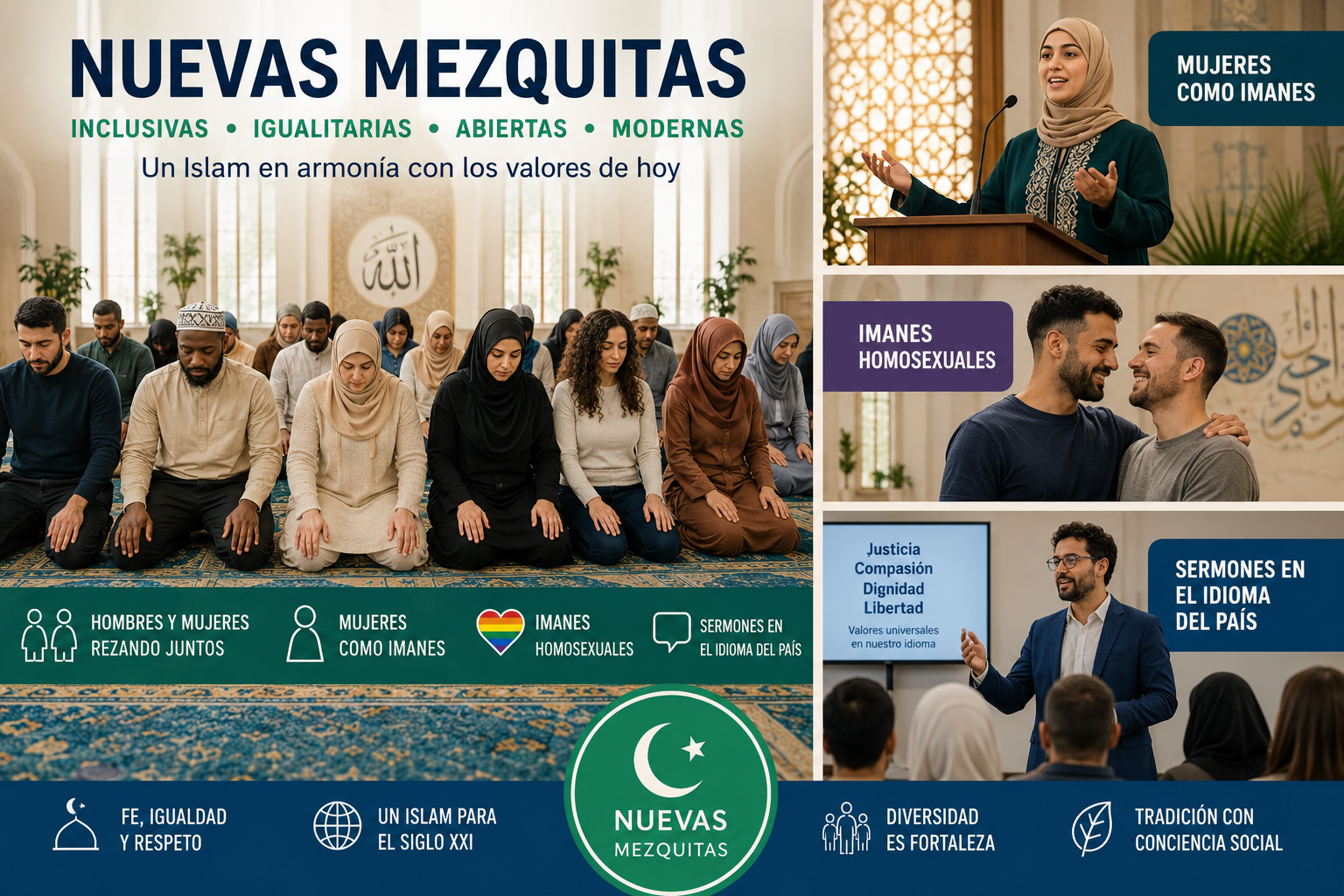
1. Men and Women Praying Together
This is probably the most symbolic reform.
In the vast majority of European mosques, men and women are separated by walls, curtains, or different floors.
In some cases, women even pray in small rooms where they can barely see the imam. This separation sends a clear message:
that men and women do not participate as equals.
A Mosque 3.0 would eliminate this division. All worshippers would share the same space, with no “main” areas reserved for men and no secondary spaces for women. Everyone would be free to choose where to stand.
Equality would begin inside the place of worship itself.
2. Women as Imams
If a woman can be a university professor, judge, minister, or head of government, why should she not be able to lead a prayer?
Women imams already exist in various countries, although they remain a minority. Mosques 3.0 would make this possibility normal.
Women could:
-
Lead prayers.
-
Deliver Friday sermons.
-
Teach theology.
-
Train new imams.
-
Lead religious communities.
Spiritual leadership would no longer depend on gender.
3. Gay Imams
This is probably one of the most groundbreaking proposals.
In many Muslim communities, a gay person faces enormous difficulties not only in becoming an imam, but even in living openly with their sexual orientation.
A Mosque 3.0 would defend a simple principle:
sexual orientation does not determine a person’s spiritual capacity.
If someone possesses religious knowledge, ethical integrity, and moral leadership skills, they should be able to lead a community. Religious authority should be based on merit, not sexual orientation.
4. Sermons in the Language of the Country
Thousands of European Muslims attend Friday sermons delivered in Arabic, Turkish, Urdu, or Berber. Many young people born in Europe barely understand these languages.
A Mosque 3.0 would prioritise the language of the country in which it is located.
In Spain: Spanish. In France: French. In Germany: German.
Religion should speak the language of the society in which it exists.
5. Full Financial Transparency
Many mosques receive funding from abroad.
Worshippers often do not know who pays, how much money comes in, who controls expenditure, or who decides how funds are invested.
A Mosque 3.0 would publish the following every year:
-
Full financial accounts.
-
Donations.
-
Salaries.
-
Assets.
-
External audits.
Trust begins with transparency.
6. Democratic Election of Imams
In many mosques, the imam is appointed from abroad or by small governing boards, with little participation from the worshippers themselves.
In a Mosque 3.0, the imam would be elected by the community through a vote, serve a limited term, and be eligible for re-election or replacement, as happens in many democratic organisations.
7. European University-Level Training for Imams
Religious leaders should understand European history, human rights, equality, philosophy, psychology, constitutional law, and the prevention of extremism.
Memorising religious texts is not enough. A European imam should understand the society in which they live.
8. Complete Separation Between Religion and Politics
Mosques should not operate as ideological branches of foreign governments, whether Turkey, Morocco, Saudi Arabia, or Qatar.
Their role would be exclusively spiritual and community-oriented.
9. Freedom to Leave Religion
No one should feel singled out or stigmatised for giving up their faith.
Mosques should publicly acknowledge that faith only has meaning when it is entirely free.
No family pressure. No social pressure. No spiritual threats. Just freedom.
10. Explicit Condemnation of All Violence
Every mosque should state unequivocally that:
-
Violence in the name of God is incompatible with faith.
-
No one deserves to be persecuted for changing their religion.
-
No insult justifies an assault.
-
Freedom of expression is part of democratic coexistence.
11. Full Equality for LGBTQ+ People
Gay, bisexual, and transgender people should be able to enter mosques without fear of rejection.
Not as an exception, but as ordinary members of the community.
Spirituality should not depend on sexual orientation.
12. Gender-Balanced Governing Boards
Mosque management should include men and women on equal terms.
Important decisions should not be reserved exclusively for men.
13. Protection of Children
Mosques should commit to:
-
Prohibiting all forms of physical violence.
-
Respecting minors’ freedom of conscience.
-
Teaching critical thinking.
-
Avoiding hate speech.
-
Promoting equality.
Religious education should never replace civic education.
14. Zero Foreign Influence
Europe needs European mosques, not religious branches of foreign states.
European Muslims should build their own religious model, adapted to European democracies.
15. Spaces for Critical Thinking
A Mosque 3.0 should not fear difficult questions.
It could organise debates on the historical interpretation of religious texts, the compatibility of religion and democracy, gender equality, and religious freedom.
Religion should not exist in isolation from contemporary knowledge.
16. A European-Muslim Cultural Centre
Film screenings and discussions, art exhibitions, writing workshops, photography and music, cooking classes, and intercultural activities.
17. “European Mosque” Certification
A voluntary certification could be created for mosques that meet standards such as:
-
Equality between men and women.
-
Financial transparency.
-
Respect for human rights.
-
Accredited training for imams.
-
Political independence.
-
Freedom of conscience.
-
Compliance with national law.
It would not be a way of controlling faith, but a recognition of a commitment to democratic values.
18. Evaluation and Continuous Improvement
Like any modern institution, mosques could undergo periodic internal and external evaluations of governance, transparency, inclusion, and community satisfaction, publishing the results and their commitments to improvement.
The Big Question
The issue is not whether all these proposals will be accepted tomorrow.
The issue is whether religious institutions can remain unchanged while society undergoes profound transformation.
Europe is no longer the Europe of a hundred years ago.
European Muslims are not the same as they were a century ago either. Millions have been born, educated, and employed in democratic societies, sharing European cultural references alongside their religious identity.
If mosques want to remain relevant to younger generations, they will probably need to address questions that were rarely raised a few decades ago: the role of women, democratic participation, transparency, freedom of conscience, and the inclusion of minorities.
Mosques 3.0 do not seek to impose a particular way of practising religion. They are a reform proposal for those who believe that religious practice can develop in full compatibility with the principles of equality, freedom, and democracy that characterise European societies.
The future of mosques in Europe will depend not only on preserving tradition, but also on their ability to engage in dialogue with the societies in which they are embedded.
True innovation does not mean abandoning faith. It means demonstrating that a religious institution can evolve without renouncing its core beliefs while fully respecting the fundamental rights of every person.