Will There Be Islamic Political Parties in European Countries?
Imagine it is the year 2055.
More than 600 million people live in Europe. Cities have changed, ten different languages can be heard on some streets, families are more diverse, and younger generations have mixed identities: Europeans, Muslims, Christians, atheists, Africans, Arabs, and Asians all share the same space.
And an uncomfortable question arises:
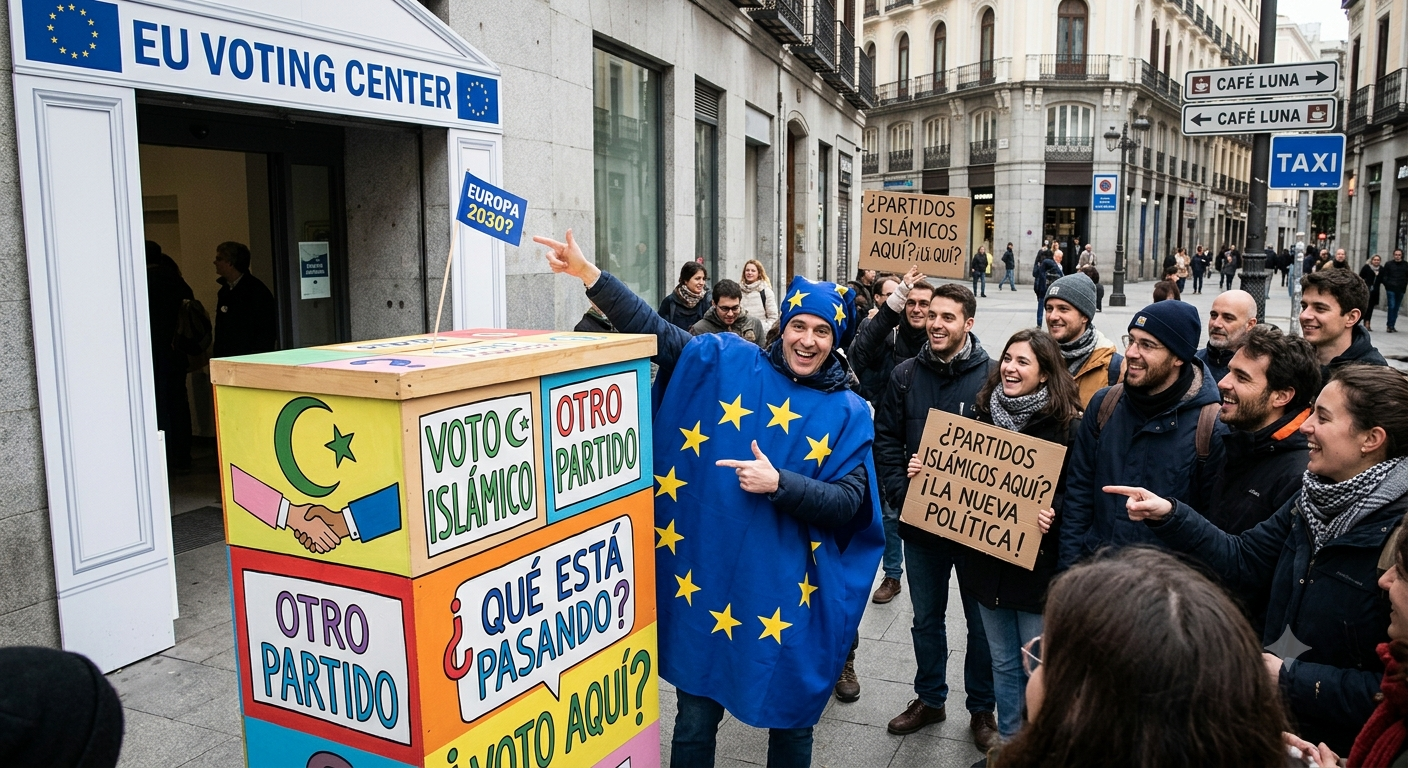
Will there be political parties inspired by Islamic values in European countries?
The short answer is simple: it is possible, but not necessarily in the way many people imagine.
Europe’s political landscape could develop along several different paths.
Scenario A: Consolidation in Western Europe (Very Likely)
In countries with large communities of Muslim immigrant origin, such as France, Belgium, the Netherlands, Germany, and the United Kingdom, the emergence of Islamic-inspired political parties is not a fantasy; it is already happening, as illustrated by Denk in the Netherlands and local political lists such as Team Fouad Ahidar in Belgium.
In these countries, such parties could gain greater influence and win seats on local councils, becoming key players in the formation of local or regional governments.
Scenario B: Marginal or Non-Existent Presence (Eastern and Southern Europe)
In Eastern European countries such as Poland, Hungary, and Slovakia, the Muslim population is extremely small. In these places, the emergence of viable Islamic parties in the coming decades is highly unlikely.
In Southern Europe, including Spain and Italy, the Muslim population is growing, but voting patterns and electoral laws make it difficult for purely religious parties to succeed nationally. At most, they might achieve representation at a very local level, as could happen in Ceuta or Melilla in Spain.
What Would These Parties Look Like? (Names, Ideas, and Programmes)
As with Christian democratic parties in Europe, an “Islamic party” would not necessarily be a homogeneous bloc. In the future, we could see two main types of parties.
Type 1: “Progressive Identity-Based Parties” (The Majority Trend)
They would not present themselves as theocratic, but as defenders of civil rights, minorities, and social justice.
-
Potential names: Justice and Cohesion, Democratic Diversity Party, Alliance for Equality, or existing names such as Denk (“Think” in Dutch).
-
Core ideas: Combating Islamophobia, defending multiculturalism, opposing discrimination, and promoting social justice.
-
Political programme:
-
Education: Allowing the Islamic veil (hijab) in public schools, providing halal food in school canteens, and funding Islamic schools through public subsidies.
-
Religion: Facilitating the construction of mosques, recognising Islamic holidays such as the end of Ramadan as official public holidays, and establishing Muslim cemeteries.
-
Foreign policy: Strongly pro-Palestinian positions and criticism of Western colonialism.
-
Type 2: “Traditionalist Conservatives” (A Minority or Localised Trend)
These parties would be more closely aligned with a morally conservative vision of society. They might even seek tactical alliances with Christian ultraconservative parties on social issues.
-
Potential names: Family Values Party, Front for Morality and Tradition.
-
Core ideas: Preserving the traditional family and rejecting the extreme secularisation of the West.
-
Political programme:
-
Opposing or restricting abortion and euthanasia.
-
Rejecting compulsory school sex education that includes LGBTQ+ content.
-
Promoting censorship of content considered blasphemous or offensive to religions.
-
The Impact on Everyday Life in Europe
If these parties gained representation and decision-making power, their impact on everyday life would be felt in three main areas.
Social Life and Education
-
School meals: Public schools would widely offer halal meat options or entirely vegetarian menus to accommodate religious dietary requirements.
-
Public holidays: Eid al-Adha, the Festival of Sacrifice, or the end of Ramadan could become official public holidays in cities or neighbourhoods with large Muslim populations.
-
Dress codes: Religious clothing, such as the veil, could become normalised in public-sector jobs, including for police officers, teachers, and civil servants.
Politics and Social Cohesion (Polarisation)
-
The backlash effect: The presence of these parties could strengthen the rhetoric of Europe’s far-right parties. This might lead to greater social polarisation, with political debate revolving constantly around national identity, religion, and immigration.
-
Government coalitions: Traditional left-wing parties, including social democrats and Greens, might find themselves obliged to form coalitions with moderate Islamic parties to govern major cities, potentially making concessions to their secular programmes.
Freedom of Expression and Liberal Values
-
Clashes over values: There would be intense debates about the limits of freedom of expression. For example, these parties might push for harsher penalties for burning the Quran or publishing caricatures of religious figures.
-
Women’s rights and LGBTQ+ communities: Tensions could arise in neighbourhoods where these parties were strongest, particularly in education, where religious families might demand the right to withdraw their children from certain civic or sex education classes.
Another Scenario: Islam Becomes Less Important
There is a possibility that almost nobody talks about.
What if younger generations stopped identifying strongly with religion?
Many young Europeans of Muslim background already identify primarily as French, Spanish, German, or Swedish. Most people continue to worry about the same things: making ends meet, finding housing, securing a good job, and giving their children a better future.
In this scenario:
-
Islamic political parties would not emerge.
-
Religion would have less political influence.
-
National or European identity would become more prominent.
-
Integration would increase.
Summary
-
There will be no uniform “takeover”: Europe will not become a political caliphate. Most such parties would operate within the rules of European democracy and coalition politics.
-
A reflection of democracy: Just as Catholics and Protestants created Christian democratic parties to defend their values after the Second World War, it is a natural development for Muslim minorities to seek their own political representation as they become established and acquire citizenship.
-
The major challenge: Europe’s real challenge will be managing coexistence between its traditional secular and liberal values and the demands of a politically active Muslim population seeking to have its values respected and represented in public life.
The Big Question
Perhaps the question is not:
“Will there be Islamic political parties in Europe?”
The real question is:
“What kind of Europe do we want to build?”
Europe can accommodate different identities as long as there is a basic agreement on the rules of the game: democracy, freedom of expression, equality before the law, and fundamental rights.
The future is not written.
Perhaps there will be parties inspired by Muslim values fifty years from now. Perhaps there will not. Religion may become more influential, or much less so. Maybe, in fifty years, asking someone “Are you Muslim?” will carry as little significance as asking someone today whether they are Protestant or Catholic.
The only certainty is that Europe will continue to change. A hundred years ago, nobody could have imagined today’s Europe. And the questions that seem impossible today will be ordinary conversations for our grandchildren.