
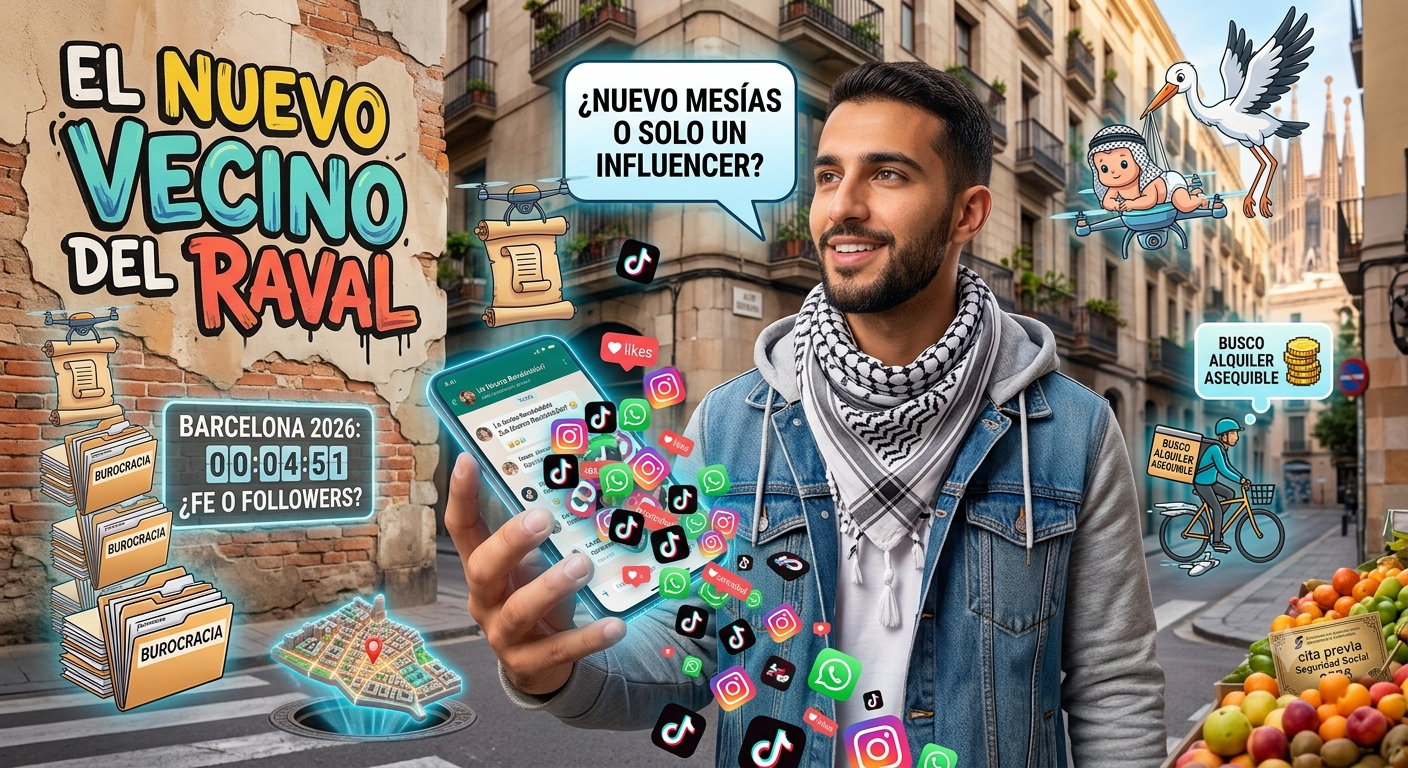
The Raval’s New Neighbour: What If Muhammad Were Born in Barcelona Today?
This article is an imaginative exercise. It is not intended to offend or describe real events, but to raise an impossible question and reflect on the clash between tradition, technology, and contemporary Europe.
A boy named Mohamed is born in a public hospital. His parents live in the Raval neighbourhood. Like any other child of his generation, he will grow up surrounded by screens, artificial intelligence, TikTok, and video games.
By the age of 12, he speaks Spanish, Catalan, and English. At 15, he has a YouTube channel with a million followers. At 18, he uses artificial intelligence to write his school assignments.
But imagine for a moment that this young man has an extraordinary personality: charismatic, intelligent, and capable of inspiring thousands of people.
His First Revelation Would Be a Notification
Forget the desert.
His first revelation would probably arrive while he was looking at his phone at 3:17 a.m. His phone vibrates: “You have a new message.”
Five minutes later, he would be wondering whether it was God, ChatGPT, a Russian hacker, or a marketing campaign.
And before telling anyone, he would do something that did not exist 1,400 years ago: Google it.
“Is it normal to hear voices?”
“How can I tell whether a spiritual experience is real?”
“Should I see a psychologist?”
He Would Have a TikTok Account
He would not need to spend years travelling across Arabia. He would simply open an account: @MahomaBCN.
First video: “I think I have an important message for humanity.”
The result: 12 million views, 500,000 comments, 300 memes, four television interviews, and a debate in the European Parliament.
The next day, half the internet would be divided:
#IStandWithMuhammad, #FakeProphet, #ProphetInfluencer, #CancelMuhammad.
His Followers Would Be an Unlikely Mix
His first followers would probably include a programmer from Terrassa, a student from Paris, a taxi driver from Berlin, a teacher from Seville, a pensioner from Valencia, and three influencers.
And, of course, someone would launch a YouTube channel analysing every word he said.
He Would Have Problems with the Tax Authorities
Some things never change. Within a few years, thousands of people would want to make donations, and then the most important question of the twenty-first century would arise:
“Who’s doing the bookkeeping?”
Because founding a spiritual movement is one thing; filing your quarterly VAT returns correctly is quite another.
What Would He Say About Europe?
This is the most interesting part. A Muhammad born in Barcelona would have grown up witnessing democracy, freedom of expression, equality between men and women, elections, social media, artificial intelligence, and human rights.
His frame of reference would not be the desert or the tribes of the seventh century. It would be Netflix, Spotify, Wikipedia, the European Union, FC Barcelona, and the Mossos d’Esquadra.
The big question is: Could someone born in 2026 think in the same way as someone born 1,400 years ago?
Probably not.
The New Message
Perhaps his message would sound something like this:
“Humanity needs less hatred, more freedom, and more common sense.”
Perhaps he would emphasise equality between men and women, coexistence between religions, protecting the planet, fighting poverty, and respecting differences.
And he would probably add a very modern phrase:
“Before arguing on the internet, go and touch some grass.”
The Impossible Interview
Imagine a television interview.
—Are you a prophet?
—I don’t know.
—Have you spoken to God?
—I’m not sure.
—Do you have any proof?
—Do you have proof that I haven’t?
—What is your opinion of artificial intelligence?
—I’m less worried about artificial intelligence than natural stupidity.
The next day, the quote would appear on T-shirts.
The Ultimate Miracle? The Price of Rent
In history, prophets perform miracles: healing the sick, multiplying food, and so on. But in Barcelona in 2026, if Muhammad wanted to convince the city’s residents that he was a divine messenger, he would have to perform the miracle everyone is waiting for: finding a three-bedroom flat in the city centre for less than €600 a month.
If he managed that, he would win over the entire city—Muslims, Christians, and atheists alike—in five minutes.
The Biggest Problem
However, he would face an enormous problem: the modern world no longer believes things so easily.
Centuries ago, a story could take years to travel across a continent. Today, it takes fifteen seconds—and another fifteen seconds for someone to question it.
His message would be scrutinised by journalists, scientists, historians, psychologists, and millions of anonymous social media users.
Never in history would a supposed prophet have faced such intense scrutiny.
The Final Question
Perhaps this thought experiment leads us to a deeper question.
It is not:
“What would happen if Muhammad were born in Barcelona?”
The real question is:
“How much of what we believe depends on the era in which we are born?”
Perhaps a child born in the seventh century and a child born in the twenty-first century would end up developing two completely different messages.
One would speak to the tribes of the desert. The other would post thirty-second videos from a café in Barcelona’s Eixample district. And both would probably be trying to answer the same question humanity has been asking for thousands of years:
How can we live together and build a better world?
Perhaps the setting changes. Perhaps the tools change. But the human quest remains exactly the same.