
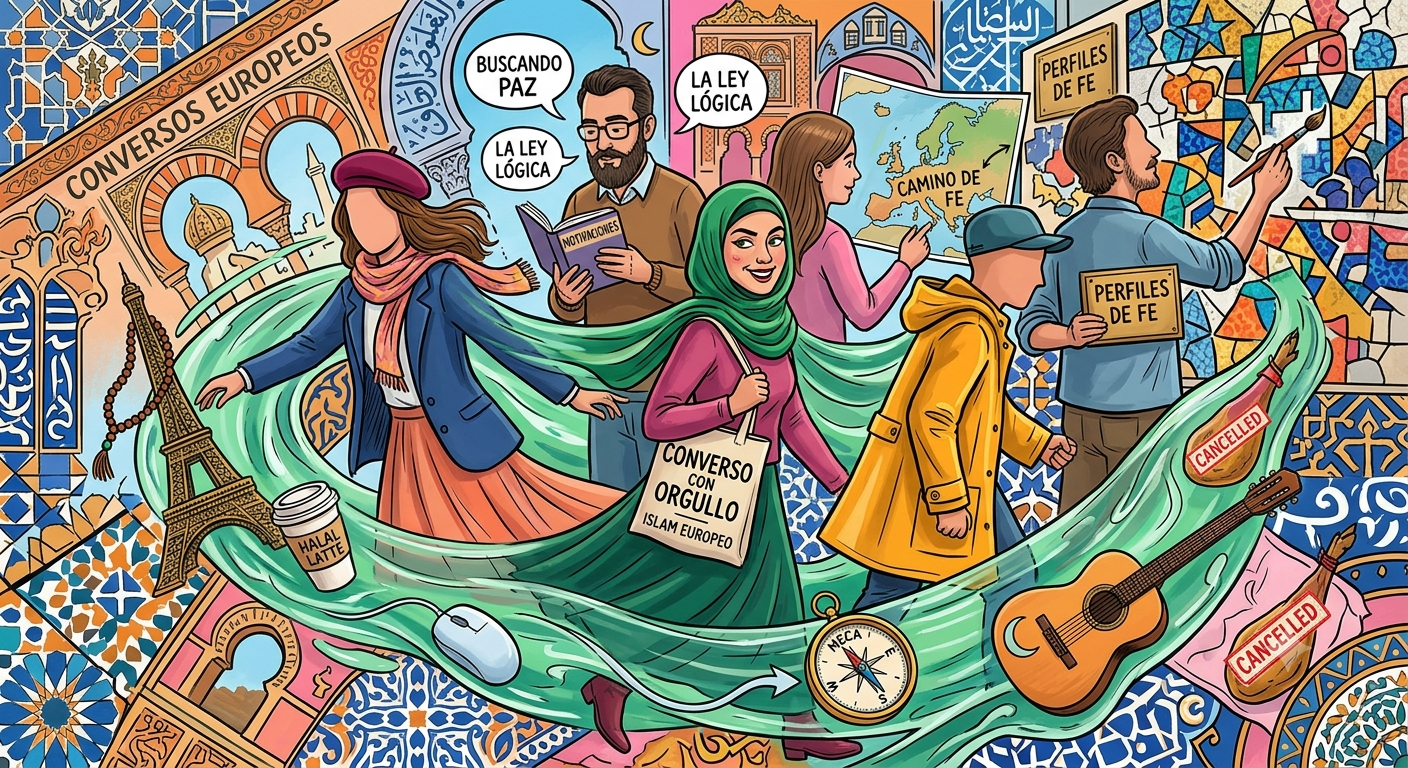
From Paella to Halal: The Phenomenon of European and Spanish Converts to Islam
There is a scene that repeats itself every year in Europe.
A young man named Javier, from Albacete. Or Thomas, from Paris. Or Peter, from Berlin. One day, he discovers Islam, starts reading about Muhammad, buys a Quran, learns to say “As-salamu alaykum,” and a few months later, he appears on Instagram announcing that his new name is Yusuf.
His mother goes into shock, his father wonders whether it is just a phase, like when he wanted to become a DJ, and his grandmother, who still does not understand how WhatsApp works, asks just one question: “But will he still come over for Sunday lunch?”
Welcome to the fascinating world of European converts to Islam.
A Small Phenomenon… but a Highly Visible One
The first thing to say is that the internet greatly exaggerates things.
If you spend too much time on YouTube, you might think that thousands of Europeans abandon their lives to convert to Islam every week. The reality is considerably more modest.
Estimates suggest that converts make up a small proportion of Europe’s Muslim population. Some studies put the number at between 200,000 and 320,000 converts across Europe, although it is difficult to know the exact figure because many countries do not record their citizens’ religious affiliation.
In Spain, the number of converts is also relatively small. Recent figures put it at around 29,000 people, within a Muslim population of more than 2.4 million.
Nevertheless, there is an interesting paradox: there are few of them, but they make a lot of noise.
We have put on our analytical glasses to examine reality without prejudice, but also without anaesthesia. So: Who are they, what are they looking for, how do they fit into the picture, and why does this phenomenon generate so much debate?
The Different Profiles: Tell Me Where You Come From, and I’ll Tell You Why You Converted
The convert community is as varied as a supermarket queue on a Saturday morning. Four broad profiles can be identified:
The “Gen Z Youngster” Looking for a Life Algorithm
Profile: Young people aged 18 to 28, highly connected and disillusioned with rampant individualism and the chaos of social media.
The appeal: In a world of fluid values and “do whatever you want,” Islam offers clear rules, daily discipline (the five daily prayers), sobriety, and a community that provides a genuine sense of belonging.
The Intellectual or Anti-Consumerist Seeker
Profile: People with academic backgrounds or sociopolitical experience who question the Western way of life.
The appeal: They find in Islam a profound critique of materialism and the excessive commercialisation of human relationships. For some, it is the ultimate way of going against the grain of a market-dominated culture.
The Mystic and “Charming” Sufism
Profile: Lovers of Rumi’s poetry, meditation, Andalusian history, and Islamic art, which is particularly prominent in cities such as Granada and Córdoba.
The appeal: They enter Islam through the door of deep spirituality and Sufism. They seek transcendence, beauty, and a spiritual connection that their local traditional religion has ceased to provide.
The “Cupid Effect” (Love or Family)
Profile: People who meet a Muslim partner and decide to adopt the religion, either out of genuine conviction that develops through living together or to promote family harmony.
Different Points of View: A Three-Way Debate
The phenomenon of native-born converts generates very different reactions depending on whom you ask.
1. Secular and Conservative Society: “But We Thought We’d Moved Beyond All This!”
For part of European society, conversion causes genuine bewilderment.
The secular/progressive camp struggles to understand how someone raised in a framework of individual freedoms can adopt a religion with moral rules perceived as strict or traditional.
The conservative/identity-focused camp views it with mistrust or suspicion, interpreting it almost as a “renunciation” of European cultural and identity roots.
2. The Muslim Community of Migrant Origin: Enthusiasm or Culture Shock?
On the one hand, the arrival of native-born converts is celebrated with joy: it demonstrates the universality of the faith.
On the other hand, there is no shortage of comical moments and cultural tensions: when a Spanish convert tries to teach theology or pronounce Arabic better than someone born in Cairo, or when the Spanish custom of spontaneity clashes with the cultural etiquette of the country of origin of the mosque community.
3. The Critical—and Realistic—Perspective
Converting to Islam as a European does not exempt you from the paradoxes of modern life. Many converts find themselves trapped in a kind of “no man’s land.”
To their lifelong friends, they are “the ones who no longer go out for drinks.” To the immigrant Muslim community, they remain “the newcomers” or “the Westerners.”
When the Convert Becomes “More Muslim Than the Muslims”
A phenomenon known in many European countries is the enthusiastic convert.
A newcomer learns four words in Arabic and, three weeks later, starts correcting Muslims whose families have practised Islam for generations.
Some experts even point out that certain converts may adopt particularly rigid versions of the religion during their first few years. This is relatively common in many religious movements: newcomers often experience their new faith with enormous intensity.
The European Debate
As with almost everything related to Islam, this subject divides opinion.
Those Who See It Positively
They argue that religious freedom includes the right to change one’s religion. Many people find peace and meaning in Islam. Europe should accept all beliefs as long as they respect the law. Religious diversity is an asset.
And they have a point: if we believe in freedom, we must also accept that someone can convert to Islam, Buddhism, or decide to worship a houseplant.
The Critics
Others, however, ask uncomfortable questions: What model of Islam are some converts adopting? Is it compatible with European values? Does it encourage integration or create parallel identities? Why do some converts end up embracing extremely conservative positions?
There is also concern about a well-documented phenomenon: converts have been overrepresented in some cases of Islamist radicalisation in Europe, although the vast majority never develop extremist views. And it is important to repeat this: conversion does not mean radicalisation.
The Impact on Europe
In numerical terms, the impact is small. In cultural terms, it is much greater.
Because every conversion raises questions that Europe has been trying to answer for years: What does it mean to be European? Can there be a European Islam? How far does integration go? Can a religion adapt to modernity?
Europe observes this phenomenon with a mixture of curiosity, bewilderment, and, at times, concern.
What Will Happen in the Future?
Everything suggests that the number of converts will continue to grow slowly in the coming years, although the main growth of Islam in Europe remains linked to immigration and demographics, rather than conversions.
We will probably continue to see surprising stories: politicians converting, university professors embracing Islam, and influencers explaining how to pray on TikTok.
And the occasional Javier who, after six months, announces: “From now on, my name is Yusuf.”
The Uncomfortable Question
Here we arrive at the question that almost nobody dares to ask:
Why do some Europeans embrace a religion that many Muslims born in Islamic countries are trying to reform or abandon?
The question is uncomfortable, but legitimate.
While in some places people are fighting for a more liberal interpretation of Islam, in Europe we find converts fascinated precisely by its more traditional aspects. It is a paradox of the twenty-first century.