
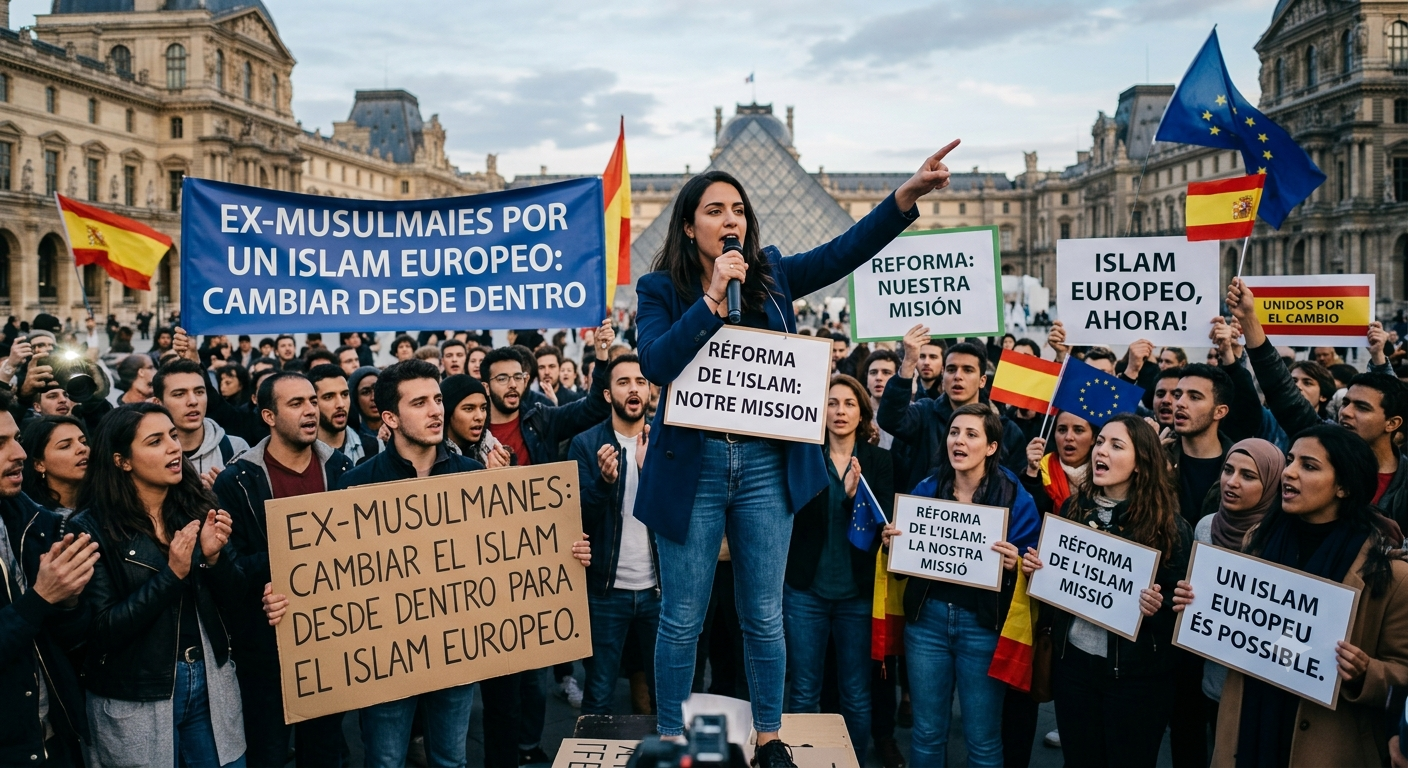
Why the Future of Islam in Europe Depends on Its Ex-Muslims
Europe’s Most Uncomfortable Club
Imagine for a moment that there is a very peculiar club. Its members know a religion inside out because they grew up within it, studied its rules, lived by its customs and, in many cases, defended it for years. But one day, they decided to leave it. Welcome to the world of Europe’s ex-Muslims.
Leaving a religion you were raised in from childhood is not easy. In fact, it can feel a lot like breaking up with a very demanding and controlling partner: first comes the argument, then a bit of family drama, followed by a phase of liberation (when trying ham or having a beer on a Friday afternoon feels like a secret mission) and, eventually, peace of mind. That is when you realise that you love your family and appreciate your culture, but you do not need to follow seventh-century rules to be a good person.
The Mirror That Asks Uncomfortable Questions
There is a widespread misconception: that if you stop believing in a religion, you are “betraying” your family or your roots. Nothing could be further from the truth. Most European ex-Muslims love their mothers’ cooking, traditional music and the architecture of places such as Granada or Istanbul. All they have done is separate their affection for their culture from the obligation to obey an imam.
They are probably one of the least understood, most controversial and most uncomfortable groups in the European debate about Islam. They make some Islamist circles uncomfortable because they question beliefs regarded as sacred. They make certain sections of the left uncomfortable because they challenge the simplified image of an “always oppressed minority”. And they make some conservatives uncomfortable because they demonstrate that change and integration are possible.
Europe talks a great deal about integration, democratic values and how to achieve a “European Islam” — a modern Islam that respects women, LGBTQ+ people and the laws of a secular state. Yet politicians and journalists almost always overlook the people who matter most in this story: Europe’s ex-Muslims.
And yet ex-Muslims could play a fundamental role in one of the great questions of the twenty-first century:
Can a European Islam emerge that is compatible with liberal democracy, legal equality and fundamental rights?
Who Are the Ex-Muslims?
An ex-Muslim is simply someone who was born into or raised within Islam and later decided to leave the religion.
The reasons vary widely: loss of faith, intellectual doubts, disagreements with certain religious rules, defence of women’s rights, defence of LGBTQ+ rights, rejection of community pressure, or the pursuit of greater individual freedom.
Some become atheists, others become agnostics, some embrace another religion, and others retain a Muslim cultural identity even though they no longer believe.
What they have in common is that they have crossed a boundary that remains extremely sensitive in many Muslim environments.
Apostasy: A Problem Europe Does Not Fully Understand
In much of Europe, leaving a religion is fairly ordinary. Thousands of people leave Catholicism, Protestantism or other faiths without anything extraordinary happening. In many Muslim-majority countries, however, apostasy remains a deeply controversial issue.
Although the situation varies by country, school of jurisprudence and religious movement, social pressure against those who leave Islam remains very strong in many societies.
That is why many European ex-Muslims find themselves in a paradoxical situation: Europe recognises their full religious freedom, but their own family or community circles may not accept that freedom.
The Double Silence
Ex-Muslims often find themselves caught between two forms of silence.
The first comes from Islamist circles that regard their very existence as a threat. The second comes from European sectors that are reluctant to address the issue for fear of being accused of intolerance.
The result? Many ex-Muslims end up invisible, and when a community becomes invisible, its problems disappear from public debate as well.
The Dissidents Who Know the System from the Inside
If someone wanted to reform a major company, they would probably listen to former employees. If someone wanted to reform a political party, they would listen to former activists.
So a logical question arises: why not listen to those who know Islam from the inside?
Ex-Muslims possess something that few academic experts can offer: direct experience. They know the rules, family dynamics, social pressures and mechanisms of religious authority. Precisely for that reason, their opinions often cause so much discomfort.
Can They Become the Architects of European Islam?
Here we reach one of the most interesting ideas in the debate.
Many ex-Muslims do not want to destroy Islam. What they want is for it to evolve and undergo a process similar to the one other religions experienced during modernity.
A hypothetical European Islam could include complete freedom to believe or not believe, full equality between men and women, a clear separation between religion and politics, full recognition of LGBTQ+ rights, and acceptance of religious criticism.
Europe as a Laboratory
Europe offers something that is absent across much of the Islamic world: freedom of expression, religious freedom, legal protection, pluralism and democracy.
These conditions turn the continent into a kind of laboratory where new interpretations of Islam can emerge. Some will thrive; others will disappear.
But religious innovation tends to emerge precisely where people are free to debate.
The “Galileo Effect”
Throughout history, many reforms have begun with dissenters.
Martin Luther was a dissenter. Galileo was a dissenter. Civil rights advocates were dissenters.
Ex-Muslims could represent something similar within the world of European Islam: the uncomfortable voice asking questions that nobody wants to answer.
Why Do They Face So Much Hostility?
Because they challenge several narratives at once. To some Islamists, they are traitors; to some activists, they are an awkward problem; and to some governments, they are a difficult issue to manage. When someone does not fit into any political label, they often end up alone.
Europe Needs to Listen to Them
Listening to ex-Muslims does not mean agreeing with everything they say. Nor does it mean attacking practising Muslims. It means recognising that diversity also exists within the Muslim world itself.
An ex-Muslim does not represent everyone. But neither does an imam, a politician or a journalist. Pluralism is precisely the foundation of a free society.
Towards a Twenty-First-Century European Islam
Ex-Muslims could become a kind of “internal democratic opposition” in the debate about the future of Islam. Not because they have all the answers, but because they dare to ask questions that others prefer to avoid.
History repeatedly shows that major reforms often begin in exactly this way: with uncomfortable people asking uncomfortable questions.
Conclusion
European ex-Muslims are a small, diverse and frequently overlooked minority. Nevertheless, they could play a far more important role than might appear in shaping a possible European Islam compatible with fundamental rights and liberal democracy.
Perhaps they will not be the ultimate builders of that future. But they could be the engineers who identify the cracks in the existing structure. And every architect knows that before building something new, you first have to understand where the cracks are.
For European ex-Muslims, the goal is not to eradicate their parents’ faith or declare a cultural war, but to dust off dogma. It is to turn a religion that is sometimes perceived as a straitjacket into a personal choice that is open, welcoming and compatible with democratic coexistence.