
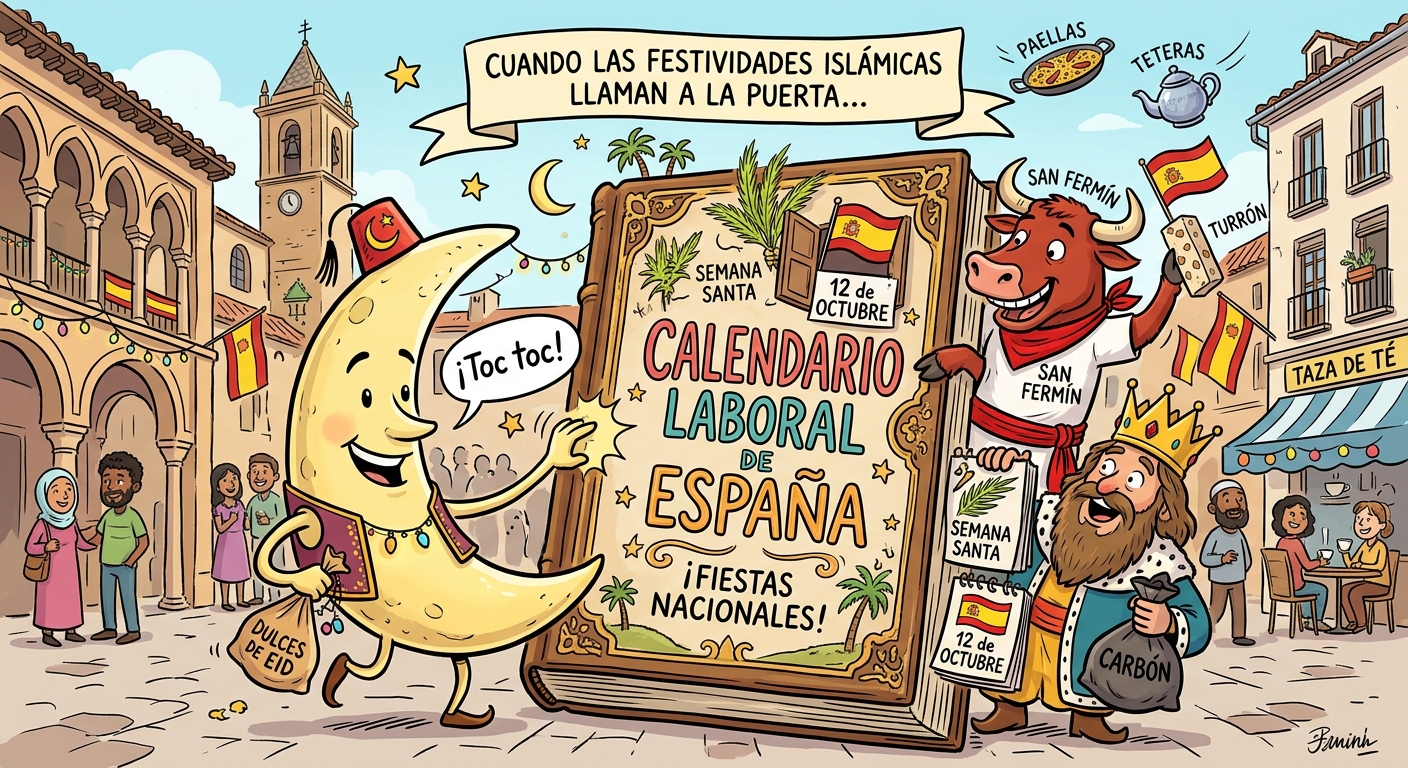
Islam and National Holidays in Spain and Europe: What Happens When Some Celebrate Constitution Day and Others Celebrate the End of Ramadan?
Spain has its national holidays. France has its own. Italy, Germany and Belgium do too. These are days that commemorate each country’s history, traditions, victories, defeats and, ultimately, the events that helped build the nation.
But Europe has changed. Millions of citizens of Muslim origin now live across the continent, and they also have their own religious celebrations: Eid al-Fitr (the end of Ramadan), Eid al-Adha (the Festival of Sacrifice) and the Islamic New Year, among others.
And this raises an interesting question. Should a country change its national calendar to accommodate a more diverse society? It is not a straightforward question. Nor should it be a frightening one to ask.
The Calendar Tells a Story Too
Holidays are not just for resting. They also serve to say: “This is important to us.”
12 October. 6 December. France’s National Day. Italy’s Republic Day… All these dates tell a collective story. If you change the calendar, you also change the narrative a society tells about itself.
When Eid Arrives… but You Have to Work
Imagine a Muslim family. For them, that day is like Christmas. They want to get together, share a meal, give presents to the children and go to the mosque. But it happens to be Tuesday at nine in the morning: there is school, there is work, there are exams. Meanwhile, the rest of the country enjoys other holidays that the family may not celebrate.
The question arises naturally. Should the state officially recognise these celebrations too?
The Different Options Available in Europe
Europe already offers very different models.
Model 1. Change Nothing
This is the simplest approach. Each country keeps its traditional public holidays. Anyone who wants to celebrate another occasion can request leave.
Advantages: A stable calendar. The same rules for everyone. Reinforces national identity.
Disadvantages: Some minorities feel their celebrations are never recognised. Workers may have to use their annual leave to observe religious holidays.
Model 2. Flexible Personal Days
Every worker receives several days off each year and decides when to use them. A Muslim can reserve them for Eid, a Christian for Easter, an atheist for a fishing trip, and a football fan for a European final (although their boss might not share their enthusiasm).
Advantages: Individual freedom. The state does not have to choose between religions. Fewer conflicts.
Many consider this an approach compatible with a pluralistic society.
Model 3. Add New National Holidays
This is where the serious debate begins.
Some propose adding Muslim festivals to the official calendar. But new questions immediately arise. Only Muslim holidays? What about Jewish holidays? Evangelical Christian holidays? Orthodox Christian holidays? Hindu festivals? Buddhist celebrations?
Europe could end up with so many public holidays that people would have to work on Sundays… and perhaps Mondays too.
The Domino Effect
Once you officially recognise one religion, others may demand equivalent treatment. It would hardly be surprising to hear: “If they have a national holiday, so should we.”
The state would then have to justify why it accepts some requests and rejects others. In liberal democracies, equality before the law is an important principle.
What About National Identity?
Here we encounter one of the major debates. Some people believe that incorporating new holidays demonstrates an open society.
Others believe it could dilute shared symbols that have united the country for generations. It is not just a religious issue; it is also a cultural one. National holidays help build a common memory. Changing them can be seen either as progress or as a loss, depending on one’s perspective.
Schools Also Enter the Picture
Imagine a class of thirty pupils. Five celebrate Eid. Three celebrate Orthodox Easter. Two are Jewish. The rest follow the usual calendar or do not celebrate any religious holidays.
The teacher needs to organise exams, school trips and activities. It does not seem impossible, but it is certainly more complicated.
Businesses Would Also Have to Adapt
Human resources departments would face new challenges. Who works? Who gets the day off? How should shifts be organised?
In hospitals, the police, fire services and public transport, these decisions directly affect day-to-day operations.
What Supporters of Greater Recognition Say
Their arguments usually include the following:
-
European society is becoming increasingly diverse.
-
Recognising religious holidays can promote inclusion.
-
Many Muslims are European citizens who participate fully in the life of their countries.
-
A flexible system reduces tensions and makes it easier to reconcile family and religious life.
What Those Who Prefer to Keep the Current Calendar Say
Their arguments usually include the following:
-
National holidays represent the country’s shared history.
-
The state should avoid favouring one religion over another.
-
Increasing the number of public holidays can complicate economic and administrative organisation.
-
Integration also involves adapting to the shared customs of the country in which one lives.
What Might a Balanced Solution Look Like?
Instead of turning every religious celebration into a national holiday, some propose a model based on individual freedom:
-
Maintain national holidays linked to the country’s history and institutions.
-
Make it easier for workers and students to request specific days off for religious reasons, within a common and transparent framework.
-
Promote mutual understanding of different traditions in schools without imposing religious practices.
-
Ensure that all faiths receive equal treatment under the law, avoiding privileges.
In this way, the state preserves its shared calendar while allowing individuals room to practise their own beliefs.
Conclusion: More Than a Calendar, a Question of Coexistence
The debate over national holidays is not simply about days off. It concerns identity, equality, integration and religious freedom. It reflects a broader challenge: how to manage pluralism in societies where inherited traditions coexist with new demographic realities.
Perhaps the goal should not be for everyone to celebrate the same holidays, but for everyone to coexist respectfully even when their personal calendars differ.
Ultimately, a cohesive society is not measured by how many public holidays it has, but by its ability to combine a shared identity with the freedom of every citizen.