
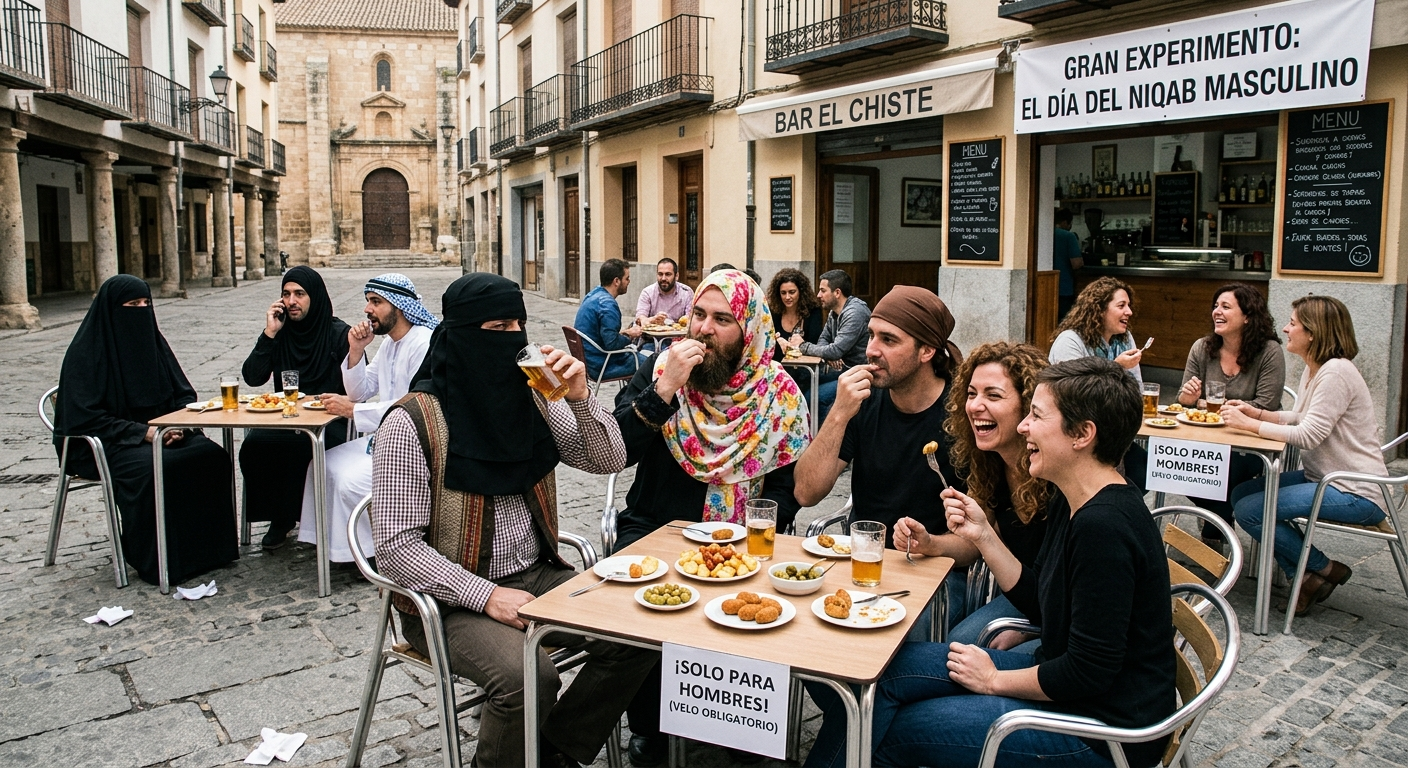
The Great Experiment: Operation Male Niqab
“Sir, before leaving the house, have you remembered your niqab?”
We hear a lot about freedom, tradition, modesty and everyone’s place in society, but nothing helps us understand someone else’s reality quite like putting ourselves in their shoes… or, in this case, underneath two metres of opaque fabric in 35-degree heat.
Let us imagine a sociological experiment: starting tomorrow, the veil and niqab become compulsory for men.
Yes, all men. From the executive riding an electric scooter to the man at the local bar who holds forth on geopolitics between beers. How would everyday life change, and what might they learn along the way?
What would happen?
The Initial Shock: Goodbye to the Beard as a Personality Accessory
The first impact would be purely aesthetic. Years spent cultivating an immaculate beard, trimmed to the millimetre and scented with essential oils, only for it to be buried beneath a mesh or a slit in black fabric.
The first male discovery: Invisibility is irritating.
The first 24 hours of the experiment would produce some memorable headlines:
The Latte Drama: Trying to drink something hot through a narrow opening without ending up with foam all over the veil and an expression of resignation.
Mobile Facial Recognition: Face ID collapsing en masse around the world.
The Summer Heat: Discovering that breathing your own hot air in the middle of July turns any ten-minute walk into an unsolicited portable sauna.
Fashion “Choices”: The Market Adapts
Since capitalism never misses an opportunity, the men’s niqab market would soon flourish. Because, of course, men need to feel they are choosing their style, even when the rule is to cover themselves from head to toe.
We would quickly see categories such as:
The Tactical/Outdoor Niqab: Military khaki, breathable Gore-Tex-style fabric and side Velcro straps for attaching car keys.
The Hijab Gym-Bro: A fitted design with anti-sweat technology and the gym logo prominently displayed at the front, so as not to lose that “fitness guy” status.
The Executive Niqab: Italian tailoring, matte silk and silver-thread details for board meetings.
The irony would be obvious: calling it “free choice” when the only real option is choosing the colour of the wrapping.
Messages from the Shadows: What It Feels Like from the Inside
Once the initial jokes have worn off, the experiment would begin to strike a deeper chord. After a week, men’s testimonies would start to change in tone:
Loss of visual identity: “I was walking down the street and my next-door neighbour, whom I’ve known all my life, didn’t recognise me. I felt like a ghost.”
The gaze of others: Feeling people judging, watching or assessing whether your veil is “properly worn” or whether too much of your forehead is showing.
The loss of voice: Noticing that when you speak with your face covered, people tend to listen less, interrupt you more or assume you have nothing important to say.
The Elections
Election season arrives. Political parties unveil their latest promises.
“We’ll reduce the thickness of the veil.” “More ventilation for everyone.” “Subsidies for lightweight fabrics.”
A new political party proposes: “My face, my decision.” Another responds: “Tradition is non-negotiable.”
Television Advertising
Brands change, too.
New men’s fragrance: “It doesn’t matter if nobody sees your face. What matters is smelling good.”
Shampoo: “Shiny hair, even if nobody can see it.”
Face cream: “Because there’s skin under the veil, too.”
The Serious Side of the Experiment
After a few weeks, questions far more interesting than the jokes begin to emerge.
How does the way we relate to one another change when we hide our faces?
How important is it to be able to look at another person’s face?
Do we feel just as free?
Do we feel just as safe?
Does our identity change when we stop showing who we are?
These questions have been around for years, and they provoke very different answers depending on culture, religion and personal experience.
The Interesting Part
Perhaps many men would discover things they had never considered before. Not because wearing a garment for a few hours allows someone to understand another person’s entire experience. It does not.
But it could help them understand certain everyday sensations: heat, discomfort, practical limitations or, for those who experience it as an obligation, the inability to decide what to wear.
At the same time, some men would say they felt comfortable wearing such clothing, reminding us that personal experiences differ and that not everyone experiences the same garment in the same way.
What If It Were Voluntary?
Perhaps the most interesting version of the experiment would be a different one. Not forcing anyone, but inviting them.
Politicians, journalists, teachers, imams, priests, activists, influencers and any citizen who wanted to take part.
Just one day. With a single condition. Afterwards, they would publicly describe how they felt. No shouting, no insults, just an account of their experience.
Conclusion
What Would This Experiment Teach Us?
That having control over our own bodies is the true starting point of dignity. That the best way to understand an imposition is to have to wear it ourselves. That comfort and freedom should not be gendered.
Thought experiments have one advantage: they allow us to change our perspective for a few minutes. They do not resolve debates, but they help us ask better questions.
Perhaps the real lesson would not be to decide who is right, but to remember a very simple principle: before expressing an opinion about how someone else lives, it is sometimes worth trying to put ourselves—if only symbolically—in their place. Or, in this case, under their veil.
The Lesson of the Experiment: Empathy by Decree
This thought experiment is not about clothing; it is about control, autonomy and empathy.
It is remarkably easy to theorise about modesty, decency or tradition when you write the rules and someone else has to follow them. But when a mandate imposed on someone else’s body becomes your own, theoretical excuses collapse on the first bus without air conditioning.
Perhaps we do not need to force anyone to wear a niqab for a month to understand the heart of the matter. We need only remember a much simpler rule: if there is a garment or rule you would not willingly apply to yourself, think twice before justifying it for others.