
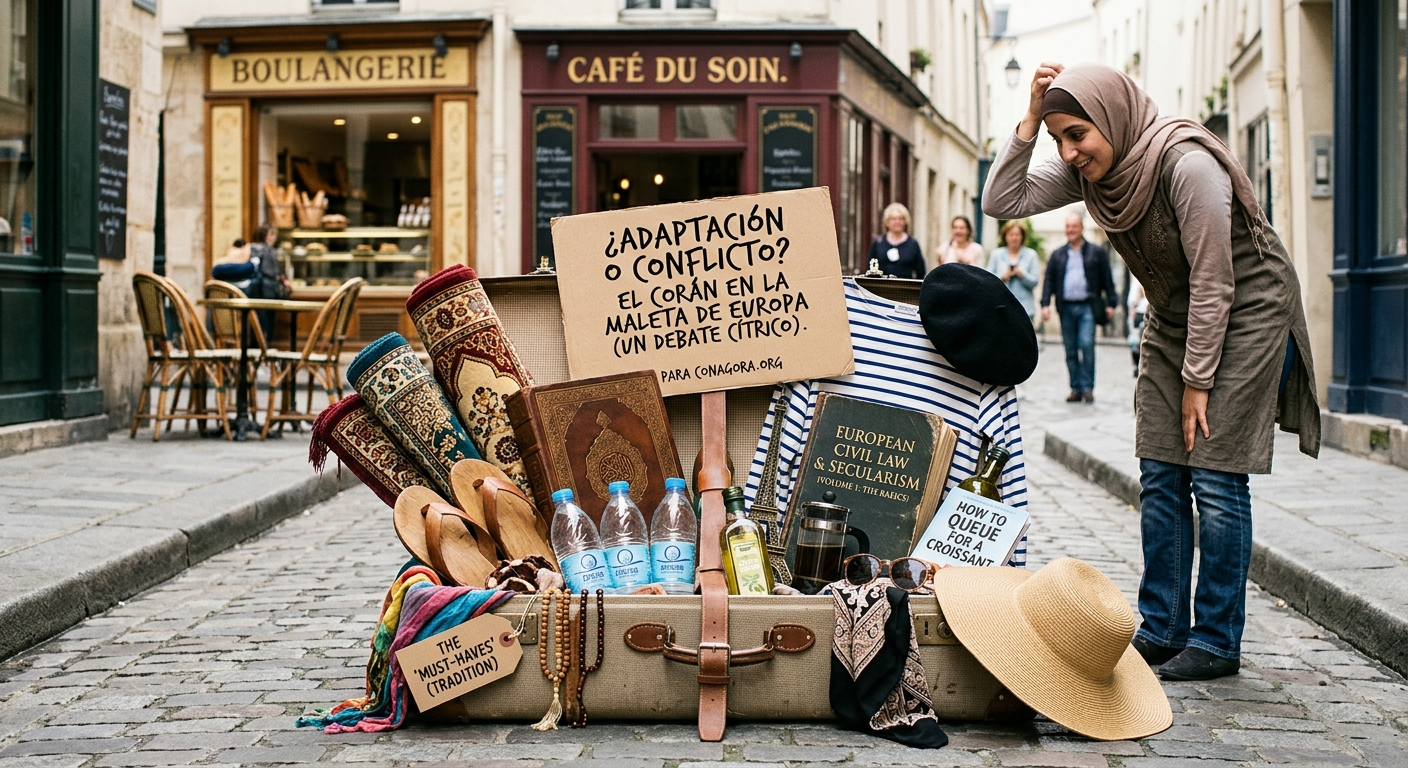
The New Neighbour and the Community Rules
Imagine a new neighbour moving into a residential building. He is friendly, polite and wants to live there for many years. But on his first day, he proposes changing the schedules, the swimming pool rules, the use of the lift and even the façade’s decoration because things were done differently in his old neighbourhood.
The other residents look at him in surprise. Not because they hate the new neighbour, but because they think: “Wouldn’t it have been easier to adapt to the building rather than change the entire building?”
This little story sums up one of the major debates Europe will face over the coming decades.
The question is not whether Muslims can live in Europe. Millions already do so perfectly normally. The real question is a different one.
Can traditional Islam remain unchanged within a European liberal society without creating tensions?
This is not a religious question, but a cultural one. And to understand where this relationship is heading, three realistic scenarios are on the table.
Option 1. Islam Adapts to Europe (“Euro-Islam”)
This is the simplest path, and probably the least controversial.
The idea is straightforward. Europe already has its own rules of the game: equality between men and women, religious freedom, freedom of expression, separation of religion and state, gay rights, civil law taking precedence over religious law…
Under this model, any religion can exist, but it accepts those common rules. This does not mean ceasing to be Muslim. It means accepting that religion belongs primarily to the personal sphere and that civil laws organise coexistence.
Many European Muslims already live exactly this way. They work, study, attend the mosque and celebrate Ramadan, while fully respecting the country’s democratic rules. It is a rather uneventful model, but, interestingly, it tends to work quite well.
Option 2. Europe Adapts to Islam (A Change of Model)
Here, the story changes completely. Instead of a religion adapting to the country, the country begins modifying its customs to accommodate certain religious demands.
For example, debates in various European countries include more public spaces for prayer, halal meals in public institutions, schedules adapted to Ramadan, recognition of religious holidays, rules on clothing in certain settings and more public funding for religious centres.
Each proposal can be debated separately, with arguments for and against. The problem arises when many citizens feel that common rules are beginning to change in response to the demands of a particular group.
That is when an uncomfortable question emerges: how far should a society adapt without ceasing to be itself?
Every society changes, but it also needs to preserve a shared core that makes coexistence possible.
Option 3. Nobody Changes (Permanent Confrontation Mode)
This is probably the most complicated option.
Islam retains all its traditional interpretations, Europe retains all its rules, and both expect the other to change first.
The result resembles a couple who have spent twenty years arguing about who should take out the rubbish. Nobody wins, and the conflicts keep recurring.
The controversies return every few months.
One day it is the veil, another day education, then caricatures, freedom of expression, equality between men and women… and so on, over and over again.
Not necessarily because most people are looking for conflict, but because some traditional religious rules and certain principles of liberal democracies can come into tension.
What Solutions Are Available?
There are no magic solutions, but there are approaches that can help. For coexistence to work without anyone having to abandon their identity, several basic principles are needed:
A firm commitment to secularism: Civil law and human rights take precedence over any religious dogma. No exceptions, no fine print.
Promoting an autonomous European Islam: Support local training for imams and theologians who interpret religious texts in the context of the 21st century, rather than importing perspectives funded by ultraconservative regimes abroad.
Integration without paternalism: Less rhetorical wishful thinking and greater mutual expectations: strict respect for the host country’s rules in exchange for genuine equality of opportunity without discrimination.
Defending the same rules for everyone: Laws must apply equally to every citizen, regardless of religion or beliefs.
Encouraging dialogue: Listening, debating and disagreeing without turning every difference into a culture war helps find shared solutions.
Promoting interpretations compatible with fundamental rights: Many religions have reinterpreted aspects of their traditions throughout history. The same process can take place wherever there is a willingness to reflect.
The “Airplane Mode” Problem
Sometimes it seems that certain religious interpretations operate like a mobile phone in airplane mode: they receive no updates. While everything around them changes, they remain exactly as they were centuries ago.
But Europe is constantly changing. Technology changes, laws change, families change and the economy changes.
Does a European Islam Exist?
An increasing number of voices are discussing this possibility. Not an Islam that differs in its spiritual essence, but a way of practising the faith that is fully compatible with a liberal democracy.
The Million-Dollar Question
Perhaps the question is not whether Europe can coexist with Islam. That already happens every day.
The real question is different: what model of coexistence will allow people with different beliefs to share the same space while respecting the same freedoms and rights?
Cultures that turn every change into a permanent war eventually exhaust everyone. And Europe, after many centuries of religious conflict, seems to have learned a fairly simple lesson.
To coexist, nobody needs to think alike. But everyone needs to accept the same rules of the game.