
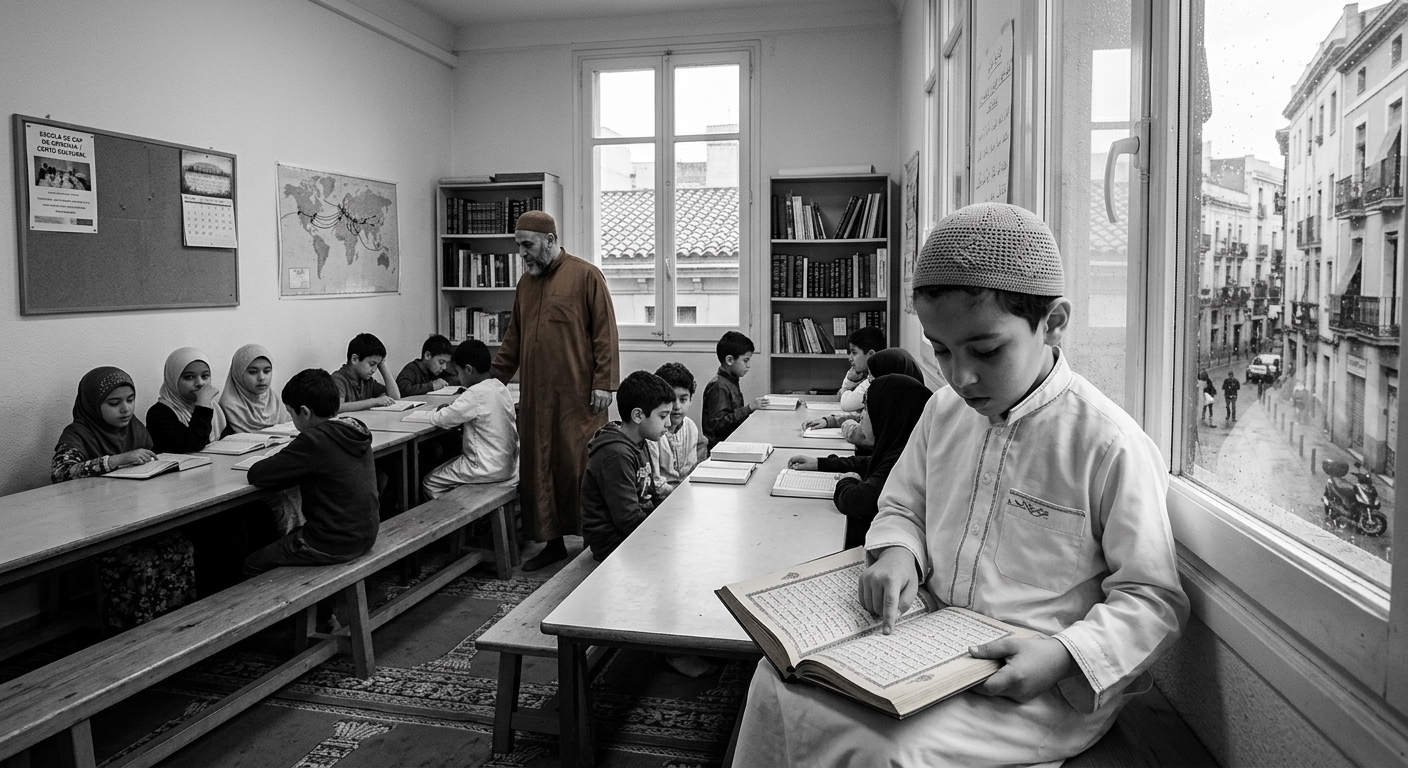
While Europe Looks at Schools from Monday to Friday, Thousands of Children Receive Another Education at the Weekend: What Happens in Weekend Quran Schools Across Europe
Imagine a perfectly ordinary scene.
It is Saturday morning. While some children play football, others take English lessons, others go to music classes, and others sleep until eleven, some children walk into a mosque or Islamic centre with a book under their arm.
They are not going to public school, nor are they taking part in a municipal extracurricular activity. They are going to learn about religion, the Quran, Arabic, prayer, Islamic history, rules of behaviour and religious values.
The uncomfortable question is very simple: What exactly is being taught there? And an even more uncomfortable question: Who supervises it?
Because teaching religion is one thing. Teaching children a particular worldview without anyone knowing exactly what they are being taught is quite another. And this is where the problem begins.
What Exactly Is a Weekend Quran School?
We are not necessarily talking about an Islamic school. These are two different things.
A formal Islamic school may be subject to the educational legislation of the relevant country and required to follow an official curriculum.
The so-called weekend Islamic schools, Quran schools, madrasas or Quran classes are generally a form of supplementary religious education.
Children continue attending conventional school during the week and usually receive religious instruction one or two days at the weekend.
Available academic research describes these schools as institutions primarily dedicated to teaching the Quran and Arabic, alongside Islamic knowledge and practices. One study on Europe found that many pupils are primary-school children and that attendance may be limited to just a few hours a week.
In other words, these schools do not necessarily replace European schooling, but neither are they simply Arabic classes. This is the first important distinction.
What Do Children Actually Learn?
It varies enormously from one centre to another. And this point is fundamental: there is no single “European Quran school”.
There are Turkish, Moroccan, Pakistani, Arab and African mosques, Salafist organisations, independent organisations, cultural associations and centres linked to different religious movements. It would therefore be absurd to claim that they all teach the same things.
However, research conducted in different countries makes it possible to identify certain subjects that appear repeatedly.
The Usual Curriculum Includes:
The Quran
Learning to read it in Arabic. Memorising surahs. Learning specific verses and recitations. Improving pronunciation. Memorising texts used during prayer.
Religion
The Five Pillars of Islam. The life of Muhammad. Stories and events from Islamic history. Religious beliefs. Islamic values and rules.
Religious Practice
How to pray. How to perform certain rituals. What is permitted. What is forbidden. How to behave as a Muslim.
Arabic
In many centres, Arabic is not taught simply as a foreign language. It is also the language of the Quran.
Identity
Another interesting element emerges here. In certain centres, particularly those organised around national communities, religious education is combined with the transmission of cultural identity.
Research conducted in Turkish mosques in the Netherlands found precisely this combination: religion, Muslim identity, Turkish identity and language learning.
Religion + language + culture + identity. This is not necessarily a bad thing, but it is something worth understanding.
Is It Simply a Matter of Memorising the Quran?
No. Or at least, not always.
Research on non-formal Islamic education in the Netherlands describes classes in which pupils learn to read and recite the Quran, memorise texts and receive instruction on values, rules, rituals, Islamic history and conduct.
In some classes, stories from the Prophet’s life are used to explain how a good Muslim should behave.
This brings us to an important issue. Learning what a religion says is one thing; learning how a person should behave according to that religion is another. The distinction may seem small, but educationally it is enormous.
Is Critical Thinking Taught?
Here we encounter one of the major unanswered questions.
Religious education does not have to be incompatible with critical thinking. A child can study the Quran, the Bible, Judaism or any other religious tradition.
The problem arises when religious teaching moves from “This is what we believe” to “This is the truth and it must not be questioned”.
Research into young Muslims who have participated in supplementary Islamic education shows that experiences and teaching approaches vary.
Therefore, the right question is not, “Do they teach the Quran?” We already know that they do. The interesting question is, “How do they teach the Quran?”
The Teacher: Who Is Standing in Front of the Children?
Another surprisingly simple question: who does the teaching?
The answer is not uniform either. Some mosques involve imams; others employ religious teachers; many rely on volunteers. And here we find an important point.
Research conducted in the Netherlands indicates that many so-called “teachers” do not necessarily have formal pedagogical training. They may be selected primarily because of their knowledge of the Quran, their language skills and their motivation.
This does not mean that they are bad teachers. It means something much simpler: knowing about religion does not automatically make someone a specialist in childhood education. And that should matter.
Is There a Common European Curriculum?
No. And this is one of the biggest grey areas.
There is no single European curriculum for weekend Quran schools, nor is there necessarily a common curriculum within an individual country.
Academic research explicitly notes that many centres do not follow a unified programme and that even mosques belonging to similar national communities may use different teaching materials.
A child may attend a mosque where the teaching consists essentially of Quran + Arabic + prayer. Another may receive Quran + Arabic + religion + culture. Another may receive Quran + religion + identity + social rules + community activities.
That is why it is impossible to speak about “what Quran schools teach” as though they were a single institution. Each centre must be investigated individually.
Who Supervises All This?
This is where we reach the most interesting point. It is also the point most easily distorted by exaggeration.
The answer depends on the country and the legal nature of the activity.
There is no single European system for inspecting Quran schools. This makes comparisons between countries essential.
The United Kingdom: A Particularly Interesting Grey Area
In England, there is a category known as out-of-school settings, which includes supplementary educational activities, including supplementary religious schools.
The British government itself recognises that these activities can include religious centres and supplementary schools. But an important distinction arises here.
In 2023, the British government told Parliament that supplementary religious schools operating as extracurricular activities are not regulated by education or childcare legislation and are not required to register with the Department for Education or Ofsted.
In other words, we cannot automatically place a weekend madrasa within the same inspection system as a school.
But that does not mean there are no safeguards.
The government has specific child-protection guidance for these activities, and in 2025 it even launched a consultation on safeguarding in so-called out-of-school settings.
Furthermore, if an establishment stops being merely a supplementary education provider and effectively begins operating as an unregistered school, other legal obligations come into play.
Ofsted states that operating an unregistered school in England may constitute a criminal offence and that mechanisms exist for investigation and enforcement.
France: The State Takes a Different Approach
France has a much more interventionist tradition of secularism, and this raises an interesting issue. French authorities distinguish between different types of activities involving minors.
Official documentation published in 2025 on inspection and oversight indicates that facilities accommodating minors whose activities consist exclusively of teaching a religion and, potentially, an associated language are not, in principle, automatically considered facilities subject to the same regulatory regime as other establishments accommodating minors.
However, the authorities can check what activities are actually taking place and act when they detect non-compliance.
This leads us to an important point: the name of the centre is not enough. An association may call itself a “cultural centre”, but what matters legally is what it actually does with children.
Spain: Who Supervises Saturday Quran Schools?
Spain has an important peculiarity.
The Spanish state officially recognises the right to receive Islamic religious education in public schools and publicly funded private schools.
Law 26/1992, which approved the Cooperation Agreement between the State and the Islamic Commission of Spain, guarantees this right to Muslim pupils. In 2022, the Ministry of Education published the official Islamic religious education curricula for Early Childhood Education, Primary Education, Compulsory Secondary Education and Baccalaureate.
But an essential distinction must be made: a class in Islamic religion at school is one thing; a Quran class on Saturday at a mosque is another. Legally, they are not exactly the same.
Islamic Religious Education Within Schools Has an Official Framework
When we talk about Islamic religious education within the education system, Spain has a curriculum.
We are not talking about an improvised class in a room inside a mosque. There is a state regulatory framework.
Furthermore, the Islamic Commission of Spain itself reminds families that they can request Islamic religious education in public and publicly funded schools and states that educational inspectors oversee compliance with the regulations.
In other words, when a child receives Islamic religious education officially at school, there is an educational framework and administrative supervision.
But… Saturday Changes the Picture
Now imagine that Mohamed is ten years old. From Monday to Friday, he attends a public school. On Saturday morning, he goes to a mosque.
Who supervises that class?
The answer is much less straightforward. A Quran class organised by a mosque does not automatically become an official school simply because it has children, a teacher and a timetable.
A Real Example: Seville
We do not have to imagine it. The Seville Mosque Foundation currently advertises Quran, reading and Arabic classes for children aged 6 to 14. The classes take place at the Foundation itself and are scheduled for the 2026–2027 academic year.
The organisation itself explains that it does not consider these classes to be just any extracurricular activity. It asks parents to ensure regular attendance and help children review their assignments.
In other words, there are children, a teacher, a programme, enrolment, homework and a religious organisation behind the activity. But we should not confuse this with an official school.
It is a religious education activity organised by a religious institution. And precisely for that reason, the question arises: what specific safeguards and checks apply?
Another Example: Granada
The Granada Mosque advertises Quran classes for children and locates them at the Cultural Centre of the Great Mosque.
The programme includes classes for minors on Tuesdays, Thursdays and Saturdays. The centre also offers adult education in subjects such as fiqh and Quranic tafsir.
Here we find another important clue. We are not talking solely about learning to read Arabic.
The religious education ecosystem can include:
Quran → interpretation → religious jurisprudence → religious practice.
This does not mean that radicalisation is taking place. It means that we are dealing with genuine religious education, not simply a language academy.
Can a Mosque Teach Religion to Children?
Yes. And this must be stated clearly.
Religious freedom protects the ability to transmit one’s beliefs. The problem is not that a Muslim family wants its child to learn about the Quran.
Similarly, a Catholic family can take its children to catechism, a Jewish family can take them to religious classes, and an evangelical family can do the same.
The democratic question should not be, “Why are they teaching religion?”
It should be: “What happens when an organisation works regularly with minors?” This is where other obligations come into play.
Child Protection: One of the Key Issues
A religious activity is not exempt from general child-protection rules.
An adult cannot create a separate legal sphere simply by saying, “I am teaching religion”.
General obligations concerning child protection, safety, premises, sexual offences and related matters continue to apply.
There is another point that should not be overlooked: the premises must also comply with the applicable regulations.
For example, Catalonia has specific regulations governing places of worship, covering safety, hygiene, accessibility, capacity, evacuation and acoustic protection.
Therefore, a mosque does not mean “a territory without rules”.
Who Supervises What Is Taught?
This is the uncomfortable part. In an official Islamic religious education class within a school, there is an official curriculum and an educational oversight structure.
In a Quran class organised privately by a religious association, there is no equivalent educational inspection system to that of a school. This difference deserves investigation: what religious content does the teacher transmit during two hours every Saturday?
The blind spot is the content itself, which still requires much more research in Spain.
Spain Also Has a Highly Decentralised Religious System
There is another important detail. The Islamic Commission of Spain is an officially registered organisation that acts as a federation of Muslim communities. The Ministry of Justice’s Register of Religious Entities lists numerous Muslim organisations affiliated with the Commission.
This means that we should not imagine a kind of “Ministry of the Quran” that decides what every mosque in Spain teaches. That is not how the system works.
There are numerous communities, associations and centres, which means that differences between one mosque and another can be substantial.
The Spanish Conclusion
Spain does not have a problem simply because Quran classes exist.
It has a much simpler obligation: to understand what happens when hundreds or thousands of minors regularly participate in educational activities outside the school system.
Religious freedom must be protected, but religious freedom should not mean a lack of transparency. Protecting children does not mean prohibiting them from learning about a religion. It means knowing who works with them, under what conditions, and what mechanisms are available when something goes wrong.
Because if Europe wants to talk seriously about integration, there is an unavoidable question: can we integrate what we do not even understand?
Saturday is also part of education. Perhaps the time has come to look inside these classrooms without prejudice, without complacency and with evidence.
Europe’s Major Blind Spot: We Know Less Than We Think
A study specifically devoted to weekend Islamic schools in Europe found that there is no detailed database that allows researchers to establish the total number of centres or the proportion of Muslim children who attend them.
In other words, when a child enters a supplementary religious class on a Saturday morning, the picture becomes blurred.
Does This Mean They Are Places of Indoctrination?
No. Most available studies do not support the claim that European Quran schools are generally centres of radicalisation.
But we should not fall into the opposite extreme either: “Since they are not all radical, there is nothing to investigate.” That makes no sense either.
The Real Problem Is the Lack of Transparency
A liberal democracy should be able to ask perfectly ordinary questions:
Who runs the centre? Who pays for it? Who teaches? What qualifications do they have? How many hours do children spend there? What child-protection rules are in place? Are background checks carried out? What happens if a child reports a problem? Who receives complaints? Is there foreign funding?
And, above all, what are children taught about the European society in which they live?
The Question Europe Should Be Asking
“What exactly does a European child learn in every educational setting they attend?”
The principle should be simple: religious freedom, yes. Opaque environments involving minors, no.
And when an educational activity transmits content that directly affects social coexistence, fundamental rights and child protection, society has the right to understand how it operates.
Should Europe Create a Register?
Not necessarily a register of “Muslim schools”. That would be discriminatory.
However, a general register could exist for organisations that regularly conduct educational activities involving minors outside school hours, regardless of whether those activities are religious, sporting, cultural or ideological.
It could include basic requirements concerning the organisation’s identity, those responsible for it, the location of its activities, its staff and teachers, legally required background checks, and basic information about its programme.
The European Paradox
Europe has learned to be very careful about religion, and that is a good thing.
After centuries of religious wars, persecution and conflict between Church and State, religious freedom is an extraordinary achievement.
But there is a paradox: sometimes we confuse religious freedom with the absence of any questions about religious activities. They are not the same thing.
Religious freedom protects belief. It does not automatically place every activity conducted in the name of religion beyond democratic scrutiny.
Conclusion: Saturday Is Also a Time for Education
The child who leaves school on Friday does not stop learning. On Saturday, they learn too. They learn religion, language, identity and values. They learn how to interpret the world… And that is not necessarily a bad thing.
But a mature democracy should not be afraid to ask: what are we teaching our children?
This is not about controlling beliefs. It is about ensuring that the freedom to believe coexists with the freedom to think.