
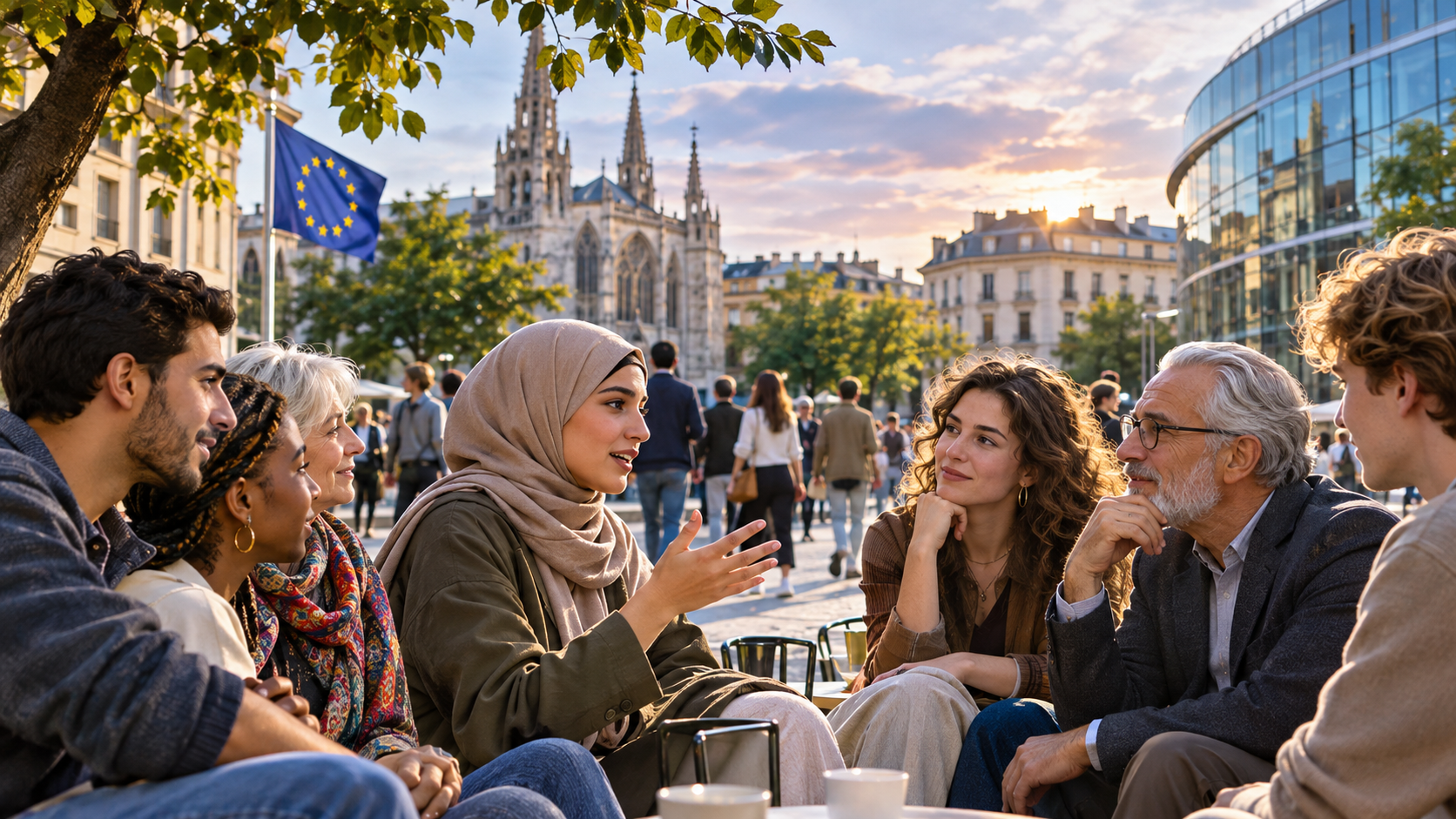
Europe 2100: Are we ready to redefine our relationship with Islam?
Europe has changed. Islam in Europe has changed too. The world is different. Yet we continue to rely on much of a legal, institutional and cultural framework built in another era. The time has come to open a serious debate about how we want to organise coexistence between religion, society and democracy over the next century.
1. A new world governed by rules from another era
Europe is changing. Its societies are no longer the same as they were thirty, forty or fifty years ago. Their populations, customs, beliefs, lifestyles and ways of understanding religion, freedom and coexistence have all changed.
Islam’s presence in Europe has also changed. We are no longer talking only about workers who arrived from other countries to find employment and who were expected to return to their countries of origin one day. We are talking about millions of people who were born, raised and educated in European societies; families who are part of their cities; and citizens who participate in their economies, institutions and social life.
We are also talking about new generations who live between different cultural reference points, people who interpret their religion in different ways, practising Muslims, non-practising Muslims and people who have left Islam.
European Islam is not a single reality. It encompasses different currents, interpretations, organisations and ways of understanding the relationship between religion and society.
Europe’s relationship with religion has also changed. A significant part of its population considers itself non-religious, while others maintain their beliefs and wish to express them publicly. Religious and cultural diversity is now part of everyday life in many European cities.
However, there is one question we have barely addressed in sufficient depth: Do we currently have an adequate model for organising this new reality?
Do the laws, agreements, institutions and rules governing relations between European societies and Muslim communities respond to today’s challenges?
Are we preparing a model of coexistence for future generations, or are we simply trying to solve today’s problems with tools designed for yesterday’s world?
This question deserves serious debate. And we should not be afraid to raise it.
2. Yesterday’s rules do not always work for tomorrow’s society
Much of Europe’s legal framework on religious freedom was developed in a historical context very different from today’s.
In Spain, for example, the Organic Law on Religious Freedom dates from 1980. The Cooperation Agreement between the State and the Islamic Commission of Spain was approved in 1992. The first established the general foundations for exercising religious freedom, while the second organised a significant part of the cooperation between the State and the Muslim communities represented within the Islamic Commission. [1][2]
These laws played an important role at the time. They responded to a Spain that had only recently begun its democratic transition and needed to establish a new model for relations between the State and religious denominations.
But decades have passed.
Spanish society has changed profoundly. The Muslim presence has acquired a different social and institutional dimension. Communication methods, religious organisations, international relations and the challenges of coexistence have also evolved.
The point is not to claim that a law is wrong simply because it is old. Fundamental rights do not lose their value over time.
The point is to recognise that a law may need to be reviewed when the reality it was designed to regulate has changed.
And this is not exclusively a Spanish issue. Other European countries have very different agreements, cooperation models and regulations, many of them shaped by specific historical circumstances.
Europe needs to ask whether these differences still respond to today’s needs and whether it is possible to establish clearer common principles.
We cannot continue treating every new problem as an isolated case. We need to review the framework as a whole.
3. Coexistence begins in everyday life
When we discuss the relationship between Islam and Europe, we tend to use broad concepts: integration, multiculturalism, religious freedom, secularism, democracy and cultural identity.
But problems and questions often arise in very specific everyday situations.
They arise in schools, hospitals, public administrations, streets and squares.
That is why reviewing the framework for coexistence should begin precisely with these situations.
4. The real debate: What kind of society do we want to build?
The issues mentioned above are important, but they represent only a small part of the wider challenge.
The fundamental debate is much broader.
Europe must decide what kind of society it wants to build over the next century.
Do we want societies in which religious identities play an increasingly important role in organising public life? Do we want a model in which religions remain exclusively within the private sphere? Or do we want a pluralistic public space where people can express their beliefs, while public institutions are governed by shared democratic principles?
These are different questions, and we cannot answer them without openly discussing what we mean by democracy, freedom, equality and coexistence.
Our position should start from one fundamental principle: European societies need a common framework based on individual rights, equality before the law, freedom of conscience and respect for democratic institutions.
No religion should stand above the law. No religious interpretation can justify violating another person’s fundamental rights.
Religious freedom protects both the right to practise a religion and the right to have no religion, change one’s beliefs, leave a religious community or criticise any religion.
This last point is particularly important.
A person must be free to leave Islam without facing pressure, threats or discrimination. A woman must be able to decide freely how to dress and how to live. Anyone must be able to question a religious doctrine without fear of retaliation.
Democratic coexistence cannot depend on everyone thinking alike. It must guarantee that we can think differently without losing our rights.
5. We cannot build the future by ignoring contradictions
One of the problems with the European debate is that certain contradictions are often avoided for fear of creating conflict.
We talk about diversity, but not always about the tensions that may arise between certain religious interpretations and individual rights.
We talk about religious freedom, but not always about the freedom of those who want to leave a religion or question its authorities.
We talk about integration, but do not always explain what responsibilities belong to institutions, religious organisations and individual citizens.
Islamophobia is also discussed. It is a real problem that must be addressed when it takes the form of discrimination or hostility towards Muslims. However, the distinction between hatred directed at people because of their religion and legitimate criticism of religious ideas, doctrines, organisations and political movements based on religion is not always made sufficiently clear.
This distinction is essential.
Criticising a religious interpretation does not mean discriminating against those who follow that religion. Likewise, defending religious freedom does not mean accepting every practice or demand made in the name of a belief.
Europe needs to recover an open debate in which difficult questions can be raised without the act of asking them automatically being treated as hostility.
Muslim organisations must also participate in this debate, recognising that their presence in a pluralistic democracy brings rights, but also responsibilities.
There can be no solid coexistence if any part of society considers its religious convictions to be beyond criticism.
6. Religious organisations must also adapt
The burden of transformation cannot fall solely on European governments.
Religious organisations must also reconsider their role and their relationship with the societies in which they operate.
European Muslim communities are diverse and have no single form of representation. However, in many places, institutional dialogue still depends on structures that do not necessarily reflect the full diversity of Muslim citizens.
Who actually represents Europe’s Muslims? What transparency mechanisms exist within religious organisations? How are their leaders selected? What influence do foreign religious authorities have? How are funding sources monitored?
These are legitimate questions that need answers.
Religious communities must be free to organise themselves, but their institutional structures must also operate transparently and comply with the laws of the country.
Foreign funding, for example, should not automatically be treated as suspicious. However, it should not be excluded from appropriate transparency mechanisms when financial, political or institutional relationships may influence an organisation’s activities.
Likewise, the training of religious leaders should respond to the needs of European societies. This includes knowledge of the languages, institutions, legal systems and fundamental rights of the countries in which they work.
The aim is to ensure that all organisations operating in Europe respect common democratic rules.
7. Education will be one of the great challenges of the next century
We cannot discuss the future relationship between Islam and Europe without discussing education.
New generations need to understand both European history and culture and the religious and cultural diversity of their societies.
They also need to learn to distinguish between religion, culture, tradition, politics and ideology.
Schools should provide knowledge, critical thinking, respect for fundamental rights and the ability to live alongside people with different beliefs.
However, no educational, religious or cultural project should be used to prevent young people from developing intellectual independence, understanding their rights or making their own decisions about their future.
Education should not produce citizens who are obedient to a religion, nor citizens who are forced to reject it.
It should develop free individuals who are able to think, choose and live together.
8. We need a new European framework for coexistence
At this point, the question is no longer whether certain rules need updating.
The question is whether we have enough ambition to build a new framework for coexistence.
Europe should promote a review process involving governments, parliaments, universities, civil society organisations, legal experts, religious representatives and citizens.
The objective is not to draft legislation exclusively for Islam.
On the contrary, the aim should be to establish a general framework governing relations between the State, religions and citizens, applicable to all religious denominations and to people with no religious beliefs.
This new framework should address at least eight major issues:
1. Religious freedom and freedom of conscience. Update legal safeguards to protect both those who practise a religion and those who leave, question or do not follow one.
2. Neutrality of public institutions. Clearly define the relationship between public authorities, religious denominations and the individual beliefs of citizens.
3. Use of public spaces. Establish transparent and common rules for religious demonstrations, celebrations, gatherings and the occupation of streets and squares.
4. Religious clothing and symbols. Clarify rights and limitations according to the context, distinguishing between private citizens, public-sector employees and representatives of public institutions.
5. Funding and transparency. Establish appropriate information, oversight and transparency mechanisms for religious organisations, including both domestic and foreign sources of funding.
6. Education and religious training. Ensure that religious education and the training of religious representatives are compatible with fundamental rights and the requirements of a democratic society.
7. Equality and individual protection. Strengthen safeguards against discrimination, religious coercion, violence, threats and any violation of the rights of women, minors and minorities.
8. Relations between institutions and religious organisations. Review models of cooperation, representation and institutional participation so that they reflect today’s religious and social diversity.
This process should also examine the respective powers of the European Union, the Council of Europe, national governments and local authorities. They do not all have the same legislative powers, but each has responsibilities within its own area of competence.
The aim should be to build a coherent framework, not to impose artificial uniformity on countries with different histories and institutional models.
9. What kind of Europe do we want in 2100?
One question should guide this entire discussion: what kind of Europe do we want to leave to future generations?
A Europe where each community lives enclosed within its own identity, with its own social rules and authorities?
A Europe where religion once again occupies a dominant position in public decision-making?
A Europe that responds to cultural challenges through blanket bans and indiscriminate restrictions?
Or a Europe where people can maintain their beliefs, change their minds, live alongside different cultures and share the same democratic rules?
We must not confuse European identity with a religion, an ethnic group or a family background.
Europe is the result of a complex history of different traditions, conflicts, political transformations and social achievements. Its contemporary identity is also connected to principles such as individual freedom, equality before the law, pluralism and democracy.
These principles do not belong exclusively to people who follow a particular religion or to those who have none.
A Muslim citizen can be fully part of European society. The question is not where someone comes from, what surname they have or which religion they practise.
The question is what rights and responsibilities we share.
But defending this model requires more than repeating broad statements about tolerance and diversity. It requires clear rules, fair enforcement and guarantees that nobody can place their personal convictions above the rights of others.
10. The aim is neither to adapt Europe to Islam nor to force Islam out of Europe
We must avoid two mistakes.
The first is thinking that Europe must change its fundamental principles every time a new religious or cultural demand arises.
The second is believing that the presence of Islam is inherently incompatible with European democratic societies.
Both positions lead to a dead end.
Coexistence does not require Europe to abandon its principles, nor does it require Muslims to give up their religious freedom.
It requires everyone to accept a common framework of rights, obligations and responsibilities.
Religious interpretations evolve, societies evolve, and institutions must also be able to evolve.
European Islam will have to find its own answers to the challenges of modernity, just as other religious traditions have had to face profound transformations.
And Europe will have to learn to manage a diversity that is already part of its reality, without losing its ability to defend democratic institutions and fundamental rights.
This also means recognising that societies are not static. The ideas, rules and institutions we consider appropriate today must be open to review through democratic procedures when circumstances require it.
11. The time to open the debate is now
The relationship between Islam and European societies cannot continue to be shaped exclusively by historical agreements, administrative decisions, isolated conflicts or negotiations between governments and religious representatives.
We need a much deeper reflection.
Laws, agreements, municipal regulations, cooperation mechanisms and forms of institutional representation must be reviewed. We must also reconsider our own cultural and political assumptions.
Some rules will need updating. Others should remain in place because they protect fundamental rights. Certain practices will need to be reconsidered, and some demands will have to be rejected when they conflict with the rights of others.
We cannot allow the future of this relationship to be decided solely in response to the crises, tensions or conflicts of the moment.
We must start thinking about future generations.
Europe needs a new social contract for coexistence, one that looks towards the 21st and 22nd centuries. A framework that protects religious freedom without allowing any religion to stand above the law; that recognises diversity without fragmenting society; and that allows differences to be expressed without abandoning shared principles.
The future is not about returning to the past or preserving the rules of the present indefinitely.
It is about having the ability to review what we have built and decide, freely and democratically, what kind of society we want to be.
The question should no longer be simply how Islam fits into Europe.
The question should be much broader:
What kind of Europe do we want to build, and what place should religion, individual freedoms, democratic institutions and coexistence have in it over the next hundred years?
This is a debate we can no longer postpone.