
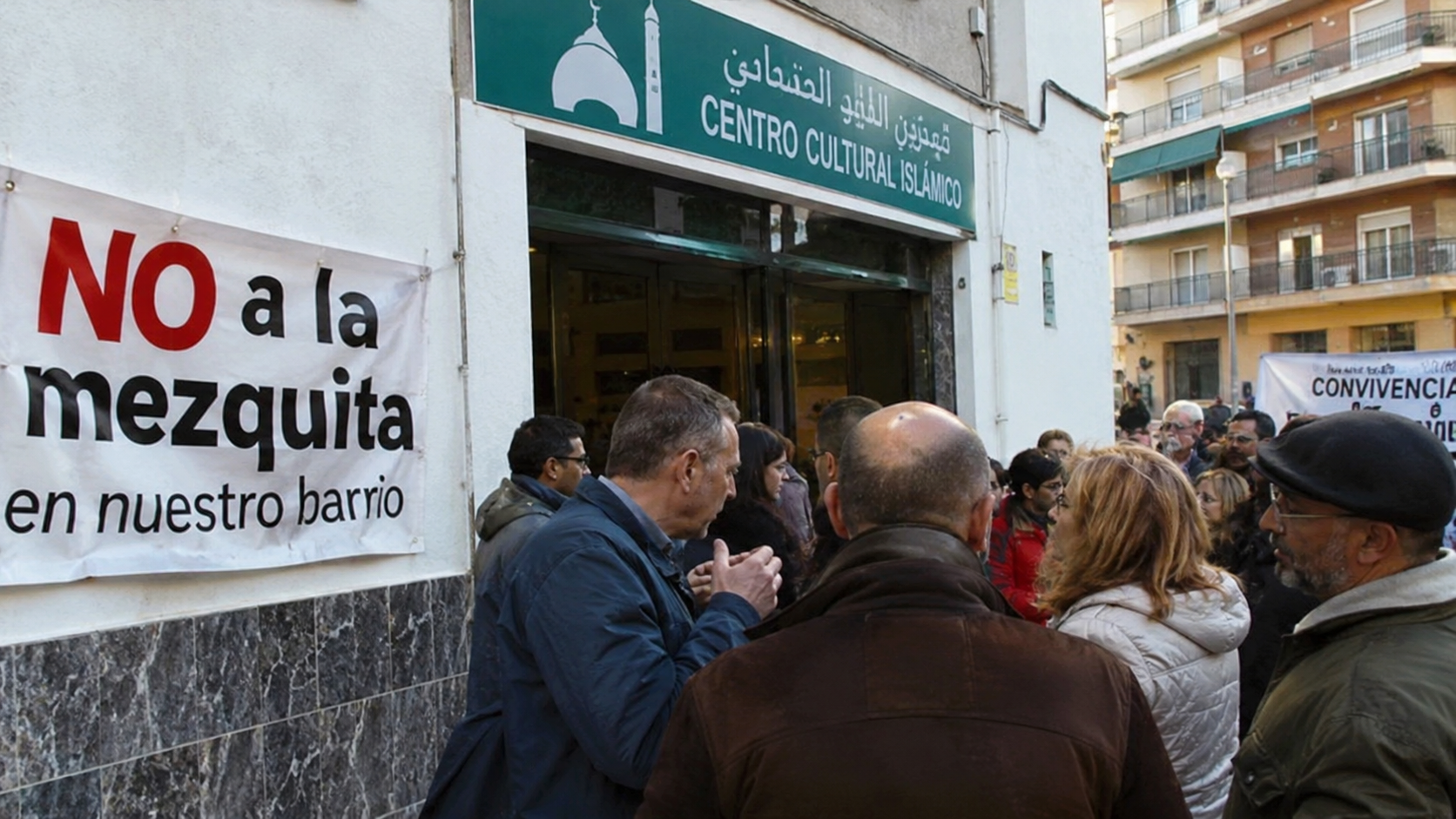
Investigation: Conflicts over the Opening of Mosques and Islamic Places of Worship in Spain (1990–2026)
Geographical scope: Spain, with particular attention to Catalonia,
the Valencian Community, Andalusia, Madrid, the Basque Country and
Murcia.
Period: 1990–2026.
Purpose: To reconstruct the conflicts that have arisen over the
opening, expansion, relocation, legalisation or construction of mosques
and Islamic prayer centres; identify the protagonists; analyse their
arguments; and document how these cases were resolved.
Three decades of opposition, negotiation, litigation and relocation
(1990–2026). An investigation into the controversies surrounding the
opening of Islamic places of worship, neighbourhood demands and the
response of public authorities.
How has Spain managed the establishment of Islamic places of worship
in its neighbourhoods, and to what extent have the solutions adopted
reconciled residents’ interests with urban-planning requirements?
This investigation is relevant because these conflicts do not all follow
the same pattern. In some municipalities, the problem has been the lack
of suitable premises; in others, neighbourhood opposition, urban
planning, permits, building safety or the involvement of political
parties. Sometimes several of these factors have overlapped.
An important clarification: There is no single national public
register recording all such conflicts. This is therefore a documented
historical record compiled from academic studies, newspaper archives,
municipal information and institutional sources.
1. Historical scale: how many conflicts have there been?
One of the key reference works for this investigation is the
anthropologist Jordi Moreras’s Una mesquita al barri (A Mosque in the
Neighbourhood), based on research conducted between 2007 and 2008 and an
earlier documentary review.
His compilation identifies 60 conflicts relating to the location of
mosques and prayer rooms in Spain between 1990 and 2008. The territorial
distribution presented is as follows:
Autonomous community Recorded conflicts (1990–2008)
Catalonia 40
Valencian Community 6
Andalusia 4
Murcia 2
Balearic Islands 2
Castile and León 2
Galicia 2
Basque Country 1
Extremadura 1
Other communities No cases recorded in that table
Total 60
Catalonia accounted for two-thirds of the conflicts recorded during this
period. The research links this concentration to the size of the Muslim
population, its urban distribution and the lack of purpose-built mosques
in Catalonia at the time under study.
The figures must be interpreted carefully: the 60 cases do not represent
60 mosques that were banned. They include situations of opposition,
controversy and conflict relating to these spaces.
Moreras also warns that counts based on press reports may omit conflicts
that never reached the media, or whose earlier and later stages were
poorly documented.
Initial conclusion: Catalonia appears as the main historical centre
of documented conflict, but subsequent cases show that the phenomenon
has also occurred in other regions and remains relevant in 2026.
2. Historical register of conflicts
A. Catalonia: the first conflicts and the most significant cases
1. Vic (Barcelona), 1990
Early documented precedents
- What happened: A Muslim community sought to open a prayer space
on Sant Pere Street. - Reasons for opposition: Around 100 residents submitted a
petition opposing the location. They argued that the street was
narrow and that a family lived on the floor above. They also
questioned whether that location would contribute to the integration
of the Moroccan community. - Municipal position: The mayor at the time described the
initiative as historic for the city. - Outcome: The historical source consulted documents the
opposition and the mayor’s response, but does not make it possible
to establish the project’s final outcome with sufficient certainty.
This is an important precedent because it shows that arguments about
space, coexistence and integration were already present in the earliest
documented episodes.
2. Lleida, Carrer del Nord, 2001–2011
Prolonged conflict and closure
One of the longest and most complex conflicts.
- What happened: The Muslim community rented former warehouses on
Carrer del Nord to use as a prayer space. - Reasons for neighbourhood opposition: Concentrations of
worshippers, noise during prayer times, use of public space and
problems relating to building work carried out on the premises. - Administrative problems: Compliance with safety requirements was
initially questioned. There were also legal disputes over works
affecting a neighbouring terrace. - Position of the Muslim community: It needed a larger and more
suitable space. The community considered that municipal restrictions
made it difficult to find a viable location. - Outcome: The premises were eventually closed because of safety
problems and overcrowding. The community was evicted in July 2011.
The conflict did not end there: the search for a larger-capacity space
continued for years.
3. Premià de Mar (Barcelona), 2002
Major neighbourhood mobilisation
One of the best-known cases in Spain.
- What happened: The At-Tauba Muslim community wanted to build a
mosque on land it owned on Joan Prim Street. - Background: The community had been using a basement premises
that had become too small and had been closed because of safety
problems. - Neighbourhood opposition: Approximately 5,500 signatures were
collected. Opponents argued that the project would harm the
neighbourhood, cause coexistence problems and potentially reduce
property values. - Political mobilisation: Josep Anglada, associated with
Plataforma per Catalunya, supported the protests.
Counter-demonstrations also took place. - Position of the Muslim community: It defended its right to have
its own suitable place of worship. - Outcome: An agreement was reached allowing the community to use
the former Voramar public school temporarily. In return, it gave up
plans to build the mosque on the land originally acquired.
The solution was temporary; it was not authorisation to build the mosque
originally proposed. Amnesty International was still noting in 2012 that
no permanent solution had been achieved.
4. Reus (Tarragona), 2003–2004
Opened following relocation
- What happened: The Muslim community intended to open a prayer
room in a former gym in the Carrilet area. - Neighbourhood opposition: Around 300 people demonstrated against
the opening. Arguments included the concentration of people, fears
about safety and claims that the presence of immigrants would
increase crime. - Municipal response: The City Council rejected any automatic link
between immigration and crime and sought an alternative solution. - Community position: Muslim representatives complained about the
treatment they had received and called for a suitable place of
worship. - Outcome: The initially proposed premises were abandoned, and the
City Council provided prefabricated units in an industrial area. The
new prayer centre opened on 12 June 2004.
This case is relevant because the conflict ended with the centre
opening, but only after it had been moved away from the originally
chosen site.
5. Santa Coloma de Gramenet, Singuerlín neighbourhood, 2004
Relocation to a peripheral area
- What happened: Strong opposition arose to a prayer room located
on Anselm de Rius Street. - Neighbourhood opposition: Around 150 residents took part in
protests. They questioned the size of the premises, ventilation,
emergency exits and the concentration of worshippers. - Community position: Muslims wanted to be able to use a nearby
and accessible place for prayer. - Municipal position: The City Council defended religious freedom
but sought a solution to ease tensions. - Outcome: The conflict was resolved by installing prefabricated
units in a peripheral area.
6. Barcelona, El Raval neighbourhood, Carrer d’Erasme de Janer, 2004
- What happened: A Pakistani-origin Muslim community intended to
open a place of worship of approximately 500 m². - Neighbourhood opposition: Some residents cited saturation in the
neighbourhood, the concentration of worshippers and the existence of
other prayer spaces. - Outcome: According to the academic documentation consulted, the
centre opened despite a petition opposing the project.
This episode is interesting because it shows that not every
neighbourhood mobilisation succeeds in preventing a centre from opening.
7. Badalona, La Pau neighbourhood, 2005
- What happened: The City Council closed a Muslim prayer room in
the neighbourhood. - Official reason: Deficiencies relating to the premises’ safety.
- Developments: Around 150 Muslims went to pray in a municipal
square to protest against the closure. - Proposed solution: The City Council proposed offering a former
factory in a nearby industrial area. - Opposition: Neighbourhood associations also mobilised against
the alternative location and collected thousands of signatures.
The documentation consulted points to a parallel political campaign, but
does not allow the final outcome of the alternative location to be
reconstructed with sufficient precision.
8. Ripoll (Girona), 2008
- What happened: Opposition arose to the opening of a prayer room
in the old town, in the Sant Antoni area. - Neighbourhood arguments: Narrow streets, concentrations of
worshippers on Fridays and possible effects on mobility. - Municipal position: The mayor argued that the application should
be processed in accordance with legal requirements and called for
dialogue between the parties. - Outcome: I have not found sufficient documentation to confirm
the final result.
9. Torroella de Montgrí (Girona), 2008–2013
Mosque eventually built
This is a particularly important case because it shows a controversy
that moved from the town centre to an industrial estate.
- Background: The Muslim community was using a small premises that
did not have enough capacity for its worshippers. - Initial opposition: Concerns were raised about the concentration
of people in the town centre and prayers taking place in the street. - Business opposition: In 2009, a campaign collected 1,872
signatures against installing the mosque on an industrial estate.
Business owners cited parking problems and argued that the estate
should be reserved for economic activities. - Political and urban-planning issues: In 2011, the City Council
revoked the building permit granted by the previous administration.
The mayor questioned both the procedure and the building’s
architecture, whose Arab aesthetic he considered unsuitable for the
surroundings. - Muslim position: The community argued that it needed its own
sufficiently large building with an architectural identity. - Outcome: The project was modified, ornamentation was reduced and
a new permit was obtained. The mosque was built between February
2012 and April 2013 and opened on 10 June 2013, with capacity for
approximately 430 people.
This is an example of an opening achieved after modifying the project
and accepting an industrial location.
10. Anglès (Girona), 2009
- What happened: A house on Carrer del Molí had been used as a
place of worship for years without the appropriate authorisation. - Neighbourhood arguments: Emergency vehicles had difficulty
accessing the site because the streets were narrow and steep. - Municipal response: Another site was proposed, and the dining
hall of a former textile factory was made available for Ramadan
prayers. - Outcome: The documentation consulted confirms this temporary
solution, but not a definitive decision on a permanent centre.
The same press report also recorded Girona City Council’s rejection of a
proposed place of worship in Taialà, following a neighbourhood campaign
that had collected around 1,500 signatures.
11. Salt (Girona), 2010–2011
- What happened: The City Council had amended its planning rules
to allow religious centres in certain areas of the Torre Mirona
industrial estate. - Political opposition: Plataforma per Catalunya opposed the
construction of a mosque and called a demonstration. - Municipal decision: On 24 August 2011, a one-year moratorium on
granting licences for places of worship in that area was approved. - Official justification: Municipal minutes referred to the need
to prepare a new proposal to promote economic activity in industrial
estates. - Outcome: The project was affected by the change in the municipal
position and the moratorium.
Amnesty International documented this episode in its report on religious
freedom and discrimination.
12. Arenys de Munt (Barcelona), 2011–2017
Permit revoked and closure
- What happened: A mosque opened in a ground-floor premises on
Avinguda de Sant Jordi, in the Pi Gros neighbourhood. - Neighbourhood opposition: Around 350 signatures questioned the
location, noise, ventilation, parking and the premises’ capacity. - Community position: The community defended the location because
the rent was affordable and moving to an industrial warehouse would
have cost more. - Court proceedings: In 2016, the High Court of Justice of
Catalonia annulled the permit because of non-compliance with parking
regulations applicable to a high-attendance establishment. The
judgment did not uphold all the grounds raised by residents. - Final outcome: In February 2017, the City Council ordered the
activity to cease.
It is important to analyse this case by distinguishing the technical
objections accepted by the court from those that did not succeed.
13. Mollet del Vallès (Barcelona), 2013–2022
- What happened: The Al Huda community intended to move its prayer
room to larger premises on Avinguda de Badalona. - Reasons for the conflict: The new site was in an area whose
planning designation did not permit the intended religious use. - Municipal response: The City Council sealed the premises because
works had been carried out without the relevant permits and
maintained that the use was incompatible with urban-planning
regulations. - Community position: The community challenged the municipal
decisions and called for sufficient space to practise its religion. - Subsequent developments: There were protests by worshippers and
public controversies. In 2022, the High Court of Justice of
Catalonia ordered that protests outside the mayor’s private home be
moved elsewhere. - Outcome: The sources consulted do not make it possible to
confirm a definitive solution for the project.
14. Barcelona, Nou Barris, 2017–2018
Opening and normalisation
One of the best-documented cases because of its social and political
dimension.
- What happened: In February 2017, residents mobilised against the
imminent opening of an Islamic place of worship, holding gatherings
and banging pots and pans. - Opponents’ arguments: Concerns about crowds, noise, safety,
changes to the neighbourhood and possible deterioration in
coexistence. - Involvement of far-right groups: Democracia Nacional entered the
dispute and amplified the campaign against the opening. - Social response: Anti-racist organisations and neighbourhood
associations mobilised in defence of religious freedom and
pluralism. - Incidents: The study documents graffiti, vandalism and 18
criminal complaints relating to hate-related conduct. - Institutional response: There was mediation, police monitoring
and follow-up by the Prosecutor’s Office for Hate Crimes. - Outcome: The prayer centre opened in February 2018. In the
summer of that year, the monitoring process considered the situation
to have returned to normal.
This case is particularly useful for studying how an initially
neighbourhood-level controversy can become a political and ideological
conflict.
15. Badalona, Artigues neighbourhood, 2018
- What happened: A new campaign was launched against the opening
of a Pakistani prayer room. - Background: The organisation’s first prayer room had opened in
2009, also amid political controversy. - Political involvement: Xavier García Albiol distributed a
leaflet stating that the neighbourhood did not need another prayer
room and that he would fight alongside residents to prevent it. - Municipal response: Mayor Dolors Sabater announced that she was
considering reporting the campaign as a possible hate crime. - Community position: Mohammed Iqbal, head of Caminos de la Paz,
accused the political leader of using the conflict for electoral
gain. - Outcome: The source consulted documents the campaign and
political controversy, but does not make it possible to state what
ultimately happened to the specific project.
B. Conflicts documented in other autonomous communities
16. Alicante, 2001–2005
- What happened: The City Council closed the prayer room on Carrer
de Jovellanos, citing the absence of an activity licence and safety
deficiencies, including the lack of an emergency exit. - Muslim position: The community said it had spent years trying to
find suitable premises and questioned whether it was being treated
differently from other faiths. - Court intervention: In 2005, closure was also ordered at the
request of residents in the building. - Community response: Around 300 worshippers went to pray on
Postiguet beach in protest. - Outcome: A temporary location was offered in the Pla de la
Vallonga industrial estate, far from the centre and with transport
difficulties.
17. Navas del Marqués (Ávila), 2004
- What happened: Residents began collecting signatures against a
prayer space that was already operating in the old town. - Neighbourhood arguments: They questioned the location and its
proximity to the Catholic church. - Municipal position: The City Council stated that no licence
application had been recorded. - Outcome: We have not found sufficient documentation to establish
the final result.
18. Seville, Los Bermejales, 2004–2010
Project blocked and location changed
- What happened: A mosque was proposed for municipal land in the
Los Bermejales neighbourhood. - Neighbourhood opposition: A residents’ platform argued that the
neighbourhood needed other public facilities and questioned the need
for a mosque at that location. - Other arguments: Some protests expressed fears relating to
safety and terrorism. - Municipal position: The City Council initially maintained the
land concession, although it considered reducing the planned
capacity. - Court proceedings: In 2010, the High Court of Justice of
Andalusia annulled the concession because of procedural defects.
Problems also arose with a second proposed location in La Cartuja. - Outcome: The community abandoned the allocation of public land
and opted to look for private land in the San Jerónimo area.
The case makes it possible to study both neighbourhood opposition and
the role of planning and procedures for allocating public land.
19. La Vall d’Uixó (Castellón), 2009
- What happened: A former car dealership of approximately 600 m²
was to be converted into a place of worship. - Neighbourhood opposition: A petition collected approximately
1,000 signatures. - Arguments: Concentrations of people, suitability of the location
and questions about the planned works. - Municipal response: The City Council halted the works,
considering that the permit requested did not cover all the
necessary work. - Outcome: We have not been able to verify the subsequent result
sufficiently.
20. Vitoria-Gasteiz, Zaramaga neighbourhood, 2010–2011
- What happened: A Muslim community applied for permission to
adapt premises as a place of worship. - Neighbourhood opposition: Residents questioned the location in a
residential-use building, the planned capacity, noise, access and
safety. - Muslim position: The community defended its right to use the
premises and undertook to comply with the regulations. - Municipal position: A works permit was initially granted, and an
alternative location was subsequently proposed to reduce tensions. - Developments: Residents in the area proposed for relocation also
opposed the alternative. The community returned to the original
location. - Outcome: The controversy was marked by the difficulty of finding
a site that did not trigger further protests.
Hostile acts against the premises were also documented during the
process, including graffiti and the throwing of animal-derived products.
21. Bilbao, Basurto neighbourhood, 2011
- What happened: Mobilisation against the establishment of a
mosque. - Opposition slogan: Protests were organised around the idea of
preventing the neighbourhood from changing as a result of the new
facility. - Administrative intervention: The City Council temporarily
suspended licences while urban-planning and administrative issues
were addressed. - Outcome: The information consulted does not make it possible to
confirm the final resolution with certainty.
22. Torrejón de Ardoz (Madrid), 2012–2014
- What happened: A Muslim community purchased two properties on
Calle Almendro to create a mosque. - Neighbourhood opposition: More than 2,000 signatures were
collected. Some residents argued that the street was narrow and that
crowds could create evacuation and mobility problems. - Political position: The conflict took on a political dimension.
- Municipal response: The City Council proposed an exchange of
sites and moving the project to an industrial estate. - Outcome: In 2014, an urban-planning measure aimed at relocating
the project to the industrial sector was approved.
The solution was relocation, not the construction of the mosque at the
originally selected site.
C. More recent cases: 2019–2026
23. Cartagena, Cuatro Santos neighbourhood, 2019
- What happened: A proposal was made to move a prayer centre from
the San Antón neighbourhood to a former gym in Cuatro Santos. - Neighbourhood opposition: Signatures were collected and concerns
were expressed about crowds, parking, safety and the concentration
of worshippers. - Muslim position: Representatives argued that the community
needed more suitable premises and offered to explain its activities
to residents. - Outcome: The sources consulted describe the project and the
mobilisation, but do not make it possible to confirm precisely
whether the relocation was completed.
24. Cartagena, Los Dolores and Plaza de San Francisco, 2019
There were other episodes in Cartagena that should not be conflated with
the Cuatro Santos case:
- Los Dolores: A campaign opposing a prayer space collected around
1,000 signatures. - Plaza de San Francisco: A mosque project prompted opposition
from business owners and hospitality operators, who expressed
concern about the location and raised fears about possible
radicalisation. - Municipal position: The City Council made progress on the
project conditional on verifying the technical requirements and
obtaining the necessary authorisations. - Outcome: Available reports indicate that the initiative was
halted or made conditional on those procedures; we have not been
able to verify that it subsequently opened.
25. Lorca (Murcia), Apolonia neighbourhood, 2020–2021
Failed relocation agreement
- What happened: The Muslim community intended to open a place of
worship on Calle Transformadores. - Neighbourhood opposition: A campaign collected approximately
1,500 signatures. Some residents expressed fears about crowds, noise
and the effects on the area. - Muslim position: Community members argued that the centre did
not necessarily have to cause problems and that they needed a place
to pray. - Municipal position: The City Council maintained that, if the
project met the requirements, it should be allowed to proceed, and
offered to seek an alternative to avoid confrontation. - Agreements: The Council undertook to look for another premises
and consider compensation for expenses incurred by the community. - Outcome: Alternative sites were offered, but the community
rejected one because it considered it too far away or unsuitable.
Protests resumed, and the conflict was not satisfactorily resolved
in the sources consulted.
26. Lleida, Cappont neighbourhood, 2024–2026
Prayer room opened in February 2026
This case is particularly important because information is available
about its recent outcome.
In January 2024:
- The Ibn Hazm community purchased premises at number 9, Avinguda
d’Alacant, with a planned capacity of 200 people. - Around 200 residents protested against its use as a prayer room.
- Around 70 people and representatives of 18 organisations held a
counter-demonstration in support of religious pluralism. - Opponents cited space constraints, flood risk, mobility and the
possible loss of value of nearby homes. - The community argued that its members lived in the neighbourhood and
needed an accessible indoor space. - The mayor defended the right to religious freedom and said that
compliance with regulations would be required.
Outcome in February 2026:
The new prayer centre was inaugurated on 6 February 2026, with capacity
for approximately 200 people. The first prayer, scheduled for 1 p.m.,
had to be moved to Camps Elisis because of the number of worshippers; a
later prayer was held inside the premises.
The community highlighted the positive reception from residents and its
commitment to respecting the rules. However, the new prayer centre does
not meet the need for a larger space for the large Friday prayers. The
community had withdrawn its project to build a much larger mosque in the
Camí dels Frares industrial estate.
This case is interesting because the initial conflict did not ultimately
prevent the centre from opening, and relations with the neighbourhood
appear to have evolved since the mobilisation in 2024.
27. L’Estartit (Girona), 2026
Conflict still open according to the latest information available
- What is happening: The Muslim community intends to move its
current mosque, on Avinguda de Roma, to a former restaurant on Plaça
del Timó. - Distance: The proposed new site is just over 100 metres from the
current one. - Neighbourhood and business opposition: A group of residents and
business owners question whether a place of worship should be
located in a residential and commercial area containing nightlife
and restaurant premises. - Arguments: Possible tensions in the area, mobility, parking,
planning compatibility and effects on businesses. - Municipal position: The City Council had issued a certificate of
urban-planning compatibility, and the mayor stated that the
licensing decision should be based on technical and legal reports. - Outcome: As of 5 August 2026, residents had submitted a request
to the City Council seeking clarification. I have not found a later
decision that would make it possible to state whether the centre has
opened.
This case connects directly with the debate about the so-called
“industrial-estate Islam”: residents are asking the community to use the
existing mosque in the Torroella industrial estate, while the promoters
argue that a place of worship is needed in L’Estartit.
3. What arguments have residents opposed to the centres used?
It is important not to present all residents as if they had the same
motivations. The cases studied reveal several different categories of
argument.
Argument What residents claim How it should be
investigated
Crowding Concentrations of Authorised capacity,
worshippers, especially actual attendance and
on Fridays and during opening hours
Ramadan
Noise Disturbance caused by Acoustic measurements
arrivals, departures and schedules
and religious activity
Mobility Difficulties with Mobility studies and
traffic, parking and municipal data
accessibility
Safety Emergency exits, Technical reports and
evacuation, fire safety licensing files
and the structure of
the premises
Property values Possible depreciation Actual property
of nearby homes transaction data, not
perceptions alone
Neighbourhood change Fears about changes in Interviews and analysis
commerce, social of neighbourhood change
composition or the
urban environment
Cultural identity Rejection of the Discourse, statements
visible presence of a and surveys
different religious
community
Ideological security Fears about Concrete evidence,
radicalisation or without generalising
terrorism about the religion
Arguments about capacity, evacuation, noise or traffic may raise
legitimate issues of planning and coexistence.
On the other hand, some protests have included claims that associate
Muslims in general with crime, radicalism or cultural threats.
Moreras’s study already noted that lack of knowledge, prejudice and
distrust towards Islam could fuel conflict, particularly after the 9/11
and 11 March attacks.
4. What arguments have Muslim communities used?
Their positions must also be included.
Five recurring arguments appear in the cases analysed:
- Need for proximity. Prayer takes place daily, and worshippers
need spaces close to their homes. Premises several kilometres away,
in an industrial estate, make attendance more difficult. - Lack of suitable premises. Many communities have used commercial
ground floors, warehouses, basements or old buildings that have
become too small. - Overcrowding. In some cases, the communities themselves
acknowledge that the available premises cannot accommodate all
worshippers, particularly on Fridays. - Unequal treatment. Some organisations claim that administrative
requirements or municipal resistance are greater when Islamic spaces
are involved. - The right to religious freedom. Communities argue that they
should be able to practise their religion under conditions
equivalent to those enjoyed by other faiths.
The experience of Lleida, Alicante, Premià and Reus shows that
relocation to industrial estates or peripheral areas can resolve part of
a neighbourhood conflict, while at the same time making everyday
religious life more difficult.
5. The role of local councils: a fundamental dimension
Local councils have played a decisive role in most of the documented
conflicts.
The sources identify four main strategies:
Municipal strategy Examples Usual outcome
Support opening, Santa Coloma, Nou Opening or search for a
subject to compliance Barris, Lleida regulated solution
with regulations
Negotiate an Premià, Reus, Santa Relocation to another
alternative site Coloma, Torrejón building or to the
outskirts
Close or block on Alicante, Lleida, Closure, litigation or
technical or Mollet, Arenys suspension
urban-planning grounds
Reorganise planning and Torroella, Salt, Lleida Industrial-estate
create areas for projects, with varying
facilities outcomes
One question is particularly relevant: to what extent are industrial
estates used as a solution to avoid neighbourhood opposition?
Moreras’s research documents several local councils promoting these
relocations as a pragmatic way out. However, it also warns that they are
not necessarily satisfactory solutions for religious communities, since
they change travel patterns and distance places of worship from the
neighbourhoods where Muslim residents live.
6. The involvement of political parties and organisations
Not all conflicts arose solely from residents’ initiatives. Several
cases document the involvement of political parties, associations or
political movements.
Notable cases in the study include:
- Premià de Mar: Participation by leaders of Plataforma per
Catalunya in opposition to the project. - Salt: Mobilisation by Plataforma per Catalunya against
installing a mosque on the industrial estate. - Torrejón de Ardoz: Use of xenophobic messages in the context of
the dispute over the location. - Nou Barris: Involvement of Democracia Nacional, followed by
mobilisation by anti-racist organisations. - Badalona: Campaign by Xavier García Albiol against the opening
of another prayer room in Artigues.
It is important to distinguish three different situations:
- Residents raising specific urban-planning or technical problems.
- Residents rejecting the establishment of a centre for cultural or
religious reasons. - Organisations or political actors using the conflict to pursue a
broader campaign against immigration or Muslims.
These categories should not automatically be conflated. However, neither
should the documented political instrumentalisation in several conflicts
be ignored.
7. What does Spanish law say?
The legal framework is essential to analysing these conflicts correctly.
Three laws are key points of reference:
Organic Law 7/1980 on Religious Freedom
It recognises the fundamental right to religious freedom and worship,
including the possibility of practising religious rites and carrying out
worship-related activities.
Law 26/1992 of 10 November
This approves the Cooperation Agreement between the State and the
Islamic Commission of Spain. It is a fundamental legal reference for
cooperation between the State and Muslim communities that are members of
the Commission and registered in the Register of Religious Entities.
Catalan Law 16/2009 of 22 July on Places of Worship
This regulates places of worship in Catalonia. It is particularly
relevant because of the concentration of historical conflicts in this
autonomous community. Its consolidated text includes the update
published in January 2014.
8. Preliminary conclusions of the investigation
The documented cases point to six trends.
First: Catalonia accounts for a large proportion of historically
documented conflicts. The academic count for 1990–2008 attributes 40 of
the 60 identified conflicts to Catalonia. This is a significant
concentration, although it should not be interpreted as a measurement of
the current situation.
Second: Conflict often emerges when a community needs larger
premises or seeks to move its prayer room to a more visible location. In
some cases, a small space had gone relatively unnoticed, but the search
for larger premises made the community’s presence more visible.
Third: Relocation to industrial estates is a recurring solution. It
can provide larger spaces and parking, but it can also make everyday
access more difficult and distance worship from the neighbourhoods where
the Muslim population lives.
Fourth: Not all conflicts end in the same way. There are cases of
opening, such as Nou Barris, Reus and Torroella; closure or revocation,
such as Arenys de Munt; temporary solutions, such as Premià; and other
cases for which no clearly documented outcome is available.
Fifth: Urban-planning controversies can become entangled with
religious prejudice and political campaigns. Each case must be examined
separately, identifying the statements and actions of the protagonists
and avoiding the automatic attribution of the same motives to all
residents.
Sixth: Opening a centre does not necessarily mean that the conflict
has ended. The 2026 Lleida case shows that a 200-capacity prayer room
can open while the need for a much larger space for large Friday prayers
remains unresolved.
Sources
- Jordi Moreras — Una mesquita al barri
- Amnesty International
- Observatory of Religious Pluralism in Spain
- CIDOB
- La Vanguardia
- El País
- Official State Gazette (BOE)
- Ararteko
- Office of the Prosecutor General of the State