
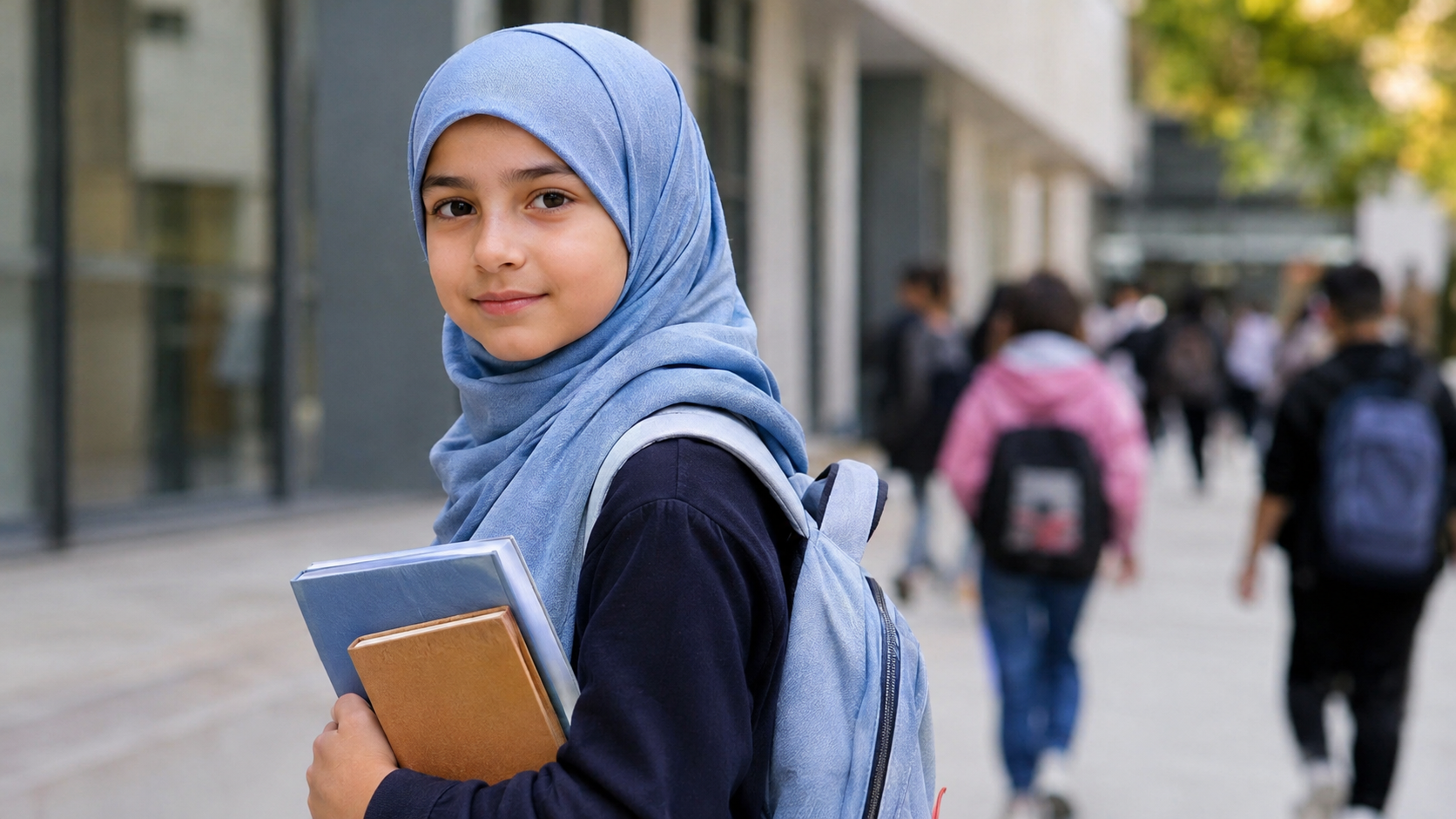
Religious freedom, girls’ autonomy, family education, social pressure and conflicts within the Spanish education system
Documentary research | Spain, 2002–2026
1. Introduction: an issue that goes beyond clothing
The wearing of the hijab by Muslim girls and adolescents brings together several debates: religious freedom, children’s rights, family education, equality between women and men, social integration and personal autonomy.
In Spain, the debate has developed mainly around schools. Since the early 2000s, there have been successive controversies involving female students who were prevented from attending class wearing the Islamic headscarf. At the same time, there have also been experiences of coexistence without conflict, as well as situations in which families themselves preferred their daughters to wait until they were older before wearing it.
However, there is a less-studied dimension: the age at which girls begin wearing the hijab, the reasons behind that decision, and the degree of freedom they have to put it on, not wear it or take it off.
This is not a minor issue. A girl may wear it because she wants to, because she identifies with a family tradition, because she has received a particular religious education, because she wants to look older, or because she feels she must wear it in order to be accepted. These circumstances are not equivalent and cannot be analysed as though they were one and the same reality.
Nor should we start from the opposite assumption: that every girl who says she wants to wear it has necessarily made a decision that is completely independent of her environment. Children’s autonomy develops progressively, and family, cultural, social and religious influences are part of that process.
This research examines both possibilities without prejudging the conclusions.
The fundamental question is not only why a girl wears the hijab, but whether she has genuine freedom to decide about it.
2. What is the hijab, and which garments should be distinguished?
Before examining the cases in Spain, the terminology needs to be clarified. In public debate, expressions such as “Islamic veil”, “headscarf”, “hijab” and “full-face veil” are often used imprecisely.
| Garment | Characteristics |
|---|---|
| Hijab | A headscarf that covers the hair and usually the neck. The face remains visible. |
| Niqab | Covers the hair and face, usually leaving the eyes visible. |
| Burqa | Covers the body and face, including the eyes, which are covered by a mesh or fabric panel. |
| Chador | A loose garment covering the body and head, generally leaving the face visible. |
This distinction matters because school conflicts involving the hijab are not legally or socially identical to those that may arise from the use of garments that cover the face.
The Government of Catalonia’s guide on religious diversity expressly distinguishes the hijab from the niqab and burqa. It considers that garments which leave the face visible do not have the same implications for communication and educational activity as garments that conceal it.
The main subject of this research is the hijab worn by children and adolescents, although some cases involving the niqab will be mentioned separately because they appear in the historical record and help explain the debate.
3. At what age can girls start wearing the hijab?
This is one of the most important questions in the research. It should be addressed from three different perspectives: Spanish law, religious interpretations and family practices.
3.1. From the perspective of Spanish law
There is no legal minimum age in Spain for a girl to wear the hijab.
Spanish law recognises minors’ rights to freedom of conscience, ideology and religion. Those rights must be exercised taking into account the child’s age, maturity and personal development, as well as the role of parents or guardians.
Consequently, there is no general prohibition on a minor wearing it at school.
3.2. From a religious perspective
In the majority of traditional interpretations of Islamic jurisprudence, the religious obligation to cover the hair is associated with the onset of puberty (bulugh) and religious accountability (taklif).
Puberty is not necessarily identified with a single chronological age. Different Islamic legal schools have used different physical indicators and criteria to determine when this stage has been reached.
For example, Egypt’s Dar al-Ifta, an official religious interpretation institution, published a response on 16 November 2025 stating that covering the hair is obligatory for women who have reached religious accountability, linking this stage for girls to their first menstruation. This is a specific institutional religious interpretation; it is not Spanish civil law and is not a binding instruction for all Muslim families living in Spain.
Two questions must therefore be distinguished:
- The age from which certain religious interpretations consider the hijab obligatory.
- The age at which a family decides to introduce it as a custom, part of religious education or an expression of identity.
The two do not necessarily coincide.
Some families may consider it appropriate for their daughters to become accustomed to wearing it before puberty. Others wait until they are teenagers. Some do not consider it obligatory, or leave the decision to the individual girl.
We have not located any general public guidance from the Islamic Commission of Spain establishing a common minimum age at which girls should start wearing the hijab.
3.3. At what ages do girls start wearing it in practice?
Documented cases in Spain show considerable variation in age.
In 2002, an El País news report described the situation of two Muslim sisters, aged 6 and 11, who attended a state-subsidised private school in Madrid. The older girl had already been wearing the headscarf for two years. The school’s headteacher explained that the family had said she should start wearing it when she turned nine. At the time, according to the headteacher, the situation was proceeding normally.
In 2007, the case of Shaima in Girona showed that much younger girls could also express a desire to wear it. The press reported different ages: 7 in a report dated 2 October, 8 in an article the following day, and 9 in the historical table in the GRAIS study. The exact age is therefore inconsistent across the documentary record.
The Institute for Women’s study also includes the testimony of Fadwa, who began wearing the hijab at age 12 or 13 on her own initiative, even though her family considered her too young.
These examples confirm that there is no uniform age in practice. They do not, however, make it possible to determine what percentage of girls start before or after puberty.
Conclusion on age: there is no legal minimum age; traditional religious interpretations generally link the obligation to puberty; and family practices include cases in which girls start before, around or after that stage.
4. Muslim communities in Spain: the organisations involved and their known positions
There is no single religious authority that determines how all Muslim girls in Spain should dress.
Spain’s Muslim community consists of different organisations, associations, federations and religious currents. Practices may vary depending on religious interpretations, family background, cultural traditions and personal decisions.
Researching this issue requires distinguishing between representative organisations, religious entities and individual opinions.
4.1. Islamic Commission of Spain (CIE)
The Islamic Commission of Spain is the main institutional interlocutor under the Cooperation Agreement signed with the State in 1992.
It plays an important role in Islamic religious education in state and state-subsidised schools. Its own information explains that parents can request Islamic religious education for their children and that the Commission provides advice and oversight for that teaching.
The CIE has also been involved in issues relating to the hijab. In an educational dispute recorded in Asturias in 2019, the administration consulted the Commission to determine whether wearing the headscarf was religiously prescribed. The regional Department of Education ultimately considered that the case fell within an exception provided for by the applicable rules. The student was an adult, so this episode should not be used to draw conclusions about girls.
One noteworthy point is that the official curriculum for Islamic religious education published in Spain’s Official State Gazette in September 2022 covers the period from Early Childhood Education through Baccalaureate. However, in the text consulted we did not find a specific rule setting an age for starting to wear the hijab or an instruction requiring girls to wear it.
4.2. Union of Islamic Communities of Spain (UCIDE)
UCIDE is a federation of Islamic communities that publishes reports on the situation of Muslims in Spain.
Its 2007 annual report included the case of Shaima, the girl from Girona. The organisation reported that the child had said she wanted to wear the headscarf and relayed the explanation that her parents were not forcing her. Its position was that the case should be resolved by respecting the girl’s freedom and right to attend school.
This position is relevant because it shows that a nationwide Muslim organisation presented a girl’s use of the hijab as a personal decision rather than an obligation imposed by her parents.
Nevertheless, one organisation’s report does not demonstrate that all Muslim families act in the same way.
4.3. Islamic Federation of the Basque Country and other organisations
In 2016, during a dispute involving a 17-year-old vocational training student who wore the niqab in Andoain, the Islamic Federation of the Basque Country expressed opposition to the student’s use of that garment.
It is important to note that this case concerned the niqab, not the hijab, and should therefore not be used as evidence of the federation’s position on a headscarf that leaves the face visible.
4.4. Is there a common position among Islamic organisations on children wearing the hijab?
Based on the public documentation located, it cannot be said that all Spanish Islamic organisations share a single position on the age at which girls should start wearing the hijab.
Nor have we found a register showing which mosques or associations recommend that families have their daughters start wearing it before puberty, which leave the decision to teenagers, or which discourage its use at an early age.
5. History of documented conflicts in Spain
5.1. Early episodes: 2002–2007
The first conflicts widely reported by the Spanish press appeared in 2002. Since then, cases have arisen in different autonomous communities.
The study by the Group for the Analysis of Islam in Europe (GRAIS) at the Complutense University of Madrid is the most comprehensive nationwide compilation located. Its press analysis identifies 21 conflicts between February 2002 and November 2023. It reconstructs 19 of them in detail because there was insufficient information about the other two.
The same study also identifies reports about schools where students wearing the hijab were accepted without problems. The record therefore does not describe prohibitions alone, nor does it represent the general experience of all Muslim female students.
Case 1. San Lorenzo de El Escorial (Madrid), 2002: Fátima
A 13-year-old Moroccan student enrolled in a Catholic state-subsidised private school was prevented from attending class wearing the hijab.
The family rejected the requirement that the girl remove her headscarf. An attempt was made to transfer her to a state school, but difficulties initially arose there too.
Finally, following the intervention of the Madrid regional Department of Education, the girl was accepted at a second state school without having to give up the headscarf.
The episode opened a debate about the relationship between schools’ internal rules, religious freedom and the right to education.
Case 2. San Lorenzo de El Escorial (Madrid), 2002: two sisters
The GRAIS study records another episode involving two sisters who had been in Spain for approximately a year without attending school because they refused to remove their hijabs and wear the uniform of the state-subsidised private school to which they had been assigned.
The younger sister remained at the state-subsidised school. The older sister was transferred to a state school, which she attended irregularly. Her situation came before the school absenteeism commission.
This case is particularly relevant because the conflict was not limited to a disagreement about clothing: it ultimately affected the girls’ continuity of education.
Case 3. Girona, 2007: Shaima
This is one of the best-known and most relevant episodes in the study of the hijab worn by children.
Shaima, a Muslim girl whose age is disputed in the sources—between 7 and 9—stopped attending class after the headteacher of Joan Puigbert-Annexa state school asked her not to wear the headscarf.
The family said that they were not forcing the girl and that she was the one who wanted to wear it. In press reports, the child explained that she had learned the custom from her maternal grandmother, with whom she had lived in Rabat.
The Catalan government intervened and instructed the school to allow her to attend wearing the hijab. The girl returned to class.
The case prompted intense debate about a minor’s autonomy, family influence and schools’ authority to establish dress codes.
Case 4. Ceuta, 2007: two students aged 12 and 13
At a state-subsidised private school where most pupils were Muslim, two students aged 12 and 13 were told that they could not wear the veil under the school’s internal rules.
The Ministry of Education intervened and reminded the school of its obligation to respect the right to education established in Article 27 of the Constitution.
The two students returned to school. The school appealed the Ministry’s decision, although the GRAIS study notes that it was not possible to locate sufficient information about the outcome of that appeal.
5.2. Conflicts between 2009 and 2011
Case 5. Lugo, 2009: a 13-year-old student
A 13-year-old student who had recently arrived from Morocco encountered difficulties enrolling in school while wearing a headscarf.
The provincial education authority instructed the school’s headteacher to readmit her and allow her to attend wearing the hijab.
The case again raised tensions between schools’ internal rules and a minor’s right to education.
Case 6. Pozuelo de Alarcón (Madrid), 2010: Najwa Malha
One of the most widely publicised conflicts.
Najwa, aged 16, went to her secondary school wearing the hijab. The school’s rules prohibited head coverings, and the management prevented her from attending class with the headscarf.
For a period, she remained in a visitors’ room while teachers provided her with class notes.
The Madrid Department of Education supported the school, and a transfer to another school took place. The family challenged the sanction and the case went to court.
The study reports that the first-instance court did not uphold the student’s claim and that the appeal was not admitted in 2013. The episode became one of the main legal reference points in Spain’s debate about the hijab and schools.
Case 7. Pozuelo de Alarcón (Madrid), 2010: another student
A second case occurred at a state-subsidised private school in Pozuelo.
A 15-year-old student enrolled in the third year of compulsory secondary education (ESO) was not allowed to wear the hijab inside the school. The student agreed to remove it during lessons and put it back on when leaving the building.
This outcome shows a different form of accommodation from Najwa’s case: there was no permanent transfer, but the student had to change her clothing inside the school.
Case 8. Burgos, 2011: a student aged between 12 and 14
During the 2011–2012 school year, a student tried to attend class wearing a headscarf. The secondary school’s rules prohibited covering one’s head inside the building.
The management moved her to the library, where she received class notes instead of participating in lessons as usual.
The family filed a complaint with the Public Prosecutor’s Office for Minors. The school ultimately imposed a sanction that involved a change of school. Administrative and judicial appeals were dismissed, and the High Court of Justice of Castile and León upheld the decision in 2014.
The student’s exact age varies across the reports consulted, which place it between 12 and 14.
Case 9. Arteixo (A Coruña), 2011: an 11- or 12-year-old girl
A primary-school student attended a school wearing the hijab. The school’s rules prohibited hats, caps, headscarves and other items covering the head.
The girl said she wanted to wear it and that her father was not forcing her. According to reports at the time, her father even tried to persuade her to remove it when attending school, but she refused.
The family reported the situation and the case attracted considerable media attention. The sanction imposed by the school was annulled because of a procedural defect. This is not equivalent to a judgment establishing that all schools must allow the hijab in every circumstance.
The episode was one of the first to reach the criminal courts and prompted changes to the internal rules of some schools in Galicia.
Case 10. Usera (Madrid), 2011: exclusion from an examination
At IES Enrique Tierno Galván, a student was excluded from an examination for wearing the hijab, following an interpretation of the school’s internal rules.
The family appealed and the school reinterpreted its rules, apologised and prevented the dispute from continuing.
The documentation consulted does not provide the student’s exact age.
Case 11. Melilla, 2011: a student wearing the niqab
A 15-year-old student left her secondary school because she was not allowed to attend wearing a full-face veil and gloves.
The Public Prosecutor’s Office for Minors opened proceedings relating to the girl’s lack of schooling and her parents’ responsibility.
This case must be treated separately: the garment was a niqab, not a hijab. It is incorrect to use it as evidence that Spanish schools prohibited the headscarf that leaves the face visible.
5.3. Conflicts between 2016 and 2019
Case 12. Valencia, 2016: an adult student
An adult vocational training student encountered difficulties continuing her studies while wearing the hijab.
The regional Department of Education reversed the school’s decision. The documentation states that three similar episodes had already occurred at the same school, with different outcomes: leaving the school, transferring to another school and giving up the headscarf.
This did not involve a minor, but the case illustrates the lack of consistent criteria among schools.
Case 13. Vitoria-Gasteiz, 2016: a fourth-grade primary-school student
A girl in the fourth year of primary school was unable to attend class wearing the hijab because of the school’s internal rules.
The education inspectorate intervened and a temporary arrangement was established: the student could not wear the headscarf in the classroom, but could wear it in the headteacher’s office. Teachers went there to teach her.
The Ararteko, the Basque Country’s ombudsman, recorded a complaint from the family in its 2016 annual report. The case contributed to the preparation of a report on the positive management of religious diversity in the Basque Country.
Case 14. Andoain (Gipuzkoa), 2016: a vocational student wearing the niqab
The study records the case of a 17-year-old student who wore the niqab.
The outcome could not be fully clarified, nor could it be established whether the news reports referred to one or two young women in different towns.
The Islamic Federation of the Basque Country expressed opposition to the use of that garment.
Case 15. Jumilla (Murcia), 2018: a student and her family’s complaint
Cruz de Piedra School repeatedly prevented a student from entering class because she wore the hijab.
Her mother, Samira, said that other female students had been allowed to attend the same school wearing the headscarf in previous years. The family alleged that the discrimination came from the school management, not from other students.
Several social organisations denounced the case. The girl eventually enrolled at another school, where she was able to attend wearing the hijab without difficulty.
Case 16. Asturias, 2019: an adult student
An adult woman taking a semi-distance-learning course encountered difficulties because she wore the hijab.
The education administration consulted the Islamic Commission of Spain about whether the garment was a religious requirement. The regional Department of Education ultimately considered that the case fell within the exception provided for by the regulations and recalled the right to freedom of conscience.
This was not a case involving a child, but it shows that an administration has sought a religious interpretation to resolve a dispute about clothing.
5.4. Conflicts between 2021 and 2026
Case 17. Guadalajara, 2021–2023: a 12-year-old student
At the beginning of the 2021–2022 school year, a 12-year-old girl wanted to start compulsory secondary education at a state school in Guadalajara while wearing the hijab.
The school’s conduct rules prohibited attending with one’s head covered. The student received sanctions and was removed from her classes.
The family appealed against the Department of Education. In March 2023, the administrative court dismissed the claim. The family did not seek an appeal and the judgment became final.
This is one of the most important cases because it shows that Spanish courts have not ruled in favour of students in every conflict.
Case 18. Málaga, 2022: two sisters at a state-subsidised private school
Two sisters who wore the hijab were separated from their classes and taken to another room at a religious state-subsidised private school.
The Moroccan Association for the Integration of Immigrants reported the situation to various regional education authorities.
The authorities found no irregularity in the school’s conduct and suggested that the family transfer the girls. The family accepted, and both moved to state schools.
The outcome was therefore a change of school rather than a solution within the original school.
Case 19. Vigo, 2023: a conflict in upper secondary education
A student who had already experienced difficulties in secondary school because she wore the hijab encountered further obstacles when she arrived at another school to study for the Baccalaureate.
The student made a legal case for her right to wear it, and the school ultimately accepted her wearing the headscarf.
Additional case. Logroño, 2025–2026: a judgment in favour of a student
In January 2026, Administrative Court No. 2 in Logroño issued Judgment 9/2026 concerning a student in the first year of the International Baccalaureate.
On 15 September 2025, the school had ordered her to leave because she attended wearing the hijab. Its internal rules prohibited hats, caps, visors, hoods, berets and similar garments.
The court considered that the decision had violated the student’s fundamental right to religious freedom and declared the order to leave the school null and void. It also awarded €2,000 in compensation for non-material damage.
The judgment could be appealed within fifteen days. We have not found sufficient information to confirm whether an appeal was subsequently filed or what its outcome may have been. This is a first-instance court judgment, not a Supreme Court ruling or definitive general doctrine for all schools.
6. What do teachers and educators say?
We have not located a representative nationwide survey that would make it possible to say whether Spanish teachers are predominantly in favour of or opposed to children wearing the hijab.
There are, however, institutional documents, educational-diversity reports, statements by trade unions and parents’ associations, and students’ testimonies that make it possible to identify different positions.
6.1. The position of the CCOO Education Federation
In November 2007, the Women’s Secretariat of the Education Federation of the Workers’ Commissions (CCOO) published a document on the hijab.
It considered the issue complex because it involved at least two dimensions: the individual’s right to decide what to wear and what to believe, and educational institutions’ right to establish operating rules.
It also noted that the debate took place between a majority culture and a minority culture, and that there were different interpretations of the meaning of the headscarf.
The union’s position was not a straightforward defence of prohibition, nor a claim that all school rules should disappear. Its document acknowledged the complexity of the issue and the existence of rights that had to be balanced.
6.2. CEAPA’s position in 2007
The Spanish Confederation of Parents’ Associations (CEAPA), through its vice-president Pedro Rascón, expressed doubts about the argument that a girl should be allowed to wear the headscarf simply because she said that she wanted to do so.
The statement was made in connection with the case of Shaima in Girona.
It is a specific historical position, dated October 2007. It should not be presented as the current position of all parents’ associations or as research into Muslim families.
6.3. Teachers and everyday coexistence
A report on child and youth diversity in the Basque Autonomous Community notes that the use of the hijab gives rise to debate among teachers and families. It states that many schools choose to allow it out of respect for other religions and cultures, although misgivings and distrust also arise.
The study warns of assimilationist attitudes when some schools recommend that students remove the headscarf so that they look like their classmates. At the same time, it notes that in many schools the issue does not lead to significant conflict.
6.4. The testimonies collected
The Institute for Women’s report includes accounts from young women describing teachers’ comments about their headscarves, questions about whether their parents forced them to wear them, and comments suggesting that they would look prettier without them.
It also includes accounts of teachers who challenged students for wearing the hijab and others who supported them.
These testimonies are relevant to the study of specific experiences of discrimination, but they do not constitute a representative survey of Spanish teachers.
Conclusion on teachers: positions vary, from defending the right to wear the hijab to expressing concern about minors’ autonomy and schools’ ability to establish rules. There is no documentary basis for attributing a uniform opinion to Spanish teachers.
7. What do families and parents themselves think?
This section deserves particular attention because much of the public debate has been conducted by talking about Muslim families without sufficiently listening to the girls or their parents.
The documented cases show different situations.
7.1. Families who introduce the hijab at a particular age
In the case reported in Madrid in 2002, a school headteacher explained that the family had said the girl should start wearing the headscarf when she turned nine.
The account shows that some families follow age-based practices and religious traditions. However, one individual case cannot establish that this is a general practice in all Muslim communities.
7.2. Parents who say they do not force their daughters
In Shaima’s case in Girona, the family said that the girl wanted to wear the hijab and that her parents were not imposing it.
The girl explained that she had learned the custom from her grandmother. Her experience shows the importance of intergenerational and family transmission, although it does not reveal how this transmission takes place in other families.
7.3. Parents who believe their daughters are too young
Fadwa’s testimony provides an important counterpoint.
Fadwa began wearing the hijab at the age of 12 or 13 on her own initiative. Her family considered her too young and did not agree with her decision.
This case shows that it cannot be assumed that families always pressure girls to cover their hair. In some cases, the pressure or desire to wear it may come from the adolescent herself.
7.4. Families who advise waiting
The report also includes the testimony of Zineb, who decided to wear the hijab after researching the issue and reflecting on it during the lockdown.
Her family did not force her and, in fact, encouraged her to think carefully because they knew she might encounter difficulties in Spain.
Her mother reminded her that she would be living in a social context different from that of a Muslim-majority country.
7.5. Families who support its use but also insist on schooling
The cases in Girona, Lugo, Ceuta and Jumilla show that some families have defended their daughters’ right to attend school without giving up the headscarf.
At times, families have had to choose between accepting a change of school and maintaining the dispute with the school management.
This is important because the debate cannot be reduced to a disagreement between parents and schools: the immediate consequence may be a disruption to the child’s education.
7.6. Is there research on families who force their daughters to wear it?
We have not located a representative nationwide study measuring how many Muslim girls are forced by their parents to wear the hijab, how many do so voluntarily, or how many want to take it off but are unable to.
The testimonies collected identify experiences of autonomy, tradition, family advice and possible pressure, but they do not quantify how widespread these experiences are.
It would therefore be incorrect to claim that most girls wear it under compulsion, just as it would be incorrect to claim that all of them wear it by completely free choice.
8. What sociologists and researchers say
Sociological and anthropological research helps explain why the hijab has become such a controversial symbol.
8.1. The headscarf as a social symbol
The Government of Catalonia’s guide on religious diversity explains that a garment can acquire different meanings for those who observe it.
For some people, the hijab represents women’s subordination, cultural separation or a form of introducing religion into the educational sphere. For others, it is a custom, an expression of identity, a religious prescription or a personal choice.
The guide warns that girls and adolescents may end up at the centre of political and cultural debates that they did not choose to take part in.
This observation is particularly important: the hijab can cease to be a personal matter and become a symbol of confrontation between adults, institutions and ideological groups.
8.2. Francisco Checa y Olmos: intercultural conflict
Researcher Francisco Checa y Olmos published the academic article “The Hijab in the Classroom: A Case of Intercultural Conflict?” in the journal Estudios Pedagógicos in 2019.
The paper analyses the hijab as a phenomenon that goes beyond a simple item of clothing and sits at the centre of debates about identity, modernity, religion and women’s rights.
Its contribution is relevant to understanding that school conflicts do not arise solely from an internal rule, but also from the social meanings attributed to the headscarf.
8.3. María Morón Antón: diversity and school management
María Morón Antón, a professor of Ecclesiastical Law of the State, published the study “The Hijab and School in Spain: A Case of Exclusionary Management of Diversity”.
The article focuses in particular on the case of Najwa Malha and questions whether the Spanish education system managed religious diversity appropriately.
Her perspective focuses on the relationship between integration, religious freedom and exclusion from school.
8.4. José Carlos Mancha Castro: prejudice and public debate
Researcher José Carlos Mancha Castro studied comments posted by readers of digital newspapers in relation to the case of a Muslim girl in Arteixo.
His work examines the prejudices, stereotypes and xenophobic expressions that appeared in public debate.
It is a useful contribution because it demonstrates that the conflict is not limited to what happens inside a school: it also takes place in the media and in the social discourse surrounding the girls.
8.5. The GRAIS study and gendered Islamophobia
The report Not with That! Discrimination against Young Muslim Women Wearing the Hijab in the Education System, prepared by the Group for the Analysis of Islam in Europe at the Complutense University of Madrid for the Institute for Women, introduces the concept of gendered Islamophobia.
Its central argument is that young women who wear the hijab may experience double discrimination: because they are Muslim and because they are women who make that religious identity visible.
The study examines students’ accounts of comments, prohibitions, isolation and educational barriers.
It is an important study, but its methodology should be made clear: it collects testimonies from women who have experienced some form of discrimination. It is not a representative survey of all Muslim women, nor a specific study of families who force young girls to wear a headscarf.
9. The Spanish legal framework: religious freedom, children’s rights and educational autonomy
Spanish legislation does not contain a specific law generally regulating the age at which a girl may start wearing the hijab.
The legal framework is built around several fundamental rights that must be interpreted together.
9.1. The Spanish Constitution
Three articles are essential:
Article 14: equality and non-discrimination.
It prohibits discrimination on grounds of sex, religion, opinion or other personal or social circumstances.
Article 16: religious freedom.
It guarantees the ideological, religious and worship freedom of individuals and communities. It also establishes that no one may be compelled to declare their beliefs.
Article 27: the right to education.
It recognises everyone’s right to education and the role of parents in their children’s religious and moral education.
These rights form the constitutional basis for disputes about the hijab in schools.
9.2. Organic Law 1/1996 on the Legal Protection of Minors
Article 6 establishes that minors have the right to freedom of ideology, conscience and religion.
It also provides that parents or guardians have the right and duty to cooperate so that minors exercise this freedom in a way that contributes to their overall development.
Article 2 establishes that the child’s best interests must take into account their wishes, feelings and opinions, as well as their progressive participation according to age, maturity and personal development.
Article 9 recognises the minor’s right to be heard and listened to in matters affecting them.
This law is fundamental to the debate about the hijab in childhood: it is not enough for parents simply to state their wishes, but family responsibility cannot be ignored either. The girl must be heard and her maturity assessed.
9.3. Organic Law 7/1980 on Religious Freedom
This law develops the religious freedom recognised in the Constitution and protects the possibility of practising or not practising religious acts, as well as the right to be free from religious coercion.
This framework protects both the possibility of manifesting a belief and the right not to be forced to perform acts that are contrary to one’s personal convictions.
9.4. Organic Law 8/1985 regulating the Right to Education
The LODE recognises basic student rights and establishes equality of rights and duties, as well as respect for students’ dignity.
This framework prevents schools from treating religious differences as an automatic reason for excluding a female student from education.
9.5. Organic Law 8/2021 on the comprehensive protection of children and adolescents against violence
This law protects minors’ physical, mental, psychological and moral integrity against all forms of violence.
In the context of the hijab, it is relevant when a minor experiences threats, humiliation, intimidation or coercion by relatives, classmates or adults.
This does not mean that every family disagreement about the headscarf automatically constitutes violence. Application of the law requires an examination of the specific situation and whether there is conduct affecting the minor’s integrity or rights.
9.6. Law 15/2022 on equal treatment and non-discrimination
Law 15/2022 provides protection against discrimination based on religion or belief and devotes Article 13 to equal treatment and non-discrimination in education.
It establishes obligations for education authorities and schools, including teacher training in diversity awareness and intervention by education inspectors to guarantee equal treatment.
This framework applies when a student receives adverse treatment for wearing a religious garment, although each case must be examined in light of its specific circumstances.
10. Regional regulations and rules governing schools
The absence of a specific national law on the hijab has meant that the issue has been addressed through general rules, internal school regulations and the criteria of regional administrations.
The rules are not identical across all autonomous communities.
10.1. Catalonia: guidance on respecting religious diversity
In 2015, the Government of Catalonia published a Guide to Respecting Diversity of Belief in Educational Centres in Catalonia.
The document is not a law, but institutional guidance for schools.
Its position is particularly relevant: it considers that the hijab does not in itself harm a girl or adolescent, and that restrictions on clothing must be justified by objective reasons, such as a risk to health or safety, clear interference with educational activity, identification or communication, or an objective infringement of other people’s rights.
The guide distinguishes the hijab from the niqab and burqa because of the effects that concealing the face may have on educational relationships. It also warns that efforts to combat possible religious coercion should not end up harming a minor by excluding her from school.
10.2. Basque Country: recommendations issued in 2016
Following the conflicts in Vitoria and other schools, in September 2016 the Basque Government’s Department of Education sent a circular to schools.
The recommendation was not to prevent the schooling of students who wore the hijab and to review internal rules that might prevent it, from the perspective of inclusive education and attention to diversity.
The Basque Government later confirmed the existence of these recommendations in a 2019 public-information access decision.
10.3. Valencian Community: Decree 195/2022
Decree 195/2022 of 11 November, issued by the Valencian Government on equality and coexistence in the education system, includes in Article 40.3(c) students’ right to wear clothing and items characteristic of their ethnic group or religion when entering educational centres.
The provision itself sets limits when such items create a problem for personal identification or undermine the dignity of other people.
It is an explicit regional rule recognising religious clothing as part of students’ rights.
10.4. The other autonomous communities
In the other autonomous communities, the issue has mainly been addressed through general education legislation, coexistence rules and each school’s internal regulations.
Schools’ autonomy allows them to establish rules for their organisation and operation, but those rules must respect the Constitution and students’ fundamental rights.
A rule that generically prohibits “covering one’s head” is not, by itself, sufficient to conclude that every application of the rule to the hijab is lawful. The purpose of the rule, its proportionality and its specific effect on the student’s rights must be examined.
11. Spanish case law: courts have not always reached the same result
Court cases show that there has been no uniform response.
In some situations, courts have upheld schools’ internal rules. In others, regional administrations have required students to be readmitted. And in January 2026, a court in Logroño found that religious freedom had been violated.
The most relevant cases are:
| Case | Year of ruling | Documented outcome |
|---|---|---|
| Pozuelo de Alarcón | 2012–2013 | The sanction was upheld at first instance; the appeal was not admitted. |
| Burgos | 2014 | The sanction requiring a change of school was upheld. |
| Guadalajara | 2023 | The family’s claim was dismissed; the judgment became final because no appeal was filed. |
| Logroño | 2026 | The order to leave the school was declared null and void for violating religious freedom, and €2,000 in compensation was awarded. |
The 2026 Logroño judgment is particularly relevant, although it should not be presented as a final ruling by the Supreme Court. It is a first-instance judgment that could be appealed.
The legal conclusion is that each case must be assessed individually. Schools may establish rules of conduct, but they cannot disregard fundamental rights, and administrations must weigh religious freedom alongside the protection of minors and the right to education.
12. What information is missing, and what cannot be claimed on the basis of current data
The available documentation makes it possible to reconstruct a history of school conflicts dating from 2002, but it does not answer every question about the hijab in childhood.
We have not located a national statistic showing:
- How many girls under 18 wear the hijab in Spain.
- How many started wearing it before puberty.
- How many wear it by personal choice.
- How many do so as a family tradition.
- How many experience family or community pressure.
- How many want to take it off but face opposition.
- How many mosques recommend that girls start wearing it at a particular age.
There is also no national register of all school conflicts. The 21 episodes identified by GRAIS come from a press analysis, not an official census of every dispute that has occurred in Spain.
13. Research conclusions
On the basis of the historical, legal, educational and sociological documentation examined, the following conclusions can be drawn.
First. There is no legal age for starting to wear the hijab in Spain
Spanish legislation establishes neither a minimum age nor an obligation to wear it. Minors’ right to religious freedom must be interpreted together with their progressive autonomy, their best interests and the responsibility of their parents or guardians.
Second. Family practices do not follow a single pattern
Traditional religious doctrine generally links the obligation to wear the hijab to puberty, but some families introduce it earlier while others leave the decision until adolescence.
The documented cases include girls and adolescents who began wearing it on their own initiative, families who recommended it, and parents who considered their daughters too young.
Third. Spanish Islamic organisations do not have a common position
The Islamic Commission of Spain is involved in Islamic religious education and has been consulted by education authorities, but no general public directive setting the age at which girls should start wearing the hijab has been located.
The positions and practices of religious organisations should be investigated directly, without attributing the same interpretation to all Muslim communities.
Fourth. School conflicts have been documented since 2002
The GRAIS study identifies 21 conflicts reported in the press between 2002 and 2023, reconstructing 19 of them in detail. Cases appear in Madrid, Catalonia, Ceuta, Galicia, Castile and León, the Basque Country, Murcia, Valencia and other areas.
Outcomes have varied: readmission, transfers to other schools, sanctions, amendments to internal rules and court judgments.
Fifth. Spanish schools have applied different criteria
Some schools have allowed the hijab without incident. Others have prohibited it through general rules against covering the head. Regional administrations have intervened in different ways, and case law has not been uniform.
The absence of a specific national regulation has contributed to differing interpretations among schools and autonomous communities.
Sixth. Girls’ autonomy must be central
It is not enough to ask parents, nor is it appropriate to automatically assume that a girl is acting under pressure. The girl herself must be heard, and her age, maturity, wishes and circumstances must be assessed.
A girl may want to wear the hijab even if her family does not consider it appropriate. She may also not want to wear it even if her family environment expects her to do so.
Seventh. Pressure to wear it and discrimination for wearing it are different problems
A minor should not be forced to cover her hair against her will. But nor should she be excluded from education for wearing a religious garment that does not objectively prevent her from taking part in school activities.
Combating possible coercion does not justify discriminating against a girl because of her religious appearance. Protecting her religious freedom does not mean ignoring a situation of coercion.
Eighth. There is a lack of specific research into family and community coercion
Available studies have focused more on school prohibitions and the experiences of students discriminated against for wearing the hijab than on the age at which girls start wearing it, family pressure or situations in which girls want to take it off.
This gap should be acknowledged, not filled with assumptions.
14. An outstanding research agenda: listening to girls
What do Muslim girls who wear the hijab, those who do not wear it, and those who have decided to take it off really think?
Answering this question would require specific interviews with adolescent girls, mothers, fathers, educators, mosque representatives, child-protection professionals and Muslim women with different life experiences.
The aim should be to establish:
- When each girl started wearing it.
- Who initiated the decision.
- What explanation she was given about its meaning.
- Whether she knows she has alternatives and can decide not to wear it.
- What would happen if she wanted to take it off.
- Whether she experiences family, community or school pressure.
- How her parents view the decision.
- What role mosques and Islamic religious classes play.
Interviews with minors must be conducted with safeguards for consent, voluntary participation, confidentiality and protection of identity. They should not be used to lead respondents towards particular answers or turn girls into representatives of a religious community.
The central conclusion left open by this documentation is that Spain has debated girls’ right to wear the hijab extensively, but has investigated much less how their decisions are formed, what influence adults have, and how much freedom they really retain to change their minds. This gap deserves specific research, based on direct testimony and safeguards for minors.