
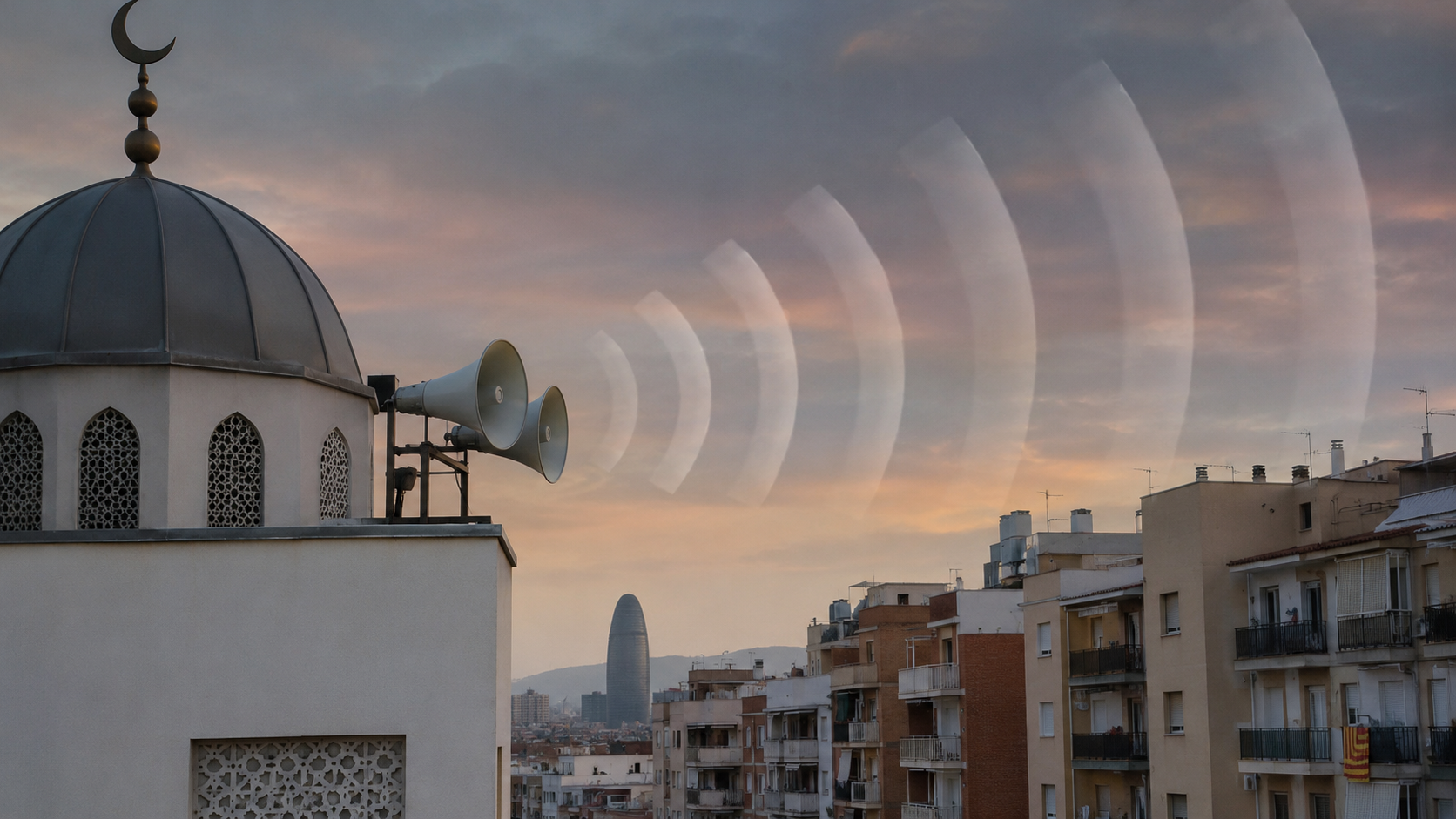
WHO HAS THE RIGHT TO OCCUPY A CITY’S SOUNDSCAPE?
1. Framing the issue: who owns a city’s soundscape?
A city is not merely a physical, architectural or visual space. It is also a shared acoustic space.
Its inhabitants live alongside bells, traffic, sirens, construction work, street vendors, terraces, celebrations, music, demonstrations and religious activities. Some sounds form part of a city’s historical identity; others emerge with new communities, new activities and new forms of cultural expression.
The Islamic call to prayer, known as the adhan, raises a particularly interesting question: to what extent does a religious community have the right to project its voice through loudspeakers into public space, making its message audible to people who do not belong to that religion and have not chosen to hear it?
The issue involves a real conflict between rights that deserve protection:
- The religious freedom of those who wish to perform the call to prayer publicly.
- Residents’ right to enjoy their homes, rest and protect their health.
- Equal treatment among religious denominations.
- The ability of public authorities to regulate public space and prevent noise pollution.
- The plural and non-confessional character of democratic societies.
The question should not be framed exclusively as “do we want to hear the call to prayer?”, but as a broader issue:
What rules should a democracy establish so that no religious, cultural or political community can acoustically appropriate shared space, without this unjustifiably preventing the exercise of its freedoms?
This research starts from a fundamental distinction: the right to perform a religious practice and the right to amplify it so that it can be heard at a distance are related, but they are not exactly the same thing.
One important point must be kept in mind from the outset: the adhan is not inherently illegal, nor is there an absolute right to use loudspeakers from any building, at any volume and at any time.
2. What exactly is the adhan?
The adhan is the Islamic call to prayer. It consists of the recitation of religious formulas in Arabic announcing the time for the ritual prayers.
Traditionally, this call was delivered by the muezzin from the minaret of a mosque. Today, it can be performed using electronic amplification systems, loudspeakers installed on the outside of the building, or equipment located indoors and directed towards public space.
In practice, three forms should be distinguished:
| Form | Characteristics |
|---|---|
| Indoor call | Heard inside the mosque or its premises. |
| Outdoor call without amplification | Delivered aloud from the building, without loudspeakers. |
| Amplified outdoor call | Broadcast through loudspeakers and capable of reaching streets, homes and public spaces. |
It is also necessary to distinguish the call to the five daily prayers from recitations, sermons and other religious broadcasts. They are not the same activity and do not necessarily have the same duration, frequency or impact.
From a religious perspective, the adhan has a ritual function. From an urban-management perspective, when it is amplified it also becomes a sound source that may affect third parties.
A legal study published by Spain’s Official State Gazette (Boletín Oficial del Estado) in 2023, by Ángel López-Sidro López, examines precisely this dual nature: the adhan as an expression of religious freedom and as a sound emission that must coexist with other rights.
3. The legal framework: which rights are in conflict?
3.1. Religious freedom: a protected right
In Spain, Article 16 of the Constitution guarantees the ideological, religious and worship freedom of individuals and communities, subject to the limits necessary to maintain public order as protected by law.
Organic Law 7/1980 on Religious Freedom gives more detail to this right. Article 2 recognises, among other freedoms, the right to perform acts of worship, celebrate rites and freely express one’s beliefs.
Therefore, a public authority cannot prohibit a religious expression simply because it disagrees with its content, because it is culturally different or because part of the population finds it uncomfortable.
However, this protection does not mean that every form of religious expression must take place without limits.
3.2. The right to rest, privacy and health
The other side of the conflict consists of the rights of those who receive the sound.
The Constitution protects personal and family privacy, health and the right to an adequate environment through Articles 18, 43 and 45.
The European Convention on Human Rights adds two particularly relevant provisions:
- Article 8: the right to respect for private and family life and the home.
- Article 9: freedom of thought, conscience and religion, including the public manifestation of beliefs.
The European Court of Human Rights has recognised that noise may raise an issue under Article 8 when it directly and seriously affects domestic life. The Convention does not guarantee absolute silence, but public authorities have obligations to protect people from serious disturbances.
3.3. Amplification is not an unlimited right
This is the legal core of the research.
Article 9 of the European Convention protects the manifestation of religion, but allows restrictions when they are prescribed by law and necessary and proportionate to protect safety, public order, health, morals or the rights of others.
Therefore, two questions must be separated:
First: can a Muslim community perform the adhan as an expression of its religion?
In principle, yes. It is protected by religious freedom.
Second: can that community broadcast it through loudspeakers across an entire residential area?
There is no automatic authorisation. The administration may establish conditions regarding volume, time, frequency, duration and the direction of loudspeakers, provided it does so according to legal, objective and proportionate criteria.
This distinction is essential to avoid two opposite errors: considering every acoustic restriction to be religious persecution, or assuming that religious freedom ceases to exist as soon as a practice can be heard outside the building.
4. Spain: where is the call to prayer allowed and where is it restricted?
4.1. There is no nationwide ban on the amplified adhan
The first important legal conclusion is that Spain has no national law specifically prohibiting the amplified Islamic call to prayer, nor one granting every mosque an automatic right to use outdoor loudspeakers.
The applicable regime results from a combination of:
- The Spanish Constitution and Organic Law 7/1980 on Religious Freedom.
- Law 37/2003 of 17 November on Noise.
- Royal Decree 1367/2007, which develops state legislation on acoustic zoning, quality objectives and noise emissions.
- Regional regulations.
- Municipal by-laws and possible administrative authorisations.
Law 37/2003 is particularly relevant because Article 2 covers all noise emitters, both public and private. The legal definition of noise pollution includes noise or vibrations that cause disturbance, risks or harm. Therefore, a loudspeaker located in a mosque is not automatically exempt because it has a religious purpose.
The consequence is that there is no national rule allowing five daily calls from any mosque, but there is also no national rule prohibiting them because they are Islamic.
The specific decision depends on the acoustic and administrative framework applicable to each location.
4.2. Spanish acoustic limits
Royal Decree 1367/2007 establishes reference values for acoustic emissions and immission from new activities, distinguishing between land uses and times of day.
For an area predominantly used for housing, Table B1 establishes the following outdoor immission limit values:
Reference values for residential areas
55 dB · Day
55 dB · Evening
45 dB · Night
These are reference values for the noise reaching the surrounding area. They should not be confused with the maximum volume a loudspeaker can physically emit. Acoustic classification, the type of activity, the assessment period and the measurement procedure all matter.
This has a practical consequence: measuring the volume next to the loudspeaker is not enough. It is necessary to check the sound level reaching residential façades and other sensitive spaces.
4.3. Ceuta and Melilla: the two Spanish territories where the call can be heard publicly
A legal study published by the BOE in 2023 notes that, although Spain has several hundred Islamic places of prayer, the amplified call can be heard in practice almost exclusively in Ceuta and Melilla. In most other places, the call is preferably made inside the mosque.
This information must be interpreted correctly: it documents a practical situation, not an official list of municipal authorisations or a legal ban elsewhere in Spain.
Ceuta
The Municipal Ordinance on the Emission of Noise, Vibrations and Other Forms of Energy, dated 5 July 1993, contains general provisions on outdoor public-address systems.
Article 38 generally prohibits the use of public-address devices outdoors for advertising, attracting attention, giving notices, entertainment and similar purposes without prior authorisation. It also provides for time restrictions, measures to prevent disturbance, acoustic studies and specific conditions on emission volume.
An important legal caveat applies: the text does not expressly prohibit the adhan or mention it by name. Nor have I found, in the documentation consulted, a specific authorisation setting out times and levels for each mosque.
It would therefore be incorrect to claim that Ceuta’s ordinance prohibits the Islamic call to prayer or grants a general and unlimited authorisation.
Melilla
The case of Melilla offers a clearly documented media controversy.
Timeline of the December 2024 controversy
- 2 December 2024: announcement of night-time restrictions
The Department of the Environment and Nature announced a ban on using loudspeakers for the call to prayer between 21:00 and 09:00. It was justified by residents’ complaints that they were having difficulty sleeping, particularly because of the early-morning call, at around 06:30. The Islamic Commission of Melilla rejected the measure, considering it a restriction on religious practice. - 20 December 2024: agreement between the City and the Islamic Commission
Both parties reached an agreement to cancel that ban and restore the previous situation. The Islamic Commission undertook to use the equipment responsibly in order to avoid disturbing residents.
The night-time ban announced in December 2024 was withdrawn through the agreement of 20 December of that year.
4.4. Is it prohibited in Barcelona, Madrid, Valencia or the rest of Spain?
We have not found a specific, general municipal ban on the amplified adhan in Barcelona, Madrid, Valencia or other major Spanish cities.
That does not mean that any mosque can install outdoor loudspeakers without authorisation or without complying with noise regulations.
The legally accurate situation is:
| Territory | Documented situation |
|---|---|
| Ceuta | The call is audible in practice; general public-address and noise regulations apply. |
| Melilla | The call is audible; a night-time ban was announced in 2024 and subsequently withdrawn by agreement. |
| Barcelona | No general authorisation or specific ban on the adhan has been identified. General rules apply. |
| Madrid | No general authorisation or specific ban on the adhan has been identified. General rules apply. |
| Valencia | No general authorisation or specific ban on the adhan has been identified. General rules apply. |
| Rest of Spain | There is no specific national ban; conditions are determined by territorial and municipal regulations. |
The absence of a known case does not prove that there have been no applications, individual authorisations or disputes in smaller municipalities. An exhaustive inventory would require consulting municipal files and by-laws in each locality.
4.5. Catalonia: a particularly interesting regulatory framework
Catalonia has its own regulatory framework:
- Law 16/2002 on protection against noise pollution.
- Decree 176/2009, which implements the law.
- Law 16/2009 on places of worship.
- Municipal by-laws and acoustic capacity maps.
Law 16/2009 is particularly clear in Article 10: places of worship must comply with noise-pollution regulations.
In addition, in 2015 the Government of Catalonia published the Guide for Respecting Diversity of Beliefs in Public Spaces (Guia per al respecte a la diversitat de creences a la via pública). In the section devoted to religious activity and acoustic impact, it states that religious freedom must be reconciled with physical and mental integrity, privacy, health and the environment.
The guide expressly states that religious centres using systems to amplify the human voice or music must respect acoustic immission limits, like any other sound emitter.
A point that deserves specific research: church bells.
Catalan technical regulations provide an exception for bells located in places of worship, because of the uses traditionally attributed to them. The guide also reproduces the requirement that certain amplification equipment must have power limiters and measures to prevent the structural transmission of noise.
This raises a relevant legal and political question:
Why can certain traditional religious sounds receive different technical treatment, while a new amplified sound expression is subject to other requirements?
We should not automatically conclude that bells are exempt from all noise regulation or that Islamic calls are discriminated against. The cited exception has a specific regulatory scope. However, it is worth analysing whether the difference in treatment is justified, whether it preserves a heritage or historical purpose, and whether it produces unequal effects for religious communities.
5. Europe: a continent without a single policy on the adhan
Europe offers a very interesting picture because countries have developed different models for resolving the same problem.
In June 2026, a report commissioned by the Dutch Ministry of Social Affairs and Employment and prepared by Labyrinth Research & Advice was published. It examines amplified calls to prayer and compares the legal situation in eight countries: Germany, the United Kingdom, Sweden, Denmark, Belgium, France, Austria and Norway.
Its general conclusion is important: none of those eight countries has specific national legislation devoted exclusively to the amplified call to prayer. General frameworks on noise, public order, authorisations and urban planning are applied, usually through local decisions. The report itself warns that the comparative information is indicative and that the available literature is limited.
This means there is no single European model. In some places, a weekly call is allowed under strict conditions; elsewhere, specific applications are rejected; in other places, the practice is not widespread.
5.1. The Netherlands: one of the most explicit legal frameworks
The Netherlands provides an important example because its legislation expressly mentions both the ringing of bells and religious calls.
Article 10 of the Wet openbare manifestaties (Public Manifestations Act) permits the ringing of bells for religious or philosophical celebrations and calls to profess a religion or belief. At the same time, it gives municipalities the power to regulate the duration and volume of these emissions.
This does not mean that any mosque has the right to broadcast any number of calls or that it may exceed local acoustic limits. The law recognises the sound-based manifestation, but allows it to be regulated.
The 2026 research: particularly interesting data
The Dutch report consulted 342 municipalities, of which 104 responded: approximately 30%.
Among the participating municipalities:
- 71 stated that religious expressions could be heard in public space. Most of the sounds mentioned were bells, alongside other religious expressions.
- 10 municipalities reported that an amplified call to prayer was made from a mosque.
- 88 stated that this practice did not exist, and 6 did not know or did not specify.
- In 8 of the 10 municipalities with an established call, debates, dialogue or incidents related to it had taken place during the previous three years.
Another significant figure: in 8 of the 10 municipalities with an amplified call, complaints or reports related to noise disturbance had been recorded, compared with 3 of the remaining 94 municipalities. However, the complaint categories in the report include different sound manifestations and do not allow all those problems to be attributed exclusively to the adhan.
The same report notes that regulation through agreements between municipalities and mosques — on volume, times and frequency — may be more practical than imposing general bans. It also records complaints, communication problems and cases in which the volume was adjusted after negotiations with religious communities.
Assessment: the call is expressly covered by law, and municipalities have the power to set conditions. It is neither an unlimited right nor subject to a general ban.
5.2. Germany: the solution in Cologne
Germany represents one of Europe’s best-documented cases of accommodation through municipal agreements.
In October 2021, the City of Cologne launched a pilot project allowing Muslim communities to apply for authorisation to broadcast the call to Friday prayers.
The municipal conditions include:
- One call on Fridays only.
- Between 12:00 and 15:00.
- A maximum duration of five minutes.
- An administrative agreement setting individual volume conditions.
- Advance information for neighbours through leaflets.
- A designated contact person to handle questions and complaints.
- Protection for the sound system to prevent tampering with the permitted volume.
On 30 October 2026, Kölner Stadt-Anzeiger reported that the pilot project had become a permanent solution. Cologne’s Central Mosque remained the only community using the permit. The call was broadcast from small loudspeakers in its outdoor area, with a maximum of 60 decibels, and not from the building’s 55-metre minarets.
This makes it possible to distinguish between the existence of a mosque with monumental architecture and the decision to turn that architecture into a sound-broadcasting platform.
The German judicial precedent
In September 2020, the Higher Administrative Court of North Rhine-Westphalia examined a dispute concerning the amplified call to prayer. Some neighbours argued that exposure to the religious message violated their negative religious freedom.
The court held that hearing a religious statement does not in itself amount to being compelled to participate in worship. The religious manifestation could be protected as long as acoustic conditions were respected and no legally relevant disturbance occurred.
Assessment: there is no unlimited authorisation, but there is a formula for locally negotiated authorisation, accompanied by technical and administrative conditions.
5.3. United Kingdom: two cities, two decisions
The United Kingdom is interesting because it shows that the same general framework can lead to different municipal decisions.
There is no specific national law on amplification of the adhan. Planning regulations, environmental rules and the regime governing noise nuisance are relevant. Local councils can investigate whether noise constitutes a statutory nuisance, meaning substantial and unreasonable interference with the enjoyment of a home or a risk to health.
Stockton-on-Tees
In 2021, a mosque obtained permission to broadcast an amplified call once a week. The case was reported by the BBC and became an example of conditional authorisation.
Peterborough
In 2021, an application to make several daily calls through loudspeakers was rejected. The expected sound impact on the residential environment was one of the main reasons.
Oxford, 2007: a political and cultural controversy
Oxford Central Mosque announced its intention to make the call to prayer three times a day. The proposal prompted protests and accusations that an attempt was being made to “Islamise England”. Ultimately, the mosque abandoned that initiative. This episode is useful for studying public opposition to the audible presence of Islam, but it should not be described as a judicial ban.
Assessment: applications are examined case by case. Stockton shows that permission can be granted; Peterborough shows that it can be refused. Acoustic and urban-planning assessments are decisive.
5.4. Sweden: authorisation and judicial review
Sweden offers another model of limited authorisation.
In 2013, Fittja Mosque obtained permission to broadcast a weekly call under conditions concerning duration and volume.
In Växjö, the police authorised one amplified call every Friday at 13:00 from May 2018, with a maximum duration of three minutes and forty-five seconds.
Some residents appealed against the authorisation, alleging disturbance and a violation of their rights under the European Convention on Human Rights.
On 24 April 2019, the Gothenburg Administrative Court of Appeal upheld the police decision. It considered that the restrictions on time, frequency, duration and volume made the authorisation proportionate.
Assessment: the call is permitted, but requires specific authorisation and is subject to technical limits. There is no right to broadcast five daily calls merely because it is a religious practice.
5.5. Denmark: the attempt to introduce a nationwide ban in 2026
Denmark was at the centre of one of the most important political debates on this issue during 2026.
On 9 June 2026, parliamentary resolution proposal B 11 was introduced in the Danish Parliament. Its aim was to ban amplified prayer or religious calls through loudspeakers in public spaces throughout the country.
The proposal was rejected on 3 September 2026:
Parliamentary vote result
47 – 63 – 2
47 in favour, 63 against, 2 abstentions. The proposal was rejected.
The result means that Denmark did not approve a nationwide ban on amplified calls to prayer. The practice remains subject to general noise and public-order rules.
This case deserves its own article because it raises a fundamental legal question: can a parliament ban a religious sound-based manifestation across the entire country without examining local circumstances?
5.6. France: laïcité, bells and outdoor religious manifestations
France has a different framework because of its model of laïcité and the 1905 Law on the Separation of Churches and State.
Article 27 states that ceremonies, processions and other outdoor manifestations of worship are regulated in accordance with municipal police rules. It expressly adds that the ringing of bells is regulated by a decision of the mayor and, in the event of disagreement, by a decision of the prefect.
French legislation contains no express nationwide ban on the amplified adhan. However, the 2026 Dutch report observes that amplified calls are uncommon in mainland France and that the practice falls under general public-order and noise rules, in a strongly secular institutional context.
An oversimplification must be avoided: France does not automatically prohibit every religious expression that can be heard outdoors. The regime governing bells also has a historical and local dimension that is not equivalent to a general permit for any religious sound emission.
5.7. Italy: the case of Parma
In 2013, the Regional Administrative Court of Parma examined a complaint relating to the excessive volume of the call to prayer.
The central issue was not the existence of the adhan itself, but the sound level of the amplifiers.
The judge focused on noise pollution and ordered the equipment to be modified or turned down, rather than ordering the call to be abolished altogether. It is a good example of a solution that seeks to correct the technical impact without eliminating the religious manifestation.
5.8. Norway: local authorisation with volume limits
In Oslo, the authorisation of a mosque’s Friday call to prayer was debated. The documented solution was to allow it provided that it complied with public-health regulations on urban noise, with a reference level of 60 decibels.
The 2026 Dutch report confirms that Norway has no specific national regime for amplified calls and that cases are assessed under acoustic rules and local authorisations.
5.9. Belgium and Austria: little specific regulation
In both countries, the 2026 comparative documentation identifies an approach based on general noise, public-order and local-authorisation rules, without specific national legislation for the amplified call.
I have not found, in the sources consulted, a general nationwide ban on the adhan in either country. This does not prove that no local restrictions or decisions exist.
5.10. Switzerland: the ban on minarets is not the same as a general ban on the adhan
In 2009, Switzerland approved a constitutional ban on the construction of new minarets by referendum.
It is important not to confuse this decision with a general ban on the Islamic call to prayer. A minaret is an architectural structure; the adhan can be recited from other places, including inside the mosque or from a rooftop.
The 2023 BOE legal analysis expressly points out this distinction and notes that the Swiss debate about minarets was also related to perceptions of the Islamic presence in the urban landscape.
5.11. Bulgaria: when the conflict turns into hostility towards worshippers
In 2011, a controversy arose around Sofia’s Banya Bashi Mosque, whose public-address system broadcast the call to prayer five times a day, for approximately five minutes each time. The loudspeakers were switched off between 22:00 and 06:00 to comply with urban noise rules.
The case reached the European Court of Human Rights in Karaahmed v. Bulgaria. The controversy was not limited to volume: nationalist demonstrators installed loudspeakers near the mosque and broadcast bells and Christian chants during Friday prayers, accompanied by anti-Muslim insults.
The case is relevant because it makes it possible to distinguish legitimate noise complaints from a campaign intended to prevent a religious minority from worshipping. Hostility towards worshippers cannot be disguised as a mere acoustic complaint.
6. European comparison: where is the call permitted and where is it prohibited?
The following table summarises the cases and frameworks we have been able to document. “Permitted” means that an established practice or authorisation exists, usually subject to conditions; “no nationwide ban has been identified” does not mean that any broadcast is lawful in every municipality.
| Country | Documented situation | Regime |
|---|---|---|
| Netherlands | Expressly permitted subject to local conditions | National law and municipal regulation |
| Germany | Permitted in Cologne and other localities | Local authorisation and acoustic limits |
| United Kingdom | Permitted in Stockton; rejected in Peterborough | Case-by-case decision |
| Sweden | Permitted in Fittja and Växjö subject to conditions | Police permit and judicial review |
| Denmark | Nationwide ban proposal rejected in 2026 | General rules |
| France | No specific nationwide ban identified; amplified practice is uncommon | Municipal police and general regulations |
| Italy | Call permitted, with judicial intervention to correct excessive volume in Parma | Acoustic control |
| Norway | Specific cases permitted subject to limits | Local and public-health rules |
| Belgium | No specific national regime identified | General and local rules |
| Austria | No specific national regime identified | General and local rules |
| Switzerland | Constitutional ban on new minarets; not equivalent to a general ban on the adhan | Architectural restriction and local regulation |
The comparison is based on the 2026 Dutch report, the 2023 BOE legal study, judicial decisions and municipal and parliamentary sources cited above.
Provisional European conclusion: the verified cases show that the debate is mostly resolved through conditional authorisations and general rules, rather than explicit national bans. The clearest exception in the recent political debate was Denmark’s 2026 proposal, which ultimately did not pass.
7. Noise pollution: when does a religious manifestation become a public nuisance?
Noise pollution is a public-health issue, not merely a subjective perception.
The European Environment Agency published its report Environmental Noise in Europe 2025, corrected in March 2026. According to the European data collected, more than 20% of the population is exposed to harmful levels of transport noise; when stricter WHO recommendations are used, the proportion exceeds 30%. Traffic is the dominant source of exposure.
It is important to emphasise that these figures concern transport noise, not religious calls. Urban noise is already a major problem, and public authorities should not add new sources without assessing their impact.
7.1. The problem is not exclusively about volume
There are five essential variables for studying the impact of an amplified call.
1. Sound intensity
Volume must be measured where the sound is received, not only at the loudspeaker. A broadcast that seems moderate next to the mosque may be much louder at certain façades because of its direction, distance and the configuration of buildings.
2. Time of day
A call at 13:00 does not have the same impact as a broadcast at 05:30 or 06:00.
The first may coincide with the city’s normal activity. The second may disturb people who are asleep.
The case of Melilla shows that the early-morning time slot can become the central element of the controversy.
3. Frequency
There is an important difference between a weekly call and five calls a day.
An authorisation granted for Friday at noon cannot automatically be extended to all five daily prayers.
4. Duration
The duration of a broadcast affects its cumulative impact. A two-minute announcement is not the same as a prolonged sound activity.
5. Direction and propagation
Installing several loudspeakers directed towards streets and homes can enlarge the affected area. Directional systems and electronic limiters can reduce the impact without necessarily eliminating the call.
The Cologne example shows that these conditions can become requirements for public authorisation.
7.2. Should religious noise receive special treatment?
An important question arises here.
A religious activity may be essential to its practitioners, but that does not mean that every outdoor broadcast must be protected from acoustic regulations.
The same issue arises with other religious activities:
- Church bells.
- Carillons.
- Music at religious celebrations.
- Amplified sermons.
- Evangelism through loudspeakers.
- Religious activities in premises located in residential buildings.
In principle, coherent noise regulation should consider the impact of the emission, not the religion of the person producing it.
The difficulty arises when historical exceptions are maintained for some religious manifestations while more demanding conditions are imposed on others.
8. The underlying conflict: religious equality or privilege for traditional sounds?
In my view, this is one of the most intellectually important chapters of the research.
For centuries, bells have formed part of the soundscape of many European cities. In many places, they announce celebrations, funerals, historical events and religious times.
The adhan introduces a sound with a function that is comparable in some respects: announcing a prayer and calling the faithful together.
However, there are differences:
- Bells can have religious, civic, timekeeping and heritage functions.
- The adhan is a specifically religious expression.
- The duration and frequency of the two sounds may differ.
- Their acoustic characteristics are also different.
- Their presence in the soundscape has a different cultural history.
Therefore, comparing bells and calls to prayer does not mean claiming that they are exactly equivalent.
It means that both should be examined using compatible criteria of equality, proportionality and protection of residents.
8.1. The Catalan example
Catalan regulations contain an express reference to bells in places of worship, excluding them from certain acoustic-protection requirements because of their traditional uses.
By contrast, places of worship that use electronic amplification of the human voice or music must comply with acoustic immission limits.
This raises several questions:
- Which historical uses justify an exception?
- Should a traditional sound and a new one receive different treatment?
- When does the protection of a traditional use cease to be reasonable if it causes significant disturbance?
- Should some accommodation be recognised for new religious communities, under the same acoustic conditions?
- Can a cultural tradition justify a permanent privilege in the use of sound space?
8.2. The Netherlands: joint treatment of bells and religious calls
Dutch legislation expressly mentions both the ringing of bells and calls to profess a religion or belief, and allows their duration and volume to be regulated.
The 2026 report also notes that municipal treatment of these manifestations must respect the principle of equality among religions, even though their legal foundations are not identical.
This model deserves study because it does not start from the assumption that traditional sounds automatically belong to the city while new sounds must remain invisible or inaudible.
8.3. Two simplistic positions should be avoided
First position: any questioning of the adhan is Islamophobia.
That is incorrect. A resident may have objective reasons to request a restriction on noise, especially when it occurs in the early hours of the morning, is repeated daily or affects rest.
The protection of health and the home does not disappear when the source of the sound is religious.
Second position: any amplified Islamic call constitutes a religious imposition on society.
That is also incorrect. A moderate, brief, daytime and regulated broadcast can be perfectly compatible with a plural city.
The religious content of a broadcast does not, in itself, prove that there is an imposition on those who hear it.
9. Is there a right not to hear religion?
This is another important issue that appears in several European legal disputes.
In the Växjö case in Sweden, some residents argued that hearing a religious call with which they did not agree violated their rights.
The Administrative Court of Appeal upheld the authorisation, reasoning that hearing a religious message does not mean being obliged to participate in that worship. What mattered was that the broadcast was subject to proportionate limits on time, frequency, duration and volume.
This distinction makes considerable sense within a pluralist democracy.
A free society cannot guarantee that its citizens will never hear religious, political or cultural messages with which they disagree.
But neither can it allow an organisation to impose unlimited sound broadcasts on its neighbours.
The freedom not to participate in a religion is not equivalent to an absolute right never to hear any religious expression. And the freedom to manifest a religion is not equivalent to an unlimited right to amplify it.
I believe this dimension deserves its own section within the research. In fact, it can provide a particularly interesting perspective: the amplified call to prayer is not heard solely as a religious sound; for part of the European population, it also functions as a symbol of cultural transformation, immigration, insecurity and the loss of identity-related reference points.
It must be analysed without falling into two simplifications: considering any opposition to the call racist, or assuming that rejection necessarily demonstrates hostility towards Muslims.
I propose incorporating the following chapter.
10. The identity dimension of rejection: fear of the unknown, cultural loss and association with terrorism
10.1. The call as a symbol of cultural transformation
For part of the European population, the amplified Islamic call to prayer represents something that goes beyond its religious dimension. Its appearance in a city’s soundscape may be interpreted as a sign of cultural transformation in a familiar environment.
For generations, the religious sounds that have formed part of the urban identity of many European cities have mainly been church bells. Although European societies have undergone a significant process of secularisation, these sounds continue to be recognised as part of their historical and cultural heritage.
The appearance of an amplified Islamic call introduces a different acoustic and symbolic element. For some citizens, it does not simply mean incorporating another religious expression, but making visible — or, in this case, audible — a transformation in the cultural composition of their neighbourhood.
This perception can foster a sense of lost cultural continuity: the impression that traditional reference points are being displaced, or that the familiar environment is changing without its residents necessarily having taken part in that transformation.
Academic research by Uriya Shavit and Fabian Spengler on controversies surrounding the adhan in non-Muslim-majority societies specifically identifies that some European opposition is not exclusively about noise. It is also linked to the perception that the call represents an expansion of Islam in public space and a retreat of traditional Christian values.
10.2. Fear of the unknown: when the sound is not understood
There is another aspect that deserves attention: cultural and linguistic distance.
The call to prayer is delivered in Arabic. For a large proportion of citizens who do not know this language or the Islamic tradition, it is a message whose content they cannot understand directly.
The listener recognises a voice, a melody, repetition and certain expressions, but does not know what they mean or what function they perform within the religious ritual.
This lack of familiarity can generate distance, discomfort or distrust, particularly when the sound is amplified in a shared urban space.
It is not necessarily a conscious rejection of religion. There may be a more immediate reaction to a cultural manifestation perceived as unfamiliar, foreign or difficult to integrate into the environment’s usual reference points.
A psychological and social phenomenon is also at work: citizens do not interpret sounds in isolation. They connect them with images, news, personal experiences and events they have encountered before.
For that reason, the same call may convey spirituality and belonging to a Muslim believer, while to a neighbour without cultural reference points about Islam it may represent an unfamiliar religious expression intruding into everyday life.
10.3. “Allahu Akbar”: the association with terrorism and its acoustic consequences
The Arabic expression Allahu Akbar, generally translated as “God is the greatest”, occupies a fundamental place in Islamic religious practice. It appears at the beginning of the call to prayer, where it is recited four times, and appears again towards the end.
It is also part of daily prayers and is commonly used in many religious and personal contexts.
However, over recent decades, this expression has acquired a second association in part of the Western public imagination: jihadist terrorist violence.
In certain attacks widely covered by the media, perpetrators pronounced this expression before or during their violent actions. Documented cases include the January 2015 attacks in Paris and other attacks linked to jihadist terrorism.
The repeated media circulation of these images and expressions has helped establish an emotional association between certain Arabic words, Islam and terrorist violence.
A study by Michelle D. Weitzel, published in 2020 in the journal French Politics, specifically analyses this phenomenon. The researcher identifies how the media association of the takbir — the expression “Allahu Akbar” — with attacks and violent incidents influences public perceptions of the Islamic call to prayer in France.
A particularly significant circumstance emerges here: the Islamic call begins with precisely the words that some people have learned to associate with terrorist incidents.
Therefore, when a mosque uses loudspeakers to broadcast the adhan, not all listeners receive only a religious message. Some may immediately associate it with news reports, attacks, threats or images of violence they have encountered previously.
This association can generate unease, rejection or even a feeling of insecurity, although there may be no real threat in the context in which the call takes place.
A fundamental distinction must be made: the fact that jihadist terrorist organisations have used this expression does not mean that the expression itself is terrorist. Its use by extremists amounts to the appropriation of an ordinary religious formula, used daily by millions of Muslims in contexts entirely unrelated to violence.
The sociological problem is not only what the expression means, but also what part of society has learned to associate with it.
10.4. When a religious sound becomes a matter of security and identity
The combination of these factors can produce a phenomenon that deserves particular attention.
An amplified call may be perceived simultaneously through three dimensions:
- Cultural: as a manifestation of the growing Islamic presence and changes in the neighbourhood’s identity.
- Acoustic: as a sound intrusion into a residential space that previously had other auditory reference points.
- Security-related: as a sound associated, through media exposure, with terrorism and Islamist radicalisation.
These three dimensions can reinforce one another.
A neighbour who initially considers the call simply annoying may begin to interpret it differently when connecting it with news about attacks, international conflicts or political discourse about Islam.
Likewise, someone who already perceives the Islamic presence as a cultural transformation may interpret the amplification of the call as a demonstration of greater religious presence or influence.
This does not mean that all these interpretations are objectively correct. It means that they influence how the phenomenon is received socially.
The result may be that an apparently technical issue — the volume of loudspeakers — turns into a controversy about collective identity, coexistence, security and the model of society.
10.5. A central question: rejection of noise, Islam or what it represents?
There is also a question that must be examined critically: are the same criteria applied to all religious manifestations?
In many European towns and cities, church bells form part of the traditional soundscape. Their presence has become socially normalised, even though they can also cause disturbance.
The Islamic call, by contrast, may be received with greater resistance precisely because it is not part of the majority’s sound tradition.
This raises a question of equality: should religious manifestations have the same opportunities for acoustic expression, or is it legitimate to impose different restrictions based on the characteristics of each sound, its frequency, timing, intensity and urban context?
Not everyone who rejects the amplified call rejects Islam. Nor is everyone who justifies their opposition on acoustic grounds necessarily expressing a purely technical concern.
We can distinguish at least four types of rejection:
| Type of rejection | Main motivation |
|---|---|
| Acoustic | Volume, frequency, timing and noise pollution. |
| Cultural | Perception of identity loss and transformation of the traditional environment. |
| Security-related | Association of the sound and certain expressions with jihadist terrorism. |
| Ideological | Opposition to a greater public presence of the Islamic religion. |
Understanding these differences is essential to explaining why a religious practice that its practitioners regard as a normal expression of their faith can generate considerable social resistance in certain European settings.
11. What model should a European democracy adopt?
International examples make it possible to identify an intermediate model between a general ban and a complete absence of regulation.
| Criterion | Proposed measure |
|---|---|
| Authorisation | Municipal application where the use of outdoor public-address systems requires it. |
| Timing | Different conditions for daytime, evening and night. |
| Frequency | Maximum authorised number of broadcasts. |
| Duration | Time limit in minutes for each call. |
| Volume | Maximum level measured at relevant receiving points. |
| Technology | Directional loudspeakers, limiters and protection against tampering. |
| Transparency | Information for neighbours, a contact person and periodic review. |
11.1. An authorisation system based on actual impact
An authorisation should include an acoustic study examining:
- Distance between the mosque and homes.
- Number of loudspeakers.
- Power and direction.
- Background noise levels.
- Façades and rooms potentially affected.
- Times and duration.
- Cumulative effects of the broadcasts.
The administration should have the means to verify compliance and modify the conditions when evidence shows that a problem exists.
11.2. The need for neutral regulation
The same measurement, assessment and protection rules should apply to any comparable sound emitter.
It would not be reasonable to allow amplified broadcasts that greatly exceed the limits simply because they come from a majority tradition.
Nor would it be reasonable to prohibit a Muslim broadcast that meets the same technical conditions as a traditional religious expression.
The administrative question should be: what level of noise reaches residents, when, for how long and with what effects?
Not: which religion is behind the loudspeaker?
11.3. Does a ban on night-time calls make sense?
This debate deserves special attention.
A night-time ban may pursue the legitimate aim of protecting sleep and health. The problem arises if it is formulated exclusively against one religion, without sufficient acoustic justification or without examining less restrictive alternatives.
A more proportionate solution could establish:
- Stricter limits at night.
- A ban on outdoor broadcasts during certain time periods if justified by the acoustic study.
- Reduced volume.
- Loudspeaker direction requirements.
- Alternatives such as an indoor call or digital transmission.
The same protection of rest should apply to bells, music, commercial public-address systems and any other comparable sound emission.
12. The arguments on both sides
We must present the positions of Muslim communities, residents, legal experts, authorities and critics.
| Arguments in favour of allowing the call | Arguments in favour of limiting it |
|---|---|
| It is an expression of religious freedom. | Acoustic space is shared. |
| Muslim communities have the right to express their faith publicly. | Residents have a right to rest and health. |
| Bells and other religious sounds also occupy public space. | Amplification is not essential to every religious practice. |
| A ban directed at Islam may be discriminatory. | Frequency and timing may cause disturbance. |
| The call may form part of the city’s cultural diversity. | Accepting a religious practice does not mean accepting any volume or frequency. |
| Regulation makes coexistence possible without general bans. | Acoustic protection should prevail when a disproportionate impact is established. |
The editorial principle that should be defended is that religious freedom must be protected, but its exercise outdoors must coexist with the rights of others.
No acoustic privileges should be granted on the basis of tradition, but neither should restrictions be imposed on the basis of religious identity.
13. What this research reveals about Europe’s evolution
Three trends deserve attention.
First: local management is replacing sweeping bans.
Cologne, Sweden, the United Kingdom and the Netherlands show that the specific conditions of each city are fundamental. Denmark’s rejection of the proposal in September 2026 also demonstrates that a nationwide ban may face significant political and legal obstacles.
Second: religious sound is becoming an urban-planning issue.
The question is no longer limited to religious rights. It also involves acoustic maps, licences, public-space management, environmental health and neighbourhood coexistence.
Third: the dispute has a symbolic dimension.
For some Muslims, hearing the adhan outdoors represents social recognition and a public presence. For some critics, that same broadcast represents a cultural transformation they question.
The conflict may therefore have two simultaneous dimensions: a material one, related to noise, and a symbolic one, related to the city’s identity.
We must not confuse them.
Conclusion
The question “who has the right to occupy a city’s soundscape?” cannot be answered by simply allowing or prohibiting the Islamic call to prayer.
A democratic city must protect religious freedom while, at the same time, preventing any organisation from imposing a disproportionate sound presence on others.
Tradition cannot be an automatic excuse for granting acoustic privileges to one denomination. And cultural novelty cannot be a sufficient reason to prohibit the sound-based expression of another.
European cases show that solutions can be found through local authorisations, time restrictions, volume limits, technical controls and dialogue between communities and residents.
But they also reveal that the call to prayer has a political and symbolic dimension that goes beyond noise: it represents a religious presence in a public space that has historically been marked by other traditions.
The fundamental question is not whether a city’s soundscape should belong to Islam, Christianity or a secular society. The question is which democratic rules make it possible to share it without any tradition enjoying an absolute privilege and without any community being excluded because of its identity.
Religious freedom allows people to make themselves heard. Democratic coexistence also requires listening to those who have to live with that sound.
Main sources and bibliography
Spain
- Spanish Constitution — Article 16.
- Organic Law 7/1980 on Religious Freedom.
- Law 37/2003 on Noise.
- Royal Decree 1367/2007.
- Catalan Law 16/2009 on Places of Worship.
- Government of Catalonia guide on diversity of beliefs in public spaces.
- Ángel López-Sidro López, “Adhan and Religious Freedom”, BOE, 2023.
Europe
- 2026 Dutch report on amplified calls to prayer and European regulation.
- City of Cologne: pilot project for the Friday call to prayer.
- Swedish Court of Appeal: Växjö authorisation.
- Danish Parliament: proposal B 11 and voting result.
- French Law of 1905 — Article 27.
- ECHR: Karaahmed v. Bulgaria.
- European Environment Agency: Environmental Noise in Europe 2025.