
The Mosque Dilemma: Why Does Europe’s Wallet Prefer an Empty Building to Foreign Money?
Imagine you are the mayor of a European city.
One Monday morning, you arrive at your office and find two letters on your desk.
The first says: “The city’s Muslims need a larger mosque. The community has grown, and the current premises are too small.”
The second says: “We are concerned that the new mosque will be funded by money from abroad.”
Suddenly, you have a problem. If the state provides the money, some citizens will ask: “Since when do we use our taxes to pay for places of worship?”
But if the state provides no money, someone else will. And that is where one of modern Europe’s great dilemmas begins.
1. The Spiritual Rental Dilemma
If Europe does not fund mosques, mosques will still need money. And money, like water, always finds a way.
Then the uncomfortable questions begin.
Who pays for the building?
Who pays the imam?
Who funds the activities?
Who influences the religious message?
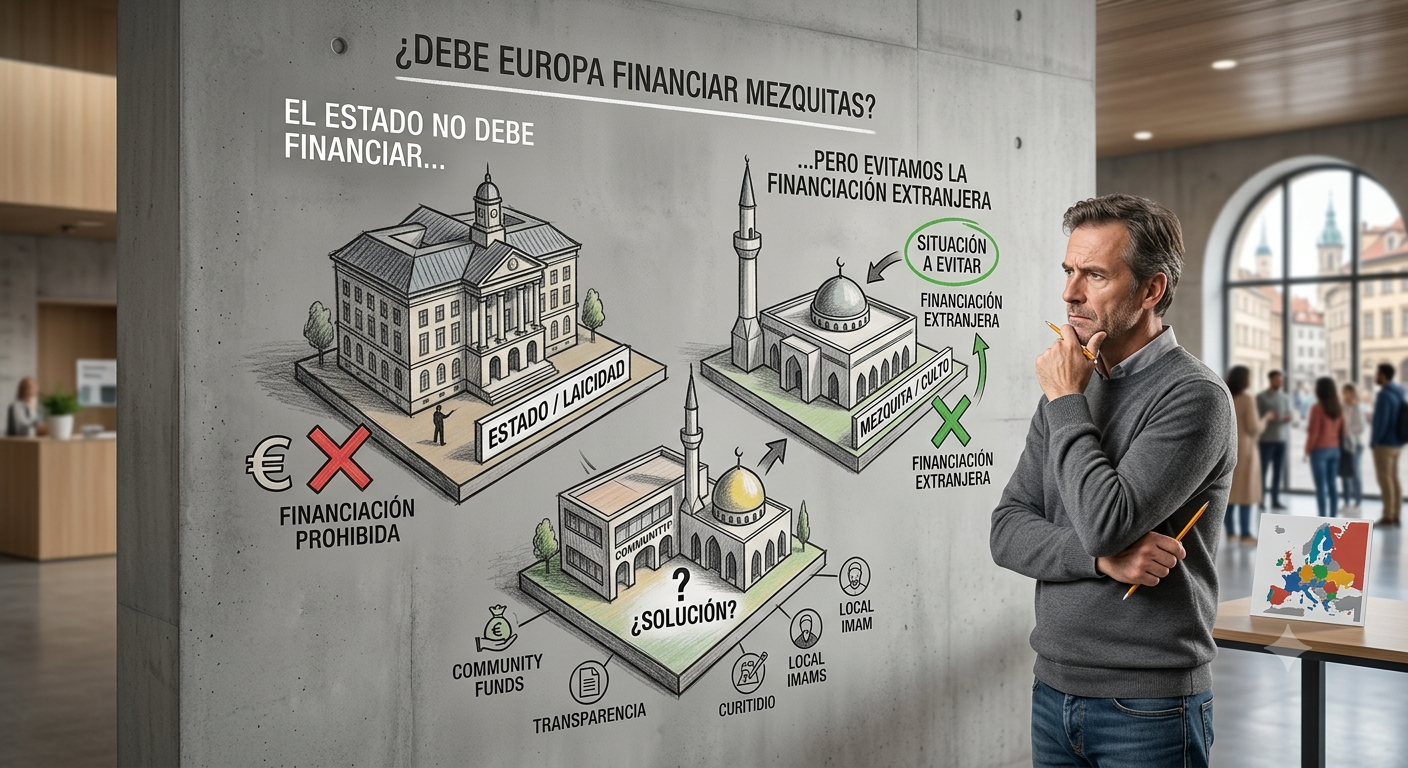
Europe faces an existential problem. It wants a “European Islam”—modern, integrated, and democratic—but does not want to spend a single euro building its places of worship. And, of course, in the marketplace of faith, there is no such thing as a vacuum: if the European state does not provide funding, foreign petrodollars will do it instead.
2. The Three Sides of the Triangle (A Dead End)
To help readers understand the logic of the problem immediately, let’s divide the situation into three rational but conflicting positions.
Side A: “Not a Single Euro of Public Money for Religion” (The Secular Logic)
The argument: Europe has fought for centuries to separate Church and State. Public money—collected in taxes from everyone, including atheists, Christians, Buddhists, and Muslims—should go to hospitals, roads, and schools, not places of worship.
The trap: In theory, this position is impeccable, but in practice, it can be blind to the circumstances. It ignores the fact that Islam is a relatively new religion in Europe and has fewer historically accumulated resources than the Catholic Church, which owns vast amounts of property and real estate. Without their own assets, local Muslim communities inevitably need external funding.
Side B: The Financial “Trojan Horse” (The Foreign Influence Risk)
The argument: If public funding is prohibited, mosques turn to foundations in Gulf countries or to the Turkish or Moroccan governments.
The trap: Money is never free. Along with the millions of euros used to build a beautiful mosque in Brussels, Paris, or Barcelona, an entire package often comes with it: imams trained abroad who do not speak the local language, ultra-conservative literature (Salafist or Wahhabi), and a worldview that clashes head-on with European democratic values and gender equality. In other words, to save public money, Europe ends up outsourcing the spiritual education of its citizens to foreign theocracies.
3. What Is the Solution? Three Ways Out of the Maze
Given that the current situation is unsustainable, European thinkers and governments are considering several creative solutions.
Option 1: The German Model (“Religious Tax”)
How it works: Germany has the Kirchensteuer (church tax). If you register as a member of a religious community, the state collects a small additional percentage from your salary and transfers it directly to your religious community to fund its activities.
The advantage: The money still belongs to the believers themselves, rather than coming from the state’s general budget, but it is regulated and transparent, helping religious communities avoid dependence on foreign sheikhs.
The challenge: This requires Muslim communities to organize themselves into official, transparent structures, which is not always easy given Islam’s internal diversity.
Option 2: The “National Oversight Foundation” (The State Filter)
How it works: Establish a public or mixed public-private foundation, as has been attempted in France. Mosques can receive donations from abroad, but not directly. All foreign money must pass through a state-controlled channel that audits where it comes from, who provides it, and what is expected in return before distributing it.
The advantage: The money is not banned, but its political and ideological control is removed. If Saudi Arabia wants to donate, the money becomes “anonymous” once it passes through the European state’s filter.
Option 3: The “Neighborhood Self-Management” Model
– How it works: Treat mosques not as giant temples of geopolitical propaganda, but as smaller local cultural centers. Encourage grassroots fundraising by local residents, who can finance their mosque euro by euro out of their own pockets, and make it easier for imams to train at European universities in theology and local constitutional law rather than abroad.
Maturing as a Society
Europe must stop behaving like a frightened teenager who prefers to close its eyes to complex problems. We cannot demand an “Islam from here” if the places of worship and the imams are imported “from there” simply out of stinginess or indifference.
The Question Nobody Asks
Perhaps we are asking the wrong question. The issue is not: “Should Europe fund mosques?”
The question is: “Who do we want to influence European Islam?”
Because, whether we like it or not, European Islam already exists. Millions of Muslims were born in Europe and speak Spanish, French, German, or Dutch. Their children will grow up here, too.
The question is whether we want an Islam that is more closely connected to European societies or one that is more dependent on external actors.
The Most European Solution Possible
Europe has a special talent: it rarely chooses between black and white.
It prefers to set up a commission, organize three meetings, publish a two-hundred-page report, and find a complicated solution that leaves everyone moderately dissatisfied.
And, curiously enough, that approach might work in this case, too.
Perhaps the future lies in mosques that are:
-
Primarily funded by their own communities.
-
Transparent.
-
Subject to limits on certain forms of external influence.
-
Led by religious figures trained in Europe.
-
Integrated into local life.
It is not a perfect solution, but it does seem like a European one.
The Conclusion
Should Europe fund mosques? The simple answer is no.
The more thoughtful answer is: it depends on what we mean by funding, because the alternative also has consequences.
Europe can decide not to get involved, but it cannot decide that the problem will simply disappear. And perhaps that is the great lesson of this debate: sometimes, governing means choosing between several imperfect solutions.
In the meantime, the question will remain on the table: if Europe does not help build a European Islam, who will?
And that is probably one of the most important questions the continent will have to answer over the coming decades.
The final message:
Regulating mosque funding is not a favor to Islam; it is an investment in our own security, social cohesion, and national sovereignty. If we genuinely want the European public sphere to remain free and secular, we must be willing to design the rules of the game. And sometimes, that means finding intelligent ways to ensure that nobody can buy our silence or our social peace with a foreign cheque.