
The Great Street Test: What Do Europeans Know About Islam?
You hop on a bus and travel around Europe for several months. You stop in Madrid, Paris, Berlin, Rome, Amsterdam, Warsaw, and Stockholm. In each city, you ask the same question to one hundred people: “What do you know about Islam?”
Most answer in less than ten seconds, and that is where the problem begins.
After speaking to one hundred Europeans, you would probably hear something like this: “It’s a religion of peace.” “I don’t know much, to be honest.” “I think they pray five times a day.” “Isn’t it the religion of Ramadan?” “I have Muslim friends, and they’re good people.” “Is it true they don’t eat pork?” “I’d rather not comment.” “It doesn’t respect women.” “It’s a sensitive subject.”
In reality, the experiment could be summed up in a single sentence: Europe lives alongside Islam every day, but can barely explain what it is.
The Great Unknown
Let’s try a little test. How many Europeans could correctly answer these questions?
How many chapters does the Quran contain? What is the difference between Sunnis and Shias? What exactly does the word “Sharia” mean? Which countries have laws inspired by Islam? What is an imam? Which aspects of Islam are religious and which are cultural? What does “halal” really mean?
Most would fail the test, and that is perfectly fine. Most Europeans would also struggle to explain the differences between Catholics and Orthodox Christians or recite all Ten Commandments.
However, there is an important difference: Islam has become one of Europe’s major topics of conversation. It is discussed on television, on social media, in Parliament, and at family dinners, but much of the time, people talk about it from a position of ignorance.
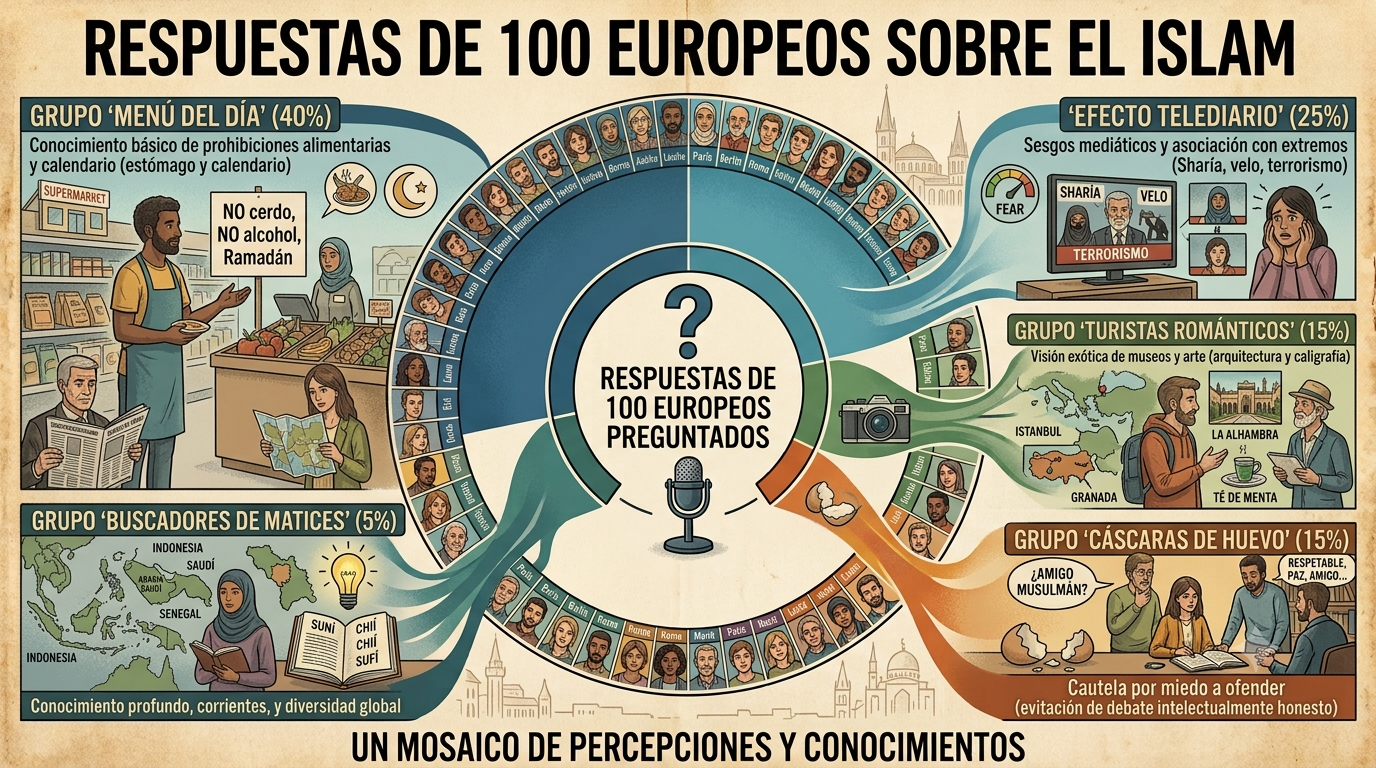
The Great Street Test: Five Typical Responses (and What They Reveal)
1. The “Daily Menu” Group (Around 40 out of 100)
For almost half of those surveyed, Islam boils down to three basic concepts related to food and the calendar: “They don’t eat pork, they don’t drink alcohol, and they observe Ramadan.”
This is the most basic level of empathy and observation. They know what they see at the supermarket or what their colleague does, but the spiritual dimension and the history behind these rituals remain a complete mystery. For them, Islam is simply a list of “forbidden” things.
2. The “TV News Effect” (Around 30 out of 100)
This is where fear, geopolitics, and media bias come into play.
They will immediately talk about Sharia (Islamic law), the veil, women’s submission, terrorism, and radicalism.
This is where we see how the media can lead someone in Cuenca or Lyon to associate a religion of 1.8 billion people exclusively with its most extreme and marginal expressions. It would be like judging Christianity in Morocco solely on the basis of the Ku Klux Klan or ultra-conservative sects in Texas.
3. The “Romantic Tourists” (Around 10 out of 100)
This group has a view shaped by One Thousand and One Nights or a weekend visit to Granada or Istanbul.
“Oh, the Alhambra! Mint tea! How beautiful Arabic calligraphy is, and how mystical Sufi music sounds!”
Although this perspective is positive, it suffers from “exoticism.” It treats a living, complex faith as if it were a museum or a theme park. Appreciating the art is fine, but Islam is not just 12th-century architecture; it is the everyday reality of millions of Europeans who are currently trying to reconcile their faith with making ends meet.
4. Those Walking on “Eggshells” (Around 15 out of 100)
The politically correct crowd. They are so terrified of sounding offensive or Islamophobic that their answers are extremely cautious.
“It’s a religion of peace, very respectable, everyone is free… honestly, I have a friend who…” They say nothing specific because they are afraid of getting it wrong.
It is both amusing and necessary to examine this Western fear of debate. Ultimately, refusing to discuss problems involving integration, sexism, or dogmatism within any religion, out of excessive political correctness, prevents mature and intellectually honest conversations.
5. The “Nuance Seekers” (Barely 5 out of 100)
These are the people who have actually read something or have had meaningful, in-depth contact with Islam.
They know that a Muslim from Indonesia—the country with the largest Muslim population in the world, a fact almost no European knows—is not the same as a Muslim from Saudi Arabia, Bosnia, or Senegal. They understand that Islam has different traditions and movements, including Sunni, Shia, and Sufi, and that it is as diverse as Christianity.
The Bar Experiment
Imagine walking into a bar and asking these questions:
Should there be women imams? Is Sharia compatible with European democracies? Should mosques deliver their sermons in the language of the country? Can a religion change over time? Does a European Islam exist?
In less than ten minutes, you will have three tables arguing, two uncomfortable people, and a sixty-year-old man saying, “Things like this never used to happen.”
Europe has a strange relationship with Islam. It is interested in it, concerned about it, but struggles to talk about it naturally.
The Wikipedia Effect
There is another curious phenomenon.
Many Europeans believe they know a great deal about Islam because they have watched three YouTube videos, two documentaries, and twenty social media posts.
That is like claiming to be a medical expert because you once searched the Internet to find out why you had a headache.
The reality is more complex. Islam has more than 1.8 billion followers and is practised differently in Indonesia, Egypt, Turkey, Morocco, and Bosnia. There is no single Islam; there are many forms of it, and that is where the difficulty begins.
We live in an age when we have opinions about almost everything and deep knowledge about almost nothing.
The Future
Europe is changing. That is a fact. In twenty years, there will be more mosques, more Muslim citizens, and more debates about identity, integration, and coexistence.
That is why it seems strange that we still talk about Islam as if it were a distant subject. It is a European issue.
The question is: “What place will Islam occupy in the Europe of the future?”
To answer it, we will first have to do something revolutionary.
Learn, read, ask questions, and, above all, recover the ability to have difficult conversations without turning them into a war.
Conclusion
Perhaps Europe’s greatest challenge is not deciding what to do about Islam.
Perhaps the real challenge is learning to talk about it as calmly as we talk about politics, philosophy, or history. Because a mature society is not one in which everyone thinks alike. It is one in which people can ask difficult questions without being afraid to voice them.