
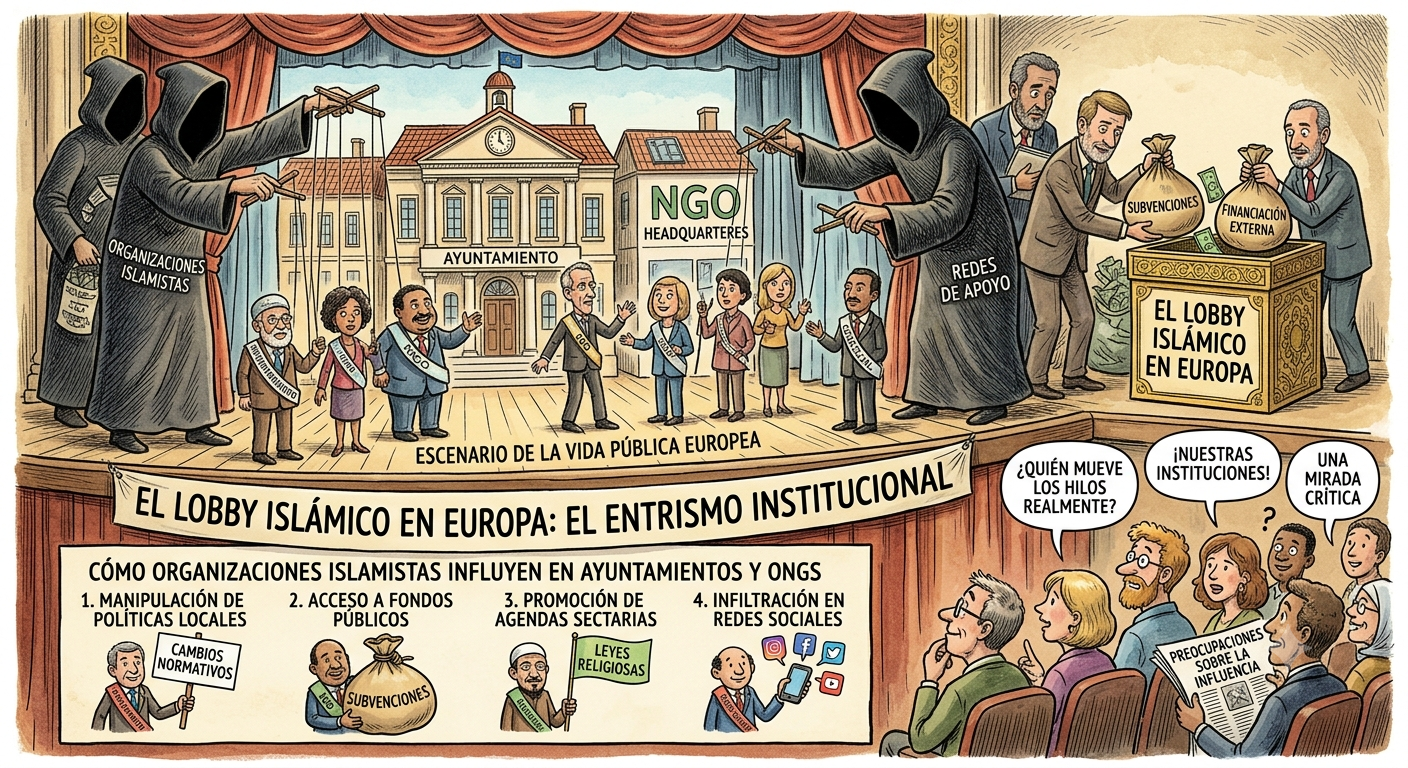
The Art of “Entryism”: How Islamist Lobbying Enters European Institutions Without Breaking a Single Plate
Imagine the scene: a local NGO receives public funding to organise a “community integration workshop”. The official press photograph shows smiles, diversity and polished speeches about coexistence. Everything looks impeccable.
What the press release does not mention is that, behind the scenes, the organisation includes activists linked to Islamist ideological networks who use every euro of grant funding and every municipal meeting to advance their own political and ideological agenda.
This is neither a spy film nor a conspiracy theory dreamed up over coffee. It is what political scientists call “institutional entryism” or “Muslim Brotherhood-style influence”, referring to the historical influence of the Muslim Brotherhood network in Europe. It involves using the tools, loopholes and values of liberal democracy itself — such as tolerance, grants for diversity initiatives and Western feelings of guilt — to exert influence from within local councils, NGOs and educational institutions.
What Exactly Is “Institutional Entryism”?
The term sounds like something out of a spy film, but the idea is straightforward. It involves attempting to influence public or private institutions from within in order to steer decisions towards particular objectives.
This can occur in local councils, universities, educational institutions, NGOs, the media, advisory bodies and foundations.
The strategy is rarely about seizing power all at once. It is much more mundane, and precisely for that reason it can be more effective. The aim is to occupy less visible spaces where important decisions are made.
Are there Islamist organisations attempting to influence European institutions to increase their political, cultural or religious power? Let’s examine how this strategy works, how it affects citizens’ everyday lives and what can be done to counter it.
1. The Entryism Playbook: From NGOs to the Town Hall
Unlike violent extremism, entryism is quiet, wears a suit and tie, and speaks fluent bureaucratic language. Its strategy unfolds in three carefully calculated stages:
Step 1: Setting up front NGOs. Associations are founded with impeccable-sounding names (“Youth Forum”, “Anti-Discrimination Collective”, “Neighbourhood Integration Association”). Their public image centres on social services, but their leadership answers to dogmatic ideological currents.
Step 2: Becoming the sole interlocutor. They present themselves to local councils and municipal departments as the “sole legitimate representatives” of the entire local Muslim community. For a councillor in a hurry, looking for votes or inclusive photo opportunities, this can be an irresistible proposition.
Step 3: Grants and lawfare. They secure public funding for their activities while using the accusation of “Islamophobia” as a shield against criticism or scrutiny of their projects and public statements.
2. How Does This Affect Everyday Life in Your Neighbourhood?
When entryism takes root at the municipal level, its effects are not abstract; they can be felt in residents’ daily routines.
Management of public spaces and facilities: Subtle but persistent pressure on municipal swimming pools to introduce gender-segregated opening hours, or demands in state schools to change menus or adapt curricula outside the framework of secular law.
A monopoly over Muslims themselves: The first people harmed by entryism are secular, non-religious or reformist Muslims. Islamist lobbying groups take control of community spaces and impose coercive social control over who qualifies as a “good” or “bad” Muslim.
Taxpayer-funded activities: Tax revenue ends up financing groups that actively promote ideas contrary to gender equality, sexual diversity or freedom of conscience.
3. How Can Entryism Be Countered Without Falling into Paranoia or Discrimination?
The democratic response to entryism should not involve restricting freedoms, but rather demanding strict compliance with democratic rules.
Grant Audits and Financial Transparency
No public funding for organisations with opaque links to fundamentalist networks or that promote discourse contrary to human rights and the Constitution. Every grant or allocation of municipal premises should be subject to clear auditing requirements.
Supporting Pluralism and Secular Voices
Local institutions should not treat religious communities as monolithic blocs. It is essential to engage directly with individual citizens, feminist groups, secular young people and freethinkers within Muslim-origin communities themselves.
Religious Neutrality in Local Government
Local councils should safeguard freedom of private religious practice while remaining firm in the public sphere: civil law, gender equality and the secular character of public institutions take precedence over any religious rule or demand.
The Big Debate: Integration or Communitarianism?
This is where we find the heart of the debate.
Supporters of These Organisations Say:
They facilitate integration. They give minorities a voice. They help solve social problems. They represent genuine needs.
Critics Respond:
They can reinforce separate identities. They encourage communitarianism. They create privileged interlocutors. They weaken shared citizenship.
In other words, are we building a society of citizens, or separate communities that constantly negotiate with the state?
The Risk of Exaggeration
There is also an important danger: treating every Muslim association as part of an international conspiracy. That would be absurd.
The vast majority of religious associations simply seek to carry out their normal activities. Confusing Islam, Muslims and political Islamism
produces more noise than analysis, and noise rarely helps us understand reality.
Conclusion: Less Conspiracy, More Transparency
The real problem is not the existence of influential Muslim associations. In a democracy, every organisation tries to exert influence.
The problem arises when that influence is exercised without transparency, without public oversight or without respect for shared democratic principles.
Nor is the solution to distrust every religious organisation. It is to demand exactly the same rules from all of them. A healthy democracy does not begin by asking who is exerting influence; it asks how that influence is exercised, what money supports it and what purpose it serves. That distinction changes everything.
Europe’s real challenge in dealing with associative entryism is not a dilemma between tolerance and intolerance, but between naivety and democratic resolve. Protecting a free, equal and safe public sphere requires recognising covert influence strategies and firmly defending the secular and liberal principles that underpin peaceful coexistence.