
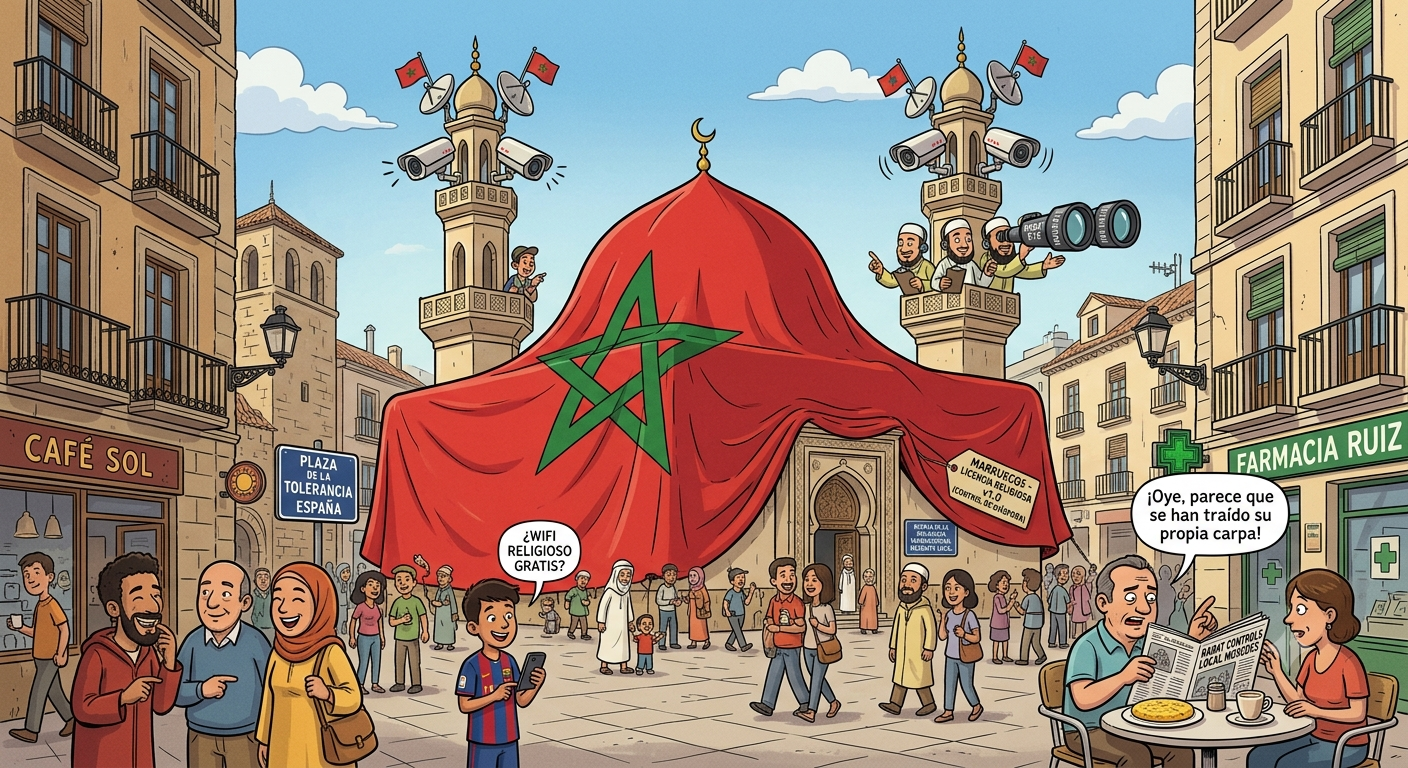
Spiritual Wi-Fi with Nationwide Coverage: Morocco’s “Remote Control” over Its Mosques in Europe
What happens when part of a religious community’s organisation depends, directly or indirectly, on a foreign state?
“When Friday’s sermon begins in Spain… but some suspect the script was written thousands of kilometres away.”
We are no longer talking about religion alone, but also about politics, influence, diplomacy and sovereignty. This is where a concept that increasingly features in European debates comes into play: religious diplomacy.
Religion Also Has a Foreign Policy
When we think about international politics, we imagine embassies, ministers or trade agreements. But some countries also use another, much more discreet instrument: religion.
Not necessarily just to control believers, but to maintain cultural, linguistic and religious ties with their citizens and descendants living abroad.
In Morocco’s case, various analysts have pointed out that the state maintains close ties with parts of its religious network in the diaspora through institutions, imam training and official bodies. The specific scope and operation of these arrangements vary from one community and mosque to another.
This also occurs in the religious management of part of the Moroccan diaspora in Spain. Behind the façade of “spiritual assistance” lies what is described as a sophisticated system of transnational religious surveillance and control. Put bluntly: a geopolitical remote control operated from Rabat that manages what is said, what is thought and who speaks in dozens of mosques across Spain.
How Does the “Control Software” Work?
To control citizens abroad, a state does not need cinematic spies in trench coats; the religious structure may be enough. The mechanism operates through several “modules”:
The imams’ payroll: Many imams working in Spain are sent, assessed or directly funded by foundations or organisations linked to the Moroccan government, such as the Hassan II Foundation or the Ministry of Habous. When the person paying your salary decides the content of the sermon (khutbah), theological freedom of teaching tends towards zero.
The sermon on repeat: Instead of discussing the real dynamics of a neighbourhood in Barcelona, Madrid or Murcia, sermons often focus on maintaining identity-based and political loyalty to the country of origin. When diplomatic tensions arise, the tone is adjusted accordingly.
Implicit community surveillance: The mosque ceases to be merely a place of faith and community and becomes a monitoring sensor. Anyone who deviates from the script, encourages critical debate or advocates a more autonomous and European form of Islam is quickly labelled “problematic”.
Blocking local integration: Keeping the community in a state of constant spiritual dependence hinders the development of an Islam genuinely adapted to the European environment, trapping younger generations in an artificial dual loyalty.
The Problem: Sovereignty, Secularism and Freedom of Debate
The problem with this model is not that people freely practise their faith—that is a fundamental right. The problem is foreign state interference in the civil and religious life of people residing in Spain.
For Rabat, the diaspora is not simply a group of emigrants. It is a crucial source of economic remittances and an instrument of political influence. Maintaining a monopoly over religious life is the cheapest and most efficient way to ensure that the community does not become ideologically “disconnected” from the homeland.
Meanwhile, European institutions often turn a blind eye out of inertia, lack of knowledge or fear of getting involved in “religious minefields”, leaving thousands of Muslim citizens caught between the state paternalism of their country of origin and the indifference of the country where they live.
The Great Dilemma
Let us imagine two models.
Model A
Imams are trained mainly abroad. Materials arrive from outside. Funding depends on international organisations. Priorities are set by external institutions.
Model B
Imams are trained at European universities. They know Spanish law. They speak the language fluently. They understand the local culture. They debate the real problems faced by young Muslims born in Europe.
Which of these two models seems better equipped to respond to European realities?
The Solutions: Cut the Cable and Free the Server
Breaking this monopoly and safeguarding both religious freedom and the autonomy of local communities does not require authoritarian measures, but rather clear, transparent and democratic rules:
Local training and accreditation for imams: Imams working in Spain should be trained and become financially independent within Europe, with recognised qualifications, knowledge of the local constitutional framework and salaries paid by the communities of worshippers themselves, rather than by foreign states.
Full financial transparency: Follow the money. No mosque or cultural centre should receive funding from foreign governments or foundations without a publicly accessible, auditable register detailing where every euro comes from and what is expected in return.
Empowering local communities: Encourage the management of religious centres to be placed in the hands of local congregational boards, including men, women and young people born or raised here, dismantling top-down structures imposed from outside.
Active neutrality on the part of the host state: Ensure that the rights to freedom of expression and debate do not stop at the mosque door. Protect those within the community who criticise state control or seek more open and autonomous ways of practising their spirituality.
Conclusion
The debate about transnational religious influence is not about setting Europe against the countries of origin of many of its citizens. It is about asking how to ensure that religious communities can develop with full freedom, transparency and autonomy within Europe’s democratic framework.
A European Islam would not have to sever its spiritual roots. But it could aspire to ensure that its decisions, priorities and leadership increasingly respond to the realities of the millions of Muslims who live, work and build their futures in Europe.
Ultimately, faith should not operate under an international roaming contract controlled by a foreign government. Freeing mosques from transnational control is the first step towards ensuring that Muslim communities in Europe own their own space, their own debates and their own future.
The truly important question is: Who decides the future of European Islam: European Muslims themselves or actors based outside Europe?