A Political Experiment: 365 Days to Discover How Much Europe Would Change
Imagine that something extraordinary happens tomorrow. There is no coup, no revolution, no tanks in the streets.
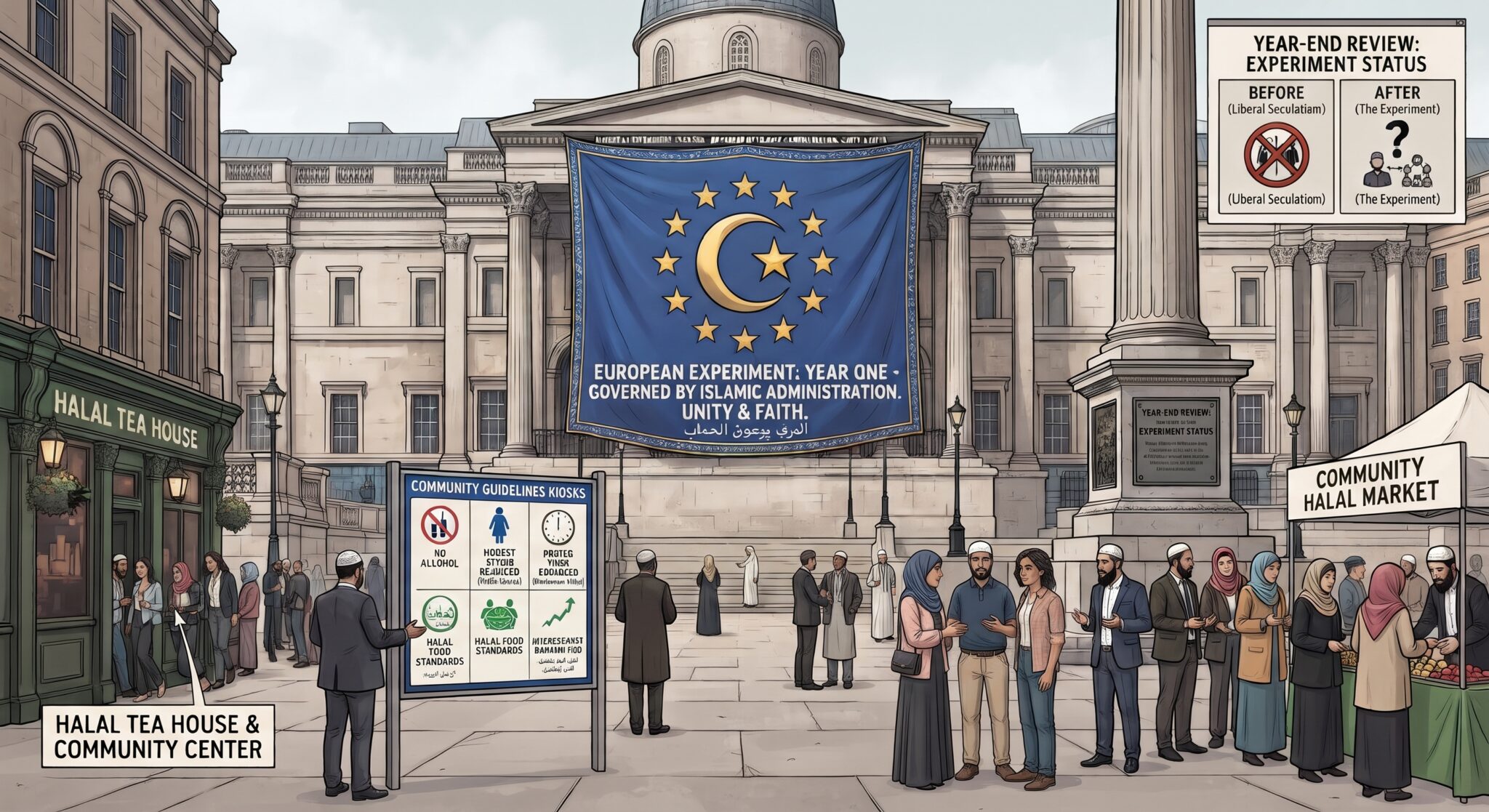
Instead, in a historic European election, a majority of citizens decides to hand political power to parties led by Muslims. For one year, Europe will have a new government.
But let us establish one condition: we are not talking about a dictatorship or a terrorist regime. We are talking about Muslim politicians who come to power through elections and who, at least initially, accept democratic rules.
And this is where our experiment begins. Because the interesting question would not be: “Would Europe be good or bad?”
The question would be: what would actually change over those 365 days? And the answer would probably be far more complicated than either side imagines.
Day 1: Europe Remains Exactly the Same
The first thing that would happen would be rather disappointing.
You would wake up. The supermarket would still be open, the underground would still run late, your boss would still send you emails, your mortgage would still demand its monthly payment, and probably nobody would force you to convert to Islam.
Why? Because governing a European country is not simply a matter of having a particular religion. There are constitutions, courts, parliaments, laws, European treaties, elections, civil servants, police forces and millions of citizens with rights.
A Muslim president could not wake up on a Monday morning and declare: “From today onwards, everyone must pray five times a day.” At least, not within a constitutional democracy that respects its own rules. And here comes the first lesson of the experiment:
Being Muslim does not automatically mean wanting to turn the state into an Islamic state.
But We Need to Change One Thing About the Experiment
For the experiment to become genuinely interesting, we need to imagine two different possibilities.
Scenario A: Democratic Muslims
Muslim politicians come to power who fully accept:
-
Democracy.
-
The separation of religion and state.
-
Religious freedom.
-
Freedom of expression.
-
Legal equality between men and women.
-
The rule of law.
In this case, the changes could be far smaller than some Europeans imagine.
Scenario B: Democratically Elected Islamists
Here, things change. These leaders believe that legislation should reflect Islamic religious principles and want to increase Islam’s role in public life. They continue to use elections, but attempt to transform institutions and laws progressively.
This second scenario is much more interesting for our experiment, because it forces us to ask where the limits of democracy lie.
Month 1: The Symbols Begin to Appear
During the first few weeks, the changes would probably be mainly symbolic.
More references to Islam at official events. Greater recognition of Muslim festivals. More funding for certain cultural and religious projects. Perhaps some public buildings would incorporate prayer spaces.
And a debate we know very well would probably emerge: how far should the state’s religious neutrality extend?
Because recognising that Muslim citizens exist is one thing.
Something very different is for the state to begin adopting a particular religion as a privileged element of national identity.
Europe would have to answer an uncomfortable question: should the state remain neutral towards religions, or should it reflect the religion of the political majority of the moment?
Month 2: Food Becomes Political
And then something seemingly much more trivial arrives: the menu.
The new governments might promote halal options in schools, hospitals, prisons and public institutions. Not necessarily because they wanted to force everyone to eat halal food.
Simply because they wanted to guarantee dietary options suited to Muslim citizens. So far, entirely reasonable.
But then the debate would begin:
Why halal? Why not kosher? Why not vegetarian? Why not any other option?
And we would discover something quite important: diversity policies can quickly turn into a competition for recognition.
Month 3: The Calendar Becomes Complicated
Now Ramadan arrives.
Imagine that European governments decide to introduce workplace adjustments during that month.
Adapted schedules. Greater flexibility. Certain forms of assistance.
Perhaps even official recognition of some Islamic holidays. Muslims would celebrate.
But then an inevitable question would arise: What about everyone else?
Europe does not have a single religion. There are Christians, Jews, atheists, agnostics, Hindus, Buddhists, people who believe in all sorts of things, and people who believe in absolutely nothing.
If the state increasingly adapts its institutions to a particular religion, a fundamental problem emerges: do we still have a neutral state?
Month 4: The Big Conflict Emerges: The Family
Here, the experiment begins to get serious.
Suppose the new leaders want to strengthen certain traditional family values.
They promote policies supporting motherhood. They advocate greater protection for the traditional family. They criticise certain cultural trends that they consider excessively individualistic.
So far, all of this is perfectly compatible with democracy. But imagine that they try to introduce legal restrictions based on a religious interpretation. The courts would immediately enter the picture.
Because Europe has fundamental rights. And here, two forces collide: religious freedom versus individual equality.
Month 5: Clothing Becomes a National Issue
And we arrive at the European classic: the veil.
Is it permitted? Yes.
Can it be banned? In certain contexts, some European countries already have restrictions.
Can a woman wear it everywhere? That depends on the country and its legislation.
Now imagine a European government clearly influenced by Islamism. It would probably try to reduce existing restrictions.
But then the opposite question would arise: can a woman be forced to wear it?
The answer should be very simple: no.
A liberal democracy should not force a woman to wear a veil.
Month 6: Education
This would probably become one of the biggest battlegrounds.
What is taught about religion? Is Islam studied in greater depth? Are Islamic religious education teachers introduced? Is the curriculum adapted? Are historical Muslim figures discussed?
All of this could be done without any problem.
But imagine that certain factions within the new government want to modify scientific or historical content because they believe it contradicts particular religious beliefs.
That would be a serious problem, because teaching about religion is one thing; using religion to decide what should count as scientific knowledge is another.
European schools would have to establish a very clear boundary: you can teach that a religion believes something, but that does not mean the state must teach that belief as a scientific fact.
Month 7: Freedom of Expression
And here we reach the most delicate point.
A government under strong Islamist influence might attempt to introduce rules against certain forms of speech considered offensive to Islam.
Perhaps certain cartoons would be banned. Perhaps restrictions on content considered blasphemous would increase. Perhaps certain works would be removed from public institutions.
Europe would then face a monumental problem, because freedom of expression includes precisely the right to criticise a religion.
Believers should be protected against discrimination, but a religious idea cannot become untouchable and immune to criticism.
Ultimately, we would end up with a democracy with a peculiar characteristic: everyone has freedom of expression, provided nobody takes offence.
In other words… nobody has freedom of expression.
Month 8: Alcohol
Now comes a much more visible measure.
Imagine that the Islamist leaders decide to drastically reduce alcohol consumption.
First, they increase taxes. Then they restrict opening hours. Next, they limit advertising. Finally, some factions propose banning it.
In a European society traditionally accustomed to wine, beer and nightlife, this would probably trigger a genuine cultural revolution.
Month 9: Women and Men
This would probably be the experiment’s biggest test.
What would happen to equality between men and women?
It would depend enormously on the kind of Muslim leaders we were imagining. A liberal European Muslim could defend exactly the same equality laws as any other politician.
A conservative Islamist government might attempt to modify certain aspects of marriage, divorce, inheritance, clothing, family life, education and sexual rights.
And that is where a constitutional battle would begin. Because Europe already has a fairly clear legal answer: individual rights cannot depend on religion.
Month 10: And What About Gay People?
Here, the experiment stops being amusing.
In present-day Europe, homosexuality is legally protected in numerous areas, and same-sex marriage is legal across much of the continent.
Here, the conflict would emerge. A government might attempt to restrict certain LGBTQ+ content in schools, limit sex education, modify equality policies, challenge same-sex marriage or restrict certain forms of public expression related to homosexuality.
European courts would then have something to say.
A government cannot use its electoral majority to remove fundamental rights from a minority simply because its religious interpretation considers that minority’s behaviour morally wrong.
And here we encounter a fundamental point:
A person may consider homosexuality morally wrong. What a democratic state cannot do is turn that religious opinion into legal inequality.
And Here Comes One of the Experiment’s Great Tests
Suppose that after one year Europe has a Muslim government, more mosques, more halal products, greater recognition of Ramadan and a stronger presence for Islamic culture.
All of that could be perfectly compatible with a liberal democracy.
But suppose, in addition, that gay people lose rights, certain criticisms of Islam are censored, women have fewer rights and leaving a religion is considered illegitimate.
That is when we would have a problem.
And not because the leaders are Muslim, but because they would be using religion to restrict individual rights. That should be the real red line in our experiment.
Day 365: The Experiment Ends
A year has passed.
Would Europe have become Saudi Arabia? No.
Would Europe be exactly the same as before? Neither.
The answer would probably be far more boring and far more interesting: it would depend on which Muslims were in power.
And this is precisely the experiment’s most important conclusion.
There is no magic button labelled “MUSLIMS” that transforms…
That is why the real question should not be:
“What would happen if Muslims governed Europe?”
It should be: “What would happen if a political movement based on a particular interpretation of Islam governed Europe?”
Now we have a serious experiment.
Conclusion: A Nightmare Worth Waking Up From
When the year finally ends and the end-of-term bell rings, European citizens take to the streets en masse, turn on their beer taps and sing a unanimous anthem celebrating liberal democracy and the secular state.
This thought experiment, however absurd and exaggerated it may seem, suddenly reminds us why the separation of political power from religious dogma is one of the West’s most valuable achievements.
Playing down fundamental freedoms out of fear of causing offence, or in the name of a misguided form of tolerance, is the first step towards allowing a dystopia of this kind to stop being science fiction and become the window through which we look at tomorrow.
Protect freedom, because once it goes out, it takes an enormous effort to switch it back on!