
A Religious Movement Europe Still Does Not Fully Understand
Imported Fundamentalism Reshaping Neighbourhoods
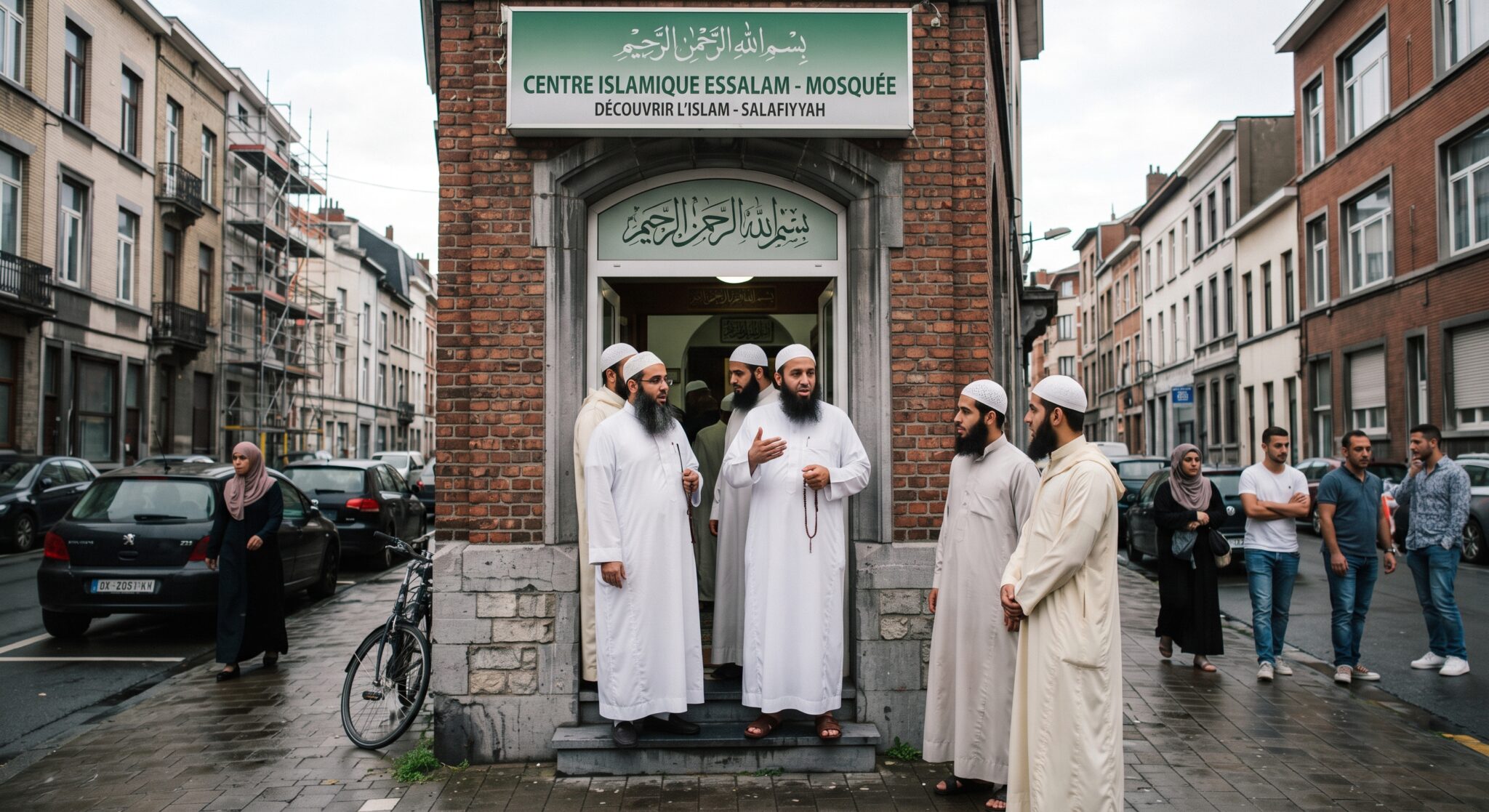
If you walk through some of Europe’s major cities, you may have noticed a subtle aesthetic and social change in certain neighbourhoods: women wearing full-length, strictly black garments; men with thick beards and no moustaches, wearing trousers above the ankles; and an outright rejection of the customs of the host country. We are not talking about the vast majority of European Muslims, who integrate their faith into democratic life as a matter of course, but about a very specific current: Salafism.
It is a religious movement that advocates a return to what it considers the authentic Islam of the earliest generations of Muslims. A significant proportion of its followers reject liberal democracy, religious pluralism and European social values. A smaller current can evolve towards violent jihadism.
That is precisely why it is worth studying without oversimplification. The question for Europe should not simply be: How many Salafists are there?
It should also be: What ideas do they defend, how are these ideas transmitted, why do they attract certain people, and what relationship do they have — or not have — with violence?
1. What exactly is Salafism?
Salafism is an ultra-conservative and fundamentalist current within Sunni Islam. Its name comes from al-salaf al-salih (“the pious predecessors”), meaning the first three generations of Muslims.
Its basic premise is simple but radical: to return to the original purity of the seventh century and purge the religion of any “innovation” or adaptation to modern times. For a Salafist:
Salafists believe that Muslims should seek to imitate the earliest generations of Islam, particularly the companions of Muhammad and the generations immediately after them.
Their fundamental idea can be summarised very simply: the closer a believer comes to the interpretation of the earliest Muslims, the more authentic their Islam will be. This produces a highly conservative interpretation of the religion.
Certain Salafist sectors strongly reject religious innovations, interpretations considered modern, Western customs, religious pluralism, equality between men and women, sexual relations outside marriage, certain forms of entertainment and artistic representation, and the consumption of alcohol.
2. Three different forms of Salafism
Although the boundaries are not always perfectly clear, we can identify three broad tendencies.
Quietist Salafism
This is the branch that focuses primarily on religion.
It wants its followers to live according to a strict interpretation of Islam, but does not necessarily seek to take over the state or use violence. It can be extremely socially conservative without being terrorist.
Political Salafism
Here, religion begins to enter politics directly.
The idea is that society should be organised according to Islamic principles. This can involve a profound criticism of liberal democracy, particularly when popular sovereignty is considered to conflict with the sovereignty of God.
Jihadist Salafism
This is the most dangerous branch. It considers the use of violence legitimate as a means of achieving political and religious objectives. This is where we find the ideology that fuelled organisations such as Al-Qaeda and the Islamic State.
This is where terrorism comes directly into the picture. Germany’s intelligence service currently points out that, although Salafism can provide an ideological foundation for jihadism, the connection between the two is not automatic in Germany or other European countries.
3. So why is Salafism such a concern?
What do they advocate? (The ideology)
Divine law (Sharia) takes precedence over any democratic constitution or European civil law.
The separation of religion and state does not exist; everything must be governed by their literal interpretation of sacred texts.
Cultural isolation: separation from Western society, which is considered “decadent”, is encouraged, creating ideological ghettos where local rules of coexistence supposedly do not apply.
Certain Salafist ideas conflict with fundamental principles of liberal democracies.
The real political problem for Europe emerges when a religious interpretation seeks to become a compulsory rule for the entire society. This is where the clash with liberal democracy occurs.
4. How did Salafism arrive in Europe?
There is no single date on which it arrived. Islam had already been present in Europe for centuries. However, contemporary Salafism began to gain prominence mainly during the second half of the twentieth century. Several factors contributed to this development.
Migration: During the decades following the Second World War, millions of workers arrived from Muslim-majority countries.
France received large communities from the Maghreb.
Germany received a large community from Turkey.
The United Kingdom received substantial communities from South Asia.
Belgium, the Netherlands, Italy, Spain and other countries also developed significant Muslim communities.
Academic research highlights differences between countries. In France, Belgium, the Netherlands and Germany, Salafism has established a significant presence among communities of Maghrebi origin, while in the United Kingdom it has followed different paths linked to communities from South Asia. But immigration alone does not explain the growth of Salafism.
Money, networks and preachers: For decades, international networks for funding, religious exchange and preacher training also developed.
Certain Gulf countries acquired enormous influence in spreading ultra-conservative interpretations of Islam internationally.
Mosques were built, associations were funded, books were distributed, preachers were sent abroad and international religious networks were established.
The internet changed the rules of the game: Then the internet arrived. This was probably more important than any mosque.
Previously, a young person interested in an ultra-conservative interpretation of Islam needed to find a preacher.
Now they can find hundreds from their bedroom. YouTube. Telegram. TikTok. Instagram. Forums. Messaging apps. Private channels. Religion ceased to depend exclusively on local religious institutions.
A young person in Barcelona, Paris, Berlin or London can listen daily to a preacher thousands of kilometres away and join a digital community with people they have never met in person.
The preacher became an influencer. This change is particularly important. New preachers no longer necessarily need a large mosque.
Germany’s 2024 report on the protection of the constitution specifically notes that Salafist preachers and prominent figures on social media use communication methods similar to those of mainstream influencers. They can reach hundreds of thousands of young people seeking an identity.
This completely changes the problem. The new space for radicalisation may not be a mosque. It may be a mobile phone.
5. Why are some young people attracted to it?
This is probably more important than any statistic, because an ideology does not grow simply because someone promotes it. It has to offer something.
Salafism can offer certain people:
Identity: “I know who I am.”
Community: “I belong to a group.”
Security: “We have clear answers.”
Morality: “We know what is right and wrong.”
Purpose: “My life has a mission.”
Distinctiveness: “We are the true Muslims.”
This can be particularly attractive to young people who feel they are living between two worlds.
6. The European paradox
Here we encounter an interesting paradox. Europe offers enormous religious freedom.
A Muslim can practise their religion, build mosques, open associations, wear certain religious symbols and raise their children within their tradition.
But that very freedom can also allow movements that reject the fundamental principles of the system providing that freedom to flourish.
This is one of the major questions Europe has yet to resolve fully: how far should a liberal democracy extend its tolerance towards movements that challenge some of its fundamental values? Salafism has brought this question to the forefront.
7. Salafism in Europe
Germany: This provides one of the best examples for observing how the phenomenon has evolved.
The Federal Office for the Protection of the Constitution estimated that approximately 11,000 people belonged to the Salafist milieu in 2024, compared with 10,500 in 2023. The same report notes that Salafism had experienced a slight decline since 2012, but that this trend may have begun to reverse in 2024.
France: This is probably one of the European countries where the phenomenon has become most visible.
There are several reasons: a large Muslim population, a long history of immigration from the Maghreb, significant religious networks and numerous suburban neighbourhoods.
Belgium and the Netherlands: These countries have also developed significant Salafist networks.
The United Kingdom has followed a different path because of its migration and religious history.
Spain: Salafism in Spain is quite diverse. There are individuals and communities that adopt a highly conservative religious interpretation but reject violence and terrorism. There is also a much smaller current that embraces jihadist Salafism.
Studies of Spain show that the Salafist presence is particularly significant in Catalonia, Madrid, the Valencian Community, Ceuta and Melilla.
Catalonia is the most interesting case. Between 2012 and 2023, approximately 35.8% of jihadists convicted or killed in Spain resided in Catalonia, according to the Elcano Royal Institute’s database. More than half of them lived in the province of Barcelona. The study itself links this concentration, among other factors, to a stronger Salafist presence in Catalonia and a visible Salafist ecosystem.
A study published after the Barcelona and Cambrils attacks noted that, in 2016, approximately one-third of Catalonia’s 256 places of worship and Islamic centres were considered to be under Salafist influence, according to an estimate cited by Elcano Royal Institute researchers.
That figure is old, and we should not present it today as though it were a snapshot of 2026. But it helps explain why Catalonia has attracted so much attention.
Ceuta and Melilla are a different case, involving very specific geographical and social factors.
Ceuta and Melilla have substantial Muslim communities, share a direct border with Morocco and contain certain neighbourhoods affected by segregation and marginalisation.
Studies of jihadism in Spain have found a significant concentration of radicalisation cases in both cities. Between 2012 and 2023, Ceuta accounted for 10% and Melilla for 8.4% of the jihadists convicted or killed who were resident in Spain and included in Elcano’s study.
Earlier research has also highlighted the Príncipe Alfonso neighbourhood in Ceuta and Cañada de Hidum in Melilla as areas where certain fundamentalist currents gained a significant foothold.
There is therefore no single “European Salafist model”. There are different forms of Salafism across Europe.
8. Are all Salafists immigrants?
No. This is another common misconception. There is a significant number of European converts.
A person may have been born into a completely secular family, converted to Islam and subsequently adopted a Salafist interpretation.
Someone born into a Muslim family may also adopt Salafism during adolescence or early adulthood.
This demonstrates something important: the phenomenon can no longer be explained simply as an import from the Middle East. Salafism is also becoming a European phenomenon.
9. Salafism and jihadism: The uneasy relationship
This is probably the most sensitive issue.
Historically, Salafism provided part of the religious vocabulary later used by jihadist movements.
Al-Qaeda and the Islamic State present themselves as defenders of a supposedly authentic Islam. This is why there is an intellectual relationship between certain Salafist currents and jihadism.
10. Twenty-first-century Salafism is much more digital
This is probably one of the most important transformations. A preacher can record a video in ten minutes. That video can reach thousands of people.
Europol has spent years specifically studying online jihadist propaganda and has observed how Al-Qaeda, the Islamic State and their supporters use digital platforms to spread narratives, propaganda and calls to mobilisation.
Is Salafism growing? The answer cannot simply be “yes”. In some places, it appears to be growing. In others, it has declined. Elsewhere, it has changed.
Germany offers an interesting example: the estimated number of Salafists fell from 11,000 in 2022 to 10,500 in 2023, before returning to approximately 11,000 in 2024.
But there is a more interesting point: influence can grow without a proportional increase in membership.
A preacher with 20,000 digital followers does not need to turn all of them into members of an organisation. They can influence their language, opinions, interpretation of religion and perception of Europe.
That is why measuring only the number of organised Salafists may give an incomplete picture.
11. The real battleground: Identity
This is probably where the future of the phenomenon lies. Europe has millions of young Muslims born in Europe. Many feel entirely European; others feel Muslim and European at the same time; still others have a more conflicted identity.
Some may find an appeal in a message telling them: “You are not really European.” “Your true identity lies elsewhere.”
This type of message can create a psychological boundary: them and us. When that boundary becomes extreme, integration becomes much more difficult.
12. What should Europe do?
First measure: Distinguish religion from extremism
A Muslim who practises their religion is not a security problem. A movement seeking to destroy fundamental rights can become a political problem.
Second measure: Monitor foreign funding
Europe should have a better understanding of who funds a mosque, who pays its preachers, which organisations receive foreign money and what strategic interests lie behind that funding.
The EU is currently paying greater attention to foreign influence, funding and transnational networks associated with radicalisation and extremism.
Third measure: Develop a more autonomous European Islam
If Europe wants to reduce its dependence on imported religious narratives, it needs to develop European Islamic structures capable of training their own religious leaders.
Imams who understand European history, liberal democracies, European laws, fundamental rights and the social realities of their communities.
The aim is not to create an “official Islam”, but to ensure that a European Islam exists that can engage in dialogue with Europe from within Europe.
Fourth measure: Do not surrender the question of identity
Europe has a problem that the police cannot solve. If a young person feels they do not belong anywhere, a movement offering them an identity will have an opportunity.
That is why integration cannot be reduced to: “Learn the language and get a job.” There must also be a sense of belonging.
A young European Muslim should be able to say, “I am Muslim and, at the same time, I am European,” without feeling that they have to choose between the two identities.
13. What future will Salafism have in Europe?
There are several possible scenarios.
Scenario 1: Stabilisation
Salafism continues to exist as a minority, conservative current. It maintains a presence on the internet and within certain communities, but remains relatively limited. This is probably the least disruptive scenario.
Scenario 2: Digital growth
The number of organised followers does not increase significantly, but their capacity to influence others grows enormously.
The preacher becomes an influencer, the community ceases to depend on the mosque, and the mobile phone becomes the main tool for spreading ideas. This scenario is particularly plausible.
Scenario 3: The emergence of a European Salafism
This scenario is particularly interesting.
A new generation could emerge that retains a highly conservative religious interpretation but fully accepts democracy, European citizenship, religious freedom, the rule of law and equality before the law.
This would be a profound transformation. Religious conservatism would not necessarily disappear, but much of the conflict with the European political system would.
The big question: Can a European Salafism exist?
This is one of the major debates of the future.
Can a Salafist fully accept that another person may be an atheist?
Can they accept that a Muslim may leave Islam?
Can they accept that a Muslim woman may choose not to wear a veil?
Can they accept that a homosexual person has exactly the same civil rights?
Can they accept that civil law takes precedence over any religious interpretation?
If the answer is yes, Europe can coexist with religious conservatism. If the answer is no, conflict with liberal democracy will be inevitable.
14. Conclusion: Neither demonisation nor naivety
Europe has made two opposite mistakes.
The first is to say: “Salafism is simply terrorism.”
The second is to say: “As long as there is no violence, any religious ideology is politically irrelevant.”
Between these extremes lies a much more interesting question: which ideas are compatible with liberal democracy, and which conflict with it?
The future of European Islam will not depend solely on how many Muslims there are. It will depend on what kind of Islam develops among the new generations of Europeans.
And that is probably the most important battle of the coming decades: not the battle against Islam, but the battle over which form of Islam will ultimately become part of the Europe of the future.