
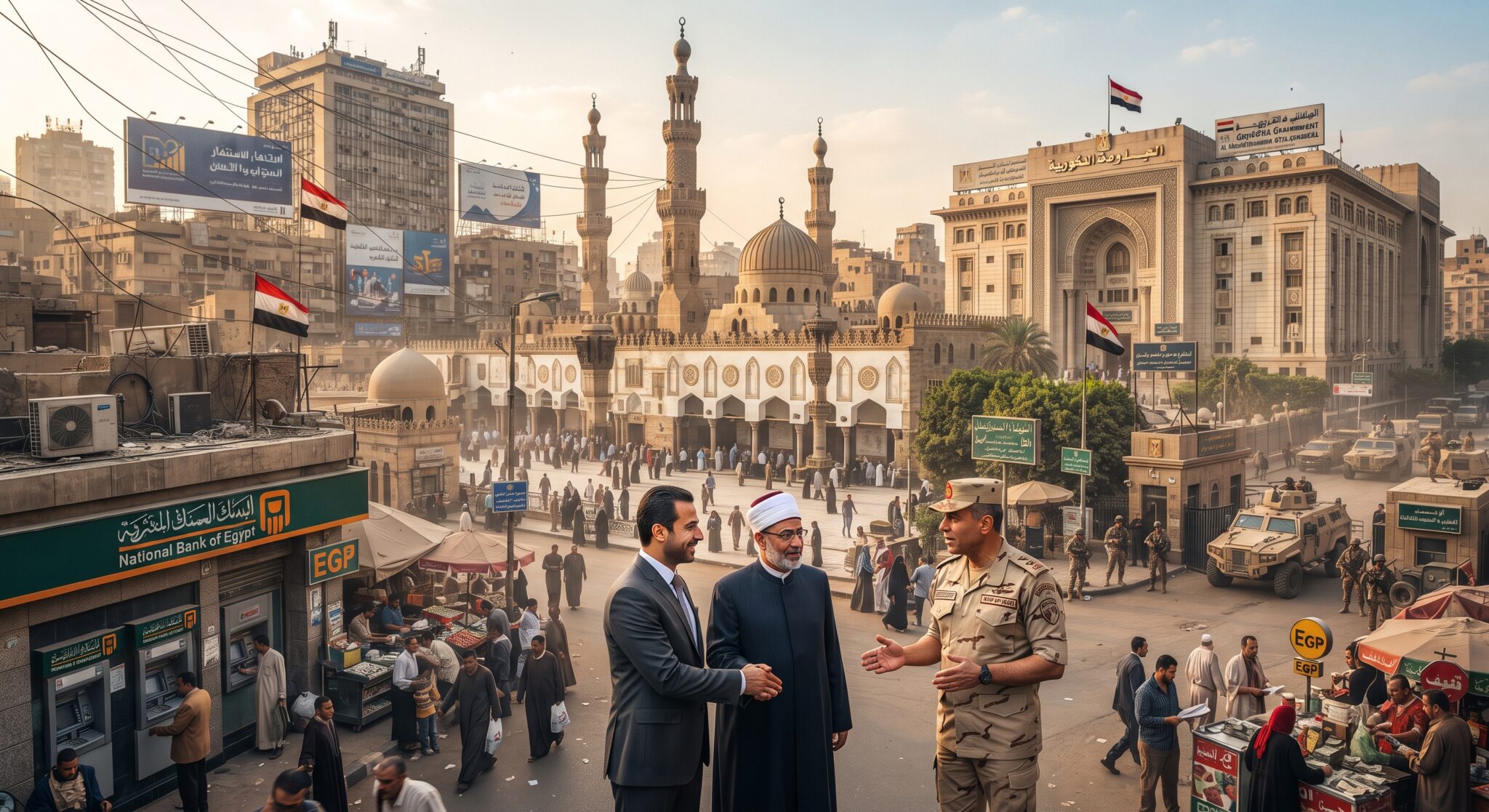
To Understand Islam in Europe, We Must Look at Its Roots
To understand Islam in Europe, we must look beyond Europe’s borders.
The Islam we find in Europe today did not originate in Europe. Its ideas, religious currents, institutions, leaders and many of its organisational structures have their roots in countries where Islam is the majority religion.
Therefore, if we want to understand what kind of Islam is coming to Europe, where it comes from, who represents it and what influence it may have, we must first understand what is happening in its countries of origin.
There is no single Islam. There are different currents, religious schools, organisations and interpretations. There are also major differences between countries. Islam in Egypt is not exactly the same as Islam in Algeria, Morocco, Saudi Arabia, Turkey or the Gulf states.
Furthermore, religion does not always operate separately from power. In many Muslim-majority countries, religious institutions maintain important relationships with the state, governments, the military, business leaders and various social organisations. These relationships can influence how Islam is interpreted and transmitted.
Some of that influence can reach Europe through mosques, associations, religious organisations, funding, educational centres, religious leaders, international networks or immigrant communities.
For this reason, studying Islam in Europe without also studying its roots can lead to an incomplete picture.
The question is not simply, “What kind of Islam exists in Europe?”
We must also ask: Where does it come from? Who funds it? Who represents it? What institutions stand behind it? Which religious current does it promote? What relationship does it maintain with the political power of its country of origin? And how does it change when it arrives in Europe?
In this series of articles, we will analyse precisely this ecosystem.
Country by country, we will examine religious institutions, their main currents, who holds power within them, how they are funded, their relationships with politics, business and other power structures, and the connections that may exist with Europe.
The aim is to understand Islam’s roots in order to better understand its presence in Europe. Because before we can engage properly with any phenomenon, we must first understand how it works, where it comes from and who its main actors are.
The ecosystem of Islamic power in Egypt is not limited to the faith of its citizens. It is a complex machinery in which the state’s official religion, military politics, major economic interests and international networks of influence are intertwined. Unlike in some other countries, religious authority in Egypt competes and cooperates closely with military power, which acts as the country’s real steering force.
Al-Azhar, the Army, the Government, the Muslim Brotherhood, Money and the Struggle to Control Islam: Egypt Has No Single Islamic Power Centre
If we want to understand Islam in Egypt, there is one question we must ask from the outset: who has the authority to speak on behalf of Egyptian Islam?
The answer is not straightforward. In Morocco, the king can be identified relatively clearly as the centre of religious authority.
Egypt is different. Here, we find several centres of power: the president, the Army, Al-Azhar, the Ministry of Awqaf, Dar al-Ifta, religious organisations, business leaders and, for decades, various Salafist and Islamist movements.
This makes Egypt particularly interesting. We are not dealing with a system in which the state simply controls religion. We are dealing with a constant struggle to control, define and use religion.
At the centre of this struggle stands an exceptional institution: Al-Azhar, an institution with more than a thousand years of history, enormous religious prestige and an influence extending far beyond Egypt’s borders.
First, We Must Understand the Egyptian State
The Egyptian Constitution establishes that Islam is the religion of the state; the principles of sharia are the principal source of legislation; Al-Azhar is an independent Islamic scholarly institution; Al-Azhar has exclusive authority over its own affairs; it is responsible for preaching Islam and spreading religious sciences and the Arabic language; and the state must provide it with sufficient funding to fulfil its objectives.
Egypt therefore has a distinctive characteristic: religion is not separate from the state, but neither can we say that the state has absolute control over every religious institution.
And that is where the struggle begins.
The First Actor: The President
Since the revolution of 1952, the president has occupied an extraordinarily powerful position in Egypt.
Gamal Abdel Nasser. Anwar el-Sadat. Hosni Mubarak. Mohamed Morsi. Abdel Fattah el-Sisi.
The first four presidents of the Republic came from different backgrounds, but the Army was at the origin of the republican regime and retained a central position. Under Sisi, that relationship entered a new phase.
Sisi served as defence minister and commander of the Armed Forces before becoming president. To understand religious power today, therefore, we must consider two institutions together: THE PRESIDENCY AND THE ARMY. Then we must ask: how do they relate to Al-Azhar?
The Religious Giant: Al-Azhar
Al-Azhar is not simply a university. It is simultaneously a university, a centre for Islamic studies, an educational network, a religious institution, an international reference point for Sunni Islam and a political actor.
Its importance is enormous. The Egyptian Constitution recognises Al-Azhar as the principal institutional authority on theological and religious matters.
The Grand Imam is elected by Al-Azhar’s Council of Senior Scholars and subsequently formally appointed by the president. His tenure is for life, and the president has no legal authority to dismiss him.
This is extremely important because it means that the president is very powerful but cannot simply dismiss the Grand Imam when a disagreement arises. Al-Azhar therefore retains a degree of autonomy.
Al-Azhar Is Not Simply an Extension of the Government
This is one of the easiest things to misunderstand.
Al-Azhar receives public funding and forms part of the state’s institutional system. But that does not mean all its leaders automatically obey the president.
Studies of Egyptian religious politics reveal a persistent tension between Al-Azhar and political power. The institution has maintained its own identity and sought to protect its autonomy from the presidency and other state religious institutions.
In other words, Al-Azhar needs the state, but the state also needs Al-Azhar. This mutual dependence produces both negotiation and conflict.
Why Does the Government Need Al-Azhar?
Because Al-Azhar possesses something the Army cannot manufacture: religious legitimacy.
A president can command the police, and a government can pass laws, but neither can automatically become a religious authority respected by millions of Muslims.
Al-Azhar has that capacity. That is why political power needs its recognition.
When Al-Azhar supports a particular position, that position can acquire religious legitimacy that the government alone does not possess.
But Al-Azhar Also Needs the State
Here is the other half of the equation. Al-Azhar receives state funding, and the state provides the resources needed to maintain its enormous educational and religious structure.
The relationship can be summarised as follows:
Government → funding / Al-Azhar → religious legitimacy
This relationship is one of the keys to the system. It is not exactly subordination, but neither is it independence. It is a relationship of mutual dependence.
The Grand Imam
The central figure at Al-Azhar today is Grand Imam Ahmed al-Tayeb. His position is particularly important because institutional safeguards protect his office from the presidency. This allows him to maintain positions of his own.
At various points in recent history, Al-Azhar has disagreed with the government’s political and religious decisions. This helps explain why Sisi has also tried to strengthen other religious institutions.
And here we encounter another actor.
The Ministry of Awqaf
Awqaf roughly means religious endowment properties.
The Ministry of Awqaf administers a substantial part of the day-to-day religious apparatus.
Its responsibilities include mosques, imams, preaching, religious heritage, religious training, supervision of sermons and part of the administration of religious endowments.
The government appoints, pays and supervises imams at authorised mosques. Preachers need authorisation, and the ministry can sanction those who fail to comply with its rules. This allows the state to exert enormous influence over what happens inside mosques.
The Friday Sermon: A Tool of Power
Here we find a fundamental component of the system. On Fridays, millions of Muslims attend mosques. The sermon can be one of the most powerful tools of social communication in any Muslim society.
For this reason, the Egyptian state tries to control who preaches and what is preached. The Ministry of Awqaf can provide sermon topics and texts. Imams who follow certain guidelines may receive incentives, while those who break the rules can be sanctioned or even lose their licences.
In other words, controlling the pulpit means controlling an important part of religious communication.
Then There Is Dar al-Ifta
Here we find another institution that is often overlooked.
Dar al-Ifta al-Misriyyah, the Egyptian House of Fatwas, was established in 1895 and initially operated in connection with the Ministry of Justice.
Its main function is to issue fatwas, meaning religious legal opinions on questions raised by citizens, institutions and authorities.
Today, it describes itself as a non-profit governmental institution that operates with operational independence and has significant international activity.
Its role is substantial. It can issue opinions on marriage, divorce, finance, inheritance, social behaviour, medical matters, terrorism, extremism and hundreds of everyday issues.
For this reason, Al-Azhar and Dar al-Ifta are two distinct centres of religious authority.
Who Can Issue a Fatwa?
The Egyptian system is quite complex in this respect.
According to the US State Department’s report on religious freedom, four bodies are officially authorised to issue fatwas: Al-Azhar’s Council of Senior Scholars, Al-Azhar’s Islamic Research Academy, Dar al-Ifta and the General Directorate of Fatwas within the Ministry of Awqaf.
This means there is no single religious voice. There are several, and that creates competition.
Four Centres of Authority
We can map the system as follows:
-
AL-AZHAR: Academic and religious authority.
-
DAR AL-IFTA: Fatwas and religious legal advice.
-
MINISTRY OF AWQAF: Mosques, imams and preaching.
-
PRESIDENCY: Political power and state leadership.
-
ARMY AND SECURITY SERVICES: The state’s coercive and strategic power, operating above or around all these institutions.
This explains why Egypt is much more complicated than Morocco.
The Great Invisible Actor: The Army
If we want to understand Egypt, we cannot relegate the Army to the background. Since the Republic was established in 1952, the Armed Forces have played a central political role. After 2013, that role expanded considerably.
In July 2013, the Army removed President Mohamed Morsi from power. Morsi had reached the presidency through elections. Abdel Fattah el-Sisi, then defence minister, subsequently became president.
Since then, the Army has become one of the country’s principal centres of power.
The Army Controls More Than Weapons
Here we encounter a particularly important characteristic.
The Egyptian Armed Forces also have an enormous economic presence. They manufacture products, participate in construction, manage infrastructure projects, engage in food production, work with public land and resources, participate in various industrial sectors, and maintain networks of retired officers who occupy important positions in companies and state bodies.
Research by the Carnegie Endowment describes the Army as an autonomous economic actor capable of influencing markets, investment and public policy. This completely changes our map of power.
Army + Economy + Politics
We can summarise it as follows:
ARMY = Political control, access to public resources, contracts, companies, infrastructure and economic influence.
This means that military power does not depend solely on the defence budget. An entire economic ecosystem exists around the Armed Forces.
The Army Also Enters the Religious Sphere
Research into Egypt’s military economy has noted that companies and organisations linked to the Armed Forces have also entered activities associated with religious endowments and pilgrimages. The involvement of retired officers in economic activities connected with pilgrimage routes and services has also been documented.
This demonstrates that the boundaries between the military, the state, the economy and religion are intertwined.
Business Leaders: First, Mubarak’s “Whales”
To understand the relationship between business and power, we must go back to Hosni Mubarak. During the final decades of his regime, a powerful class of businesspeople emerged with close links to political power.
They were particularly associated with Gamal Mubarak and the National Democratic Party. These businesspeople obtained contracts, access to resources, privatisation opportunities and privileged economic positions.
Carnegie notes that during the 1990s and 2000s, businesspeople connected to Mubarak and his son Gamal came to wield greater economic influence than companies directly linked to the Army.
This created a rivalry.
On one side were civilian businesspeople connected to the presidency.
On the other were the Army and military officers.
The 2011 revolution completely altered that balance.
2011: The System Breaks Down
In 2011, Mubarak fell. The Army temporarily took political control. And an opportunity emerged that the Muslim Brotherhood had been waiting decades to seize.
The Muslim Brotherhood: The Great Alternative Religious Power
The Muslim Brotherhood was founded in Egypt in 1928. Over the following decades, it developed an enormous social network. It was not merely a political organisation.
It also established schools, hospitals, pharmacies, charities, mosques and support structures.
This model enabled it to build direct relationships with sections of the population. Its greatest strength was not merely religious; it was also social and organisational.
Mohamed Morsi: When Islamism Reaches the State
Following the 2011 revolution, the Muslim Brotherhood won the parliamentary elections, and Mohamed Morsi became president in 2012.
For the first time, an organised Islamist movement had reached the heart of the Egyptian state.
But Morsi made a fundamental mistake in terms of the balance of power: governing Egypt did not mean controlling the Egyptian state.
The Army remained extremely powerful. Al-Azhar, the judiciary, the police, the intelligence services, economic interests, the media and numerous elites also existed outside the Muslim Brotherhood’s control.
2013: The Final Confrontation
In 2013, political tensions reached breaking point. The Army intervened. Morsi was deposed, and the Brotherhood was subsequently banned and persecuted.
The government designated the organisation as a terrorist group, and its political structure was dismantled within Egypt. The result was radical. The state came to regard the Muslim Brotherhood not simply as an electoral opponent, but as a national security threat.
The State Dismantles the Brotherhood’s Social Infrastructure
This aspect deserves particular attention. The state did not simply ban the party. It also targeted the social infrastructure that had enabled the Brotherhood to build influence.
Academic research describes four strategies: nationalisation, corporatisation, extraction of resources and the creation of new institutions. These were used to bring the Islamic services sector under state control.
In December 2013, more than a thousand Islamic associations were taken over.
This is fundamental because controlling religion does not simply mean controlling mosques. It also means controlling who helps the poor, who runs schools, who provides services, who collects donations, who organises associations and who builds a social network.
The Major Shift Under Sisi
Sisi’s model can be summarised as follows.
Before: Official Islam, Al-Azhar, the Brotherhood, Salafists, charities and independent mosques.
After 2013: The state sought to concentrate control over the religious sphere. Associations were given less autonomy; control over mosques and imams increased; religious funding and Islamic organisations came under greater scrutiny; and religious discourse was more closely monitored.
Academic research describes this process as an authoritarian reconstruction of the Islamic sector.
Does This Mean Sisi Controls Al-Azhar?
Not completely. And we must avoid oversimplification here.
Sisi has tried to strengthen state institutions under executive control, but Al-Azhar retains considerable autonomy. Researchers have, in fact, described a persistent tension between the government and Al-Azhar.
The government needs a religious institution that can legitimise the state, but Al-Azhar does not want to become merely a government department.
This creates an uncomfortable balance: the state wants to use Al-Azhar’s authority but cannot always control it completely.
Al-Azhar Versus the Army
This is probably one of the most interesting relationships.
The Army possesses coercive power, money, companies, territory and political influence.
Al-Azhar possesses religious legitimacy, religious knowledge, historical prestige and an educational network.
Neither can completely replace the other. We can therefore think of their relationship as a kind of exchange:
The Army says, “I can maintain the state.”
Al-Azhar says, “I can provide religious legitimacy.”
Both need to prevent a third actor from emerging that could dominate the religious sphere: independent political Islamism.
The Common Enemy: Independent Islamism
Since 2013, the regime has sought to eliminate or neutralise independent Islamist structures.
But a paradox emerges here. The state needs to combat extremism, yet to do so it also wants to control religious discourse.
This has led to policies designed to control sermons, train imams, regulate mosques, supervise associations, control funding and promote particular religious narratives.
The government presents these measures as tools against extremism. They can also be interpreted as mechanisms of political control.
And What About the Salafists?
Salafists are another important element.
After 2011, some Salafist movements gained considerable political influence. The al-Nour Party became an important electoral force.
But after 2013, their political space contracted considerably.
The Sisi regime has preferred a model of religious Islam controlled by the state over organised political Islam operating independently of it.
This distinction is fundamental. The government does not seek to eliminate Islam. It seeks to eliminate or neutralise centres of Islamic power that could compete politically with the state.
Money: Who Funds Egyptian Islam?
Here, we need to distinguish between several sources.
-
The state: Funds institutions such as Al-Azhar.
-
The Ministry of Awqaf: Administers religious endowments and finances part of the mosque and imam infrastructure.
-
Awqaf or religious endowments: Assets dedicated to religious and social purposes.
-
Private donations: Historically important for religious and charitable organisations.
-
Businesspeople: May fund religious and charitable initiatives.
-
Social organisations: Played an important role in service provision for decades.
-
Foreign funding: Has been important at certain times and in certain sectors, particularly in connection with Islamist movements and transnational religious networks.
The fundamental point is that money creates autonomy. An organisation that controls its own finances can establish schools, hospitals, mosques, media outlets, associations and support networks. That is why controlling funding also means controlling power.
The Money Behind Charity
This point deserves particular attention.
Imagine a poor family with two options:
-
Receive assistance from the state.
-
Receive assistance from a religious organisation.
If the religious organisation provides food, medicine, education, financial assistance, employment and social support, it builds something more important than a good reputation: social dependence.
And social dependence can become political influence.
This explains why charitable organisations were at the centre of the competition between the state and the Muslim Brotherhood for decades.
Egypt’s External Religious Power
Here we reach another fundamental dimension.
The Egyptian Islamic ecosystem does not end at Egypt’s borders.
Al-Azhar is a global institution. Its influence reaches Africa, Asia, the Middle East, Europe and Muslim communities around the world.
Dar al-Ifta also seeks to become an international reference point for issuing fatwas and explicitly states that its work is directed towards Muslims worldwide.
Egypt therefore possesses something other states do not: an enormous international infrastructure of religious authority.
Al-Azhar as an International “Brand” of Sunni Islam
Over the centuries, Al-Azhar has accumulated prestige.
An African student can study at Al-Azhar. A European Muslim can consult an Egyptian fatwa. A foreign government can seek religious cooperation. An imam can receive training in Egypt.
This generates soft power. Egypt can influence other countries not only through diplomacy or the military, but also through religious education, imam training, fatwas, books, conferences and religious cooperation.
The Struggle for Islam Is Also a Geopolitical Struggle
Here the issue becomes even more interesting. Egypt competes indirectly with other centres of Islamic authority, including Saudi Arabia, Morocco, Qatar, Turkey and other countries.
Each seeks to promote particular interpretations, institutions or networks. Islam is therefore not merely a spiritual matter. It can also be a tool of diplomacy, soft power, regional influence and security policy.
The Great Battle: Controlling Authority
We now arrive at the heart of the problem.
The real struggle is not simply: “Is Egypt an Islamic state?”
The much more interesting question is: Who has the right to define what Islam means in Egypt?
The Muslim Brotherhood’s answer is organised Muslim society.
Al-Azhar’s answer is the religious scholars and the academic tradition.
The Ministry of Awqaf’s answer is the state-regulated religious institution.
Dar al-Ifta’s answer is authorised specialists in Islamic jurisprudence.
The government’s answer is that the state must guarantee stability and combat extremism.
And the Army provides something different: the capacity to impose political order.
And Here We Find a Major Paradox
Egypt seeks to control Islam to prevent political Islam from controlling the state.
In other words, the state controls religion to prevent a religious organisation from controlling the state. This is probably one of the best ways to summarise the Egyptian model.
But it has a consequence: the more the state controls religious discourse, the harder it becomes to determine where religion ends and politics begins.
Is Egypt a Secular State?
No. The Constitution establishes that Islam is the religion of the state and that the principles of sharia are the principal source of legislation.
But neither is Egypt an Islamic republic in the Iranian style. The Egyptian system is different.
We could define it as an authoritarian republican state in which Islam enjoys constitutional privilege and the state apparatus seeks to control the religious sphere.
Within that sphere, one institution enjoys extraordinary autonomy: Al-Azhar.
Conclusion
Egypt does not have a single owner of Islam. It has a struggle for religious authority. The Egyptian Islamic ecosystem is much more complex than it appears, and no single institution controls everything.
The Army has the weapons, the government controls the state, but Al-Azhar possesses something different: religious authority. That is why the relationship between the Army, the government and Al-Azhar is one of the keys to understanding Egypt.
The great paradox is that the regime needs a religious institution strong enough to provide legitimacy, yet sufficiently controlled to prevent it from becoming an independent political power.
Al-Azhar, meanwhile, needs the state to fund its enormous structure, but it must also preserve enough autonomy to remain credible as a religious authority.
At the same time, the government seeks to keep the Muslim Brotherhood outside the system and control independent religious networks, particularly their social and economic resources. The persecution and dismantling of the Brotherhood’s structures after 2013 were fundamental elements of this strategy.
The result is a system that can be summarised as follows: in Egypt, political power needs Islam, but it does not want Islam to possess independent political power. This tension explains much of contemporary Egyptian politics.