

The Habit of Questioning: Why Freedom of Expression on Islam Must Be Democratised in Europe
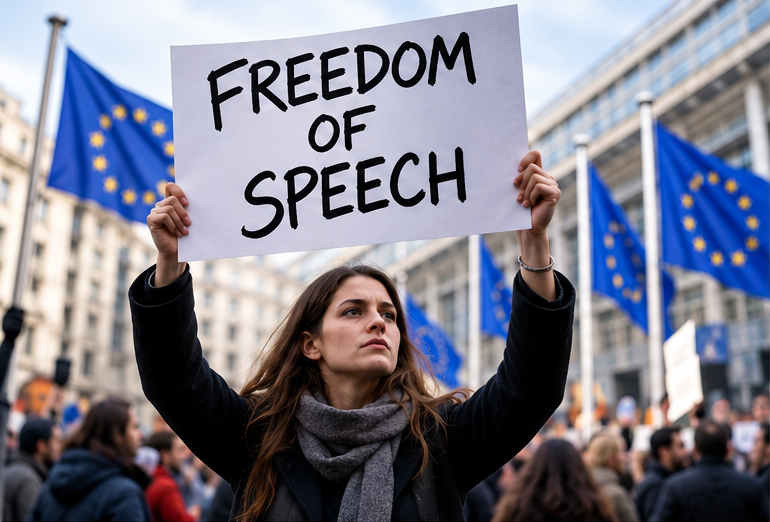
Expanding the Boundaries of Freedom of Expression: When criticism of Islam ceases to be an exception and becomes a normal practice in a democratic society.
A free society is not one in which nobody feels offended, but one in which ideas can be challenged without offence becoming a reason to silence them.
1. The Problem: Why Do Some Criticisms Still Make Headlines?
In Europe, criticising Christianity is part of everyday life. People make jokes about the Church, question religious dogmas, satirise sacred figures and publicly discuss the influence of religion on politics. Such criticism may cause anger, but it is not usually considered an extraordinary event.
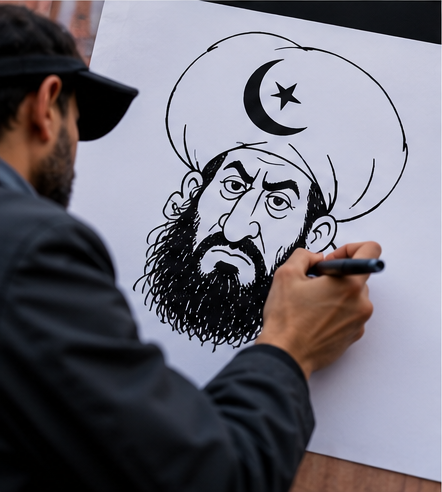
With Islam, however, certain debates can take on a particular intensity. A cartoon of Muhammad, criticism of the hijab, a discussion about Islamic law or a question about the role of religion in education can quickly turn into a political, media or social controversy. Some religious issues have become particularly sensitive subjects.
The problem arises when this sensitivity begins to function as an informal boundary: certain issues can be discussed, while others seem too delicate to address openly.
A democracy should not decide which ideas may be criticised according to how much anger that criticism might provoke.
2. Moving the Red Lines: Gradually Expanding What Can Be Said
The Theory of Moving the “Red Lines”
There is a clear sociological phenomenon: a society’s red lines are defined by where everyday practice places them. If the limits of what “can be said” remain very narrow for fear of controversy, any comment outside those boundaries is perceived as an explosion.
What Does This Theory Involve?
Rigid red lines: If a dogma or set of beliefs is never criticised, questioning it even once a year is experienced as an extraordinary attack.
Shifting the boundary: If criticism, satire and rigorous analysis of Islam take place regularly and openly, the limits of what society considers “acceptable” or “tolerable” expand.
The effect of peaceful desensitisation: When criticism becomes habitual, it loses some of its capacity to shock or provoke scandal. Instead of being an event that dominates headlines, it becomes a routine subject of debate.
Societies do not establish the boundaries of what they consider acceptable once and for all. Those boundaries change over time.
Decades ago, some criticisms of the Catholic Church could provoke far greater social rejection than they do today. The declining influence of religious institutions, increasing secularisation and the repetition of public debates all contributed to making such criticism less exceptional.
This process offers an important insight: the more accustomed a society becomes to hearing criticism, the less extraordinary that criticism may seem.
The aim is not to force anyone to accept an opinion. It is to ensure that hearing it is not automatically interpreted as an act of aggression requiring an exceptional response.
Applied to Islam in Europe, this approach involves expanding the space for discussion about its doctrines, institutions, practices and political and social influence.
The red line shifts when an issue that once provoked major controversy begins to be debated normally. It shifts again when society discovers that it can discuss another issue without the mere act of doing so constituting a threat to social cohesion.
For example:
- If criticism of religious dress codes provokes major controversy, the debate can continue by examining their implications for individual freedom and equality between men and women.
- If questioning the relationship between religion and legislation is interpreted as disrespectful, it can be explained why democratic laws must remain open to debate regardless of religious beliefs.
- If making jokes about Islamic symbols is automatically regarded as an intolerable provocation, the right to satire can be defended, just as it is defended when the target is another religion or a political institution.
- If questions about the influence of religious organisations in schools cause discomfort, their funding, activities and proposals can be investigated using the same criteria applied to any other organisation.
The aim is not to make everyone agree with these criticisms. It is to ensure that they can be expressed, discussed and answered without controversy alone bringing the debate to an end.
3. Habit as a Mechanism of Freedom
How can a society become accustomed to criticism?
Passing laws is not enough. Freedom of expression also depends on social customs, the media, universities, educational institutions and citizens’ willingness to listen to opinions they do not share.
There are five particularly important mechanisms.
First: Repeating the Debate Without Turning Every Controversy into a Crisis
When an issue is debated only once, it can be presented as an exceptional event. When it is examined regularly, it no longer necessarily occupies an extraordinary place.
Issues relating to Islam should be able to appear in the media, in books, in classrooms and in political discussions as naturally as debates about other religions and ideologies.
This does not mean repeating an accusation until it becomes accepted as truth. It means allowing a legitimate question to be raised again, criticism to be reconsidered and an answer to be challenged.
Repetition normalises the right to debate, not an obligation to share a particular conclusion.
Second: Separating Criticism of a Religion from Attacks on Its Believers
This is one of the fundamental points.
Criticising an Islamic doctrine is not the same as claiming that all Muslims are dangerous. Questioning a religious rule does not mean denying the rights of those who follow it. Satirising a sacred figure does not mean justifying discrimination against people who regard that figure as sacred.
Ideas, institutions and practices must be open to scrutiny. People, meanwhile, retain their rights, dignity and religious freedom.
This distinction makes it possible to defend broad freedom of expression without turning it into an excuse for prejudice.
It also requires the same standard to be applied to all religions: criticism should not be considered legitimate or illegitimate solely because of the identity of those who feel offended.
Third: Stop Treating Offence as Sufficient Reason to Silence Someone
Religious ideas can occupy a central place in a person’s life. For this reason, criticism may be painful for them.
But if feeling offended were enough to prevent an expression, any group could attempt to shield its beliefs from public criticism by claiming that it finds such criticism offensive.
The result would be unequal freedom of expression. The most sensitive ideas, or those whose defenders exerted the greatest social pressure, would end up receiving special protection.
In a democracy, offence may justify a response, a protest, a rebuttal or a debate. It should not automatically become a veto.
The Council of Europe points out that Article 10 of the European Convention on Human Rights also protects expressions that may offend, shock or disturb. This protection is not absolute, but it establishes an essential foundation for democratic debate.
Fourth: Normalising Humour, Satire and Irreverence
Satire has a particular function: it allows society to question what it considers untouchable.
Cartoons, parodies, novels, plays and comedy programmes can examine the contradictions of a religion or exaggerate certain aspects of it in order to challenge them.
Humour is not always intelligent, fair or accurate. A cartoon may be poor, a joke may be unpleasant, and satire may be based on a mistaken interpretation.
But a free society does not require every expression to be brilliant before allowing it.
If religious satire is accepted only when it offends nobody, it loses precisely part of its critical function.
The fundamental question is not whether a representation is irreverent. It is whether someone is trying to ban it simply because it challenges a belief, or whether other legally relevant grounds exist, such as incitement to violence or discrimination.
Fifth: Applying the Same Standards to All Religions
Equality in the face of criticism is essential.
If the Bible can be questioned, the Quran must also be open to questioning. If decisions made by the Vatican can be satirised, decisions made by Islamic organisations must also be open to scrutiny. If the political power of Christian churches can be debated, the political influence of Muslim institutions must also be open to investigation.
The principle must be the same: no religion acquires a general right to remain beyond public scrutiny.
4. What Reactions Might Occur within Muslim Communities in Europe?
Expanding the space for criticism may produce different responses. It would be a mistake to imagine European Muslims as a uniform bloc or to attribute a common reaction to all of them.
Positions may vary according to age, family country of origin, degree of religiosity, personal experiences, theological traditions and political views.
At least five possible reactions should be distinguished.
A. Acceptance of Debate
Some Muslims may understand criticism as a normal part of democratic coexistence. They may defend their religion, explain their beliefs and respond to their critics without demanding that those critics stop expressing themselves.
They may also consider that debate makes it possible to distinguish their own convictions from the positions of particular religious leaders or organisations.
This response demonstrates that belonging to a religion does not necessarily mean rejecting the freedom to criticise it.
B. Public Defence of Religion
Other believers may respond through articles, peaceful demonstrations, debates, campaigns or educational initiatives.
This response is legitimate. Freedom of expression does not belong exclusively to those who criticise a religion; it also protects those who defend it.
The fundamental difference lies between responding to an idea with another idea and attempting to prevent the first idea from being expressed.
A democratic society must protect both possibilities.
C. The Perception of Discrimination
Some people may interpret criticism of Islam as a sign of rejection of Muslims as a whole, particularly if they experience discrimination or if public messages conflate religion with generalisations about its followers.
This perception does not automatically prove that all criticism is discriminatory. However, it should not be dismissed without examining the content, context and manner in which the criticism is expressed.
The solution is not to prohibit any criticism that might be interpreted as offensive. It is to distinguish between legitimate scrutiny of ideas and the unjustified attribution of negative characteristics to millions of people.
D. Pressure to Establish Social Limits
Certain leaders, associations or activists may demand that content be removed, that particular cartoons be avoided or that any representation they consider offensive to Islam be deemed unacceptable.
It is legitimate to request corrections, protest and defend a religious interpretation. The problem arises when someone seeks to turn that preference into a general obligation for journalists, artists, teachers or citizens.
At that point, the discussion is no longer exclusively religious. It becomes a question of who decides the boundaries of public debate.
Democratic institutions must prevent pressure from any group from determining, on its own, which ideas may be challenged.
E. A Radical Reaction from a Minority
Under certain circumstances, a religious controversy may lead to campaigns of intimidation, threats or calls to punish those who express criticism.
Such conduct must be examined and addressed on an individual basis. It is not legitimate to attribute it to European Muslims as a whole.
However, it would also be wrong to ignore such behaviour when it occurs. If a threat causes a journalist, writer or ordinary citizen to abandon a criticism out of fear, freedom of expression is reduced in practice, even when no law has prohibited that criticism.
The democratic response must protect those who are threatened, investigate criminal conduct and prevent fear of a violent reaction from becoming an informal mechanism of censorship.
6. The Goal: Making Criticism of Islam Unexceptional
The strategy of expanding the boundaries of freedom of expression does not need to take the form of a permanent campaign to provoke believers. It can develop through the normal practices of an open society.
The media can address religious issues without automatically treating them as untouchable. Universities can study Islamic doctrines and institutions with academic rigour. Artists can use satire. Citizens can express disagreement. Believers can respond, debate and defend their convictions.
What matters is that none of these activities should be considered exceptional merely because Islam is their subject.
Cultural change occurs when criticism stops generating a crisis simply because it was previously difficult to express. This does not mean disagreements disappear. It means society learns to live with them without turning every disagreement into a threat.
In this process, education and everyday experience can help reduce the perception that questioning a belief necessarily means attacking those who hold it.
Conclusion: A Freedom That Does Not Depend on Each Group’s Sensitivities
Freedom of expression grows stronger when religious ideas can be questioned, satirised and rejected as a normal part of public life.
The more normal it becomes to discuss Islam in Europe, the less necessary it will be to treat every criticism as an exception. And the less exceptional criticism becomes, the harder it will be to justify granting a particular doctrine special protection against disagreement.
The aim is not for Muslims to accept criticism without responding, nor for society to adopt an anti-Islamic position. The aim is to ensure that nobody can claim a general right to remain outside public debate on religious grounds.
Democratic coexistence does not require people to abandon their convictions. It requires them to accept that others may question those convictions.
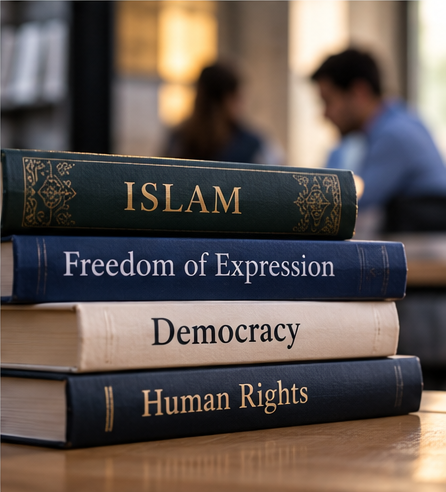
A religion can be respected as a personal choice without being protected from criticism. And a person can defend their faith without having the right to impose silence on those who question it.
Ultimately, moving the boundaries of freedom of expression means expanding the range of subjects that can be discussed and reducing the power of offence, social pressure or fear to determine what a society dares to say.
Normalising criticism of Islam does not restrict anyone’s rights; on the contrary, it expands the space of freedom for European society as a whole.
The test of a democracy is not how much it protects ideas from criticism, but how well it protects people’s right to discuss those ideas freely.
Sources and References
- Council of Europe. Parliamentary Assembly of the Council of Europe.
Clarify the missing section numberingRemove the duplicate title line