
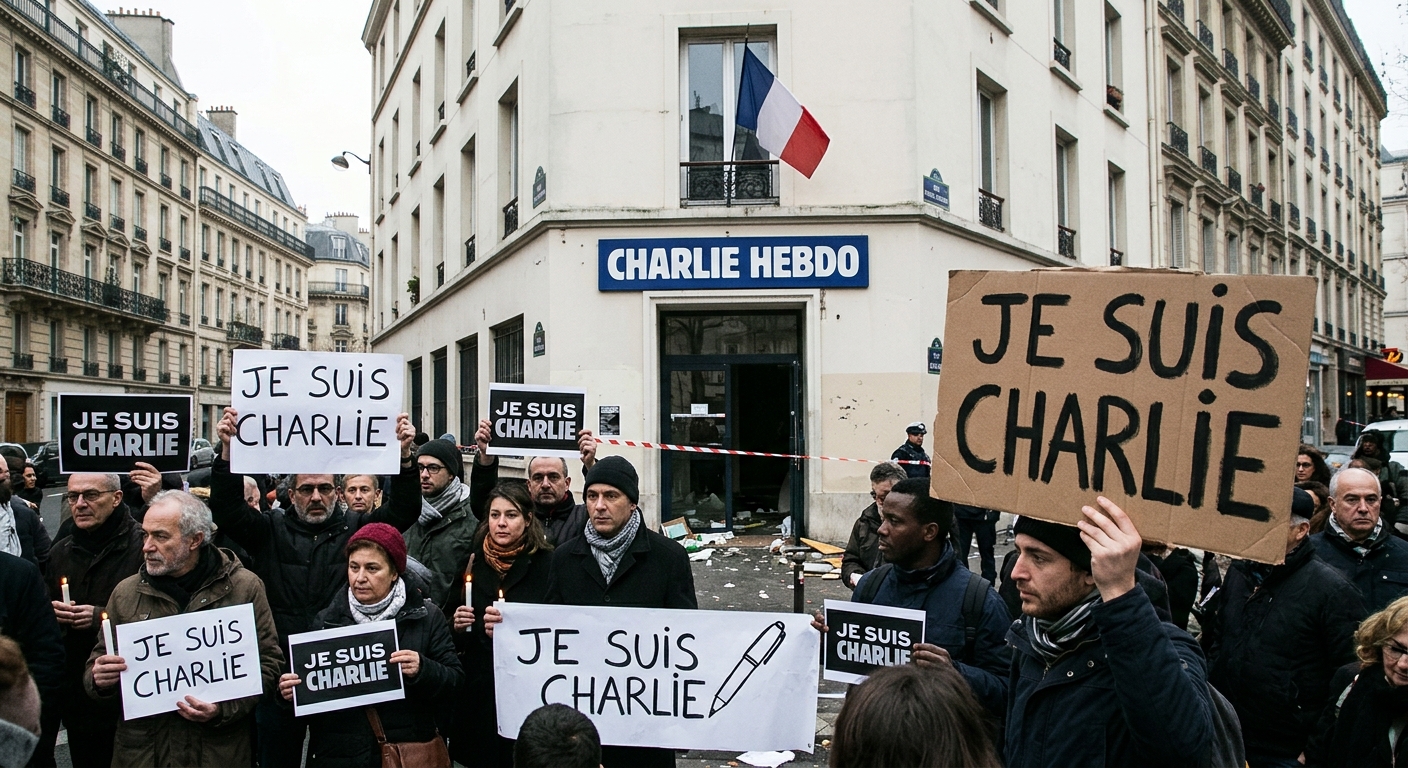
The Charlie Hebdo Attack
Series: Attacks Against Thinkers and Journalists in Europe · Article 1
On 7 January 2015, European history changed forever. A terrorist attack in the heart of Paris against the satirical magazine Charlie Hebdo challenged freedom of expression, triggered a major cultural confrontation and marked the beginning of a wave of attacks across the continent.
The attack on 7 January 2015 was not merely an assault on a satirical magazine. It was the murder of journalists, cartoonists and police officers in Paris, carried out by Islamist terrorists who claimed to be acting in the name of Al-Qaeda in the Arabian Peninsula. The attack opened a European debate about freedom of expression, jihadist violence, security and coexistence in democratic societies.
The importance of this case lies in examining a fundamental question: what happens when a society allows the threat of violence to influence what its journalists, writers and citizens dare to say?
Charlie Hebdo: The Massacre That Sought to Silence the Pen
On 7 January 2015, two terrorists entered the offices of a Parisian satirical magazine and murdered twelve people. Among the victims were cartoonists, journalists, an economist and police officers. The attack was neither an accident nor a simple outburst of violence: it was a terrorist operation targeting people because of their work and the ideas they represented.
But to understand what happened, we must look beyond the images of the tragedy. We must understand the magazine’s history, the threats it had received, the killers’ backgrounds, the security failures, the public response and the consequences that continue to be debated across Europe.
A democracy is not measured solely by its ability to celebrate freedom of expression when everything is going well. It is also measured by its ability to protect that freedom when someone threatens to kill.
1. Before the Attack: A Magazine That Made Provocation Its Profession
What Was Charlie Hebdo?
Charlie Hebdo is a French satirical magazine known for its cartoons, provocative humour and criticism of religion, politics, political parties and institutions.
Satire is not necessarily intended to be kind. Its purpose may be to ridicule, offend and challenge things that other people consider untouchable.
In the case of Charlie Hebdo, criticism of religion was part of a tradition of radical secularism. The magazine did not direct its mockery exclusively at Islam; it also targeted Christianity, Judaism and other beliefs, as well as politicians and public figures.
However, its cartoons of Muhammad provoked a particularly intense reaction among Islamist groups, who considered such depictions a serious offence against the Prophet.
The Muhammad Cartoons and the 2006 Crisis
In 2005, the Danish newspaper Jyllands-Posten published cartoons of Muhammad. The images triggered international protests, debates about freedom of expression and episodes of violence in several countries during 2006.
Charlie Hebdo reproduced some of those cartoons and published others. In February 2006, its cover featuring a depiction of Muhammad and the headline “C’est dur d’être aimé par des cons” — “It’s hard to be loved by idiots” — sparked major controversy.
The magazine was sued by Muslim organisations in France, but in 2007 the French courts acquitted Charlie Hebdo in the case concerning the cartoons, ruling that the publications were protected by freedom of expression in the context under examination.
The Threats Before 7 January
The Charlie Hebdo editorial team had been exposed to threats for years.
In November 2011, after the magazine published a cover related to the electoral victory of an Islamist party in Tunisia and the controversy surrounding Islam, its premises were firebombed. The attack destroyed part of the office.
Several members of the editorial team subsequently received threats. Charb, the magazine’s editor, was placed under police protection.
The danger did not suddenly appear on 7 January 2015. There were already signs that the publication’s work had turned its journalists into targets for extremist groups.
An uncomfortable question deserves to be asked: how can a society protect its journalists when threats persist for years and become part of their everyday lives?
2. The Perpetrators: Who Were the Kouachi Brothers?
The men who carried out the attack on the magazine were brothers Saïd Kouachi and Chérif Kouachi, French citizens of Algerian origin.
Both were born in France and had experienced social marginalisation, personal difficulties and radicalisation. Their backgrounds neither explain away nor justify the murder of the journalists, but they help us understand that jihadist terrorism does not arise only from people who arrive from abroad to carry out an attack.
Chérif Kouachi had previously been convicted for his involvement in networks connected with sending fighters to Iraq. He had also been imprisoned, where he came into contact with people associated with jihadist ideologies.
Saïd Kouachi travelled to Yemen and received training connected with Al-Qaeda in the Arabian Peninsula, according to subsequent investigations and reports.
Why Did They Attack Charlie Hebdo?
The central motive was revenge for the cartoons of Muhammad and the jihadist ideology that justified using violence against people regarded as enemies of Islam.
Al-Qaeda in the Arabian Peninsula claimed responsibility for the attack. In a subsequent statement, the organisation presented it as an operation against those who had insulted the Prophet.
3. 7 January 2015: How the Massacre Unfolded
A Minute-by-Minute Account of the Horror
On Wednesday, 7 January 2015, at around 11:30 a.m., the editorial team was holding its weekly editorial meeting. The location was 10 Rue Nicolas-Appert, in Paris’s 11th arrondissement.
-
11:30 a.m. — The Kouachi brothers burst in, armed.
-
11:35 a.m. — Massacre in the editorial meeting room, with ten people killed.
-
11:40 a.m. — Escape, a street shoot-out and the murder of police officer Ahmed Merabet.
-
8–9 January — A massive manhunt ends with the terrorists being killed.
1. The Break-In: 11:30 a.m.
Two masked men dressed in black, brothers Chérif and Saïd Kouachi, burst into the building armed with Kalashnikov assault rifles. They killed the caretaker at the entrance and forced a cartoonist at gunpoint to enter the code for the secure door.
2. The Shooting in the Editorial Office: 11:32–11:37 a.m.
They entered the meeting room shouting “Allahu Akbar” (“God is greatest”). They asked for specific names and fired at point-blank range at the cartoonists and editorial staff. In just a couple of minutes, they executed almost everyone present.
3. The Escape and the Final Shooting: 11:40 a.m.
They left the building shouting, “We have avenged the Prophet!” As they fled, they encountered a police patrol. A 42-year-old officer, Ahmed Merabet, fell wounded on the pavement. One of the terrorists approached him and shot him in the head before escaping in a stolen car.
4. The Manhunt and Its Conclusion: 8 and 9 January
France deployed more than 88,000 security personnel. On 9 January, the Kouachi brothers barricaded themselves inside a printing works north of Paris. Following an intense exchange of fire with the special forces, both were shot dead.
At the same time, an associate of the brothers, Amedy Coulibaly, took hostages at a kosher supermarket in Paris, killing several people before being shot dead.
4. The Victims: The Loss of a Generation of Independent Minds
The attack left twelve people dead and eleven injured. Among those killed were some of the most iconic figures in French humour and illustration.
| Name | Role / Profession |
|---|---|
| Stéphane Charbonnier (“Charb”) | Magazine editor and cartoonist |
| Jean Cabut (“Cabu”) | Legendary French satirical illustrator |
| Georges Wolinski | Influential and long-established cartoonist |
| Bernard Verlhac (“Tignous”) | Cartoonist and regular contributor |
| Philippe Honoré | Illustrator and cartoonist |
| Bernard Maris | Economist and magazine contributor |
| Elsa Cayat | Psychoanalyst and columnist; the only woman killed in the editorial office |
| Michel Renaud | Guest attending the meeting |
| Mustapha Ourrad | Algerian-born copy editor |
| Frédéric Boisseau | Maintenance worker and building caretaker |
| Franck Brinsolaro | Police officer assigned to protect Charb |
| Ahmed Merabet | Police officer murdered in the street during the escape |
The list of victims is documented in official commemorations and public records of the January 2015 attacks.
They were not simply “provocative cartoonists”. They were professionals with different occupations, opinions and life stories.
5. The Escape and Three Days of Terror in France
The attack on Charlie Hebdo formed part of a sequence of attacks that lasted from 7 to 9 January 2015.
The Kouachi brothers were pursued by police and eventually located at a printing works in Dammartin-en-Goële, northeast of Paris, on 9 January.
On the same day, terrorist Amedy Coulibaly took hostages at the Hyper Cacher Jewish supermarket near Porte de Vincennes in Paris.
Coulibaly had also murdered police officer Clarissa Jean-Philippe in Montrouge the previous day.
The January attacks left a total of seventeen people dead, excluding the three terrorists killed by security forces.
The Hyper Cacher Supermarket
The attack on the Jewish supermarket was not identical to the one at Charlie Hebdo. It had a different target and was linked to antisemitic and jihadist ideology.
Four people were murdered inside the supermarket:
-
Philippe Braham.
-
Yohan Cohen.
-
Yoav Hattab.
-
François-Michel Saada.
The incident showed that the terrorist violence during those days targeted several groups: journalists, police officers and Jewish citizens.
It is important to preserve the distinctions between the individual attacks without losing sight of the common context of Islamist terrorism that affected France that week.
6. How Could It Happen? Questions About Security and Prevention
One of the most important issues in understanding the attack is the performance of the security services.
The perpetrators were not unknown to the authorities. Chérif Kouachi had been convicted of activities related to jihadist networks, and the brothers’ backgrounds included contacts with extremist circles.
However, preventing an attack is a complex task. Having a criminal record or having been under surveillance does not mean that authorities can know with certainty when, where and how an attack will occur.
Subsequent investigations and analyses identified problems relating to the monitoring of suspects, coordination between services and the evolution of radicalisation methods.
In the following years, France strengthened its intelligence services, cooperation between agencies and legal tools against terrorism.
The Uncomfortable Questions
It is not enough to ask what the terrorists did. We must also ask:
-
What information did the authorities have before the attack?
-
What surveillance measures had been applied?
-
Were there warning signs that were not interpreted correctly?
-
How can a threatened person be protected without turning their life into a prison?
-
What balance should exist between security and fundamental rights?
7. “Je suis Charlie”: The Response of a Society in Shock
Following the attack, France experienced an extraordinary wave of public mobilisation.
The slogan “Je suis Charlie” — “I am Charlie” — became a symbol of solidarity with the victims and of the defence of freedom of expression.
Millions of people took part in demonstrations across France. On 11 January 2015, a huge march in Paris brought together political leaders from different countries and citizens who wanted to express their rejection of Islamist terrorism.
The slogan could mean different things to different people:
-
Solidarity with the murdered journalists.
-
Defence of freedom of expression.
-
Rejection of Islamist violence.
-
Defence of French republican values.
-
Identification with the magazine and its right to satirise.
Not everyone who used the slogan shared the same opinions about Charlie Hebdo, Islam or French politics. The symbol served as a broad expression of rejection of the murders and solidarity with the victims.
Was Everyone Charlie?
Here we encounter an interesting question.
Can you defend the freedom to publish a cartoon without sharing its humour? Yes.
Can you defend freedom of expression while criticising a cartoon because you consider it offensive? Also yes.
Solidarity with the victims does not require abandoning critical thinking. And critical thinking does not require justifying violence against those who publish.
The defence of freedom of expression is stronger when it does not depend on whether we like the content.
8. The Consequences in France: Security, Secularism and Social Divisions
The attack had profound consequences for French politics and society.
8.1. Strengthening Security
France strengthened its counterterrorism measures and protection for locations considered vulnerable.
Following the January 2015 attacks, the French government introduced reforms concerning intelligence and terrorism prevention. The Intelligence Act of July 2015 expanded certain surveillance powers and the tools available to security services.
In November 2015, France suffered further terrorist attacks in Paris, leaving 130 people dead. That context led to an expansion of emergency measures, some of which were subsequently incorporated into ordinary law.
The debate is not straightforward: the state has an obligation to protect the population, but security measures must respect fundamental rights and be subject to oversight.
8.2. French Laïcité
The attack reignited the debate about laïcité, the French model of secularism.
In France, laïcité is associated with the separation of the state and religions, freedom of conscience and the neutrality of public institutions.
9. The Consequences in Europe: An Attack That Crossed French Borders
The attack did not remain confined to Paris. Its impact spread across Europe and influenced discussions about freedom of expression, security and the relationship between religion and the state.
9.1. Freedom of Expression as a European Issue
The massacre turned Charlie Hebdo into an international symbol. Defending the magazine became part of political statements, demonstrations and debates about the role of satirical journalism.
The European Parliament paid tribute to the victims of the January 2015 attacks. Its statement at the time included the names of those murdered at Charlie Hebdo, in Montrouge and at the Jewish supermarket.
The central question was not whether all European institutions should adopt the magazine’s humour, but whether a journalist could be murdered for publishing an opinion or a cartoon.
9.2. The Debate About Self-Censorship
One of the most difficult effects to measure is self-censorship.
A journalist may decide not to publish a report because they believe it is not sufficiently in the public interest. That is part of professional judgement.
But they may also decide not to publish something because they fear a terrorist threat. In that case, violence begins to influence the content of the press indirectly.
Not every editorial change following an attack necessarily constitutes self-censorship. Newsrooms may change their practices for security, ethical or journalistic reasons. The question is whether the threat of violence ends up unjustifiably restricting public debate.
9.3. Protecting Journalists and Writers
The Charlie Hebdo case must also be placed in a broader context: that of writers, journalists, teachers and intellectuals threatened because of their ideas.
Threats can take different forms:
-
Intimidation campaigns.
-
Death threats.
-
Organised harassment.
-
Physical violence.
-
Pressure to withdraw a publication.
-
Terrorist attacks.
These situations do not all have the same level of severity. But they all deserve to be examined in terms of freedom of expression and personal protection. A free society should not force its writers to choose between remaining silent and exposing themselves to violence.
10. The Trial of the Accomplices: Justice After the Massacre
The attack did not end with the deaths of the three terrorists involved in the January 2015 attacks.
The investigation continued to identify people who had provided weapons, logistical support and other forms of assistance.
In 2020, fourteen defendants connected with the January attacks stood trial in Paris.
Three Months of Hearings
The trial began in September 2020 after being postponed because of the COVID-19 pandemic. It lasted 54 working days.
Fourteen Defendants in Total
Eleven appeared in court, while three were tried in absentia after fleeing to Syria to join Islamic State before the attacks.
The French courts handed down sentences ranging from prison terms to life imprisonment, depending on the responsibility attributed to each defendant. They were not all considered equally responsible and did not receive identical sentences.
The Most Severe Sentences
Mohamed Belhoucine — Life imprisonment
Tried in absentia, he was considered Amedy Coulibaly’s ideological mentor and a direct accomplice in the attacks. He is believed to have died in Syria, although there is no official confirmation.
Ali Riza Polat — 30 years in prison
Described as the central figure in the logistical network, the court found that he played a wide-ranging role in actively helping the attackers obtain weapons and ammunition, while being aware of their jihadist ideology.
Hayat Boumeddiene — 30 years in prison
Coulibaly’s former partner, tried in absentia. She was convicted of financing terrorism and belonging to a terrorist criminal network after fleeing to Syria days before the attacks.
The Other Defendants
Three defendants received sentences of between 13 and 20 years in prison for terrorist criminal association.
Seven defendants were sentenced to between four and ten years in prison for ordinary criminal offences, including weapons or vehicle trafficking. The court considered that there was insufficient evidence to establish their ideological links to jihadist terrorism.
Why Was the Trial Important?
Because the fight against terrorism is not limited to killing the perpetrators.
It also requires investigating how they obtained their weapons, who supported them, which networks facilitated their movements, who knew about their plans and what evidence can establish criminal responsibility.
The trial also had historical significance. It was recorded for the French judicial archives because of its exceptional importance.
Justice cannot bring the victims back to life, but it can help establish the facts, determine responsibility and create a public record of what happened.
11. The Return of Threats: Charlie Hebdo After 2015
The story did not end on 7 January.
The magazine continued publishing, but its journalists had to live with security measures and persistent threats.
In September 2020, during the trial relating to the attacks, Charlie Hebdo republished the cartoons of Muhammad that had been at the centre of the controversy. The decision generated new threats.
On 25 September 2020, a man attacked two people with a knife near the magazine’s former headquarters, mistakenly believing it was still operating there. The attack was linked to the publication of the cartoons.
This episode shows how a terrorist attack can produce a chain of consequences that continues for years.
It also forces us to ask a question without a simple answer: how can freedom of expression be protected when a particular publication becomes a permanent target for those seeking to impose silence through violence?
12. Questions Europe Should Not Avoid
At this point, it is worth raising the fundamental questions.
Question 1. Can We Defend Freedom of Expression Without Defending Every Publication?
Yes. Freedom of expression protects a right; it does not require us to agree with every opinion or consider every publication sound.
A democratic society must allow debate about religion, politics and ideas, even when that debate is uncomfortable.
Question 2. Should Criticism of Religion Have Limits?
No, although the precise answer depends on the legal framework and context of each country.
Fundamental rights are not identical across all European legal systems, and there are restrictions relating to incitement to violence, threats and other unlawful conduct.
But we must distinguish between criticism, even offensive criticism, and direct incitement to violence or hatred.
Question 3. Can Fear Become a Form of Censorship?
Yes. Fear can influence the decisions of journalists, editors and citizens. But it is necessary to demonstrate how this happens in each case rather than automatically attributing every editorial change to it.
The existence of threats does not mean every decision not to publish constitutes censorship. It means security and press freedom must be examined together.
Question 4. How Can Jihadism Be Combated Without Harming Citizens’ Rights?
Combating terrorism requires prevention, investigation and measures to protect people. However, those measures must be compatible with fundamental rights, justified and subject to oversight.
Security should not become a blanket authorisation to restrict any expression that causes discomfort.
13. The Great Debate: What Does Defending Freedom Really Mean?
The attack on Charlie Hebdo exposed a contradiction that Europe continues to face.
On the one hand, European democracies defend freedom of expression, freedom of conscience and equality before the law.
On the other, some people and movements believe that certain religious ideas should not be subjected to criticism, satire or representation.
A free society needs clear rules, protection against violence and a space where people can discuss even the most sensitive subjects.
What If Fear Determines What Gets Published?
Imagine a newsroom that receives threats. The editor has two options: publish a report or withdraw it out of fear of an attack.
Withdrawing it may be a legitimate security decision. But if the same situation occurs across Europe and journalists stop covering certain subjects because they know they could be attacked, violence will have achieved a political and cultural effect.
A terrorist does not need to control a newsroom to influence it. Sometimes it is enough for the threat to be credible.
That is why protecting journalists is not merely a private matter for media companies. It is a matter of public interest.
14. What Does Charlie Hebdo Teach Us About Islamism in Europe?
The attack raises an issue that deserves serious analysis: the presence of violent Islamist ideologies and the radicalisation mechanisms that can lead to terrorism.
However, not all Muslims are Islamists. Not all Islamists are terrorists. And not everyone who criticises cartoons of Muhammad justifies violence.
At the same time, we must not minimise the role of jihadist ideology in justifying the murder of the journalists.
15. Key Facts About the Attack
Attack Profile
Terrorism
| Detail | Information |
|---|---|
| Date | 7 January 2015 |
| Location | Paris, France |
| Main target | Charlie Hebdo editorial office |
| Direct perpetrators | Saïd and Chérif Kouachi |
| Organisation that claimed responsibility | Al-Qaeda in the Arabian Peninsula |
| Deaths at Charlie Hebdo | 12 |
| Deaths in the related January attacks | 17 |
| Trial of accomplices | September–December 2020 |
The total of seventeen victims refers to all the attacks between 7 and 9 January 2015. The three terrorists also died during police operations.
16. Timeline of Events
2005–2006 — Background
Cartoons of Muhammad published in Denmark and reproduced by Charlie Hebdo trigger controversy and international protests.
2011 — Threats
The Charlie Hebdo headquarters is firebombed. Threats against the magazine continue.
7 January 2015 — Attack
The Kouachi brothers attack the Charlie Hebdo editorial office and murder twelve people. They subsequently kill police officer Ahmed Merabet while fleeing.
8 January 2015
Amedy Coulibaly murders police officer Clarissa Jean-Philippe in Montrouge.
9 January 2015
The Kouachi brothers are killed during the police operation in Dammartin-en-Goële. Coulibaly murders four people at the Hyper Cacher supermarket and dies during the police intervention.
11 January 2015
Millions of people take part in solidarity demonstrations in France. Paris hosts a march attended by international leaders.
2 September–16 December 2020
The trial of fourteen defendants connected with the January 2015 attacks takes place.
7 January 2025
France commemorates the tenth anniversary of the attack and pays tribute to the victims.
Conclusion: The Pen Against the Gun
The attack on Charlie Hebdo was a mass murder committed to punish expression that the terrorists considered offensive.
Freedom of expression is not defended because everything that gets published is admirable. It is defended because no one should have the power to decide, through violence, which ideas are allowed to survive.
Studying attacks against writers, journalists and thinkers in Europe means learning about their victims, analysing the ideologies that motivated the perpetrators and asking what democracies can do to protect the right to think and express oneself freely.
Because a society that stops debating out of fear has already begun to lose something important.
Photographs of Charlie Hebdo articles
Sources: Government of France; French Ministry of Justice; European Parliament; Reuters.