What If Europe Needed an Institution to Build a Liberal European Islam?
An idea that may seem impossible today, but could seem necessary twenty years from now
What if Europe created an institution dedicated exclusively to a question that has remained unresolved for decades?
Can a fully European Islam develop that is compatible with liberal democracy, fundamental rights, equality between men and women, and Europe’s secular societies?
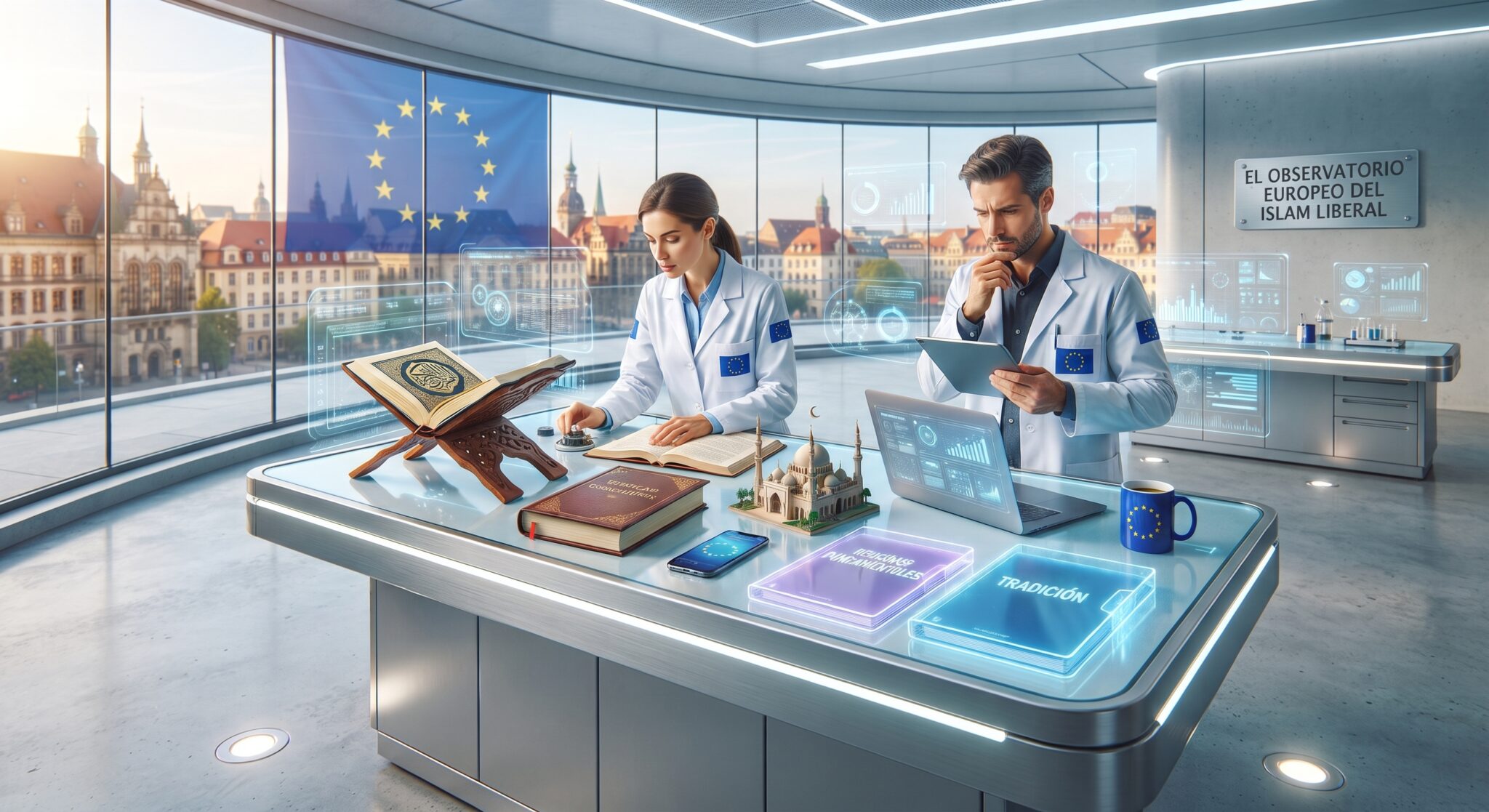
We are not talking about a new mosque, an imams’ council, or an institution that claims to represent all European Muslims. We are imagining something different: a European Observatory for Liberal Islam.
An institution dedicated to studying, developing, experimenting with and promoting a version of Islam that can exist within Europe’s liberal democracies without having to choose between religious identity and European citizenship.
The “European Observatory for Liberal Islam” is presented as a proposal for the future. And that is precisely why it is worth asking the question: What would it look like?
1. What exactly would this Observatory be?
The name may seem unusual.
Why an “observatory” if its purpose would be more than simply observing? Because its first mission should be precisely to conduct research before attempting to transform anything.
Europe already has Muslim organisations, mosques, associations, federations, universities and research centres working on different aspects of Islam. There are also movements advocating liberal or progressive interpretations of Islam.
In Germany, for example, the Liberal-Islamischer Bund, a federation of communities with an explicitly liberal orientation, has existed since 2010. A recent study has examined precisely how these ideas move from theological discourse into the everyday practices of Muslim communities.
But isolated initiatives are one thing; building permanent European infrastructure is quite another.
The Observatory would have a far more ambitious mission: to investigate which elements of Islamic tradition can be reinterpreted in a European context and to develop religious, educational and social models compatible with liberal democracy.
2. It would not be a “Ministry of Islam”
Here we encounter the first delicate issue. Who would have the right to decide what “liberal Islam” is?
The answer should be: nobody.
The Observatory should not become a European religious authority. There should be no “Grand Imam of Europe” deciding what 30 or 40 million Muslims are allowed to believe. That would contradict the very philosophy of liberalism.
European Islam would have to be pluralistic. That is why the Observatory should operate more like a combination of a think tank, research centre, ideas laboratory, community network, educational platform, training centre, trends observatory and public forum for debate.
Its authority would not come from saying, “This is the true Islam.”
It would come from saying, “This is one possible interpretation of Islam that is compatible with the principles of a liberal democracy. Let us study it, debate it and see whether it works.”
3. Who would be involved?
This would be one of the project’s key elements. It should not consist exclusively of theologians. A common mistake would be to assume that Islam equals imams. European Islam is much broader.
The Observatory could bring together:
Muslim thinkers: People capable of studying the Quran, Islamic tradition, Islamic law and the history of Muslim thought.
Sociologists: To study how European Muslims actually live, because what books say is one thing, while what happens in a neighbourhood in Barcelona, Paris, Brussels or Berlin may be quite another.
Legal experts: Particularly specialists in fundamental rights, religious freedom, equality, freedom of expression, family law, education and European legislation.
Muslim women: Their representation should be particularly significant, not as institutional decoration, but in leadership, research and decision-making positions.
Young European Muslims: A project designed to build the European Islam of the future would need to be led in part by second- and third-generation Europeans, who should play a central role.
Psychologists and educators: To study issues such as identity, integration, religious education and generational conflicts.
Economists and public policy experts: Because the project would also need to examine how Muslim communities participate in Europe’s economy and society.
Non-Muslims: This would also be important. An Observatory for Liberal Islam should not become a closed club of Muslims talking only to other Muslims. It would need Christian, Jewish, atheist and agnostic intellectuals, as well as interested citizens, because its aim would be to foster
coexistence.
4. A European structure, not a centralised organisation
We could imagine a three-tier structure.
Level 1: European Council
This would be the strategic body, perhaps comprising between 15 and 25 people. Representation criteria or quotas could be established for generations, gender, areas of expertise, communities and academic backgrounds. Its role would be to set the overall strategy.
Level 2: Specialised departments
This would be the real intellectual engine. For example:
Department of Theology and Reform
It would study issues such as Quranic interpretation, hadiths, Islamic law, the relationship between tradition and modernity, and the reinterpretation of texts.
Department of Islam and Democracy
It would examine questions such as: can someone be fully Muslim and fully democratic?
It would also explore the separation of religion and state, religious freedom, pluralism, the rule of law and freedom of expression.
Department of Women and Equality
One of the most important departments. It would examine marriage, divorce, inheritance, female religious leadership, education, gender-based violence, personal autonomy, dress and relationships between men and women.
Department of Youth
Probably one of the most strategically important departments, because the project would likely fail if it could not connect with young Europeans.
It would study identity, radicalisation, secularisation, sexuality, education and popular culture.
Department of European Mosques
The Observatory could develop voluntary standards for mosques covering financial transparency, imam training, female participation, respect for the constitutional order, prevention of extremism, local integration and independence from foreign governments.
5. What does “liberal Islam” really mean?
This would be the heart of the project. “Liberal” should not mean “an Islam that Europeans like”. Nor should it mean “an Islam that abandons everything traditional”.
The issue would be much more complicated.
A liberal European Islam could begin with a simple idea: religion can preserve its spiritual dimension without seeking to control citizens’ legal, political and social lives.
In other words, you can pray. You can fast. You can go to the mosque. You can celebrate your religious festivals. You can follow dietary rules.
But at the same time, you accept that civil law belongs to the democratic state and applies equally to everyone. That principle could be fundamental.
8. Where would the money come from?
This would probably be one of the most important questions.
If an organisation wants to transform European Islam but depends financially on foreign governments, its independence becomes questionable.
The model would have to be exceptionally transparent. It could be financed through several channels.
Private donations: Citizens, businesspeople and philanthropists.
Membership fees: Communities and members could pay a small annual contribution.
Foundations: European foundations interested in democracy, education, human rights or social cohesion.
Research: University projects and European programmes could fund specific research initiatives.
Own activities: Courses, conferences, training and consultancy.
But there would be one golden rule: no donor should be able to buy the Observatory’s ideological direction. The organisation would have to publish an annual account of who funds it, how much they contribute and how the money is spent.
Funding from Muslim-majority governments? A clear red line would need to be established here.
If the aim is to build an autonomous European Islam, structural dependence on foreign governments would be difficult to justify.
A foreign country could fund general academic research. But if it paid for the Observatory’s political and religious infrastructure, an immediate question would arise: are we building a European Islam or importing foreign interests?
It would therefore be advisable to legally limit donations from foreign governments or make them fully public and subject to strict independence rules.
9. The objectives
Short term: During the first three years, the Observatory should not attempt to “reform Islam”. That would be too ambitious.
Its objective should be to build the infrastructure.
Year 1: Establish the institution, adopt a code of ethics, recruit researchers, create a digital library, study existing experiences, identify liberal communities, build a European network and produce a map of European Islam.
Year 2: Conduct research on Islam and democracy, freedom of expression, women, young people, mosques, radicalisation and foreign funding.
Begin pilot projects. For example, ten voluntary European Muslim communities could participate in experiments with new community models.
Medium term: The Observatory could become a kind of European laboratory for Islamic thought.
It would publish books, train imams, create university programmes, produce documentaries, organise debates, collaborate with local councils and work with universities.
And something fundamental could emerge: a new generation of European Muslim intellectuals.
People born in Barcelona, Paris, Brussels or Berlin who do not automatically need to import religious answers from societies with very different circumstances.
Long term: No longer needing the Observatory.
Here lies an interesting paradox. The Observatory’s success should not be measured by whether it becomes a gigantic institution.
Its real success would be ensuring that, thirty years from now, nobody asks, “Can a European Islam exist?”
Because the answer would simply be, “Of course.”
There would be European mosques, European theologians, European Muslim thinkers and intellectuals, artists and others who could be Muslim without their religious identity constantly conflicting with their European identity.
A possible roadmap towards 2050. We could imagine four phases.
2026–2030: Research.
Build knowledge, networks and pilot communities.
2030–2040: Experiment.
Develop new educational, religious and community models.
2040–2050: Consolidation.
Develop a generation of European intellectuals, religious leaders and communities.
After 2050: Normalisation.
Make the concept of “European Islam” no longer an exception.
10. But this is where the problems begin
All of this sounds very good on paper. But there is a major problem: who has decided that Muslims want this project?
It is one thing for some European intellectuals to consider a liberal Islam desirable. It is quite another for millions of Muslims to want to participate in it.
Europe has conservative, liberal, progressive, practising, reformist and traditionalist Muslims, as well as people who simply have no interest in theological debates.
That is why the Observatory would have to accept an uncomfortable reality from the outset: it would probably never represent all Muslims, and it should not try to.
Second problem: Who defines “liberal”?
This is the real battleground.
Is it liberal to accept homosexuality?
Is it liberal to accept that a woman can be an imam?
Is it liberal to reinterpret inheritance rules?
Is it liberal to abandon certain traditional rules?
Where does reform end and a new religion begin?
These questions have no easy answers.
And that is precisely why the Observatory should avoid becoming a factory for dogma. Its motto could be: “We do not have all the answers. We have an obligation to ask the questions.”
Third problem: The reaction of traditional Islam
A project of this kind would probably face opposition.
Some groups might accuse it of promoting “Westernised Islam”. Others would say, “This is not Islam”.
The Observatory would have to accept that such conflict is part of the debate. But it would need to respond with a simple idea: nobody is obliged to participate.
A liberal society allows different religious interpretations to coexist. The proposal would not be to eliminate traditional Islam, but to create an alternative.
11. And who would pay the political price?
Here we encounter another difficulty.
A European government might be delighted by an organisation promoting democracy, equality and social cohesion.
But if the government began funding it directly, suspicion would immediately arise: “Is the state creating its own Islam?”
That would be a difficult accusation to avoid. This is why…
12. Would it work?
We have to be honest: nobody knows.
Even the concept of “European Islam” remains the subject of academic debate. Some researchers argue that a European adaptation of Islam already exists; others warn against treating it as a homogeneous category.
Moreover, the history of reform movements shows that gaining intellectual recognition is much easier than building a broad social base.
A project may have outstanding researchers and yet fail to attract people to its mosques.
It may publish excellent books without changing a single community. It may organise conferences without changing a single family. That is why the real test would not be in Brussels. It would be in the neighbourhood.
The big question
Perhaps the Observatory’s real objective should not be to “create a liberal Islam”. That would be too pretentious.
It could be formulated differently: to create the conditions in which European Muslims can freely develop an Islam compatible with liberal democracy.
The difference is enormous. In the first case, an institution seeks to design a religion. In the second, it creates a space where communities themselves can evolve.
And perhaps that is the only way such a transformation could have any chance of success.
A utopia or a necessity?
The European Observatory for Liberal Islam might seem like a utopian idea today. But major cultural transformations often begin this way: someone proposes an institution that does not yet exist to address a problem we do not yet know how to solve.
Europe does not need an “official Islam”. Nor does it need an Islam manufactured in Brussels offices.
But it could need something that is currently far more fragmented: a European space where Muslims, intellectuals, women, young people, academics and citizens can experiment, debate and develop new ways of living Islam within a liberal democracy.
The project would face enormous difficulties. It could fail, remain confined to a small intellectual elite, or come under attack simultaneously from Islamist, conservative and anti-religious groups.
But that is precisely why it deserves to be debated. Because the question of the future will not simply be: “Will Muslims integrate into Europe?”
Perhaps the more interesting question is: “What kind of Islam will emerge when third-, fourth- and fifth-generation European Muslims stop looking exclusively towards their families’ countries of origin and begin developing their own answers?”
Perhaps we will then discover that the future of European Islam is not decided in Mecca, Cairo, Ankara or Rabat. It is decided, little by little, in the neighbourhoods of Barcelona, Paris, Brussels, Berlin, London, Amsterdam and Milan.
And perhaps the true laboratory of European Islam is not a mosque.
It is Europe itself.