
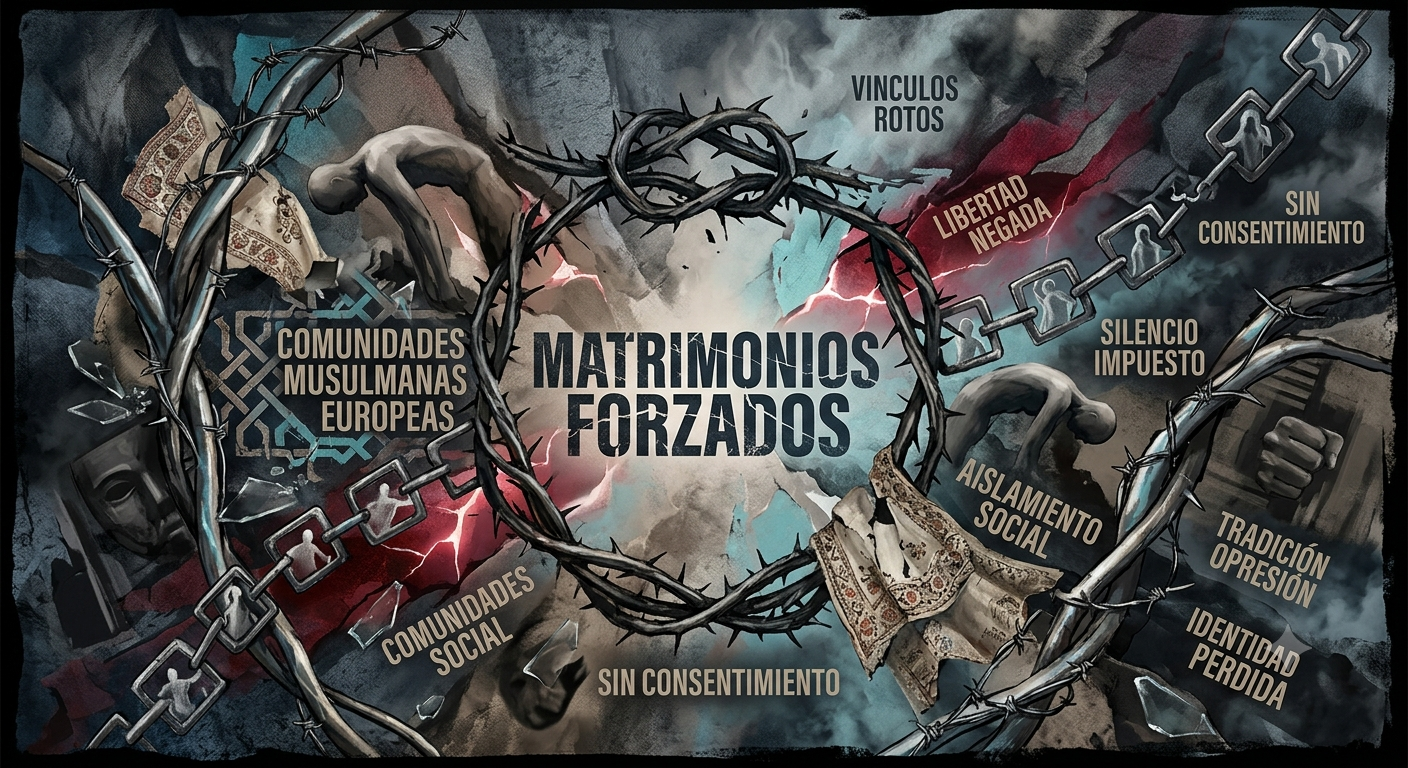
Forced Marriages in Europe: When “I Do” Comes with Family Instructions
The Marriage That Comes with Built-In GPS
When most Europeans think of a wedding, they imagine a couple in love, guests taking photos, an uncle dancing worse than he thinks he does, and a cake that is impossible to cut.
For some people, however, especially young people from certain traditional backgrounds, the story can be very different. Instead of choosing whom to share their lives with, they discover that someone else has already made the decision for them.
Welcome to the complicated world of forced marriages, a reality that still exists in parts of Europe and fuels intense debate about integration, human rights, tradition and individual freedom.
What Exactly Is a Forced Marriage?
Before going any further, let’s make a fundamental distinction that is often confused in casual debates:
Arranged marriage: Two adults agree to let their families introduce potential partners, but both retain the genuine right to say “no” without being rejected, threatened or blackmailed.
Forced marriage: There is no real option to say no. The “I do” is obtained through physical violence, isolation, emotional blackmail (“You’ll break your mother’s heart and drive her to her grave”) or deception (“We’re going on holiday to our home country to visit your uncles”), only for the person to arrive and have their passport taken away. And that is where the problem lies.
Why Does It Happen?
The reasons usually involve a mixture of tradition, social pressure, family control and fear of what others might say.
In some cases, the justifications include preserving cultural identity, maintaining family traditions, preventing relationships considered inappropriate, protecting family honour and strengthening ties between families.
The problem is that no tradition can justify depriving someone of the right to choose whom they want to share their life with.
The Modus Operandi: From Emotional Blackmail to a One-Way Ticket
How does this happen in cities such as Barcelona, Paris, Berlin or London? Rarely does it begin with a cinematic kidnapping. More often, it starts with subtle, persistent psychological pressure.
Guilt as a weapon: A young woman is made to believe — in more than 80% of cases, according to the article’s claim, the victims are young women or teenage girls — that the honour of the entire family depends on her marrying a distant cousin from her ancestral village.
The “holiday” trip: This is a classic deception tactic. The family arranges a summer trip to Morocco, Pakistan, Bangladesh or Senegal. Once they land, the passport “mysteriously” disappears, and a prospective husband appears whom the young woman has never met in her life.
Social isolation: Her contacts are monitored, her access to her phone or social media is restricted, and she is gradually cut off from school or university.
The Great European Conflict
Europe is built on a fairly simple idea: everyone should be able to make fundamental decisions about their own lives. These include choosing a partner, getting married or remaining single, having children or not, and practising a religion or leaving it.
When a forced marriage occurs, there is a direct clash between that individual freedom and certain extremely conservative family customs.
The Effects on Victims
Sometimes the issue is discussed as though it were simply a cultural conflict. It is not. The consequences can be very serious.
Anxiety and depression: Living a life you did not choose can cause significant psychological harm.
Family breakdown: Anyone who opposes the marriage may face rejection or isolation.
Loss of opportunities: Many victims abandon their studies or professional ambitions.
Violence: In the most serious cases, physical threats or assaults occur.
Is It a Problem Exclusive to Muslims?
No. Forced marriages have historically existed in many cultures, religions and regions of the world. However, in Europe, much of the public debate focuses on certain communities originating from countries where these practices remain socially present.
Acknowledging this reality does not mean targeting millions of European Muslims, the vast majority of whom reject forced marriage. That is precisely why it is important to discuss the problem without resorting either to silence or to prejudice.
The Uncomfortable Silence
One of the most interesting questions is why this issue can sometimes be so difficult to discuss. Some people fear fuelling xenophobic rhetoric; others fear being accused of racism.
Meanwhile, while everyone argues about how to talk about the problem, victims continue to need help. The solution is not to stay silent. It is to speak with rigour, evidence and respect.
What Impact Does It Have on Europe?
Beyond the direct victims, forced marriages create several problems.
They hinder integration: When young people feel they are living under rules incompatible with the freedoms of the country where they were born, social tensions emerge.
They undermine trust: Society expects everyone to respect the same basic rules.
They fuel polarisation: Extremists on all sides use these cases to advance their own agendas.
They damage the image of entire communities: The actions of a minority can generate unfair stereotypes about millions of people.
Enough Looking the Other Way: Real Solutions
For years, parts of Europe’s political and social establishment fell into the trap of well-intentioned paternalism: “We’d better not intervene, in case someone calls us Islamophobic or racist.”
Wrong. Protecting a young woman from being forced into marriage is not racism; it is defending the rights of a European citizen. So what needs to be done to eradicate this practice?
A. Prevention in Schools and Professional Training
Secondary schools are the first line of defence. Teachers, social workers and primary healthcare professionals need clear protocols to identify warning signs, such as prolonged absences before holidays, sudden behavioural changes or social isolation.
B. Strict Legal Frameworks and Border Controls
Countries such as the United Kingdom, as well as Spanish legislation, recognise forced marriage as a specific criminal offence. But more needs to be done.
Consular protocols: European embassies abroad must be equipped to rescue and repatriate citizens who are being held overseas against their will as quickly as possible.
Safe accommodation networks: Supported housing and financial and psychological assistance should be available so that young people who report forced marriage do not end up homeless or cut off from everyone around them.
C. The Voices of Muslim Communities Themselves
The ultimate solution will not come solely from the top down; it must also come from within. Imams, community leaders and Muslim women’s associations must speak out unequivocally: forced marriage violates Islamic legal principles, which require the free and explicit consent of both parties for a marriage contract to be valid.
The Ultimate Test
There is a very simple question that distinguishes tradition from coercion:
“Can this person say no and remain free?”
If the answer is yes, we are talking about a personal choice. If the answer is no, we are facing a fundamental rights issue.
The Bottom Line
Democratic Europe rests on a very simple premise: your life belongs to you, not to your family, your tribe or your community’s traditions.
Ensuring that young people of Muslim origin in Europe can fully exercise their individual freedom is not an attack on their roots. In a liberal democracy, the most important right is not the right to get married. It is the right to choose.