
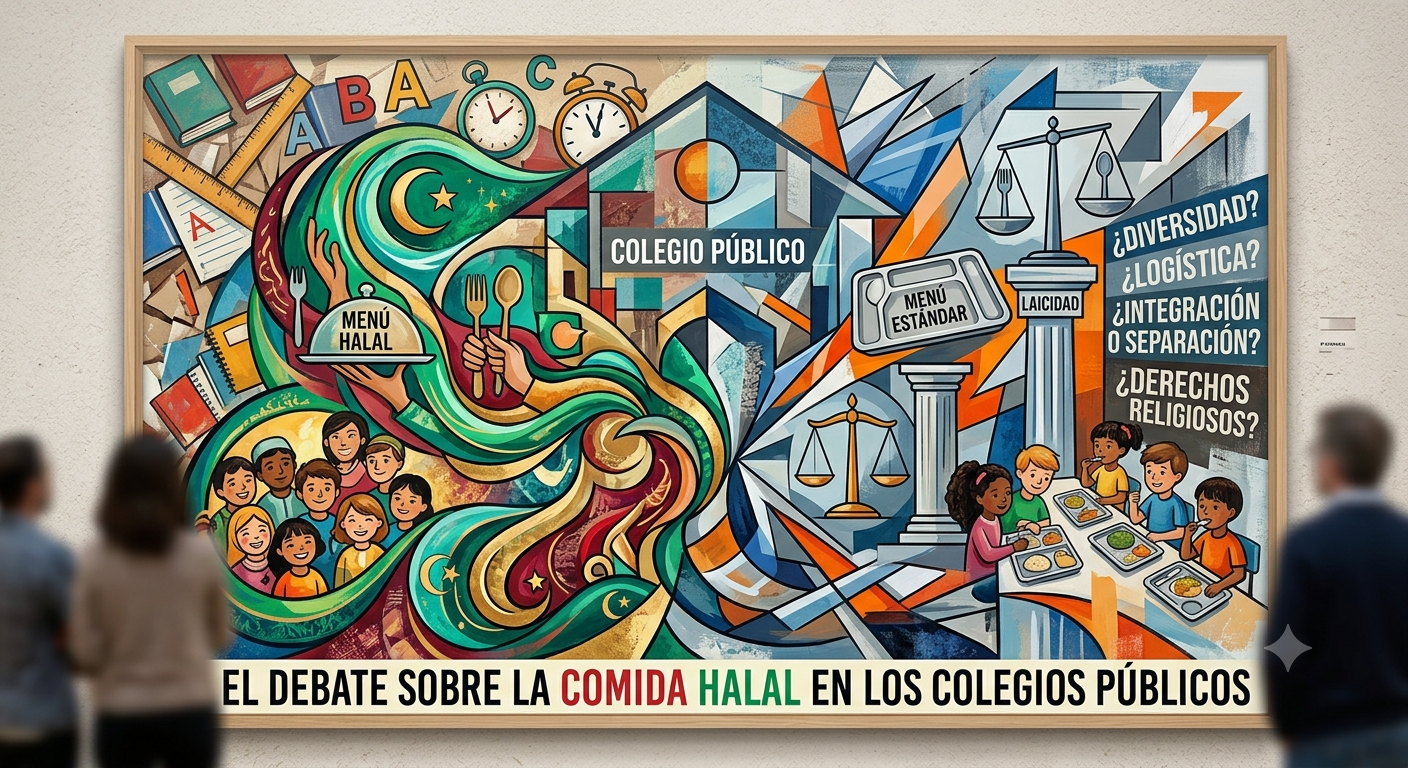
Croquettes or Halal? The Great School Cafeteria Battle
If there is one thing capable of bringing an entire nation to a standstill and sparking heated debates in the parents’ association WhatsApp group, it is not international politics or the price of petrol: it is the school lunch menu.
A few years ago, school menus were pretty straightforward. Monday: lentils. Tuesday: pasta. Wednesday: fish that no child wanted to eat. And Fridays, if you were lucky, croquettes.
But Europe is changing, Spain is changing, and classrooms are changing. Today, in many state schools, children from families with different religions, cultures, and customs share the same space.
And at the heart of this gastronomic and philosophical crossroads, a major dilemma has emerged in recent times: should state schools offer halal menus (adapted to Islamic dietary requirements) for Muslim pupils?
Get your appetite ready, because this debate has ingredients to suit every taste… and opinions that pack more of a punch than harissa.
1. The Inclusion Camp: “One Dish for Everyone, Everyone at the Table”
Supporters of this option are clear about their position. Their argument is simple: state schools exist to welcome everyone, not to leave anyone out (especially not with an empty stomach).
Freedom of religion and conscience: If we do not force a vegetarian child to eat a beef steak, and we give a coeliac child gluten-free pasta, why should we exclude those who follow a diet for religious reasons?
Real integration: Having everyone eat together in the same dining hall, even if they have different menus, builds a sense of community. According to this view, refusing to offer halal meals effectively forces these pupils to bring packed lunches from home or, quite simply, to stop using the school meal service.
In short: If we want an inclusive school, inclusion must also be demonstrated with a fork in hand.
2. The Secular Camp: “Secularism Starts at the Mouth”
In the opposite corner of the ring are staunch defenders of public neutrality. For them, bringing religion into the school kitchen means opening Pandora’s box.
State neutrality: State schools should be secular. If we start adapting menus to the requirements of a particular faith, where do we draw the line? A kosher menu tomorrow? A Pastafarian menu on Friday?
Common ground: They argue that school dining halls should be spaces of standardised equality. To avoid religious complications, they propose a Solomon-like solution: offer a vegetarian or fish-based option to anyone who does not want to eat meat. No religious labels, no complications.
In short: God, whatever name we give him, should not dictate the terms of a school catering contract.
3. The Logistics Camp: “Folks, We Just Don’t Have the Time—or the Budget!”
Then there are school principals, cooks, and managers, whose arguments come not from philosophy or theology, but from the end-of-month spreadsheet.
Kitchen complications: Preparing halal food is not simply a matter of buying meat with the appropriate certification. It also requires preventing cross-contamination during food preparation and cooking. In schools with small kitchens or cold-chain catering systems, managing four or five different menus (allergies, intolerances, vegetarian, halal) can turn the service into a logistical nightmare.
Costs and contracts: Adapting supply chains increases costs, and in public education, every penny counts.
In short: Cooks already have enough trouble getting children to eat their spinach without having to coordinate three different food certifications on top of everything else.
So, What Now? In Search of the Magic Recipe
As with most debates in a bar—or a staff room—nobody has an absolute monopoly on the truth, but the debate is well and truly served:
-
Is food a cultural right that state schools should guarantee?
-
Or is secularism a safeguard of equality that requires religious requirements to be kept out of classrooms and off the plates?
Perhaps the solution is not so complicated and lies in flexibility: offering a high-quality, neutral menu (vegetarian or fish-based) as a universal alternative for anyone who does not eat certain meats, or finding ways to structure catering contracts that reflect the actual diversity of the neighbourhood without bankrupting the school.
One thing is clear: while we try to reach an agreement, the table remains set. And the big question continues to hang in the air: can we teach diversity without choking on the process?
The Uncomfortable Question
There is another issue that hardly anyone wants to raise for fear of appearing intolerant:
Should a democracy continually adapt to religious customs, or should religions gradually adapt to democracies?
It is a legitimate question.
Europe has spent decades trying to find the balance between integration and accommodation. The problem is that nobody can agree on where the line should be drawn.