
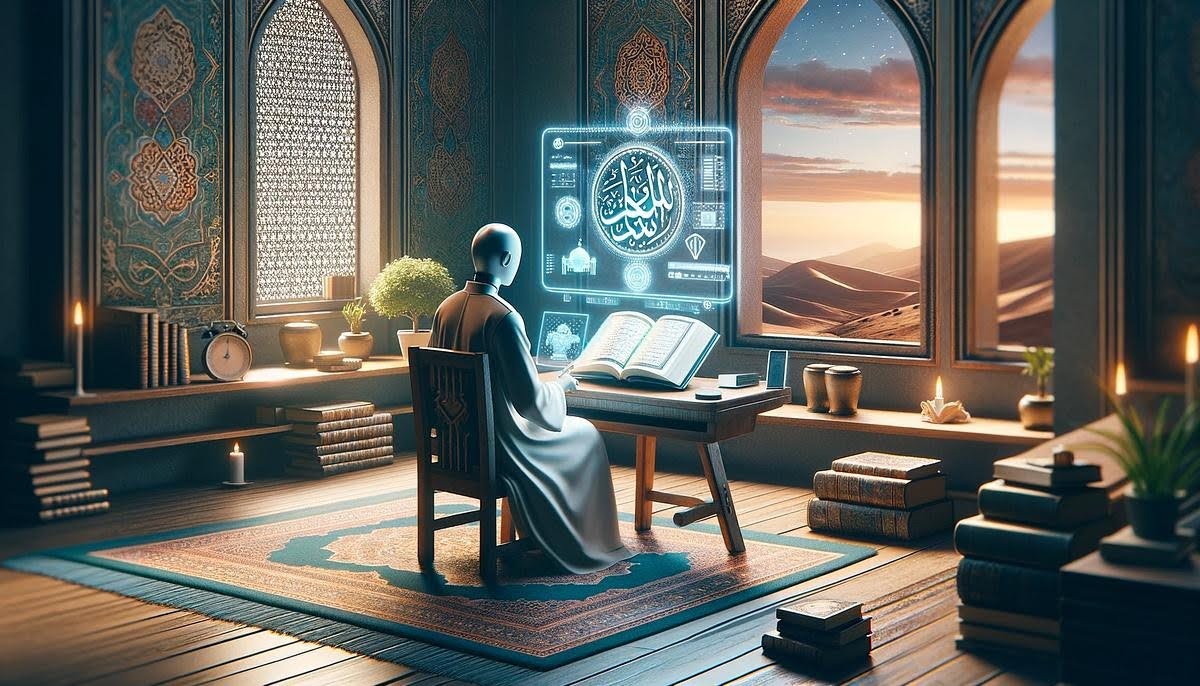
An experiment on history, religion, freedom of expression, and the limits of a machine
Can artificial intelligence imagine the personality, ideas, and physical appearance of one of the most important religious figures in history? And what happens when that figure is the Prophet Muhammad, whose visual representation provokes deep rejection in many Muslim communities?
This raises an essential question in a free society: can we investigate, ask questions, and represent religious ideas and figures without fear, even when the subject is uncomfortable?
From our perspective, the answer must be yes. But freedom of expression requires more than courage: it requires responsibility, knowledge, and honesty.
A historical and religious figure of enormous influence
Muhammad, known in Islam as the Prophet Muhammad, is the central figure in the emergence of Islam.
For Muslims, he is God’s messenger and the last of the prophets. His teachings and example occupy a fundamental place in the religious lives of millions of people.
His influence extends beyond religion. His figure is connected to the political, social, and cultural history of Arabia and to the expansion of a civilization that transformed a significant part of the world.
However, talking about Muhammad is not straightforward.
For a believer, this is not simply a matter of studying a figure from the past. It means discussing a sacred figure associated with faith, identity, and spiritual life.
For a historian, by contrast, the question is how to reconstruct the life of someone who lived in the seventh century using the available sources and applying critical methods. Both perspectives exist.
Historical research can examine a religious figure. A believer can defend that figure’s sacred status. In a pluralistic society, both positions must be able to be expressed without criticism turning into hatred or religious sensitivity becoming a general prohibition on debate.
The first problem: what do we really know about Muhammad?
Before asking an AI to imagine his personality, we must ask a more basic question:
What information do we have about him?
Our understanding of Muhammad comes from several types of sources. These include the Quran, collections of hadiths, traditional biographies, accounts of his military campaigns, and other historical testimonies.
These sources are not identical. They were produced in different contexts, and not all of them can be analyzed in the same way.
The Quran is the sacred text of Islam and an essential source for understanding the religious message associated with Muhammad. However, it is not a complete biography organized chronologically.
Traditional biographies, known as sira, provide many more details about his life. Researchers must nevertheless examine when these accounts were transmitted, how they were compiled, and how much historical reliability can be attributed to each one.
Historian Robert Hoyland has explained that writing a biography of Muhammad involves dealing with different types of sources and applying various methods to assess their authenticity.
Furthermore, academic research is not entirely uniform. Different positions exist regarding the value and interpretation of early sources.

How does artificial intelligence imagine the Prophet Muhammad?
When discussing Muhammad, the founder of Islam, we have no photographs, reliable contemporary portraits, or physical descriptions that can be independently verified. According to tradition, he was born around 570 and died in 632, in a world in western Arabia very different from modern European society.
It would therefore be inaccurate to claim that we know exactly what he looked like. However, we can construct a reasoned portrait by combining traditional descriptions, the context of seventh-century Arabia, and the precautions required for historical reconstruction.
How do I imagine his physical appearance?
Traditional descriptions recorded in the hadiths—accounts of the words and actions attributed to Muhammad—allow us to outline some of his features. Historian W. Montgomery Watt, for example, includes a physical description based on traditional testimonies, although this does not mean that every detail can be historically verified.
The face
I would imagine him with a face featuring strong, defined features, a broad forehead, a prominent nose, dark eyes, and thick eyebrows. Traditional sources describe his face as attractive and his expression as pleasant. We cannot know his exact proportions with certainty or reconstruct his individual appearance.
The hair and beard
Traditional descriptions mention dark hair, somewhere between straight and wavy, and a full beard. I would imagine him with relatively long hair by modern standards, without a contemporary haircut or an excessively groomed appearance.

His body and physical presence
Tradition portrays him as a man of average or slightly above-average height, with broad shoulders and a solid build. I would not depict him as a modern muscular athlete, but rather as someone accustomed to walking, travelling, and enduring the demands of life in an arid environment.
Clothing and everyday appearance
It is important not to project onto the seventh century the image of religious leaders from later periods.
I would imagine him wearing simple, practical clothing:
- A long tunic made from natural fabric, suitable for the heat and everyday life.
- A cloak or piece of fabric draped over his shoulders, useful for protection against the sun and the cold at night.
- Leather sandals.
- A natural beard and hair without the styling associated with modern hairdressing.
- When travelling, a bag or small amount of luggage typical of the period.

What kind of character might he have had?
I find this aspect more interesting than his physical appearance because it requires us to distinguish the traditional religious image from a historical interpretation of the individual.
We cannot enter his mind or know his private personality with certainty. We can, however, analyze the profile conveyed by Islamic sources and the kind of leadership he exercised, according to accounts of his life.

1. A communicator capable of attracting followers
I would imagine him as someone who knew how to address groups, communicate convictions, and build a shared identity. His religious messages, personal authority, and the promise of belonging to a new community helped him gather followers in an environment where tribal relationships were fundamental.
There is no need to assume that he was a perfect orator. It is enough to recognize that he succeeded in turning an initially small movement into one of considerable influence.
2. Persistent and convinced of his mission
Tradition portrays him as someone who continued preaching despite opposition. Historically, the transition from preaching in Mecca to building a community in Medina reveals a continuity of purpose and an ability to adapt to very different circumstances.
My interpretation is that he possessed strong convictions and considerable perseverance. This does not, by itself, demonstrate how he experienced his revelations internally: that question belongs to the realm of faith and historical debate.
3. A social and political leader
I would not imagine him merely as a preacher isolated from the world. In Medina, his role included leading a community, resolving disputes, forming alliances, and organizing collective defence.
This requires us to distinguish between spiritual authority, political ability, and military leadership. Throughout his historical trajectory, these three dimensions became intertwined.
4. A strong sense of justice, but not necessarily universalist in the modern sense
Traditional sources portray him as a trustworthy person and someone who intervened in disputes. However, it would be anachronistic to automatically attribute to him our contemporary understanding of individual equality, freedom of conscience, or the separation of religion and state.
His moral outlook must be understood within the religious and social context of late antiquity, rather than measured solely against twenty-first-century political categories.
5. Capable of exercising authority and making difficult decisions
An exclusively gentle, peaceful, and conciliatory image does not reflect the entirety of his life. Accounts of his life also include armed conflicts, strategic decisions, sanctions, and confrontations with adversaries.
A historical portrait must include this dimension without automatically turning it into a moral condemnation. What matters is analyzing specific decisions, their circumstances, and their consequences, rather than idealizing or demonizing him.
How might he have behaved in everyday life?
If I were to construct a plausible historical scene, I would not imagine him talking about religion constantly or maintaining a solemn expression at all times. I would imagine him alternating between moments of conversation, negotiation, reflection, and authority.
According to the traditional descriptions recorded by Watt, he is said to have spent long periods in silence and reflection, walked energetically, and remained constantly active. He is also described as someone who smiled and expressed his emotions.
In my narrative reconstruction, he would have the following characteristics:
- Observant: attentive to relationships between people, loyalties, and conflicts in his surroundings.
- Pragmatic: able to adapt his actions to circumstances and negotiate alliances when he considered it appropriate.
- Charismatic: someone whose presence and words could influence his followers.
- Reserved at certain moments: someone capable of remaining silent and reflecting before acting.
- Firm in the face of opposition: not necessarily willing to give way when he believed his mission or the survival of his community was at stake.
- Conscious of his authority: particularly as his religious, political, and military position became consolidated in Medina.

Context is essential: seventh-century Arabia
To imagine him realistically, we must avoid a common mistake: thinking of Muhammad as though he had lived in a contemporary society with the same institutions, values, and social relationships that exist today.
The western Arabia of his time was part of the world of late antiquity, connected to other regions of the Middle East through trade routes and religious networks. Social life was shaped, among other factors, by family and tribal ties, commerce, reputation, alliances, and conflicts.
In that setting:
Personal authority mattered enormously. The ability to inspire trust, maintain alliances, and resolve disputes could be decisive for leadership.
Religion was not separated from public life as it is in modern secular states. Religious beliefs could provide the foundations for social norms, collective obligations, and forms of authority.
A community’s survival could depend on negotiation and force. Alliances, migrations, and armed confrontations were part of the region’s political reality.
The position of women, enslaved people, and subordinate groups must be studied within its historical context. We should neither idealize the society of that time nor attribute today’s legal and moral categories to it without qualification.
Muhammad’s historical biography must be situated within this world, even though the available sources do not allow us to reconstruct every detail of his life with certainty.
Why is the representation of Muhammad so sensitive?
In many Muslim communities, there is deep opposition to visually depicting the Prophet, particularly when an image is interpreted as disrespectful or as a caricature.
However, Islamic traditions have not always held a single position on all images. Throughout history, manuscripts and works of art in certain Muslim contexts have depicted Muhammad, sometimes with his face veiled or through symbolic devices.
Contemporary opposition to depicting the Prophet is an important reality to understand when considering the reactions an image may provoke.
Here we encounter a tension inherent in democratic societies: disagreement and offence cannot become a justification for silencing, threatening, or assaulting others.
Freedom of expression: without fear and without censorship?
This experiment has a second purpose: to discuss freedom of expression.
No historical figure should be excluded from all investigation simply because part of the population considers that figure sacred.
If we cannot analyze a religious figure, discuss their ideas, or investigate their decisions, we would be severely restricting knowledge.
But defending freedom of expression does not mean that every expression is intelligent, rigorous, or useful.
A person may have the right to publish an opinion and, at the same time, face criticism for its lack of precision, poor taste, or factual errors.
The goal is to defend freedom of expression that allows people to ask questions without fear, conduct research without religious impositions, and engage in debate without turning opponents into enemies who must be silenced.
Freedom does not require everyone to agree. It requires us to be able to disagree without resorting to violence.
Conclusion: a machine, a historical figure, and a free society
Artificial intelligence can imagine Muhammad in many different ways.
It can create a description of his personality. It can analyze his ideas. It can compare historical interpretations. It can produce symbolic images associated with his era.
But it cannot guarantee that we know the Prophet’s inner personality. Nor can it manufacture an authentic photograph of his face or turn an interpretation into historical truth.
What it can do is open a conversation.
A conversation about the power of images.
About the relationship between history and religion.
About the limits of artificial intelligence.
About freedom of expression.
And about our ability to live together with questions that have no simple answers.
Democratic societies need the freedom to investigate and discuss. We do not want a society in which ideas are protected from all criticism.
The question is not whether we should be afraid to investigate Muhammad.
The question is whether we are capable of doing so with intelligence, courage, and responsibility.
Because a free society is not one in which nobody feels uncomfortable. It is one in which we can talk about uncomfortable subjects without allowing fear to decide for us.
Reference sources
Oxford Bibliographies, Oxford Academic, Robert Hoyland
Wiley Online Library, Jonathan A. C. Brown , John Tolan — Representaciones medievales de Mahoma