
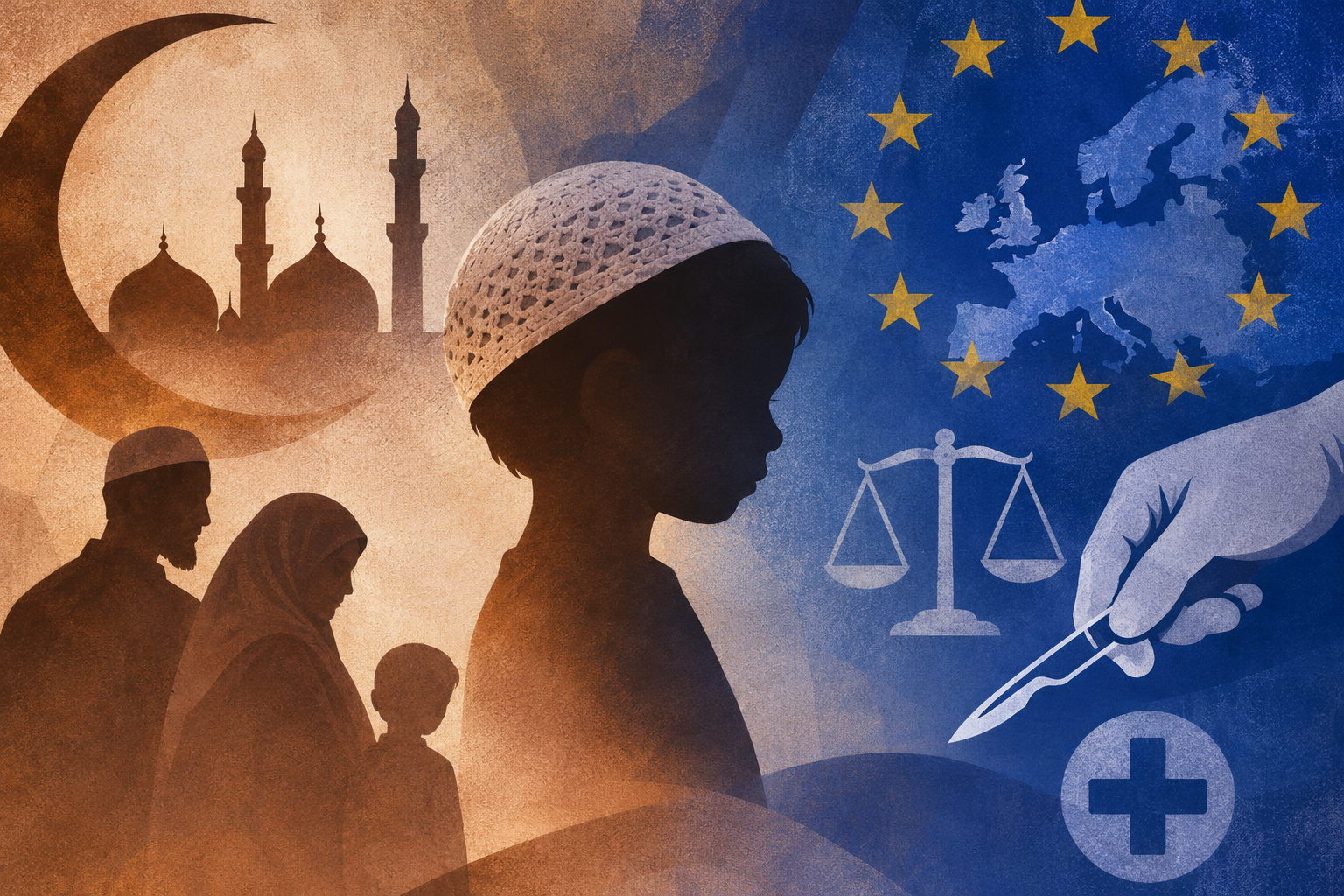
Where Does Parental Religious Freedom End and the Child’s Autonomy Begin?
A debate involving children’s rights, bodily integrity, tradition, religious freedom and the limits of parental authority.
This research examines the male circumcision of children and adolescents for religious reasons, particularly within European Muslim communities. It covers its legal, medical, religious, social and political dimensions.
The central question is not simply whether circumcision should be permitted or prohibited. It is more complex:
Can a family make an irreversible decision about part of a child’s body when that child is not yet capable of understanding, accepting or rejecting that decision, invoking the parents’ right to pass on their religion?
This question is particularly relevant in Europe, where the protection of individual rights, religious freedom, the child’s autonomy and equality before the law coexist with religious traditions that consider circumcision an important practice.
1. Defining the Scope of the Research
Before examining the debate, it is important to distinguish between three different situations.
1.1. Male circumcision for religious reasons
This consists of the total or partial removal of the foreskin of a boy or adolescent without necessarily having a medical indication.
In Islam, the practice is commonly known as jitan or khitān. It is considered an important religious tradition by many Muslims, although differences exist between Islamic legal schools and religious authorities regarding whether it is obligatory, recommended and the appropriate age for performing it.
Circumcision is also part of the Jewish tradition (Brit Milah) and certain Christian communities.
1.2. Circumcision for medical reasons
It is performed when clinical problems justify the procedure, for example, certain forms of pathological phimosis, foreskin scarring or recurrent inflammatory conditions.
In these cases, the procedure is assessed according to medical criteria: diagnosis, necessity, therapeutic alternatives, risks and benefits for the patient.
It should not be confused with the circumcision of a healthy boy for exclusively religious reasons.
1.3. Female genital mutilation
This is a different category. Female genital mutilation procedures have distinct medical and legal characteristics and consequences and are criminally prohibited in numerous European countries.
Although the comparison arises in legal and ethical debates about bodily integrity, it is not correct to automatically equate the two practices.
The research must examine the differences in anatomy, severity, consequences, social context and legal treatment, without using that distinction to avoid the debate about the rights of male minors.
2. The Fundamental Conflict: Four Rights That May Come into Conflict
Childhood circumcision raises an especially complex problem because it does not simply pit religion against medicine. Several rights are involved.
| Right or interest | Holder | Central issue |
|---|---|---|
| Religious freedom | Parents and community | The right to pass on beliefs and traditions. |
| Physical integrity | Child | The right not to undergo unnecessary or non-consensual bodily interventions. |
| Personal autonomy | Child | The right to participate in decisions concerning one’s own body. |
| Parental authority | Parents | The right and duty to protect, educate and represent the minor. |
The problem is that parents make decisions on behalf of a person who is not yet able to make certain decisions independently.
However, parental authority does not mean that parents own their children’s bodies.
Its purpose is to protect the child and make decisions that serve the child’s best interests.
This raises a fundamental question: can an irreversible intervention without a therapeutic purpose be considered to serve the child’s best interests because it contributes to their religious and cultural integration?
There are legal and ethical arguments on both sides.
3. The International Framework: What Do Children’s Rights Say?
3.1. United Nations Convention on the Rights of the Child
The 1989 Convention on the Rights of the Child is one of the most important international references for examining this issue.
Five articles are particularly relevant.
Article 3. Best interests of the child
It establishes that the best interests of the child must be a primary consideration in all decisions affecting them.
This includes decisions made by parents, healthcare institutions and public authorities.
Article 12. The right to be heard
It recognises the right of children capable of forming their own views to express them freely and to have those views given due consideration in accordance with their age and maturity.
Article 14. Freedom of thought, conscience and religion
It recognises the child’s own religious freedom, as well as the right and duty of parents to guide the child in exercising that freedom, in accordance with the child’s evolving capacities.
This article is particularly important: religion is not exclusively a parental right. It also belongs to the child.
Article 19. Protection against violence
It requires States to protect minors against all forms of physical or mental violence, injury, abuse or neglect while they are in the care of their parents or other individuals.
Article 24. Health and traditional practices
Paragraph 3 establishes that States must take effective measures to abolish traditional practices that are harmful to children’s health.
This raises a controversial legal question: should ritual male circumcision be considered one of these practices, or can it be permitted under certain conditions?
The Convention does not contain an express and specific prohibition of ritual male circumcision. Its application to this issue is debated through the combined interpretation of children’s rights.
3.2. Council of Europe: Resolution 1952 (2013)
One of the most relevant European policy documents is Resolution 1952 (2013) of the Parliamentary Assembly of the Council of Europe, entitled Children’s Right to Physical Integrity.
Paragraph 2 expressly includes the circumcision of young boys for religious reasons among the practices raising concerns about children’s physical integrity.
The resolution invites States to:
- Examine and define the medical, healthcare and safety conditions governing these interventions.
- Inform families about the risks and alternatives.
- Promote intercultural and interreligious dialogue.
- Encourage the participation of minors in decisions concerning their physical integrity.
- Examine provisions that would prevent certain interventions until the child is old enough to be consulted.
The resolution does not call for a general ban on male circumcision. Paragraph 7.5.2 asks for the medical, healthcare and other conditions that must be met to be defined. The Council of Europe itself subsequently clarified that the resolution did not call for the practice to be prohibited.
Furthermore, it is a non-binding parliamentary resolution, not a European law directly applicable in Member States.
3.3. Is There Common European Legislation?
No.
The European Union does not have harmonised legislation specifically regulating non-therapeutic male circumcision of minors.
Each country establishes its own conditions through a combination of:
- Healthcare legislation.
- Medical consent regulations.
- Fundamental rights.
- Religious freedom.
- Parental authority.
- Criminal law.
- Professional standards and child protection regulations.
A medico-legal study published in 2025 by G. Pulin and other researchers specifically examines legislative differences between Germany, Italy, France, the United Kingdom, Sweden, Iceland, Poland and Romania. Its general conclusion is that there is considerable diversity in legal and ethical approaches.
4. Spain: Is Islamic Childhood Circumcision Legal?
4.1. There Is No Specific Spanish Law on Ritual Male Circumcision
In Spain, I have not identified any national law that specifically and comprehensively regulates male childhood circumcision for religious reasons.
Nor is there a general prohibition of the practice.
Its legal framework is constructed from several different regulations.
Spanish Constitution
Article 16 protects ideological, religious and freedom of worship rights.
However, this right does not establish that the religious decisions of parents take precedence over their children’s fundamental rights.
Article 15 protects the physical and moral integrity of all individuals.
Minors are also holders of these rights.
Civil Code: Article 154
This is an essential reference.
It establishes that parental authority must always be exercised in the interests of the children, respecting their personality, rights and physical and mental integrity.
It also establishes that children who have sufficient maturity must be heard before decisions affecting them are made.
This has an important consequence: parents cannot automatically justify any bodily intervention simply by invoking their exercise of parental authority.
Civil Code: Article 156
Parental authority is exercised jointly by both parents, or by one parent with the express or tacit consent of the other.
In the case of an irreversible bodily intervention without a therapeutic purpose, the need to obtain the agreement of both parents becomes particularly important.
Where disagreement exists, the judicial authority must resolve the matter in accordance with the child’s best interests.
4.2. Organic Law 1/1996 on the Legal Protection of Minors
This law establishes the best interests of the minor as a priority principle.
It also recognises the child’s right to be heard in decisions affecting their personal, family and social life.
Article 6 recognises the minor’s ideological and religious freedom, as well as the role of parents in guiding its exercise.
Therefore, the minor is not simply a passive recipient of their parents’ religious decisions. They have their own rights and a degree of autonomy that evolves as they develop.
4.3. Law 41/2002 on Patient Autonomy
This law regulates informed consent in healthcare interventions.
Article 9 is particularly relevant:
- When a minor lacks the intellectual or emotional capacity to understand the scope of the intervention, consent is given by their legal representative, after hearing the minor’s opinion.
- Emancipated minors and those over 16 who do not fall within certain exceptions give their own consent.
- Decisions made through legal representation must be guided by the greatest benefit to the patient’s life or health.
Article 10 requires information to be provided about the consequences and risks of the intervention before written consent is obtained, where such consent is required.
An unresolved issue: this law regulates healthcare activity but does not establish a special legal framework for ritual circumcision. Its application must therefore be analysed alongside the rules governing minors’ rights and parental authority.
Nor should it be interpreted to mean that parental signatures automatically make any non-therapeutic intervention legally justified.
4.4. Can Article 149.2 of the Criminal Code Be Applied?
Article 149.2 of the Criminal Code punishes genital mutilation in any of its forms with prison sentences of six to twelve years.
The question is whether this expression can include ritual male circumcision.
The debate is not purely theoretical. Spanish case law exists on this subject.
In Order 355/2006, dated 21 September, the Provincial Court of Castellón examined a properly performed childhood circumcision and concluded that the facts did not fall within the offence of genital mutilation under Article 149.2.
A legal analysis published in the Yearbook of State Ecclesiastical Law in 2018 by Agustín Motilla also refers to Order 598/2008 of the Provincial Court of Barcelona.
In the latter case, the Court ordered the dismissal of proceedings concerning a circumcision performed in Casablanca, taking into account that the operation had been medically indicated due to phimosis, had been performed by a doctor in accordance with the lex artis, and had also taken place outside Spanish territory.
It is therefore necessary to distinguish between two issues:
Properly performed circumcision and circumcision carried out through a defective or dangerous procedure.
The same legal study documents convictions for negligent injury and negligent homicide when the operation was performed without medical knowledge, in unhygienic conditions and with serious consequences.
The cases included are:
- Provincial Court of Almería, 3 November 2004: conviction for negligent injury following a procedure that resulted in the loss of part of a child’s glans.
- Provincial Court of Lleida, 1 October 2014: conviction of the parents for gross negligence following a home circumcision that caused haemorrhaging and placed the baby’s life at risk.
- Provincial Court of Zaragoza, 5 February 2010: conviction for negligent homicide after a six-month-old baby died from haemorrhaging caused during a circumcision performed in extremely inadequate conditions.
The important legal conclusion is that the absence of a specific prohibition does not mean that anyone can perform circumcision under any circumstances without facing criminal liability.
4.5. What Happens in Spain’s Public Healthcare System?
There is a particularly relevant study published in 2019 in the Revista Pediatría de Atención Primaria.
Its title is: Situation of Circumcision for Religious Reasons in Spain.
A national survey was conducted involving 49 public hospitals with paediatric surgery services.
Results of the 2019 survey
76.6%
Of the participating paediatric surgeons did not perform circumcisions for religious reasons within the public healthcare system.
65%
Would refer patients to private healthcare.
65%
Had experienced some form of conflict with families when refusing the procedure.
39%
Of those who agreed to perform it did so to prevent procedures being carried out in worse conditions outside hospitals.
57%
Did not know whether it was included in the portfolio of services of Spain’s National Health System.
2019 survey, 142 responses out of a total of 200 questionnaires sent. It does not represent a measurement of all Spanish healthcare activity in 2026.
scielo.isciii.es+2
The study also notes that Catalonia and the Basque Country had excluded this indication from public medical practice.
It is important not to confuse exclusion from public healthcare with a general legal prohibition of circumcision.
The Spanish problem revealed by this study is the absence of a uniform protocol. The response depends to a considerable extent on the criteria adopted by each healthcare centre and each professional.
5. Europe: Legislation and Regulation Country by Country
The European situation presents very different models. Some countries have passed specific laws, others allow the practice under general healthcare conditions, and others leave much of the issue to the courts and professional regulations.
5.1. Germany: A Specific Law Allowing Circumcision
Germany is one of the most important legal examples.
The 2012 Cologne Case
On 26 June 2012, the Cologne Regional Court issued a judgment considering the circumcision of a young boy to constitute bodily injury.
The case originated from the circumcision of a four-year-old Muslim boy performed by a doctor. Two days later, the child suffered haemorrhaging and was taken to the emergency department.
The court considered that the parents’ religious freedom did not automatically prevail over the child’s right to physical integrity and self-determination.
The judgment triggered an intense political, religious and legal debate in Germany.
The Legislative Response: Section 1631d of the German Civil Code
The German Parliament passed a specific provision, incorporated into the Civil Code as §1631d BGB.
It allows parents to consent to non-medically necessary male circumcision when the child lacks the capacity to understand and decide, provided that:
- It is performed in accordance with the rules of medical practice.
- It does not endanger the child’s welfare, including consideration of the purpose of the intervention.
- The person performing it meets the established requirements.
During the first six months of life, the procedure may also be performed by specially trained and designated individuals from a religious community, provided they have competence equivalent to that required to perform it.
The German model: it expressly recognises the parents’ ability to authorise circumcision but establishes limits related to the child’s welfare and the safety of the procedure.
5.2. Sweden: Specific Regulation and the Child’s Right to Object
Sweden passed Act 2001:499 on the Circumcision of Boys.
It is one of Europe’s strictest models regarding the regulation of the procedure.
The law establishes:
- Consent from the minor’s legal guardians.
- Consent from both guardians when they share parental responsibility.
- Information for the child when their age and maturity allow them to understand it.
- An obligation to ascertain the child’s opinion.
- A prohibition on performing the procedure against the child’s will.
- An obligation to use pain-relief measures.
- Appropriate hygienic conditions.
Regarding who may perform it, the law allows the procedure to be carried out by a doctor or a person holding special authorisation.
However, there is an important restriction: a person who is not a doctor cannot circumcise boys older than two months. From that age onwards, an authorised doctor must perform the procedure.
5.3. Norway: Special Legislation of 2014
Norway passed the Lov om rituell omskjæring av gutter, the Act on Ritual Circumcision of Boys, on 20 June 2014. It entered into force on 1 January 2015.
Its purpose is twofold: to ensure that the practice is carried out safely and to ensure that a legal service remains available to communities wishing to perform it.
Its conditions are:
- The procedure must normally be performed by a doctor.
- Another person may also perform it if a doctor is physically present and assumes responsibility.
- Adequate analgesia must be provided before, during and after the procedure.
- Consent must be obtained from the holders of parental responsibility.
- The child must receive information when they have sufficient age and maturity.
- Their opinion must be taken into account.
- The procedure cannot be performed against their will.
The legislation also requires regional health authorities to organise a safe service offering this procedure.
It is an example of a solution that does not prohibit religious tradition but subjects its implementation to detailed public regulation.
5.4. Denmark: Legal Under Healthcare Conditions
The Danish Patient Safety Authority expressly states that non-therapeutic male circumcision is legal.
However, it establishes that the procedure must comply with official safety guidelines.
The State has developed recommendations concerning the intervention, its risks, professional conditions and procedural requirements.
The Danish debate is particularly intense regarding the age of consent.
In 2016, the Danish Medical Association argued that circumcision should not be performed before the child is capable of making the decision themselves, although this professional position did not become a legal prohibition.
It is therefore necessary to distinguish between the ethical position of the medical organisation and the law currently in force.
5.5. Finland: A Supreme Court Judgment
Finland offers one of the most interesting judicial cases.
In 2008, the Supreme Court issued judgment KKO:2008:93.
The case concerned a mother who had authorised the circumcision of her four-and-a-half-year-old Muslim son.
The procedure was performed by a doctor, under local anaesthesia, for religious and cultural reasons.
The Supreme Court considered that although circumcision constitutes an irreversible intervention affecting physical integrity and may cause pain and complications, under the specific circumstances of the case it did not constitute a criminal offence of bodily injury.
The court took into account:
- The family’s religious and cultural tradition.
- The importance the procedure could have for the child’s identity and social integration.
- The fact that the operation had been properly performed.
- The absence of permanent damage or unnecessary pain.
However, the reasoning includes an important qualification: a child who does not understand the meaning of the intervention cannot justify it exclusively through their own right to religious freedom.
The court assessed the circumstances as a whole and the child’s best interests.
5.6. United Kingdom: A Complex Legal Situation
In England and Wales, there is no specific law comprehensively regulating ritual male circumcision.
The practice has developed through general rules concerning consent, parental authority, criminal law and case law.
The British Medical Association (BMA) recommends taking the following into account:
- Medical risks and benefits.
- The irreversible nature of the intervention.
- The child’s religious upbringing.
- The beliefs of both parents.
- The family and cultural context.
- The psychological, social and emotional benefits that may be claimed.
The BMA recommends obtaining the consent of both parents when they share parental responsibility and obtaining the child’s consent when they have sufficient maturity. If the parents disagree, it recommends referring the matter to the courts.
Case Re P (Circumcision: Child in Care), 2021
An English court examined a request by Muslim parents who wanted to circumcise their son, who was in care.
The judge acknowledged the importance of the child’s Muslim heritage and the value that the practice held for his parents.
However, the judge considered that the intervention should be postponed until the child had sufficient maturity to make the decision himself.
The decision took into account that:
- The child was in care.
- His carers did not support the intervention.
- His siblings had not been circumcised either.
- The intervention was irreversible.
- There was a possibility that, as he grew older, the child might not wish to identify with that tradition.
The judge concluded that the child’s Muslim identity could be preserved through religious education and contact with his parents, without immediately performing the intervention.
Case Alazawi v Rex, 2026
Particularly relevant judgment from 2026
On 23 July 2026, the Court of Appeal of England and Wales delivered judgment in Alazawi v Rex [2026] EWCA Crim 947.
The case concerned a man who performed non-therapeutic circumcisions on babies and children, mainly Muslims, travelling to family homes.
The man had no medical qualifications and had performed procedures in inadequate conditions. The proceedings included charges and convictions relating to fraud, serious bodily injury, assaults and offences involving the administration of medication.
The court confirmed an important principle: in England and Wales, ritual circumcision does not necessarily require the person performing it to be a doctor and, in that sense, non-medical practice is not regulated through a specific professional authorisation system.
But this does not mean that every way of performing it is legal.
A procedure performed under unsafe conditions that exposes a minor to a significant and unnecessary risk of additional harm may constitute a criminal assault.
The judges also indicated that it would be preferable for Parliament to regulate these non-medical procedures.
This case is particularly relevant because it demonstrates that the issue is not limited to parents’ right to consent: it also concerns who may perform the intervention, under what conditions and with what degree of responsibility.
5.7. France: No Specific Law
France does not have a specific national law expressly authorising or prohibiting ritual male circumcision.
It is accepted that it may be performed within the healthcare framework, provided professional rules are respected.
A document from Nantes University Hospital (CHU de Nantes) states that there is no specific legal text regulating the authorisation or prohibition of non-medical circumcision.
It also indicates that:
- The operation is not reimbursed by the French Health Insurance system (Assurance Maladie) when there is no medical indication.
- Patient safety must be respected.
- The procedure must be coordinated between the surgeon, anaesthetist and healthcare facility.
- Joint consent from both parents is required.
In France, civil case law has also considered ritual circumcision not to be an ordinary act of parental authority for which the other parent’s tacit consent may be presumed.
5.8. Belgium: A Particularly Intense Ethical and Judicial Debate
Belgium is one of the most interesting cases for studying the conflict between religion, medicine and physical integrity.
The Consultative Bioethics Committee, 2017
The Belgian Consultative Bioethics Committee published Opinion No. 70 on 8 May 2017.
The document extensively examines the ethical legitimacy of male circumcision without a medical indication.
Its members did not reach a common position.
One group considered that it could be permitted if:
- It was performed under appropriate healthcare conditions.
- A safe technique was used.
- Appropriate pain management was provided.
- Parents received complete information about the risks.
Other members considered that the removal of healthy genital tissue without the minor’s consent constituted an ethical violation of bodily integrity and that the procedure should be postponed until the child could decide.
All members agreed that the costs of non-medical circumcisions should not be covered by social security.
As an alternative, the document proposed exploring symbolic practices that would respect physical integrity.
Investigation into Ritual Circumcisers in Antwerp, 2025–2026
In May 2025, police searches were conducted at three locations in Antwerp as part of an investigation into ritual circumcisions.
On 6 May 2026, the Antwerp Public Prosecutor’s Office announced that it was seeking to refer two mohelim — Jewish ritual circumcisers — to the criminal court.
The offences under investigation concerned alleged intentional injuries to minors and the illegal practice of medicine.
The main issue was whether the procedures had been performed by individuals without recognised medical training and without medical supervision.
The source published on 6 May indicated that the Indictment Chamber was due to examine the matter on 18 June 2026 to decide whether it should proceed to trial.
We have not been able to verify the subsequent outcome of that decision in the sources consulted. It should therefore not be presented as a conviction.
Although this case concerns Jewish tradition, its implications may be relevant to the debate on regulating Muslim ritual circumcision.
5.9. The Netherlands: A Highly Critical Medical Position
In the Netherlands, non-therapeutic male circumcision is not prohibited.
However, the Royal Dutch Medical Association (KNMG) maintains a highly critical position.
Its position, updated in March 2022, considers non-therapeutic male circumcision of minors to violate the child’s physical integrity and autonomy.
The organisation argues that there are no predominant medical or hygienic benefits justifying subjecting a healthy minor to the procedure.
It also points to possible complications and recommends that doctors discourage the practice and actively inform parents.
The KNMG nevertheless acknowledges that a prohibition could push procedures into clandestine and less safe environments.
Its position is supported by various Dutch medical associations.
5.10. Italy: An Administrative Decision of September 2026
Italy also presents recent developments.
On 7 September 2026, the Regional Administrative Court of Lombardy, based in Brescia, issued Order No. 328.
The court considered that ritual circumcision, even when performed for religious reasons and technically straightforward, constitutes a surgical operation affecting physical integrity.
It therefore established that it must be performed in protected healthcare facilities linked to structures authorised to provide hospital care, rather than in certain non-protected clinics.
The decision considered that this requirement did not prevent the exercise of religious freedom because the practice remained permitted in facilities providing the necessary safeguards.
It is a regional administrative decision linked to the case under examination; it should not be confused with a national ban on ritual circumcision.
5.11. Iceland: An Attempt to Ban Circumcision in 2018
Iceland was the scene of one of Europe’s most intense debates.
In February 2018, a parliamentary proposal was introduced to ban non-therapeutic male circumcision of minors, arguing that the child’s right to decide about their own body should be protected.
The proposal generated strong opposition from Muslim and Jewish organisations and religious freedom advocates.
The bill was not passed before the parliamentary session ended in June 2018 and was not reintroduced in September of that year.
Therefore, Iceland did not adopt that ban.
5.12. European Comparison
The following table summarises the different models and the main documented elements.
| Country | Legal situation | Most relevant aspect |
|---|---|---|
| Germany | Permitted under specific legislation | Parental consent and protection of the child’s welfare. |
| Sweden | Specific regulation | Prohibition on performing the procedure against the child’s will. |
| Norway | Specific regulation | Responsible doctor, analgesia and parental consent. |
| Denmark | Legal under guidelines | Debate concerning the age of consent. |
| Finland | Accepted through case law | Assessment of the child’s best interests in each case. |
| England and Wales | Permitted under general rules | Case law on consent and criminal law limits. |
| France | No specific law | Joint parental consent and healthcare conditions. |
| Belgium | No general prohibition identified | Controversy over who may perform the procedure. |
| Netherlands | Not prohibited | Highly critical institutional medical position. |
| Italy | Permitted under conditions | 2026 regional decision concerning protected healthcare facilities. |
| Iceland | No ban adopted | Proposed ban withdrawn in 2018. |
This comparison does not replace an examination of each country’s legislation: particularly in countries without a specific law, regulation may depend on general healthcare, civil and criminal law.
A European review published by Euronews on 19 February 2026 indicated that no general national ban was in force and that some countries imposed specific professional and healthcare requirements.
6. Judicial and Media Cases That Have Shaped the Debate
Several events help explain why the issue has extended beyond the family and religious spheres.
Cologne, Germany — 2012
A court judgment considered the circumcision of a Muslim boy to constitute bodily injury. The debate led Germany to pass specific legislation.
Reference: Landgericht Köln, 151 Ns 169/11.
Finland — 2008
The Supreme Court considered lawful, under the specific circumstances, a properly performed circumcision on a four-and-a-half-year-old Muslim boy.
Reference: KKO:2008:93.
England — 2021
The Re P case postponed a circumcision requested by Muslim parents until the child could participate in the decision.
Reference: [2021] EWHC 1616 (Fam).
Antwerp, Belgium — 2025–2026
Investigation into two ritual circumcisers for alleged illegal medical practice and injuries to minors.
Documented public status: prosecution request for referral to trial in May 2026.
England — 2026
The Alazawi case confirms that the absence of medical qualifications does not, by itself, make every ritual circumcision illegal, but that an unsafe procedure may constitute a criminal offence.
Reference: [2026] EWCA Crim 947.
These cases show that courts do not always respond with a general prohibition or authorisation. They frequently examine the circumstances of each minor: age, decision-making capacity, parental consent, healthcare environment and the purpose of the intervention.
7. What Does Medicine Say? Benefits, Risks and Controversies
This section is essential because part of the religious debate relies on presumed hygienic or preventive benefits.
It is necessary to distinguish proven medical benefits in certain contexts from the justification for performing an irreversible procedure on a healthy baby in Europe.
7.1. Is It Medically Necessary?
There is no general medical indication for circumcising all boys.
The European Association of Urology (EAU), in its paediatric urology guidelines, distinguishes between physiological conditions and diseases of the foreskin.
For example, the fact that a baby’s foreskin cannot be retracted does not automatically mean that the child has pathological phimosis.
Foreskin retractability develops naturally during childhood:
- At birth, only approximately 4% of boys have complete retractability.
- By the end of the first year, around 50%.
- At three years of age, approximately 89%.
Therefore, the inability to retract the foreskin in many young boys is a physiological phenomenon that does not require treatment when there are no relevant symptoms.
The EAU also distinguishes between pathologies that may justify intervention, including certain cases of secondary phimosis, recurrent balanoposthitis and lichen sclerosus or balanitis xerotica obliterans.
7.2. Potential Health Benefits
The medical arguments used in favour of circumcision include:
Reduction in certain childhood urinary tract infections.
Associations have been observed between circumcision and a lower risk of urinary tract infections during the first year of life.
However, the benefit depends on the child’s risk profile and does not, in itself, constitute a recommendation for universal circumcision.
Reduction in the risk of certain sexually transmitted infections.
Some trials conducted in African countries with a high prevalence of HIV have shown a reduction in the risk of heterosexual HIV acquisition among circumcised men.
However, these studies were conducted in specific epidemiological contexts and do not automatically justify circumcising all European newborn boys.
Hygiene.
Circumcision facilitates certain hygiene practices, but genital hygiene can be maintained without removing the foreskin.
Penile cancer.
An association between certain foreskin conditions and penile cancer has been studied, but the disease is rare and the EAU expressly states that routine neonatal circumcision is not indicated for its prevention.
7.3. Risks and Complications
Like any surgical procedure, circumcision can cause complications.
Among the best-known are:
- Bleeding.
- Infections.
- Acute pain and pain during recovery.
- Injury to the glans.
- Excessive or insufficient tissue removal.
- Wound-healing problems.
- Meatal stenosis.
- Adhesions and anatomical alterations.
- The need for further procedures.
A systematic review and meta-analysis published in 2021 included 351 studies and approximately four million participants.
Its results estimated an overall complication risk of 3.84%.
For non-therapeutic circumcisions, the estimated percentage was 3.34%. The most frequently reported complications included bleeding, device removal and infections.
These results must be interpreted cautiously: the studies come from different countries, age groups, techniques and healthcare settings, so the figure should not be directly applied to every European hospital or practitioner.
7.4. What Do We Know About Long-Term Consequences?
There is research into genital sensitivity, sexual function, satisfaction, psychological well-being and personal experiences following circumcision.
There is not sufficiently consistent scientific evidence to claim that all circumcised individuals experience reduced sexual satisfaction, nor to claim that the procedure has no possible individual effects.
The problem is that studies do not always use the same methods, populations and variables.
From a children’s rights perspective, there is also an issue independent of medical outcomes: even if an intervention does not produce detectable clinical harm, it remains irreversible and is performed on someone who has not been able to make the decision.
7.5. What Do Medical Organisations Say?
There is no completely uniform European professional position on this issue.
| Organisation or institution | Position |
|---|---|
| European Association of Urology | Distinguishes physiological development from pathologies that may justify circumcision. |
| KNMG, Netherlands | Ethical opposition to non-therapeutic circumcision of minors. |
| British Medical Association | Individual assessment of the child’s best interests, religious and cultural context, consent and risks. |
| Belgian Bioethics Committee | Divided positions between allowing it with safeguards and considering that it should be postponed until the child’s consent. |
A review paper published by Matthew Deacon and Gordon Muir in the International Journal of Impotence Research concludes that non-therapeutic circumcision of healthy children has little high-quality medical evidence demonstrating an overall benefit and entails avoidable risks.
This is a conclusion reached by those authors, not a unanimous position held by all medical organisations.
8. What Does Islam Say? The Religious Dimension of Circumcision
It is important not to analyse the practice solely from a European legal perspective. Understanding the conflict requires examining its religious significance.
8.1. Is It Explicitly Commanded in the Quran?
There is no Quranic verse that explicitly commands male circumcision.
Its religious foundation is found mainly in prophetic traditions, hadiths and legal interpretations developed by the different Islamic schools.
An academic article by Hossein Dabbagh, published in 2022 in the Journal of Religion and Health, specifically examines the debate over whether male circumcision is religiously necessary within Islam.
The paper points out that its religious status is based on secondary sources of Islamic jurisprudence and that disagreements exist among religious authorities concerning the interpretation and authority of those sources.
Therefore, it is not correct to claim that all Islamic currents hold exactly the same legal position.
8.2. Is It Obligatory or Recommended?
Interpretations differ.
In some legal approaches, it is considered a religious obligation. In others, it is a highly recommended practice or a tradition associated with ritual purity and fitra.
The importance of circumcision in Muslim communities is widespread, but this social prevalence should not be confused with a completely uniform religious interpretation.
8.3. At What Age Is It Performed?
Unlike the Jewish tradition, which normally establishes the eighth day of life for Brit Milah, Islam does not have a single universal date for performing circumcision.
It may be performed:
- During the first days or months of life.
- During the first years of childhood.
- During later childhood.
- During adolescence, before certain stages of religious or social life.
Customs vary between countries, families and communities.
The Encyclopaedia Iranica documents this diversity of ages and ceremonial forms in different Muslim societies.
8.4. Why Do Many Muslim Families Consider Circumcision Important?
From the perspective of practising families, it may have several meanings:
Religious identity. It is understood as a sign of belonging to the Muslim community.
Prophetic tradition. It is linked to religious tradition transmitted through the hadiths.
Ritual purity. In certain approaches, it is associated with cleanliness and preparation for particular religious practices.
Social integration. In certain communities, a boy who has not been circumcised may be perceived as someone who has not completed a practice considered important for community belonging.
Family transmission. Parents may understand that they are passing on to their son a religious tradition that they themselves received from their own parents.
These arguments are not merely medical. They concern identity, belonging, family continuity and religion.
For this reason, the debate cannot be resolved simply by demonstrating that there is no universal medical necessity.
8.5. Is There Opposition to Circumcision Within the Muslim World Itself?
Critical reflections also exist within contemporary Muslim thought.
Some authors argue that the absence of an explicit Quranic command, the diversity of legal interpretations and the evolution of children’s rights justify reviewing the timing and conditions of the practice.
Hossein Dabbagh’s paper is particularly useful because it examines whether circumcision is genuinely necessary from a religious perspective and how disagreements between Muslim authorities should be addressed.
This does not mean that there is a Muslim consensus against the practice. Nor does it mean that Muslim parents lack religious arguments to defend it.
The important point is to recognise that Islam is not a uniform doctrinal bloc on every detail of this issue.
9. The Debate Between Children’s Rights and Parents’ Religious Freedom
There are two major positions, although each contains different nuances.
9.1. Arguments in Favour of Allowing Childhood Circumcision
Supporters of the practice consider that:
- Religious freedom includes the right of parents to pass on their religion to their children.
- Circumcision is a deeply rooted tradition in Muslim identity.
- Belonging to a religious community is not merely an individual decision that begins in adulthood.
- Prohibiting the practice may exclude or stigmatise certain religious communities.
- Performing it under appropriate healthcare conditions can reduce risks.
- A total prohibition may encourage clandestine procedures without medical supervision.
- Performing the procedure during childhood may avoid it being carried out later, at a more advanced age, when the procedure and recovery may be more complicated.
The 2008 Finnish judgment and German legislation are examples of how these arguments have been recognised within certain legal frameworks.
9.2. Arguments in Favour of Restricting or Postponing It
Critics consider that:
- It is an irreversible intervention on a child who has not been able to give consent.
- Healthy bodily tissue is removed without a therapeutic necessity.
- Religious freedom also belongs to the child, not exclusively to their parents.
- Religious identity can be transmitted through education, family life and community participation without necessarily performing a bodily intervention.
- The practice can be postponed until the minor has the capacity to decide.
- Parental consent should not be sufficient to authorise every irreversible modification of a minor’s body.
- The absence of a medical purpose may make the intervention more difficult to justify in terms of the child’s best interests.
These positions appear in the Council of Europe’s resolution, the position of the Dutch KNMG and part of the Belgian bioethical debate.
9.3. A Particularly Sensitive Question: What Happens When the Child Says No?
This aspect is decisive.
A baby cannot express their wishes. A young child may not understand the medical and religious meaning of the intervention. An older child may already have a clear opinion.
Swedish and Norwegian legislation expressly recognises that ritual circumcision cannot be performed against the child’s will.
In England and Wales, the BMA recommends obtaining the minor’s consent when they have sufficient maturity and understanding.
In Spain, the minor’s rights to participation and autonomy must also be taken into consideration, but there is no specific law on ritual circumcision establishing a veto framework with the same level of precision as the Swedish and Norwegian laws.
Here a question arises that deserves further psychological and sociological research:
Should a 10-, 12- or 14-year-old child be considered to have the right to reject a practice that their parents regard as essential to their religious identity?
And, conversely:
To what extent can a State prevent parents from passing on a religious practice that they consider fundamental when the procedure is performed safely?
10. Circumcision and the Integration of Muslim Communities in Europe
This issue also has a social and political dimension.
Circumcision is one of the bodily practices through which tensions can be observed between:
- The continuity of religious traditions.
- The integration of Muslim communities.
- The secularisation of European societies.
- The protection of individual rights.
- The progressive autonomy of minors.
For many families, the intervention is a normal expression of their religious identity and a practice they do not question.
For some sectors of European society, however, the idea that parents can authorise an irreversible genital modification for religious reasons raises an individual rights issue.
There is also a question of equality: if parents are allowed to authorise certain bodily modifications for religious reasons, what criteria should be used to determine which practices are acceptable and which are not?
The answer cannot depend exclusively on whether a tradition is ancient, widespread or practiced by a minority.
Legislation should take into account the characteristics of the intervention, its risks, its purpose, consent and the rights of the minor.
The German case, the debate within the Belgian Bioethics Committee and Council of Europe Resolution 1952 demonstrate that this tension has existed for years and remains unresolved.
11. What Model Should Europe Adopt?
The comparison makes it possible to identify three main models.
| Model | Characteristics | Representative countries |
|---|---|---|
| Legislative recognition | Explicitly permitted, subject to limitations. | Germany. |
| Specific healthcare regulation | Requirements concerning consent, personnel, hygiene and analgesia. | Sweden and Norway. |
| General legal framework and case law | General healthcare, civil and criminal law applies. | France, England and Wales, Finland and others. |
There is a fourth position in the ethical debate: that of professionals and groups who believe that non-therapeutic circumcision should be postponed until the minor can make the decision themselves.
The most demanding regulatory model does not necessarily have to involve banning the practice.
It could be based on:
- Informed consent from both parents.
- Clear and documented information about the risks and irreversible nature of the procedure.
- Performance in appropriate healthcare facilities.
- Qualified personnel subject to supervision.
- Appropriate pain management.
- A prohibition on proceeding against the child’s explicit wishes.
- The minor’s right to receive information adapted to their age.
- The possibility of postponing the procedure when there is a serious dispute concerning the child’s best interests.
- Public monitoring of complications and the professionals performing these procedures.
This model is close to some of the safeguards established in Sweden and Norway, although it does not completely resolve the controversy over whether parents should be allowed to authorise the procedure when the child is too young to consent.
Conclusions: Where Does Parents’ Religious Freedom End?
The research allows several conclusions to be drawn.
First. Ritual male circumcision is recognised as an important religious practice in numerous Muslim communities, but its interpretation is not completely uniform within Islam.
Second. The absence of a medical indication is the element that creates the main conflict. The procedure is not performed to treat a specific disease, but to fulfil a religious, cultural or identity-related purpose.
Third. Parental consent cannot be considered unlimited. Parental authority must be exercised for the benefit of the minor and must respect their physical integrity, rights and progressive autonomy.
Fourth. European countries have developed different models. Germany, Sweden and Norway have opted for specific legislation, while other countries rely on general regulations and case law.
Fifth. There is no uniform European medical position. Some organisations consider that non-therapeutic circumcision lacks sufficient medical justification and should be postponed; others accept its performance, taking into account the religious context and the child’s best interests, provided appropriate safeguards are in place.
Sixth. The safety of the procedure is a separate issue from its religious legitimacy. Even where the practice is permitted, an intervention performed negligently or dangerously may give rise to civil or criminal liability.
Seventh. Spain has a specific regulatory gap. There is no national law dedicated to this practice, and the approach taken by public healthcare centres is not uniform.
Parents’ religious freedom deserves protection. However, that freedom cannot automatically become an unlimited right to decide on any irreversible bodily intervention involving a minor.
The real debate lies in determining which decisions parents can legitimately make on behalf of their children and which should be reserved until the minor has the capacity to decide.
Can a religious tradition justify an irreversible intervention on the body of a healthy child who does not yet have the capacity to consent, or should the future adult’s right to decide about their own physical integrity prevail?
This is the question that makes Islamic childhood circumcision one of the most complex debates concerning religious freedom, children’s rights and the limits of parental authority in contemporary Europe.
Main Sources and Bibliography
Spain
- Spanish Civil Code — Articles 154 and 156.
- Organic Law 1/1996 on the Legal Protection of Minors.
- Law 41/2002 on Patient Autonomy.
- Spanish Criminal Code — Article 149.
- Agustín Motilla, Ritual Circumcision of Minors, 2018.
- Situation of Circumcision for Religious Reasons in Spain, 2019.
International and European Law
- United Nations Convention on the Rights of the Child.
- Council of Europe — Resolution 1952 (2013).
- Medico-legal Aspects of Male Ritual Circumcision in Europe, 2025.
- Euronews — Circumcision for Religious Reasons, 19 February 2026.
National Legislation and Court Judgments
- Germany — Civil Code, §1631d.
- Sweden — Act 2001:499.
- Norway — Act on Ritual Circumcision of Boys.
- Finland — Supreme Court, KKO:2008:93.
- England — Alazawi v Rex, 2026.
- British Medical Association — Core Ethics Guidance, 2025.
- Belgium — Consultative Bioethics Committee, Opinion 70, 2017.
- Italy — Lombardy Regional Administrative Court, Order 328/2026.
Medicine and Religion
- European Association of Urology — Paediatric Urology Guidelines.
- Male Circumcision Complications — Systematic Review and Meta-analysis, 2021.
- Deacon and Muir — What Is the Medical Evidence on Non-Therapeutic Child Circumcision?, 2023.
- KNMG — Position on Male Circumcision of Minors, updated in 2022.
- Hossein Dabbagh — Is Circumcision Necessary in Islam?, 2022.