
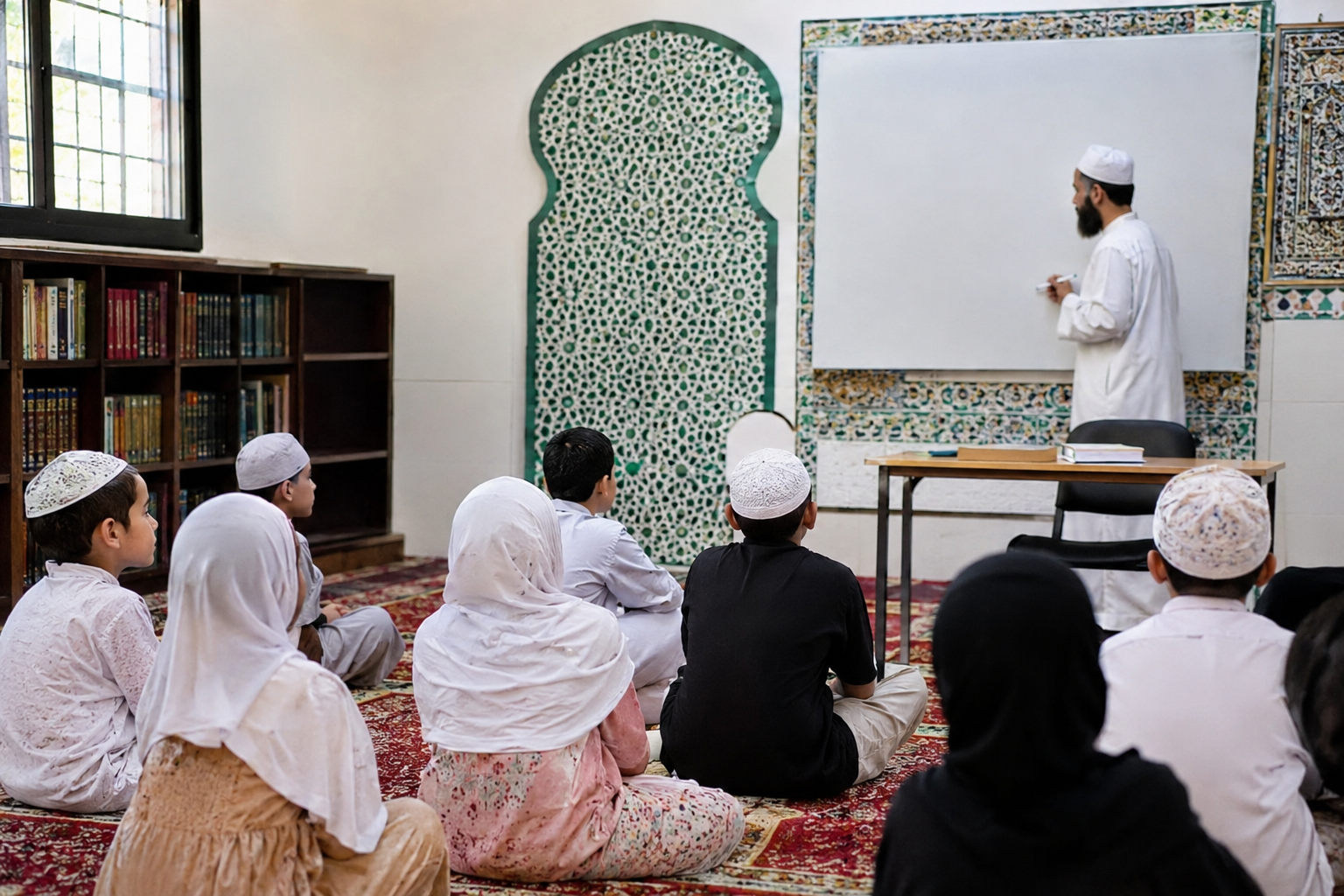
Research: What they teach, who organises them, how they are funded, at what age children attend, where they are concentrated, and what oversight public authorities exercise.
1. Scope and objectives of the research
Qur’anic schools, also known as maktab, madrasa or Islamic teaching centres, constitute a relatively under-researched phenomenon in Spain. They are places where children and adolescents receive religious education outside regular school hours. They may operate inside mosques, in premises belonging to Islamic associations or in independent facilities.
Their activities take place within the framework of the right to religious freedom, but their operation raises educational, legal and social questions that deserve specific investigation.
This research focuses exclusively on extracurricular Islamic religious classes. It does not primarily cover Islamic religious education provided in public and publicly funded private schools, nor Arabic language or Moroccan culture classes, although these forms of education will be mentioned where necessary to avoid confusion.
One issue shapes the entire research: Spain does not have a national census of Qur’anic schools or official statistics on the number of minors attending them. Nor is there a comprehensive public database identifying their teachers, programmes, fees, managers or sources of funding.
This makes it necessary to work with academic documentation, religious-entity registers, journalistic investigations, legislation and testimonies.
The research starts from one premise: the right to transmit the Islamic religion must be analysed alongside children’s rights, freedom of conscience, compulsory schooling and safeguards against any form of violence or coercion.
2. What are Qur’anic schools and how do they operate?
Different terms are used in Spain to describe these activities:
-
Qur’anic school: A common expression for classes primarily devoted to learning and memorising the Qur’an.
-
Madrasa: An Arabic word meaning educational centre. It can refer to anything from a children’s religious class to an institution providing advanced Islamic studies. Not all madrasas have the same level or offer the same content.
-
Maktab: A term used in some contexts for basic religious classes for children.
-
Qur’an classes: A common name for activities organised by mosques and Muslim associations.
-
Community Islamic education: A broader expression covering religious instruction, Qur’anic reading, prayer, values and education about Islamic traditions.
These terms do not correspond to Spanish administrative categories. Using the word madrasa does not mean that the establishment is an officially recognised school or that it has a formal educational structure.
In Spain, many of these activities take place in the afternoons, on Saturdays or Sundays. Some are held in classrooms within mosques, while others operate in association premises.
Timetables and programmes depend on each community. There is no national authority establishing a compulsory timetable or curriculum for all extracurricular Qur’anic schools.
3. Historical background: when did these schools emerge in Spain?
It is necessary to distinguish between the historical presence of Islam in the Iberian Peninsula and the emergence of contemporary community-based Qur’anic schools.
The tradition of Islamic religious education has very ancient historical roots in Al-Andalus. However, no direct institutional continuity should be assumed between medieval madrasas and today’s Spanish Muslim associations. Their institutions, political contexts and legal structures are different.
3.1. Before 1978: a limited and dispersed Muslim presence
For much of the twentieth century, the organised Muslim presence in Spain was limited, with important exceptions such as Ceuta and Melilla.
In these territories, Muslim communities maintained their religious practices and their family and community-based traditions of transmission. Religious education took place in community settings, although the available documentation concerning specific activities for children is fragmentary.
During this period, there was no national register providing information about the number of Qur’anic schools or their pupils.
3.2. 1980: recognition of religious freedom
Organic Law 7/1980 on Religious Freedom represented a decisive change.
Article 2 recognises the right to receive and provide religious education and information, as well as the right to choose religious and moral education for minors in accordance with family convictions, both inside and outside the school environment.
This recognition provided the legal framework allowing Muslim communities to organise religious education activities in Spain.
3.3. 1992: institutional recognition of Islamic communities
On 10 November 1992, Law 26/1992 was approved, incorporating the Cooperation Agreement between the Spanish State and the Islamic Commission of Spain.
The agreement recognises Muslim pupils’ right to receive Islamic religious education in public and publicly funded private educational institutions, at the levels covered by the legislation.
It also regulates the participation of Islamic communities in appointing teachers and preparing the content of this instruction.
It is important to emphasise that the agreement did not establish a national network of extracurricular Qur’anic schools, nor did it give the Islamic Commission of Spain responsibility for directing all religious activities for children organised by mosques.
3.4. The 1990s and 2000s: expansion of communities and Qur’anic classes
Immigration from Morocco, Pakistan, Senegal and other countries contributed to the expansion of Muslim communities in numerous Spanish cities.
As these communities grew, so did the need for religious spaces, activities for children and instruction in languages and religious texts.
Ceuta is a particularly relevant case. Academic studies document the proliferation of independent Qur’anic schools during the 1990s and describe the differences between religious instruction provided within schools and education organised by mosques and community centres.
The research also records that some schools used materials from the Moroccan education system, while official teaching in Spanish schools had specific textbooks adapted to the Spanish curriculum.
3.5. From 2010 to the present
Over the last fifteen years, the development of Muslim communities has consolidated the presence of mosques and Islamic associations in numerous municipalities.
Religious education for children continues to be provided mainly through the communities themselves, using a variety of organisational models.
At the same time, debate about Islamic education within the formal education system has continued because the subject has not been sufficiently implemented in several autonomous communities.
Available documentation allows us to conclude that extracurricular Qur’anic classes have an established history in certain localities. However, it does not provide a national starting date, identify the first officially documented school or offer a complete quantitative account of their development.
Key academic reference: María Navarro Granados, doctoral thesis Peace and Non-Violence in the Teaching of Islam in Spain.
4. What exactly do Qur’anic schools teach?
There is no compulsory national curriculum for extracurricular Islamic schools. Each community organises its classes according to its religious criteria, the knowledge of its educators, the pupils’ ages and the materials available.
Based on research conducted in Ceuta and Catalonia, several main areas of content can be identified.
4.1. Teaching the Qur’an
This is the core activity of many of these institutions.
Pupils may learn:
-
The Arabic alphabet.
-
Reading Qur’anic texts.
-
Pronunciation and recitation.
-
Memorisation of surahs and verses.
-
Rules of recitation (tajwid).
-
Basic interpretation of certain passages.
-
The relationship between the Qur’anic text and religious practices.
In some centres, memorisation is the central teaching method. Others attempt to combine reading with explanations of the meaning of the texts.
Research conducted in two neighbourhoods of a municipality in the Barcelona metropolitan area found differences between educational models: some mosque classes placed greater emphasis on recitation and memorisation, while certain academies established by Muslim women educators sought to focus more on values and explain the meaning of religious teachings.
4.2. Learning Arabic
The second major area is Arabic language instruction, particularly Classical Arabic or Modern Standard Arabic, which is used in religious texts.
The subjects normally taught include:
-
The alphabet and writing.
-
Reading and comprehension.
-
Vocabulary.
-
Basic grammar.
-
Pronunciation.
-
Reading religious texts.
For families of Moroccan origin, there is a particular linguistic challenge: many children grow up speaking varieties of Moroccan Arabic at home, whereas the Arabic used for Qur’anic reading and formal instruction is different.
The study published in Migraciones in 2025 identifies precisely this problem. The young people interviewed valued learning Arabic, but some acknowledged difficulties expressing themselves orally and in writing, despite having attended these classes for years.
4.3. Foundations of the Islamic religion
Depending on the institution, programmes include:
-
The five pillars of Islam.
-
Belief in Allah.
-
The prophets and their stories.
-
The life of Muhammad (sira).
-
The foundations of faith (aqida).
-
The meaning of Ramadan.
-
Prayer practices.
-
Rules concerning purification and ablution.
-
Islamic religious festivals.
Certain centres also address the Prophetic tradition (hadith) and religious rules governing everyday conduct.
4.4. Morality, conduct and religious rules
Moral education is another important part of these programmes.
Children may receive instruction on:
-
Respect for parents and elders.
-
Obedience and responsibility.
-
Honesty.
-
Solidarity and helping others.
-
Behaviour within the community.
-
Family relationships.
-
Clothing and behaviour.
-
The distinction between what is permitted (halal) and what is forbidden (haram).
The content and interpretation of these rules are not identical across all communities.
This raises an issue that deserves attention: teaching religious values is not the same as transmitting a single, unquestionable interpretation of social rules. The pupils’ age, maturity and ability to ask questions and engage in debate are important factors when assessing educational quality.
4.5. Islamic history and culture
Some schools incorporate:
-
History of Islam.
-
Biographies of the prophets.
-
History of the first Muslim communities.
-
Religious traditions.
-
Celebrations in the Islamic calendar.
-
Muslim culture and heritage.
In Ceuta, research by the University of Granada documented a school that included Islamic history, religious ethics and Islamic music among its subjects.
4.6. Additional activities
Not all schools limit themselves to religious classes.
Some also offer:
-
Additional support in mathematics and Spanish.
-
English and French lessons.
-
Computer skills.
-
Adult literacy.
-
Reading and calligraphy workshops.
-
Excursions.
-
Sports activities.
-
Camps and community gatherings.
-
Activities specifically aimed at girls and adolescents.
For example, the Sharif al-Idrissi school in Ceuta combined Qur’anic instruction with English lessons, academic support and activities for adults. The school at Ibn Ruch Mosque included mathematics, Spanish, French and computer classes.
Conclusion on educational content: Qur’anic schools are not all the same. Some operate primarily as places for reading and memorising the Qur’an, while others combine religious instruction, language education, cultural activities and academic support.
5. At what age do children start, and how long do they attend?
5.1. There is no minimum age established at national level
Spanish legislation does not establish a specific minimum age for minors attending community religious classes.
The decision normally rests with families and the organisation providing the classes, without prejudice to children’s rights and general child-protection regulations.
Documentation from Ceuta provides specific examples:
| Documented centre | Pupils’ age | Approximate number of pupils |
|---|---|---|
| Sharif al-Idrissi | 3–12 years | 300 |
| Al-Fayr | 3–13 years | 100 |
| Al-Manar | 6–18 years | 150 |
| Imam Malik | 6–16 years | 260 |
| Al-Kadi Ayyad | Children and young people | 115 |
Historical data from the University of Granada study published in 2013. These figures do not represent current enrolment.
These examples show that some schools accepted children from the age of three. However, they do not establish that this is the usual starting age in Spain.
5.2. Timetables
Timetables depend on each organisation.
The Ceuta research documented activities from Monday to Friday in the afternoons, while the Catalonia study also described classes organised on Saturdays and youth activities during the week.
Three common models can be identified:
-
Short afternoon classes after regular school.
-
Classes concentrated on Saturdays or Sundays.
-
More intensive programmes combining several sessions per week.
Some centres organise courses and activities during school holidays.
5.3. How many hours do children spend attending these classes?
There is no national average.
The academic study of adolescents in Ceuta, based on data collected during the 2015–2016 school year, found that Muslim participants attending extracurricular religious classes spent an average of 5.2 hours per week on these activities.
This is a local, historical figure and should not be used as an estimate for all Muslim children in Spain.
It is also relevant that some adolescents interviewed in the Catalonia study considered the concentration of activities during weekends excessive.
6. How do these schools emerge, and who establishes them?
The research identifies several ways in which these schools are established.
6.1. Initiatives by families and individuals
Some schools begin informally when a person with religious or linguistic knowledge gathers a group of children.
They may start in a private home, a room or a small premises.
Research conducted in the Barcelona metropolitan area documents this model: before the expansion of local associations, some female educators received children in their own homes and personally covered the costs of the activity.
6.2. Initiatives established by mosques
Other schools emerge within mosques.
The community identifies the need for a place where minors can learn the Qur’an and receive religious instruction.
When the number of pupils increases, specific classrooms may be set up, age-based timetables established or the school separated from the mosque’s ordinary worship activities.
6.3. Independent Islamic associations
There are also initiatives that become independent of mosques or are established directly as cultural or religious associations.
The Ceuta study documents how some schools began as cultural associations and subsequently registered as religious entities.
Al-Manar, for example, originated at al-Umma Mosque, began operating as an independent school in 1992 and registered as a religious entity in 1995.
6.4. Associations established by Muslim women
An important development has been the creation of educational initiatives led by women.
The 2025 academic research describes female educators who began teaching in private homes, subsequently worked in premises belonging to religious organisations and eventually established their own associations and academies.
In some cases, these initiatives emerged because the educators wanted greater autonomy over teaching methods, content and activities for children.
The study identifies tensions between some female teachers and male leaders of religious organisations, particularly concerning the importance of play, excursions and a teaching approach based on children’s needs.
Therefore, not all Qur’anic schools are organised by imams or male leaders. There are educational projects led by women who play an important role in religious and cultural transmission.
7. Who is behind Qur’anic schools?
There is no national authority directly managing all extracurricular Islamic schools.
Their organisational structure is relatively fragmented.
7.1. Islamic communities themselves
Most documented initiatives depend on local organisations:
-
Islamic communities.
-
Mosques.
-
Religious associations.
-
Muslim cultural associations.
-
Women’s associations.
-
Independent educators and teachers.
Management may be the responsibility of a board of directors, the mosque’s imam, an educational committee or a group of families and teachers.
7.2. The Islamic Commission of Spain
The Islamic Commission of Spain (CIE) has an institutional role in relations between the State and the Islamic communities participating in the 1992 Cooperation Agreement.
It is involved in regulated Islamic religious education within the education system, particularly in relation to the approval of content and the suitability of teachers.
However, one fundamental point must be clarified:
The CIE is not a state inspectorate overseeing all extracurricular Qur’anic schools, nor does it automatically direct classes organised by each mosque or association.
The fact that a community belongs to a federation or maintains relations with the CIE does not mean that all its educational activities have been officially approved by the Ministry of Education.
7.3. UCIDE and UCIDCE
The Union of Islamic Communities of Spain (UCIDE) is a federative structure bringing together different communities and federations.
In Ceuta, the Union of Islamic Communities of Ceuta (UCIDCE) has played a coordinating role between associations and schools.
Research by the University of Granada documents efforts to improve Arabic language teaching, organise teaching teams and coordinate activities between Qur’anic schools.
These structures have the capacity to represent, coordinate and promote cooperation, but they should not be confused with an administrative authority that inspects all centres.
7.4. Influence from countries of origin and foreign educational materials
Some centres use books and materials produced outside Spain.
The Ceuta research documented the use of textbooks also employed in Moroccan schools and reviewed by the relevant Moroccan religious education authorities.
It also identified the use of materials adapted to Muslim children living in Europe.
The 2025 Catalonia research likewise found a transition from materials imported from countries of origin towards books organised by educational levels, with teaching guides and references more suitable for pupils born and educated in Spain.
This demonstrates that transnational influence exists in part of Islamic education, but it does not allow us to conclude that these schools are controlled by foreign governments.
To claim that a school receives money from Morocco, Saudi Arabia, Turkey, Qatar or another country, specific financial documentation would be necessary. The origin of a textbook does not demonstrate who finances the centre or controls its decisions.
8. Documented historical examples of Islamic schools in Spain
The research on Ceuta published by the University of Granada in 2013 provides one of the most detailed inventories we have found of specific Qur’anic schools. Its data reflect the situation examined during that period, not the current circumstances of each establishment.
8.1. Al-Manar, Ceuta
Established as an independent school in 1992
Al-Manar originated within al-Umma Mosque and subsequently acquired organisational independence.
It registered as a religious entity in 1995.
According to the study:
-
It had approximately 150 pupils.
-
It accepted boys and girls aged between 6 and 18.
-
It offered Arabic, Qur’an and Islamic conduct classes.
-
It operated from Monday to Friday in the afternoons.
-
It employed paid teachers.
-
It was financed through family fees and had received grants from the Pluralism and Coexistence Foundation.
The study highlighted that it was one of the first schools in the city to secure employment contracts and Social Security coverage for its teachers through this funding model.
This is a relevant example because it shows how a Qur’anic school could evolve from a community initiative into an organisation with classrooms, administration and employed teachers.
8.2. Al-Kadi Ayyad Madrasa, Ceuta
Association established in 1995
The association was established in 1995 as a cultural organisation and registered as a religious entity in 2006.
The study describes it as a neighbourhood madrasa located in El Príncipe.
It had its own building, several classrooms, an Islamic library and a conference room.
Its educational activities were aimed at approximately 115 children and young people and relied mainly on volunteer teachers.
Its programme included religious instruction and educational and cultural activities.
8.3. Sharif al-Idrissi, Ceuta
Established in 1995
It was founded on the initiative of an individual who considered it necessary to establish a school providing religious education to children in the El Príncipe neighbourhood.
At the time examined by the University of Granada:
-
It had three centres.
-
It served approximately 300 pupils.
-
Boys and girls were aged between 3 and 12.
-
It had nine teachers.
-
It taught Arabic, the Qur’an and Islamic conduct.
-
It also provided additional English tuition.
-
One of its locations had a nursery.
Funding came primarily from monthly family fees, supplemented by a small grant from the Pluralism and Coexistence Foundation for specific projects.
It is one of the clearest examples of an organisation combining religious education, childcare and academic support.
8.4. Al-Fayr, Ceuta
Established in 2006
It was promoted by residents of the El Príncipe neighbourhood because al-Amin Mosque was unable to accommodate all the children requiring religious education.
The centre brought together approximately one hundred pupils aged between 3 and 13.
The study documented:
-
Arabic and Qur’an teaching.
-
Organisation by age, gender and level.
-
One volunteer teacher.
-
Arabic materials also used in Moroccan schools.
-
Basic education for adult women.
-
Drawing, calligraphy and reading workshops.
-
Sports activities and excursions.
The organisation registered as a religious community in 2008.
8.5. Abu al-Hasan Ach Charri Qur’anic School, Ceuta
The school has historical links to Sidi Embarek Mosque. The research records an earlier educational tradition and indicates that the centre was formally established in 1998.
During the period studied, it had four classrooms and served more than 500 children distributed across different shifts.
It provided:
-
Arabic.
-
Qur’an.
-
Academic support.
-
Educational and family activities.
Since 2006, the school had a management board, a school council and a parents’ association.
This centre deserves particular attention because of the organisational conflict that developed around it, which is explained later.
8.6. Imam Malik, Ceuta
The school was located within the grounds of Muley el Mehdi Mosque.
The study documented approximately 260 male and female pupils aged between 6 and 16, distributed across four classrooms and several shifts.
According to the managers interviewed, the teaching staff consisted of Moroccan teachers selected through a merit-based recruitment process.
The subjects included Arabic, Islamic ethics, Islamic education and culture, the history of Islam and religious music.
The school used textbooks employed in Morocco and reviewed by the Habous authorities. It also organised Qur’an memorisation competitions.
8.7. Ibn Ruch Mosque School, Ceuta
This centre combined religious education and Arabic classes with academic support.
The programme included mathematics, Spanish, French and computer skills.
The research highlighted that, during certain periods, attendance at academic support activities was higher than attendance at religious classes. It also described volunteer teachers and family contributions.
This is an interesting example because it shows that some spaces organised around mosques also operate as educational and social support centres.
9. How much do the classes cost, and how are they financed?
There is no official fee or national average.
Fees are determined locally and depend on premises, teaching staff, materials and additional activities.
9.1. Documented prices
Two investigations provide information about some of the costs involved:
Barcelona metropolitan area
€10–20
Average monthly fee reported by families attending the academies examined in the 2025 study.
Madrasas investigated in Andalusia
€30–50
Monthly fee per family reported by Europa Sur in April 2023.
Al Rahma Mosque, Algeciras
€15
Monthly fee mentioned in the 2023 report, which also described a designated classroom and a teacher holding a teaching qualification.
These amounts are local examples from different years and contexts. They do not constitute a national fee structure and cannot be used to estimate the sector’s total income.
9.2. Where does the money come from?
The documented sources of funding include:
Family fees. These are an important source of income for paying rent, utilities, books and staff remuneration.
Donations and voluntary contributions. Some communities receive contributions from members or people who support their activities.
Voluntary work. There are centres where educators work without receiving a regular salary.
Grants and subsidies. The Ceuta study documented grants from the Pluralism and Coexistence Foundation for specific projects run by certain organisations.
Community resources. Some mosques support activities through shared community resources or donations.
The Catalonia research describes financial difficulties in maintaining rented premises and paying salaries, as well as competition between educational initiatives for family contributions.
9.3. Is there foreign funding?
This question must be addressed with particular rigour.
There are materials produced in Morocco and other transnational religious and educational connections. International cooperation networks between Muslim communities also exist.
However, no statistics have been identified indicating what percentage of Spanish Qur’anic schools receive money from foreign governments, international foundations or private organisations in other countries.
Law 26/1992 recognises the right of the CIE and its member communities to receive financial contributions, organise collections and accept offerings and donations. This establishes a legal possibility of funding, not proof that a particular centre has received funds from abroad.
10. Which autonomous communities have the highest concentration?
There is no national map of Qur’anic schools. It is therefore necessary to use indirect indicators: estimated Muslim population, the number of Islamic communities and documentation concerning identified centres.
One of the available documents is the Demographic Study of the Muslim Population 2024, prepared by UCIDE and published in 2025.
According to its methodology, it uses information from the population register, nationality and data concerning Islamic communities. It is not a national census of religious beliefs or an official statistic on schools.
10.1. Geographical distribution of the Muslim population
UCIDE’s estimates for 2024 identify the following autonomous communities as having the largest Muslim populations:
| Autonomous community | Estimated Muslim population |
|---|---|
| Catalonia | 694,046 |
| Andalusia | 417,139 |
| Community of Madrid | 323,700 |
| Valencian Community | 278,370 |
| Region of Murcia | 146,744 |
UCIDE estimates; these figures do not represent the number of pupils or Qur’anic schools.
10.2. Registered Islamic communities and organisations
The same report records 2,098 Islamic organisations and 2,024 religious communities across Spain.
The distribution is as follows:
| Autonomous community | Islamic organisations | Communities |
|---|---|---|
| Catalonia | 399 | 391 |
| Andalusia | 345 | 335 |
| Valencian Community | 261 | 255 |
| Madrid | 156 | 146 |
| Castilla-La Mancha | 140 | 137 |
| Murcia | 139 | 136 |
| Aragon | 99 | 96 |
| Basque Country | 94 | 91 |
| Balearic Islands | 69 | 63 |
| Ceuta | 70 | 67 |
These figures do not represent Qur’anic schools. They include religious communities and other organisations. Some may be limited to worship activities, while others may not have premises open to the public. The figures help identify the geographical presence of Muslim organisations, not calculate the number of classrooms for children.
10.3. Territories of particular relevance to the research
Catalonia. It is one of the autonomous communities with the largest estimated Muslim populations and the highest number of Islamic organisations. The 2025 study on community education provides direct evidence of teaching models in the Barcelona metropolitan area.
Andalusia. It has a considerable Muslim presence and has been the subject of journalistic investigations into madrasas in municipalities across different provinces. The Campo de Gibraltar area appears in the available documentation.
Madrid. Its Muslim population is large and it has numerous Islamic communities, but no public statistics identify the number of Qur’anic schools.
Valencian Community. The presence of Muslim communities is significant, but specific information about extracurricular centres is limited.
Murcia. Its Muslim population and registered communities justify including it among the territories requiring further research.
Ceuta and Melilla. These territories are particularly important for the historical study of community-based Islamic education. Ceuta has much more detailed documentation than most autonomous communities.
The geographical conclusion is that Catalonia and Andalusia stand out both in terms of estimated Muslim population and the available documentation. However, without a specific register, it cannot be stated that they necessarily have the highest number of Qur’anic schools.
11. What do teachers, educators and former pupils think?
One of the problems with Spanish research on this subject is the shortage of studies that listen directly to people participating in these activities.
The article by Roser Girós Calpe, Marta Bertran Tarrés and Jordi Pàmies Rovira, published in the journal Migraciones in 2025, represents an important contribution.
Their research was conducted in two neighbourhoods of a municipality in the Barcelona metropolitan area and used interviews, discussion groups and observation of educational activities.
The sample included:
-
9 teachers.
-
8 family members.
-
25 former pupils aged between 13 and 19.
-
8 representatives of associations.
-
5 municipal officials.
Eight of the nine teachers interviewed were women. The research is not representative of all Spain, but it provides direct testimonies from an environment where these activities are present.
11.1. What educators think
The female educators interviewed believe that community-based education can meet a need that is not always addressed by family education or the school system.
Their objectives include:
-
Transmitting religious knowledge.
-
Teaching Arabic.
-
Explaining Islamic practices.
-
Helping children understand their family and religious identity.
-
Creating spaces for social interaction.
-
Providing guidance to adolescents living between different cultural reference points.
Some teachers have worked in community education for many years and have established their own educational initiatives.
Differences between teaching models also emerge. Some educators prefer an approach combining religion and debate, while others consider it important not to separate the Arabic language from cultural and religious content.
11.2. What some educators criticise
The same study reveals problems concerning professionalisation.
The difficulties include:
-
Lack of financial resources.
-
Low remuneration.
-
Rental and maintenance costs.
-
Competition between initiatives for family contributions.
-
Difficulties finding teachers.
-
The need to adapt materials to pupils born in Spain.
One of the most relevant issues is pedagogical training. The educators and students interviewed describe differences between traditional teaching methods and more participatory approaches.
The study includes criticism from former pupils concerning classes excessively based on notebooks and blackboards, repetition of content and difficulties in developing oral and written Arabic skills.
11.3. What young people who attended these schools think
The testimonies vary.
Some former pupils value having learned to read Arabic, gained a better understanding of religion and maintained a connection with their families and traditions.
Others highlight that the classes helped them understand religious matters that their parents were not always able to explain.
One of the most interesting contributions of the study is that some young people were not satisfied with learning a practice simply because of family tradition. They wanted to understand why it was performed and to be able to justify their own decisions.
The article records that associations provided explanations about matters such as prayer, fasting and clothing, and gave young people tools to consult the texts themselves.
However, they also expressed frustration about the lack of pedagogical continuity and the difficulty of using Arabic fluently.
11.4. The situation of girls and adolescents
The Catalonia research offers an important perspective on the experiences of Muslim adolescent girls.
Some young women explained that these activities allowed them to discuss issues relating to the hijab, fasting, family relationships, religious practices and their identity as Muslim women born or raised in Catalonia.
The study does not describe all schools as egalitarian spaces, nor does it claim that all young women share the same interpretation of Islam.
What matters is that it shows that some adolescents use these spaces to discuss and negotiate their own identities, rather than simply receiving religious instructions.
12. Why do families send their children?
There is no representative national survey establishing what percentage of Muslim families use Qur’anic schools or what their motivations are.
Nevertheless, research conducted in Ceuta, Andalusia and Catalonia makes it possible to identify several reasons.
12.1. Transmitting the family’s religion
For many families, Qur’anic education is part of their children’s upbringing, just as other families transmit religious, cultural or philosophical traditions.
They want their children to become familiar with the Qur’an, understand prayers and learn the main practices of Islam.
12.2. Maintaining a cultural and religious identity
Some immigrant families consider it important for their children to know the language and traditions that form part of their family history.
This may be particularly relevant for children born in Spain, who do not necessarily retain their parents’ language.
12.3. Belonging to a community
Qur’anic schools can also provide meeting places for families.
Children meet others from their neighbourhood, develop relationships and participate in shared activities.
The study of the Barcelona metropolitan area identifies these community networks as an important part of the educational experience.
12.4. Learning the Qur’an and understanding religious practices
Some families want their children not simply to reproduce the religious practices of adults, but to understand their foundations.
One of the educators interviewed in Catalonia explained that children should be able to answer why they fast, pray or follow certain practices, rather than simply saying that they do so because they belong to a Muslim family.
12.5. Finding a space for support and integration
The Catalonia study shows that some associations function as guidance centres for young people who have experienced racism, stereotypes or difficulties explaining their religious identity.
For example, some adolescent testimonies describe feeling uncomfortable when their schools made assumptions about their country of birth or language skills because of their family background or clothing.
These community activities provided them with spaces to share experiences and receive support.
12.6. Not all families agree
Disagreement also exists within Muslim families themselves.
The 2023 Europa Sur report included testimonies from parents who had withdrawn their children from certain madrasas because they disagreed with the content or teaching methods.
These statements demonstrate that there is no single position within the Muslim community on how religious education for minors should be organised.
13. Documented conflicts and controversies in Spain
The existence of Qur’anic schools does not in itself imply that conflicts exist. However, the available documentation identifies several episodes relating to compulsory schooling, the conditions of premises, internal organisation, discipline and the content of certain teachings.
It is important to distinguish between a journalistic allegation, a social controversy, a parliamentary intervention and an administrative or judicial decision. They do not have the same evidential value.
13.1. Ceuta, 2001: the issue of compulsory schooling
Documented parliamentary debate
On 20 June 2001, during a session of the Spanish Congress of Deputies, the issue of Muslim minors in Ceuta was raised. According to the parliamentary intervention, some were attending Qur’anic schools during the first years of compulsory education.
The concern was that some children aged between 6 and 12 were receiving religious and Arabic instruction without simultaneously completing basic Spanish education, and that they subsequently entered schools with deficiencies in fundamental subjects, particularly languages.
The intervention mentioned 45 requests for school transfers or enrolment and acknowledged that it was difficult to establish the total number of minors affected.
Why is this case important?
Extracurricular religious education is permitted, but it cannot replace compulsory schooling.
This episode shows that when community-based religious education becomes an alternative to basic education, a legal and educational conflict arises.
It must be emphasised that the parliamentary debate does not prove that all Qur’anic schools in Ceuta violated compulsory schooling requirements, nor does it allow that problem to be extrapolated to the present situation.
13.2. Ceuta: conflict between Luna Blanca and the Sidi Embarek Mosque community
Documented organisational conflict
One of the most interesting cases concerns the Abu al-Hasan Ach Charri Qur’anic School.
The school was linked to Sidi Embarek Mosque. In its early years, it operated under the protection of the Luna Blanca Charitable and Religious Council.
A split subsequently occurred and the Sidi Embarek Mosque Islamic Community was established, taking responsibility for the school.
The 2013 research describes how both organisations shared the same physical space and how their conflict made it difficult for educational activities to operate normally.
The centre had four classrooms and served more than 500 children across different shifts.
This case reveals an issue that is not particularly visible from outside: internal disputes over religious representation, mosque management and control of resources can also affect educational activities for minors.
It was not necessarily a doctrinal conflict, but rather a dispute over organisation and community management.
13.3. Andalusia, 2023: allegations concerning licences and conditions at certain madrasas
Journalistic investigation
On 16 April 2023, Europa Sur published an investigation into Qur’anic schools in several Andalusian cities.
The report claimed that some centres were operating without the required licences and described alleged deficiencies in safety, evacuation procedures, accessibility and the condition of their premises.
It also questioned the pedagogical qualifications of certain teachers and described disciplinary methods that the journalist considered outdated.
The publication reported monthly fees of between €30 and €50 per family.
The report also stated that some Muslim families had withdrawn their children from certain centres because of disagreements over content and teaching methods.
The contrast: Al Rahma Mosque in Algeciras
The same investigation described a centre which, according to the journalist, had a municipal licence to provide classes, had a suitable classroom and had employed a teacher with a formal teaching qualification and knowledge of Arabic.
The published fee was €15 per month.
This contrast is important: no general conclusion can be drawn about all madrasas in Andalusia based on problems attributed to specific establishments.
13.4. Granada: former female pupils’ testimonies about isolation and behavioural rules
Additional information published by Europa Sur in 2023 included the testimonies of two sisters who recalled their childhood experiences at a mosque in Granada.
The young women reported receiving teachings that they interpreted as restrictive regarding their relationships with non-Muslims and their participation in certain social activities.
They also described unequal treatment of boys and girls.
Their testimonies highlight the importance of understanding how minors experience educational activities, in addition to examining written programmes and statements made by those responsible for the centres.
13.5. Catalonia: tensions between educational models and religious authorities
The 2025 research on Muslim communities in the Barcelona metropolitan area describes internal tensions between some female teachers and male leaders of religious organisations.
The issues debated included:
-
The use of play in classes.
-
Excursions.
-
Religious instruction versus the teaching of values.
-
Women’s participation in directing activities.
-
The need to create independent educational spaces.
Some teachers eventually established their own associations and academies.
13.6. The hijab and girls’ education
The Europa Sur report described activities organised around the hijab at a mosque in Algeciras and questioned the messages conveyed to adolescent girls.
Religious education may address clothing and the interpretation of Islamic rules. However, there is a difference between explaining a religious practice and pressuring a girl to adopt it.
The journalistic investigation mentioned above presents a critical interpretation of activities at one specific centre.
14. What oversight exists over Qur’anic schools?
This is one of the most important issues in the entire investigation.
The first conclusion is that there is no single state inspectorate overseeing the content of all extracurricular Qur’anic schools.
Community religious education is subject to a different regime from regulated formal education.
14.1. Registration of religious entities
Religious communities may register with the Register of Religious Entities of the Ministry of the Presidency, Justice and Relations with Parliament.
Registration allows the organisation to be legally recognised and facilitates the exercise of certain rights.
However, religious registration is not equivalent to an educational licence.
An organisation may be properly registered as an Islamic community without therefore being authorised to provide official education, issue academic qualifications or use any property as an educational centre.
14.2. Who inspects the content?
Extracurricular Qur’anic classes are not subject to the same curriculum inspection system as an authorised school.
The authorities do not have a single compulsory curriculum for the Qur’an, religious interpretation or Islamic education that applies to all community organisations.
This means that communities enjoy considerable autonomy in defining their educational content.
However, that autonomy does not allow them to transmit teachings or apply methods that violate the law or children’s rights.
14.3. Who checks the safety of the premises?
Municipal councils and regional authorities may intervene in matters relating to urban planning, activities, safety, accessibility, public health and building conditions.
A mosque authorised for worship should not automatically be considered authorised for any additional activity taking place inside the building.
The municipal administration must assess the actual use of the premises and the requirements applicable to the specific activities.
14.4. Child protection
Organic Law 8/2021 on the comprehensive protection of children and adolescents against violence is particularly important.
Article 57 establishes the obligation to present a negative certificate from the Central Register of Sexual Offenders and Human Trafficking for access to activities involving regular contact with minors.
The legislation covers both paid and unpaid activities, as well as those primarily aimed at minors.
Therefore, people who regularly teach Qur’anic classes to children must comply with this requirement, even if they work as volunteers.
The law also establishes obligations to report situations of violence and mechanisms for protecting minors.
14.5. Are teachers required to hold pedagogical qualifications?
Two situations must be distinguished.
In regulated religious education within schools, there are requirements concerning qualifications, teaching competence and religious suitability established by the applicable legislation.
In extracurricular community-based religious education, there is no single compulsory state pedagogical qualification for everyone who teaches the Qur’an.
This can result in very different models: teachers employed with academic qualifications, imams, people with religious studies, experienced female educators or volunteers.
The absence of a common qualification does not mean that all teachers lack training. However, it makes it difficult to compare their teaching abilities and guarantee a consistent minimum level of quality.
15. Spanish legal framework: what the law allows and where its limits lie
15.1. Spanish Constitution
Article 16 recognises ideological, religious and freedom of worship rights.
Article 27.3 recognises parents’ right to ensure that their children receive religious and moral education in accordance with their convictions.
These rights form the constitutional basis for extracurricular Qur’anic schools.
However, they must be interpreted alongside children’s rights and other constitutional obligations.
15.2. Organic Law 7/1980 on Religious Freedom
Article 2 expressly recognises the right to receive and provide religious education and to choose religious and moral education for minors in accordance with family convictions, both inside and outside the school environment.
Article 6 recognises the autonomy of religious communities to organise themselves and establish their own rules, while respecting the legal system and fundamental rights.
This is the main law protecting the existence of community-based Qur’anic classes.
15.3. Law 26/1992 on cooperation with the Islamic Commission of Spain
The 1992 Cooperation Agreement recognises the possibility of receiving Islamic religious education in public and publicly funded private educational institutions.
Article 10 specifically regulates this education within the school system, including the participation of the Islamic Commission of Spain in appointing teachers and approving content and materials.
Article 10 should not be interpreted as a compulsory curriculum regulation for all community madrasas.
Article 11 provides that the CIE and its member communities may receive contributions, donations and offerings.
15.4. Compulsory schooling: between the ages of 6 and 16
The Organic Law on Education establishes ten years of compulsory and free basic education, normally between the ages of 6 and 16.
No Qur’anic school can replace compliance with this obligation.
Extracurricular religious classes must be complementary and cannot prevent a child from attending primary or secondary school.
This issue is particularly important in light of the documented events in Ceuta in 2001.
15.5. Organic Law 8/2021: protection against violence
The LOPIVI also applies to community activities that regularly work with minors.
Among other obligations:
-
A negative certificate from the relevant sexual-offences register for educators and volunteers who have regular contact with children.
-
The duty to act when there are indications of violence.
-
Protection of physical and psychological integrity.
-
Prevention of degrading treatment.
-
Respect for the best interests of the child.
There is no general exemption for religious organisations.
15.6. Regional and municipal legislation: Catalonia as an example
Catalonia has Law 16/2009 on places of worship.
The law regulates the conditions for opening and using places of worship that are open to the public.
Article 9 provides for a municipal opening and use licence, with certain exceptions in which a prior notification procedure may apply.
It also allows intervention in situations that compromise the safety or public health conditions of the premises.
In practice, a religious association organising regular classes in a premises must check that the urban-planning use, the activity and the condition of the building comply with the applicable regulations.
Other territories have their own urban-planning and activity regulations. There is no specific national law uniformly regulating all Qur’anic schools.
15.7. Can the State inspect a Qur’anic school?
Yes, within its legal powers and for legally established reasons.
For example, the authorities may intervene in cases involving:
-
Safety violations.
-
Activities requiring a licence that do not have one.
-
Violence against minors.
-
Abandonment of or failure to comply with compulsory schooling.
-
Violations of fundamental rights.
-
Employment or tax violations.
-
Educational activities presented as regulated formal education without the required authorisation.
What does not exist is a general power to impose an official theological interpretation of the Qur’an on all Muslim communities.
Religious freedom protects doctrinal diversity, but it does not eliminate the application of general law.
16. What do we know about the actual size of this phenomenon?
This is probably the most significant information gap.
We have not identified a complete national census of extracurricular Qur’anic schools that would allow us to establish:
-
Total number of centres.
-
Number of pupils.
-
Starting age.
-
Number of weekly hours.
-
Number of teachers.
-
Teachers’ qualifications.
-
Educational programmes.
-
Family fees.
-
Funding received.
-
Licences and conditions of premises.
-
Inspections and sanctions.
The figure of 2,098 Islamic organisations recorded by UCIDE for 2024 does not answer these questions. These are religious organisations and communities, not children’s schools.
The 2013 Ceuta study estimated that approximately one thousand children attended Islamic and Qur’anic education activities in that territory at the time of the research. This is a local figure from more than a decade ago and cannot be extrapolated to the whole of Spain or used as a current estimate.
The absence of statistics does not demonstrate irregularity, but it prevents a rigorous national assessment.
17. Critical assessment: main problems and outstanding questions
The sources consulted reveal several issues that deserve public attention.
17.1. Lack of information and transparency
We do not know precisely how many children receive extracurricular Qur’anic education in Spain.
Nor is there a public system providing information about which centres employ teachers, which rely on volunteers, what programmes they use or how they are funded.
This lack of information makes both academic research and the work of public administrations more difficult.
17.2. Differences in educational quality
The Catalonia research shows that some initiatives have evolved towards educational models adapted to pupils born in Spain.
Others continue to rely on traditional methods based on repetition, memorisation and written exercises.
Variation is not necessarily negative: memorisation can have a legitimate role in teaching sacred texts. The problem arises when it is not accompanied by comprehension, explanation, dialogue and adaptation to the pupils’ age.
17.3. Training and protection of educators
The lack of common pedagogical requirements makes it difficult to establish the level of preparation of everyone working with minors.
A teacher may possess extensive religious knowledge while simultaneously needing specific training in child psychology, conflict resolution, pedagogy or violence prevention.
Religious knowledge and educational competence are different skills.
17.4. Autonomy of female educators
The research conducted in the Barcelona metropolitan area demonstrates that some women have created their own educational spaces in order to achieve greater methodological and organisational autonomy.
This aspect deserves further research because it challenges the idea that all Qur’anic education is directed exclusively by imams or male structures.
17.5. Potential tensions between religious tradition and children’s autonomy
The transmission of behavioural rules, clothing requirements and religious practices may generate tensions as children grow older and develop their own questions and criteria.
The issue is not to prevent centres from teaching their beliefs, but to ensure that the educational process does not rely on threats, humiliation, physical punishment or coercion.
17.6. Relations with society and public schools
Some centres provide support to families experiencing difficulties with integration, discrimination or a lack of social networks.
However, it is also necessary to ensure that they do not become spaces that encourage distrust towards the rest of society or discourage ordinary school attendance.
18. Conclusions
The research shows that extracurricular Qur’anic schools form part of the lives of numerous Muslim communities in Spain. Their expansion is linked to the growth of the Muslim population, the establishment of mosques and associations, and the need to transmit religious knowledge to new generations.
However, the available information is uneven and fragmentary. Ceuta has detailed historical documentation concerning several schools, while more recent studies on Catalonia provide valuable information about community-based education, female educators and the experiences of former pupils. In Andalusia, journalistic investigations have reported specific problems at certain facilities.
Eight main conclusions can be drawn from these sources.
First. There is no single national network of Qur’anic schools.
The initiatives depend on local communities, mosques, associations and educators. The Islamic Commission of Spain has an important institutional role, but it does not direct or inspect all extracurricular activities.
Second. The programmes vary considerably.
Some centres prioritise Qur’anic recitation and memorisation; others teach Arabic, history, Islamic morality and religious practices; some incorporate academic support, cultural activities and spaces for adolescents.
It is incorrect to present all centres as if they shared an identical curriculum.
Third. Children can start attending at an early age.
The documentation from Ceuta includes centres that accepted pupils from the age of three. There is no national minimum age for these community activities.
Fourth. Funding comes mainly from diverse community-based models.
Family fees, donations, voluntary contributions and project grants are documented. There are insufficient statistics to claim that foreign funding is the main source of income for these schools.
Fifth. There is a geographical distribution linked to the presence of Muslim communities.
Catalonia and Andalusia stand out in terms of the size of their estimated Muslim populations and the number of Islamic organisations. Madrid, Valencia and Murcia are also relevant. However, the concentration of Muslim communities does not equate to the number of Qur’anic schools.
Sixth. The educational experience is not uniform.
Studies show centres that have professionalised their teaching staff and adapted their materials, alongside initiatives facing funding problems, precarious conditions and underdeveloped teaching methods.
There are also Muslim female educators who have promoted alternative models with greater participation by women.
Seventh. Legislation protects religious freedom but establishes general obligations.
Qur’anic schools may teach the Islamic religion. However, they must respect compulsory schooling, fundamental rights, safety regulations and child-protection obligations.
The absence of a national curriculum does not mean exemption from legal oversight.
Eighth. The lack of public information is a fundamental problem.
At present, it is difficult to establish how many centres exist, how many minors attend their classes, what training teachers have or what material conditions they offer.
It does not seem reasonable for a regular activity aimed at minors to remain practically invisible from the perspective of statistics and public information.
What should the public administration do?
A balanced public response could be based on five measures:
-
Improve knowledge of the phenomenon. Create a statistical inventory of extracurricular religious activities without interfering with beliefs or imposing a religious doctrine.
-
Check the safety of premises. Ensure that spaces where minors regularly gather meet the applicable requirements.
-
Apply child-protection protocols. Verify compliance with the LOPIVI, including the certificates required for teachers and volunteers.
-
Promote educational professionalisation. Offer voluntary training or agreements to improve the pedagogical knowledge of people working with minors.
-
Protect children’s freedom of conscience. Ensure that they can ask questions, express disagreement and progressively develop their own convictions.
Final reflection
The existence of Qur’anic schools is not in itself a problem for a democratic society. Religious freedom protects the right of Muslim families to transmit their faith, just as it protects the rights of other communities.
However, religious freedom cannot be used to justify every educational practice.
The fundamental issue is to ensure that children’s religious education takes place under appropriate conditions, with responsible educators, safe facilities, respect for compulsory schooling and protection of minors’ evolving autonomy.
19. Sources and bibliography
A. Academic studies
1. Briones, Rafael; Tarrés, Sol; Salguero, Óscar (2013).
2. Girós Calpe, Roser; Bertran Tarrés, Marta; Pàmies Rovira, Jordi (2025).
3. Study on education and religion in Ceuta.
B. Institutional and demographic documentation
4. UCIDE (2025). Demographic Study of the Muslim Population. 2024.
5. Ministry of Justice. Register of Religious Entities.
C. Journalistic investigations
6. Europa Sur (16 April 2023). José Ángel Cadelo. Thousands of Andalusian children receive education in Islamic madrasas without supervision or licences.
D. Spanish legislation
7. Spanish Constitution of 1978. Articles 16, 27 and 39.
8. Organic Law 7/1980, of 5 July, on Religious Freedom.
9. Law 26/1992, of 10 November. Cooperation Agreement between the State and the Islamic Commission of Spain.
10. Organic Law 2/2006, of 3 May, on Education.
11. Organic Law 8/2021, of 4 June. Comprehensive Protection of Children and Adolescents against Violence.
12. Law 16/2009, of 22 July, on Places of Worship in Catalonia.
E. Parliamentary documentation
13. Spanish Congress of Deputies. Committee Proceedings, No. 276, 20 June 2001.
Nota: He conservado las referencias bibliográficas tal como aparecen en el original, incluso cuando este no proporciona el título completo de algunos estudios. No he añadido referencias que no estuvieran en el documento fuente.