
Survival Guide: How to Debate Islam Without Being Accused of “Islamophobia”
There are debates that begin with an apparently innocent question: What do you think about the Islamic veil?
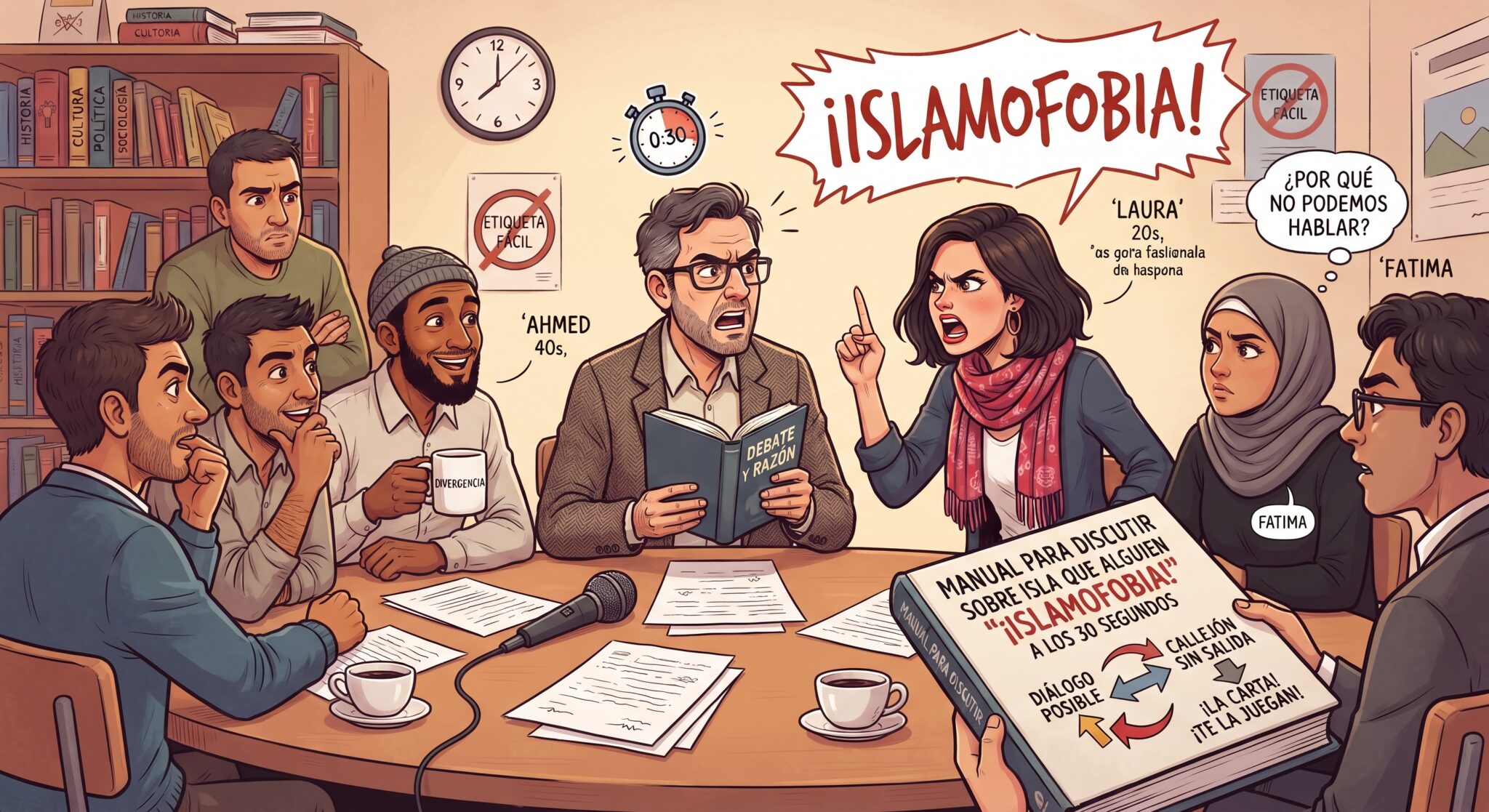
And thirty seconds later, someone replies: “Islamophobia!”
Game over. The word has been played. It is like showing a red card before the match has even started. That’s it. You have lost the right to reply, and worst of all, your coffee has gone cold while someone explains how wicked you are for questioning something.
But here is a small problem: if we use “Islamophobia” to describe absolutely any criticism of Islam, the word eventually loses its meaning.
And that helps neither Muslims who suffer discrimination nor those who legitimately want to discuss religion, culture, integration or politics.
So we propose something revolutionary: a short guide to discussing Islam without turning every conversation into a linguistic emergency.
Rule No. 1: Separate the Believer from the Dogma (or the Mother of All Arguments)
If you criticise medieval rules concerning women’s rights in Islam, someone will accuse you of hating your neighbour on the fifth floor, who wears a headscarf and is an absolute sweetheart.
If you analyse sacred texts and their most violent interpretations, someone will tell you that you are generalising about a billion people.
The survival trick: remember the golden rule of basic logic.
Religions are ideas; people are people. Ideas can be debated, criticised, ridiculed and examined under a microscope, just as we do with Christianity or capitalism. People deserve respect. If your conversation partner cannot understand this simple distinction, they do not want to debate; they just want to win a medal for moral purity.
Rule No. 2: You Can Criticise an Idea Without Hating the Person Who Believes It
This seems straightforward. But it is constantly forgotten in debates about religion.
If I say, “I believe a particular interpretation of the Quran should be open to criticism,” I am not saying, “I hate Muslims.”
If I say, “I believe a particular religious rule conflicts with equality between men and women,” I am not saying, “Muslim women are inferior.” I am criticising an idea or a practice.
And here we repeat a fundamental distinction: people deserve rights; ideas deserve debate. A liberal democracy should be able to protect both without confusing them.
Rule No. 3: Be Careful with the Phrase “That’s Islamophobia”
Here is where things get interesting. Islamophobia exists. A person can be insulted, discriminated against or attacked simply for being Muslim. That is a real problem.
But there is an enormous difference between…
Turning everything into “Islamophobia” does not help people who genuinely experience discrimination.
Because if everything is Islamophobia… then nothing ends up being Islamophobia. This is linguistic inflation.
When a word is used for everything, it eventually means very little.
Rule No. 4: Ask, “Which Part, Exactly?”
This is possibly the most useful tool in the entire guide.
Someone says: “That’s Islamophobia.”
Your response: “Which part, exactly?”
There is no need to get angry. No need to shout. Simply ask: “Which part of what I said do you consider Islamophobic?”
The conversation changes immediately.
Rule No. 5: Do Not Talk About “Muslims” as Though They Were a Monolithic Block
Another dangerous phrase: “Muslims think…”
Muslims? All of them?
Those from Morocco? Indonesia? France? Spain? Islamists?
The word “Muslims” can conceal enormous diversity. The more precise your statement, the harder it will be to dismantle.
Rule No. 6: Data Are Your Friends
Here comes a revolutionary piece of advice: bring data.
Because saying “Muslims think X” is easy. Proving it is another matter.
If you are going to make a claim about the opinions, behaviour or attitudes of European Muslims, look for surveys, studies and statistics. And cite your source.
This has an additional advantage.
You can reply: “This is not just my impression. I am referring to this study.”
Rule No. 8: Do Not Turn an Exception into a Rule
Imagine we find an imam saying something radical. Does that mean all Muslims think the same way? No.
We find a problematic mosque. Does that mean all mosques are problematic? No.
And here is one of the basic rules of critical thinking: one case proves that something can happen; it does not automatically prove that it is commonplace.
Rule No. 9: Do Not Make the Opposite Mistake Either
Now comes the other trap. Suppose someone presents a case of Islamist extremism.
The response: “That does not represent Islam.”
That may be true. But using it as an automatic response does not solve the problem either.
Because we can ask: Why did it happen? Was there a religious interpretation behind it? Social problems? Ideology? An extremist environment? A combination of factors?
Refusing to investigate these questions because they are uncomfortable is not critical thinking either. It is simply the reverse version of prejudice.
Rule No. 10: The Little Islamophobia Detector
Here is our homemade detector. Before calling someone Islamophobic, ask five questions:
-
Are they attacking people or criticising ideas?
-
Are they generalising about all Muslims?
-
Are they using evidence or simply relying on prejudice?
And now for the reverse detector. Because we do not want to cheat, either. If someone uses “Islamophobia” to avoid answering a legitimate criticism… that is a problem.
The Goal Is Not to Win the Argument
This should be the basic principle of any debate about Islam.
The aim is not to make the other person end up saying, “You’re right.” The aim is to achieve something much more difficult.
The danger begins when a word functions like a switch: “Islamophobia.”
And the lights go out automatically.
The Real Problem Is Not the Word
The word Islamophobia can be useful when it describes a real phenomenon: hostility, prejudice or discrimination against people because they are Muslim.
The problem arises when it is used as an emergency button to shut down any uncomfortable discussion about Islam.
The irony is that criticism of religion was one of the driving forces of the European Enlightenment. Criticising the Pope, mocking saints or debating the contradictions in the Bible cost Europeans centuries of struggle against ecclesiastical censorship. Yet as soon as the spotlight falls on Islam, we enter an exclusion zone where humour and criticism are treated as “intolerable provocation”. What a step backwards!
The real danger of shouting “Islamophobia!” at the slightest provocation is not just that intellectual debate becomes impoverished. It is also that reformists, feminists and Muslim thinkers themselves are left undefended as they risk their lives in the Islamic world by calling for freedom and democracy.
So the next time someone throws the label at you ten seconds after you start speaking, smile, take a deep breath and remember: in a room where a religion cannot be criticised for fear of the consequences, freedom of expression has already packed its bags.
And frankly, that is not a party worth attending.