
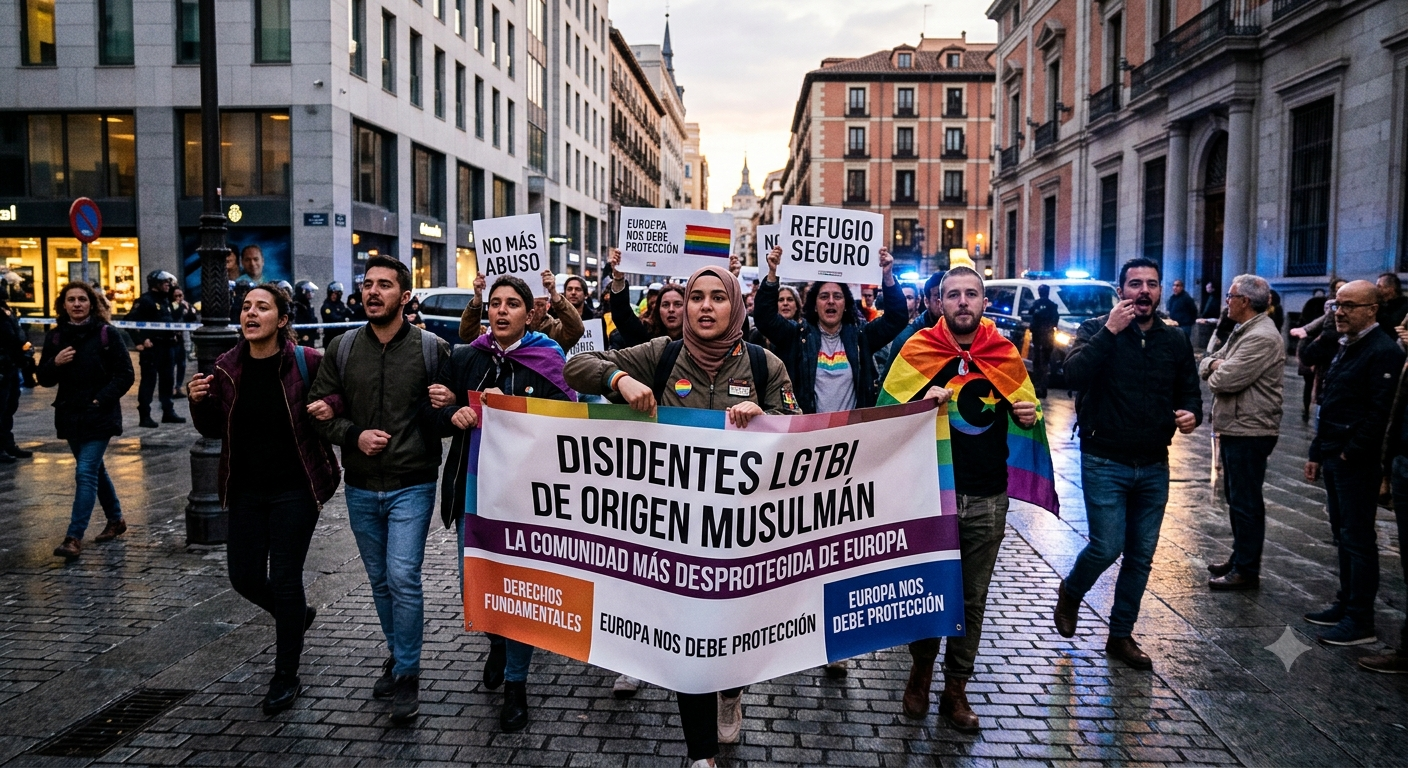
Caught in the Crossfire: Why LGBTQ+ People of Muslim Background Are Europe’s Forgotten Minority
Imagine, for a moment, that you belong to a minority. Now imagine that within that minority, you are also part of a minority—and that some people believe talking about your situation might be too uncomfortable.
Welcome to one of Europe’s least discussed paradoxes: the lives of many LGBTQ+ people of Muslim background. They are Europeans, Muslims, ex-Muslims, or people from Muslim families, and they are lesbian, gay, bisexual, or transgender.
In theory, Europe is the continent of individual rights. In practice, many of these people feel caught between two fires.
Living a Double Life
Many young people say they lead two completely different lives.
The first begins when they leave home: at university, at work, or with friends. There, they can show who they really are.
The second begins when they return home. They change their clothes, hide conversations, delete messages, and invent imaginary boyfriends or girlfriends.
They learn to answer the same question over and over again: “When are you going to get married?”
The answer is usually an awkward smile.
The Conflict Between Identity and Tradition
Here is where the major clash emerges. In many European countries, sexual orientation is recognized as part of individual rights.
However, many traditional interpretations of Islam consider same-sex relationships incompatible with Islam. Not all Muslims think alike; some believers advocate a more inclusive interpretation.
But there are also communities where coming out can have very serious family consequences.
Fear Does Not Always Come from the State
When Europe talks about LGBTQ+ rights, it often focuses on laws. But sometimes the problem is not legislation. It is the living room at home, family pressure, the fear of rejection, losing contact with one’s parents, being thrown out of the family home, or being forced to hide one’s identity for years.
These are private conflicts that rarely appear in the statistics.
The Invisible Among the Invisible
What is striking is how rarely anyone talks about them.
Some sections of the political right use their situation solely to attack Islam. Some sections of the left prefer to avoid the subject for fear of encouraging xenophobic narratives.
Meanwhile, those living through this reality feel that nobody fully represents them.
They do not want to be used as a political weapon. They want to be able to live freely.
Is There a Real Problem? Yes.
Various European organizations working with LGBTQ+ people have documented cases involving family rejection, forced marriages intended to conceal sexual orientation, psychological pressure, social isolation, threats within family or community settings, and, in some cases, physical violence.
At the same time, it is important to remember that these situations do not affect every Muslim family and cannot be generalized to millions of people. Every story is different.
The Great Silence
There is an interesting phenomenon. When an activist criticizes the Vatican, hardly anyone is surprised. When someone criticizes a conservative interpretation of Islam, the conversation often becomes much more tense.
Some people fear being accused of intolerance. Others believe that remaining silent does nothing to help those who are suffering.
The progressive left’s blind spot: For fear of being accused of “Islamophobia” or of “fueling hate speech,” many social organizations and progressive political parties prefer to stand aside when sexism or anti-LGBTQ+ attitudes originate within religious minorities. In practice, this leaves dissenters without a clear network of institutional support.
The far right’s exploitation of the issue: On the other side, populist or xenophobic movements readily use this community’s situation as “political ammunition” against immigration in general, without ever offering real solutions for the victims.
This raises an uncomfortable question: Are we doing a better job of protecting religious sensibilities than vulnerable people?
Not everyone will give the same answer. But the question deserves to be debated.
What Realistic Solutions Are Available?
Breaking this pattern does not require grand theoretical speeches, but concrete measures to provide civil and social protection.
Safe Havens and Safe Exit Networks
Many young people experiencing harassment or violence within their families lack the financial independence to move out.
Specific programmes offering accommodation, refuge, and legal advice are urgently needed for LGBTQ+ people fleeing fundamentalist pressure within their own families or communities.
Ending Institutional Paternalism
Public authorities must stop treating imams or conservative religious associations as the “only legitimate representatives” of communities with migrant backgrounds.
Funding should go directly to organizations representing dissenters, ex-Muslims, and Arab or Muslim LGBTQ+ communities, and these groups must be given a voice of their own.
Guaranteeing Secularism in Public Life
Civil laws, school programmes on diversity, and individual rights must be fully enforced in every neighbourhood and district, without cultural exceptions or exemptions based on “religious sensitivities.”
Guaranteeing freedom of worship is a fundamental pillar of democracy. But ensuring that everyone can love whom they want, dress as they choose, and believe—or stop believing—in whatever they wish without fearing for their lives is a sacred duty.
Europe cannot call itself a land of freedom if it allows shadow zones to exist where fundamental rights stop at the front door.
Giving a Voice to Those Who Live This Reality
Too often, people talk about them. Far less often, they listen to them.
Personal experiences help us understand the problem better than any political slogan.
A Question for Europe
Europe often presents itself as the continent of freedom.
So it is worth asking: Are we capable of offering particular protection to those who are most alone?
Minorities need protection, but minorities within minorities need it even more.
Conclusion: Freedom Is Also Measured by the Hardest Cases
A democracy does not demonstrate its commitment to fundamental rights when it protects those who already enjoy social support.
It demonstrates that commitment when it protects those who barely have a voice.
LGBTQ+ people of Muslim background are not a uniform group.
Every story is different. Every family is different. Every community approaches these issues in its own way.
But when someone fears losing their family, their community, or their safety simply for being who they are, the debate ceases to be theoretical. It becomes a human rights issue.
And here Europe has a clear responsibility: to ensure that nobody has to hide who they are in order to feel safe.
Perhaps the true test of a democracy is not how it treats the majority, but how it supports those who are most isolated.
Because a free society does not force people to choose between identity, dignity, and freedom.