
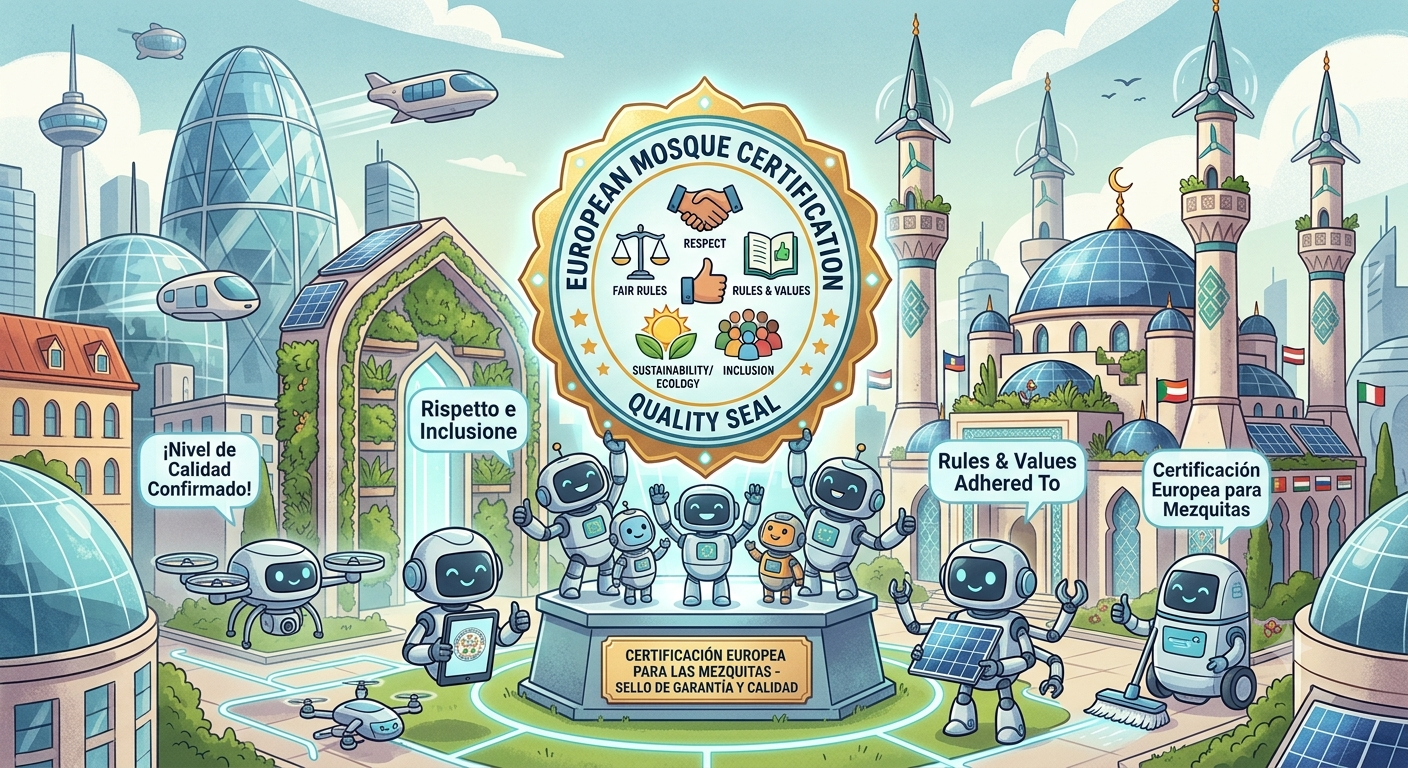
The Mosque with Stars: Does Europe Need a Quality Certification for Islamic Centres?
ISO 9001 Certification for European Mosques
Imagine you are looking for a restaurant. Before going in, you check the reviews, hygiene standards, Michelin stars, or any label that guarantees a certain level of quality.
Now imagine something similar happening with mosques—not to judge anyone’s faith, and not to decide who is a good or bad Muslim, but to offer something very simple: transparency.
It may sound strange today, but perhaps in twenty years it will be perfectly normal.
The Birth of the “Certified European Mosque” Label
It is the year 2040. Europe has spent decades debating integration, radicalism, equality between men and women, and foreign funding of religious centres.
After years of controversy, a simple idea emerges:
Create a voluntary certification for mosques that want to publicly demonstrate their commitment to European democratic values.
Something similar to the environmental, energy-efficiency, or quality certifications already used by thousands of businesses.
No one would be required to obtain it, but those that did could proudly display it at their entrance, like a seal of trust.
How Would It Work?
The certification would be managed by an independent agency made up of legal experts, human rights specialists, Muslim representatives, academics, and members of civil society.
An audit would be carried out every four years. If the mosque met the requirements, it would receive the label; if it ceased to meet them, it would lose it.
As simple as that.
The 10 Golden Rules
1. Equality Between Men and Women
The certified mosque publicly recognises the legal and moral equality of men and women. It cannot promote speeches portraying women as inferior.
2. Explicit Condemnation of Violence
The mosque must publicly reject terrorism, religious violence, and all forms of extremism. No ambiguity. No excuses. No fine print.
3. Financial Transparency
All money received must be declared. Worshippers have the right to know who funds the centre. No mysterious donations from abroad.
4. Understandable Sermons
At least a substantial part of sermons must be delivered in the country’s official language. If a mosque is in Spain, Spanish citizens should be able to understand what is being taught.
5. Protection of Minors
An absolute prohibition on any content promoting child marriage, violence, or discrimination. Children learn about religion, but they also learn about citizenship.
6. Respect for Religious Freedom
The mosque recognises the right to believe, as well as the right not to believe or to leave a religion.
7. Accredited Training for Imams
Imams must receive training in European law, equality, fundamental rights, and the history of the country in which they serve.
8. Cooperation with the Local Community
The mosque organises activities open to the neighbourhood: open days, debates, cultural activities, and volunteering.
9. Rejection of Antisemitism and Homophobia
Religious criticism is legitimate; discrimination against people is not.
10. Commitment to Democracy
The mosque recognises the supremacy of democratic laws over any religious interpretation. Civil law is the law for everyone.
What Benefits Would It Bring?
Here comes the interesting part.
The certification would not simply be a diploma to hang on the wall. It would bring tangible advantages.
Priority for grants and tax incentives: Local authorities could give priority to certified centres when allocating funding for projects.
Greater public trust: Neighbours would know exactly which principles the centre upholds.
Access to educational programmes: Certified mosques could collaborate with schools and universities.
Public recognition: Similar to what happens with sustainable businesses or transparent NGOs.
A European network of best practices: The most successful initiatives could be shared across countries.
How Many Stars Would a Mosque Have?
Here comes the fun part. Just as hotels have stars, mosques could have different levels.
-
One star — Bronze label: Meets the basic requirements.
-
Two stars — Silver label: Also develops social and educational projects.
-
Three stars — Gold label: Becomes a benchmark for integration, transparency, and innovation.
It would be the religious equivalent of a Michelin star.
Some mosques would compete to earn the third star, not for financial prestige, but for social recognition.
Critics Would Raise Their Hands
Naturally, the idea would have its detractors.
Some would say: “The state should not evaluate religious centres.”
Others would respond: “It already supervises schools, associations, foundations, and organisations receiving public funding.”
Some would argue: “This discriminates against Muslims.”
Others would reply: “Then the certification should be open to any religious organisation.”
And here we arrive at the real question: Is this religious control, or simply a tool for transparency?
Utopia or an Inevitable Future?
Thirty years ago, few people imagined energy-performance certificates for homes, sustainability audits, or eco-labels on food. Today, they are commonplace.
Perhaps in a few decades, it will also seem normal for religious institutions to publicly demonstrate their commitment to fundamental rights.
Not to tell anyone how to believe, but to show how that belief coexists with a democratic society.
Perhaps the mosque of the future will not be the largest, the richest, or the most spectacular. Perhaps it will simply be the one that earns three European stars for public trust.
And in an increasingly diverse Europe, that could become the most valuable seal of all.