
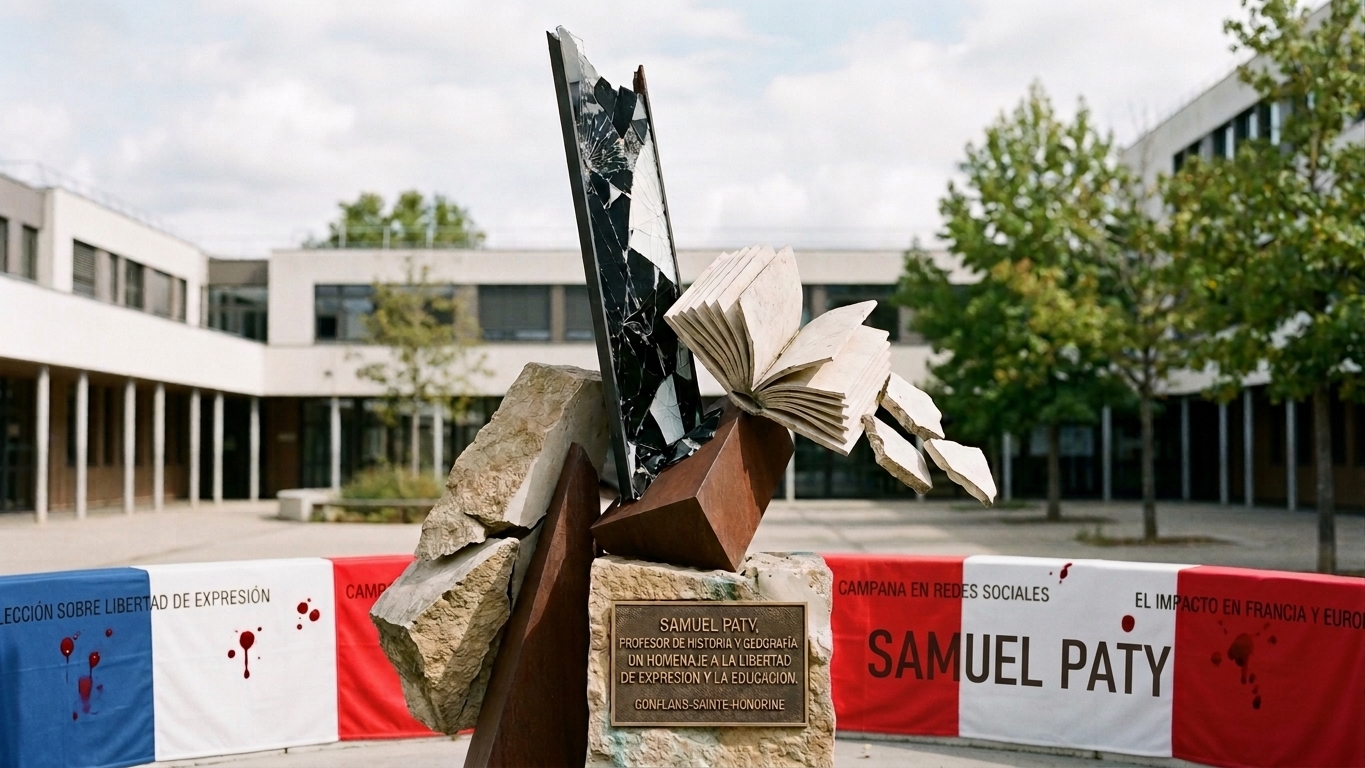
Samuel Paty
16 October 2020 was no ordinary day for European education. It was the day ideological violence reached a devastating low point in the classrooms of the French Republic. The daylight beheading of teacher Samuel Paty turned a secondary school classroom into the epicentre of a heated debate about the limits of freedom of expression, the impact of social media and the rise of Islamist extremism.
1. Who Was Samuel Paty?
Samuel Paty was a 47-year-old French History and Geography teacher who worked at Bois-d’Aulne secondary school in Conflans-Sainte-Honorine, near Paris.
He taught moral and civic education. His work included explaining issues such as freedom of expression, freedom of the press and the limits of debate in a democratic society.
He was not a political leader or a public figure. He was a teacher preparing lessons and working with teenagers.
On 16 October 2020, he was murdered and beheaded near his school by Abdoullakh Anzorov, an 18-year-old radicalised man of Chechen origin and Russian nationality. The attacker was shot dead by police shortly afterwards.
The central question is simple, but uncomfortable:
How can a lesson about freedom of expression lead to a terrorist murder?
To answer this, we need to reconstruct the chain of events.
2. The Beginning: A Lesson on Freedom of Expression
5 and 6 October 2020: The lesson
Samuel Paty prepared an activity for pupils in the equivalent of the third year of secondary school, approximately 13 or 14 years old.
The activity was entitled: “Dilemma situation: to be or not to be ‘Charlie’”.
The aim was to discuss freedom of expression and the publication of religious cartoons. In that context, Paty showed cartoons of the Prophet Muhammad published by the satirical magazine Charlie Hebdo.
Before showing the material, he explained that some images might be offensive and offered pupils the option of looking away or temporarily leaving the classroom. The content and precise format of the lesson were subsequently examined by the education inspectorate. It concluded that choosing to address freedom of expression and show a cartoon was compatible with the educational curriculum, although it also examined aspects of how the session had been conducted.
3. The Lie That Set the Hate Campaign in Motion
7 October: A pupil who had not attended the lesson
A 13-year-old pupil told her father that she had attended Samuel Paty’s lesson and that the teacher had asked Muslim pupils to leave the classroom before showing the cartoons.
However, the investigation established that the girl had not attended that lesson. She had been temporarily excluded from school for a disciplinary matter unrelated to Paty’s session.
The teenager had invented the account she gave her father. She was subsequently prosecuted for making a false accusation.
The father, Brahim Chnina, posted messages on social media attacking the teacher. He portrayed Paty as someone who had humiliated Muslim pupils and called for him to be removed from teaching.
The problem was not simply that a teenager had told a lie. The problem was that adults turned a false account into a public accusation without properly checking the facts.
Can a lie kill?
A lie alone does not explain a terrorist attack. Between a false accusation and a murder lie the decisions of many people.
But in this case, the lie became fuel for a campaign of public targeting:
-
A pupil told a false story.
-
Her father spread accusations against the teacher.
-
Videos and messages were published on social media.
-
Paty’s identity and workplace were exposed.
-
The matter reached a radicalised young man who decided to murder him.
The criminal responsibility of each person had to be determined individually. Not everyone involved played the same role, and they did not necessarily all know the terrorist’s intentions.
4. From a School Dispute to a Digital Campaign
8 October: Complaint and accusations
Brahim Chnina filed a complaint against Samuel Paty, including an allegation that the teacher had shown pornographic images. He also circulated a video attacking the teacher and demanding his dismissal.
The accusation did not reflect what had actually happened in the classroom. The educational and judicial investigations established that the complainant’s daughter had not attended the lesson she described.
12 October: Abdelhakim Sefrioui enters the picture
Abdelhakim Sefrioui, an Islamist activist, joined a new campaign against Paty. He recorded and circulated a video identifying the teacher and the school.
The publications helped create an atmosphere of hostility. The prosecution subsequently argued that Chnina and Sefrioui had knowingly created an environment that could encourage violence against the teacher.
At trial, both denied wanting to provoke a murder. The question was not simply whether they had issued a direct order to kill, but whether their actions constituted knowing participation in a terrorist project under the applicable legal definition.
The logic of the “digital fatwa”
In this case, the expression “digital fatwa” has been used to describe a specific dynamic: publicly identifying a person, accusing them of attacking religion, and making it easier for them to be identified and turned into a target for a hostile audience.
The expression does not mean that all religious criticism is a fatwa or that every online accusation constitutes terrorism. It refers to a combination of factors:
-
False or unverified accusations.
-
Dehumanisation of the target.
-
Disclosure of personal information.
-
Public pressure.
-
Ideological justification of violence.
-
The presence of individuals willing to take action.
The lesson is clear: words are not equivalent to murder, but they can help create the conditions that make it possible.
5. The Killer: Abdoullakh Anzorov
Abdoullakh Anzorov was 18 when he murdered Samuel Paty. He was of Chechen origin, held Russian nationality and lived in France.
He had become radicalised and had expressed jihadist ideas online. He was never tried for the murder because he was shot dead by police minutes after the attack.
The investigation reconstructed how Anzorov contacted people connected with the campaign against Paty and sought help locating him. It was also established that he had paid several pupils to identify the teacher and tell him who he was when he left the school.
It is important not to confuse:
-
The direct killer: Abdoullakh Anzorov, who was killed by police.
-
Those accused of helping him: their responsibility was examined in court.
-
Those who spread the hate campaign: they were tried for their own actions and for the connection the courts established between those actions and the attack.
These people did not all have the same intentions or perform the same role.
6. 16 October 2020: Reconstructing the Day of the Murder
-
14:00 — Waiting: Anzorov arrives near the school carrying a large kitchen knife and an air pistol.
-
16:00 — Paid assistance: The attacker approaches several pupils at the school entrance and offers them around €300 to identify Samuel Paty physically when he leaves. Two teenagers accept the offer and point out the teacher.
-
17:00 — The attack: Paty leaves the school and walks towards his home. Anzorov follows him and attacks him on a residential street, inflicting multiple wounds and beheading him.
-
17:05 — Claiming responsibility: Immediately after the crime, the attacker posts a photograph of the victim’s head on Twitter alongside a message addressed to French President Emmanuel Macron, calling the teacher a “dog of hell”.
-
17:10 — Police response: Police officers corner the attacker a short distance from the scene. After threatening the officers and attempting to fire his imitation weapon, Anzorov is shot dead.
In the morning: An apparently normal school day
Samuel Paty went to Bois-d’Aulne school, where he taught History and Geography.
In the preceding days, he had filed a defamation complaint and explained his account of events to the police. The conflict generated by online publications had already caused concern at the school.
During the afternoon: The attacker waits near the school
Anzorov travelled to the area around the school from a location nearly 100 kilometres away. According to the investigation, he asked pupils who the teacher was and offered them money to identify him.
Several minors took part in locating the teacher. French courts subsequently convicted five pupils for their involvement in preparing the attack, while another pupil was convicted of making a false accusation.
At approximately 17:00: The murder
Samuel Paty left the school and walked through an area nearby.
The attacker followed him and assaulted him with a knife. The teacher was murdered and beheaded in the street.
The crime was extremely brutal and had a symbolic dimension: the attacker wanted to punish a teacher for addressing cartoons and freedom of expression. The French National Anti-Terrorism Prosecutor’s Office investigated the case as a jihadist terrorist attack.
Minutes later: The attacker publishes his message
After the murder, Anzorov posted an online message claiming responsibility for the crime and attacking French President Emmanuel Macron.
Publishing an image of the victim’s body formed part of the claim of responsibility. We do not reproduce that image: it is not necessary to understand the events, and turning it into visual content would contribute to the killer’s propaganda.
Shortly afterwards: Police intervention
Police located the attacker in the nearby town of Éragny.
Anzorov threatened officers with an air pistol and a knife. Police opened fire and killed him. The attacker could not be interrogated or brought to trial.
7. What Was the Motive?
The attacker’s stated motive was connected to the cartoons of Muhammad shown during the lesson on freedom of expression.
Anzorov believed Samuel Paty had committed an offence against Islam and decided to murder him. The crime was investigated as Islamist terrorism.
8. Who Were the People Tried and Convicted?
French courts examined the responsibility of several individuals. The main adult defendants were:
Brahim Chnina
The father of the pupil who originated the false accusation. He participated in the campaign against Paty. He was sentenced at first instance to 13 years in prison and, on appeal in March 2026, to 10 years for terrorist criminal association.
Abdelhakim Sefrioui
An Islamist activist and preacher who participated in videos and actions against the teacher. He was sentenced to 15 years in 2024, and his sentence was upheld on appeal in March 2026.
Naïm Boudaoud
A friend of Anzorov, accused of helping him prepare the attack. In 2024, he received a 16-year sentence for complicity in terrorist murder. On appeal in 2026, he was sentenced to six years for criminal association without a terrorist designation.
Azim Epsirkhanov
A friend of Anzorov, accused of helping him obtain the means for the attack. He was sentenced to 16 years in 2024. On appeal in 2026, he received a seven-year sentence for criminal association without a terrorist designation.
Four other people were also tried in 2024 for their links to the ideological or logistical preparation of the attack and their contacts with the attacker. Their sentences ranged from one year in prison to longer terms, depending on the responsibility the court found proven.
9. The Trial of the Six Minors
In December 2023, six former pupils were convicted after being tried behind closed doors because they were minors when the events took place.
One of the pupils was convicted of making a false accusation after falsely claiming to have witnessed the lesson and stating that Paty had expelled Muslim pupils.
The other five minors were tried for their involvement in locating the teacher. According to the prosecution, some had received money to identify him and point him out to the attacker.
The sentences varied, from suspended sentences to a partially adjusted custodial sentence.
This raises a difficult question:
How should the justice system respond when teenagers participate in a chain of events that ends in a terrorist murder?
10. The 2024 Trial of the Adults
The trial of eight adults took place before a special court in Paris between November and December 2024.
The defendants were not tried for being Muslim or for holding a religious opinion. They were tried for specific conduct: helping the attacker, participating in the campaign against Paty, providing ideological support and other acts connected with the attack.
On 20 December 2024, all eight were convicted and received sentences ranging from one to 16 years in prison. Two friends of the attacker received 16-year sentences for complicity in terrorist murder. Brahim Chnina was sentenced to 13 years and Abdelhakim Sefrioui to 15 years for terrorist criminal association.
The decision sparked debate about a major legal issue:
How far can criminal responsibility extend to people who create a hate campaign when they do not explicitly order a murder and have no direct contact with the terrorist?
The court considered that Chnina and Sefrioui’s actions had knowingly helped create an atmosphere that could encourage a transition to violence. The defence rejected that interpretation and challenged the scope of the prosecution’s case.
11. The 2026 Appeal: A Different Outcome
The legal proceedings did not end in 2024.
In March 2026, the appeal court changed the sentences of three of the four defendants who appealed.
| Defendant | 2024 sentence | 2026 appeal sentence |
|---|---|---|
| Abdelhakim Sefrioui | 15 years | 15 years |
| Brahim Chnina | 13 years | 10 years |
| Naïm Boudaoud | 16 years | 6 years |
| Azim Epsirkhanov | 16 years | 7 years |
In the cases of Boudaoud and Epsirkhanov, the appeal court considered that it had not been proven that they knew about Anzorov’s terrorist intentions. It therefore ruled out the terrorist character of the criminal association and reduced their sentences.
Sefrioui’s 15-year sentence was upheld, while Chnina’s sentence was reduced to ten years.
12. The Wider Significance of the Attack
Samuel Paty’s murder was not merely a crime against an individual. It had several dimensions affecting France and other European countries.
12.1. The educational dimension
A teacher was murdered for teaching a lesson about freedom of expression.
The message teachers may take from this is disturbing: addressing controversial religious issues can lead to personal threats.
If teachers stop explaining sensitive subjects for fear of being publicly targeted, education loses an important part of its purpose.
12.2. The freedom of expression dimension
Religious cartoons can hurt people’s feelings. Freedom of expression, however, also protects speech that provokes, makes people uncomfortable or criticises beliefs.
12.3. The radical Islamism dimension
The killer used an extremist interpretation of Islam to justify violence. The case showed how jihadist propaganda and narratives about religious offence can influence radicalised individuals.
The response should not be limited to identifying attackers after they have acted. It must also examine how radicalisation, propaganda, ideological isolation and the glorification of violence develop.
Prevention, however, must be precise. A strategy that confuses religious observance, ethnic origin or Muslim practice with terrorism can generate discrimination and undermine the trust needed to prevent radicalisation.
12.4. The social media dimension
Social media allowed a local accusation to become a public campaign.
A video can reach thousands of people in a short time. A false accusation can be repeated until it appears true. A person who is targeted can be exposed without having the ability to respond at the same speed.
The case raises an important question:
Should platforms bear greater responsibility when their systems facilitate harassment campaigns, the exposure of personal information or terrorist propaganda?
13. The Shortcomings of the French Response
13.1. Was the teacher adequately protected?
Samuel Paty had been publicly targeted and had filed a defamation complaint. The school intervened, and the administration examined the dispute.
The General Inspectorate concluded that the institution had responded and provided support to the teacher, while also examining how the lesson had been conducted and how the situation had been managed.
At the same time, subsequent investigations and debates raised questions about the assessment of the risk posed by online publications and the protection of someone who had been publicly identified.
It is not correct to claim, without evidence, that a single institution caused the murder. The attack resulted from a chain of individual decisions. But that does not prevent us from asking whether the authorities could have detected or managed the threat more effectively.
13.2. The responsibility of security services
The state must protect citizens, including teachers who receive threats.
However, no security system can guarantee that it will detect every threat or prevent every attack. Assessments must be based on the information available before the crime, not solely on what becomes known afterwards.
An important question is whether the information circulating online was properly assessed and whether sufficiently rapid mechanisms existed to identify a specific threat.
14. What Effects Did It Have in France?
Defending the republican school system
Samuel Paty became a symbol of French public education and its role in teaching republican values.
Following the murder, national tributes and events were organised in schools. On 2 November 2020, French schools held a memorial ceremony that included a minute’s silence and the reading of a letter from Jean Jaurès to teachers.
The institutional response emphasised freedom of expression, laïcité (state secularism) and the protection of teachers.
Greater concern among teachers
The murder caused anxiety among teachers who address issues such as religion, history, colonialism, international conflicts and freedom of the press.
The question is difficult: how can a controversial subject be taught without sacrificing academic freedom or ignoring the safety of pupils and teachers?
The answer should not be to automatically ban contentious subjects. It should include training, teaching materials, institutional support and clear protocols for situations involving threats.
15. What Effects Does It Have Across Europe?
Samuel Paty’s murder forms part of a series of attacks and assaults linked to jihadist extremism in Europe. It also brought renewed attention to other attacks against journalists, cartoonists and citizens who had been targeted because of their ideas or work.
Its European implications can be analysed in five areas.
1. Protecting teachers and journalists
States must protect people whose professions involve investigating, teaching, criticising or publishing information.
2. Digital radicalisation
Radicalisation can develop through videos, messages, private groups and propaganda.
3. Freedom of expression
The debate about cartoons is not exclusive to France. Other European countries must decide how to balance freedom of expression, protection against incitement to hatred and religious freedom.
4. Coexistence between citizens
Attacks can increase distrust towards entire communities. Such reactions can fuel polarisation and provide arguments both for Islamist extremists and for movements that portray all Muslims as a threat.
16. What the Samuel Paty Case Forces Us to Discuss
First question: can a religion be placed beyond criticism?
In a liberal democracy, no religion should be excluded from public debate simply because it is a religion.
A cartoon may be in poor taste. An article may be unfair. An opinion may be wrong.
The democratic response is discussion, criticism, peaceful protest or, where appropriate, recourse to the courts.
Violence must never become a means of censorship.
Second question: what responsibility do people have when spreading accusations?
Social media has reduced the cost of targeting someone in front of thousands of users.
Responsibility is not the same for everyone: sharing unverified information is not the same as organising a campaign, publishing personal information and continuing to make accusations after learning they are false.
Third question: how can radical Islamism be combated without attacking Muslims?
This is one of the most important questions.
Combating Islamist extremism requires examining its ideas, networks, propaganda methods and justifications for violence.
Criticism of radical Islamism does not need to become an accusation against an entire community. In fact, generalisations can undermine the fight against extremism by generating exclusion, distrust and polarisation.
Fourth question: can a democracy protect freedom without being naive?
Democracy must defend freedom of expression. It must also protect its citizens against specific threats.
This requires something more difficult than choosing between “absolute freedom” and “absolute security”:
Security should not be used as an excuse to silence debate.
Conclusion: The Teacher, the Lie and the Knife
Samuel Paty died after teaching a lesson about freedom of expression.
A teenager told a lie. An adult spread accusations. Other people fuelled the campaign. A radicalised young man decided to turn a controversy into a murder.
Each stage deserves to be studied separately. If we talk only about the knife, we fail to understand the entire chain of events that preceded it.
The Paty case reminds us that religiously motivated violence does not always begin with a bomb. Sometimes it begins with an unverified accusation, an inflammatory video, a campaign of public targeting and someone who decides that another person’s life is worth less than their own ideology.
The democratic response must be firm but also intelligent. It must protect freedom of expression without ignoring threats.
A free society is measured not only by its ability to allow pleasant opinions. It is also measured by its ability to protect those who express ideas that others consider offensive.
Mistake number one: minimising the problem
It would be a mistake to deny the existence of radical Islamism, violence justified in the name of religion or intimidation campaigns against people who criticise certain religious interpretations.
The facts of the Paty case show that these problems exist and can have fatal consequences.
Mistake number two: turning the case into a collective accusation
It would also be a mistake to use the murder to portray all Muslims as suspects, enemies or responsible parties.
Sources: Le Monde, TF1 Info, Le Monde, Associated Press