
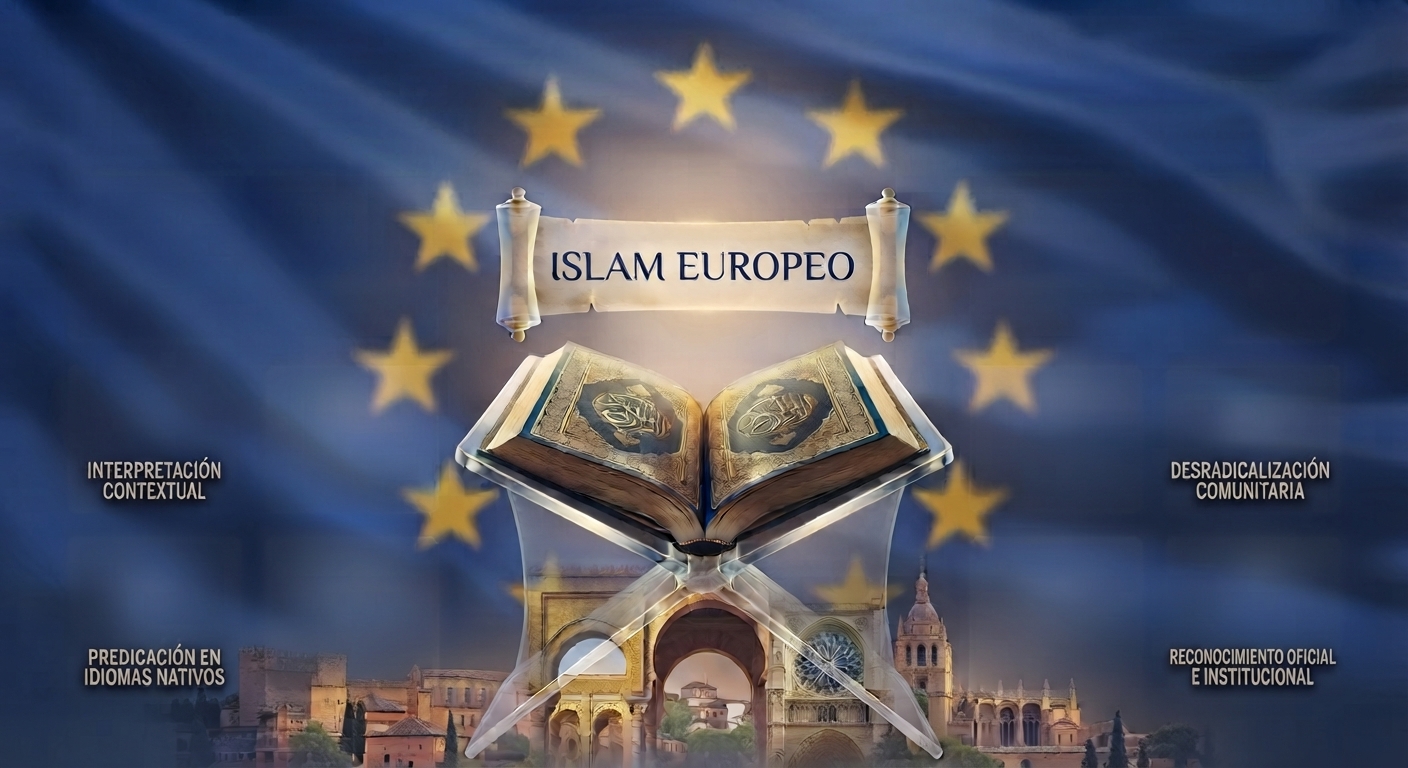
“The 10 Commandments of European Islam 2050”
If your phone’s software hadn’t been updated since the year 632, your screen would probably still be frozen in black and white, and your battery would last two minutes. Religion is somewhat similar: the spiritual engine may be powerful, but if the “operating system” refuses to download modernity patches, compatibility issues with the 21st century are inevitable.
For Islam not merely to fit into today’s Europe, but to become a force for freedom and coexistence, here are ten key reforms, explained without beating around the bush.
This is not about destroying a religion or imposing anything on anyone. It is about exploring ideas that some consider necessary, others consider impossible, and many consider dangerously interesting.
Let the debate begin.
1. Definitively separate religion and politics
This is probably the most important reform.
For centuries, in many Muslim societies, religion and political power have been closely connected. Modern democracies, however, embrace a different idea: the state governs, religion inspires, and neither controls the other. The benefits would be enormous.
Political disagreements would no longer automatically turn into religious conflicts. And a bad government could no longer hide behind sacred arguments.
2. ‘Deprecate’ medieval customs (Say goodbye to outdated rules)
In programming, when code becomes old and no longer serves its purpose, it is marked as deprecated (obsolete). Applying tribal customs from the 9th century to present-day Europe is like trying to install an artificial intelligence programme on a battery-powered calculator. We need to distinguish between what is sacred and timeless and what consists of outdated social rules.
3. Full religious equality between men and women
Absolute equality in rights, roles and leadership. Genuine reform means that women should not only manage communities, but also be able to lead prayers, interpret sacred texts and make jurisprudential decisions on an equal footing.
It is difficult to imagine profound reform without addressing this issue.
4. Absolute freedom of thought and apostasy
Treating doubt, criticism or abandoning the faith as a “crime” is one of the most anti-modern rules imaginable. Genuine faith requires the freedom to join, express opinions and leave without social or legal consequences. Democratic coexistence requires accepting that faith only has value when it is freely chosen.
5. Reinterpret texts in the light of the 21st century
For centuries, interpretations responded to specific historical contexts.
The problem is that today’s world is radically different. We have democracy, artificial intelligence, universal human rights and legal equality.
The question is unavoidable: can a 9th-century interpretation answer the challenges of the 21st century?
6. End transnational surveillance: Cut the geopolitical roaming
Enough mosques being run like diplomatic branches of foreign governments. Muslim communities in Europe should be funded locally, choose their own representatives and cut the cord of “remote control” exercised by countries of origin through their sermons.
7. Transparent mosques as modern organisations
Imagine if every mosque published an annual report covering its budget, funding, projects, activities and objectives.
Exactly as many foundations and associations already do. Trust tends to grow when information is available.
8. Train imams to European standards
Community leaders must live in the same century and share the same reality as their congregations. Training imams at local universities, with studies in human rights, contemporary philosophy and sociology, is vital to ensure that sermons address real life in the neighbourhood rather than dogmas disconnected from their surroundings.
9. Create a European Council for Islamic Thought
Europe has universities, legal scholars, philosophers, theologians and Muslim intellectuals. Yet much religious thought still depends on institutions located outside Europe.
Why not establish our own centres for reflection? A space where European Muslims can develop answers to Europe’s challenges.
10. Put the individual at the centre
Perhaps this is the reform that encompasses all the others.
The idea is simple: individual conscience must occupy a central place. Not the group. Not social pressure. Not the family. Not the neighbourhood. Not the community.
The individual, their decisions, their freedom, their responsibility, their relationship with God—or their decision to have no religious
relationship at all.
Why are these reforms so controversial?
Because every reform challenges existing structures. And structures rarely allow themselves to be reformed without a struggle.
Supporters argue that these ideas would help Islam adapt more effectively to modern democratic societies. Critics respond that they could dilute fundamental traditions or reinterpret the religion too extensively.
That is why these debates are so intense. They are not about minor details; they are about the future.
European Islam in 2050
Imagine, for a moment, a Europe twenty-five years from now with its own European Islam. Impossible?
History shows that many transformations once considered impossible eventually happen. A hundred years ago, nobody could have imagined how Europe, technology or everyday life would change.
Perhaps the great debate of the 21st century is not whether Islam can change.
Perhaps the real question is: what changes will make it possible to preserve faith while strengthening freedom? And that debate, whether we like it or not, has already begun.