
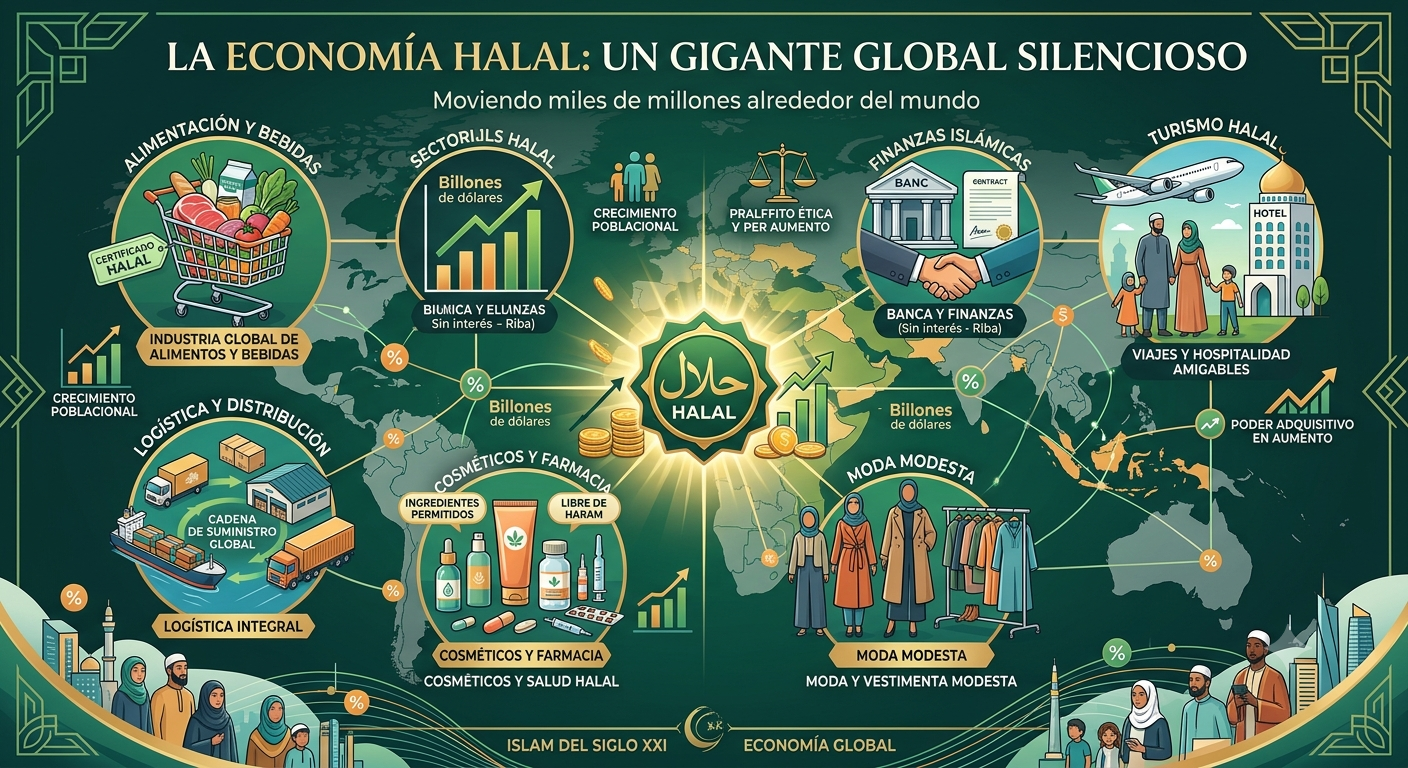
When Religion Also Moves Billions
When we think of religion, we usually imagine mosques, churches, or temples. We think of faith, rituals, or spirituality, but rarely do we think about money.
And yet, Islam is at the centre of one of the world’s largest economies. We are not talking only about Muslim-majority countries.
We are talking about a global industry worth hundreds of billions of euros a year, one that continues to grow as the Muslim population increases and its purchasing power rises.
Behind the word “halal” lies an entire universe of businesses, banks, hotels, travel agencies, insurance companies, digital platforms, and distribution networks.
To understand Islam in the twenty-first century, we must also understand its economy. There is a silent economic giant moving billions of euros every year, and it shows no signs of stopping. We are talking about the halal economy.
What Does “Halal” Mean?
The word halal simply means “permitted” or “lawful” under Islamic law (Sharia).
What began as a rule strictly governing how meat was slaughtered for Muslims has now evolved into a global commercial empire, spanning everything from high finance to luxury holiday resorts.
With a global Muslim population already exceeding 2 billion people and an emerging middle class eager to spend, the halal market has become a major attraction for international capitalism.
How does this economic ecosystem work, and how is it changing global business? Let’s break it down in simple terms.
1. The Food Empire: Much More Than “Clean Meat”
The food sector is the foundation of the entire industry. For a product to be certified as halal, its meat must come from animals slaughtered according to specific religious requirements. It must be free from pork and alcohol, and the production process must prevent cross-contamination in factories.
The sector includes much more than meat: sausages, sweets, non-alcoholic beverages, ready-made meals, baby food, frozen products, and more.
Today, major Western multinationals such as Nestlé, Unilever, and Danone have enormous divisions dedicated exclusively to obtaining the “halal” certification.
They do not do this for spiritual reasons, but for straightforward commercial calculations: the halal food market is worth more than one trillion euros a year.
This is no longer about a small neighbourhood butcher’s shop. It is about entire supermarket aisles in London, Paris, and Madrid filled with certified products.
2. Halal Tourism: Luxury Holidays Without “Sins”
Tourism is one of the most dynamic and fascinating sectors of this economy. Middle- and upper-class Muslim travellers want the same things as anyone else: to relax, discover new places, and enjoy luxury. The difference is that they want to do so without compromising their faith.
This is where halal tourism comes in, creating a multimillion-euro hotel infrastructure.
“Dry” hotels: Five-star establishments where not a drop of alcohol is served and all food is 100% halal.
Absolute privacy: Beaches, spas, and swimming pools with separate schedules for men and women or areas reserved exclusively for women, allowing them to wear the burkini comfortably and without unwanted attention.
Spiritual amenities: Rooms equipped with a qibla indicator (showing the direction of Mecca), prayer mats, and television channels featuring family-friendly content.
Countries such as Malaysia, Turkey, and Indonesia lead this market, but European destinations such as Spain, particularly Andalusia, are rapidly adapting their hotels to attract wealthy tourists from the Persian Gulf.
3. Halal Banking and Investments: Money Without Interest
This is perhaps the most complex and surprising sector. Islamic law strictly prohibits riba (the charging or payment of interest), considering it usury and exploitation. It also prohibits investing in businesses regarded as harmful (haram), such as gambling, betting, tobacco, pornography, and pork production.
So how does an Islamic bank operate if it cannot charge interest on loans? Through cooperation and shared risk.
The Murabaha method (Purchase and Resale): If you need to buy a house, the bank purchases it on your behalf and then sells it to you at a slightly higher price, allowing you to pay in instalments. There is no interest; instead, there is a commercial profit margin agreed upon from the outset.
The Mudaraba method (Risk-Sharing Partnership): You provide the business idea, and the bank provides the money. If the business makes a profit, the returns are shared. If it fails, both parties bear the losses.
Interestingly, following financial crises in Western countries, Islamic investment funds and banking—which together manage more than €3 trillion—attracted the interest of non-Muslim investors because of their ethical positioning, restrictions on pure speculation, and requirement that each investment be backed by a real asset, such as a building or a commodity. These features are often presented as making the system more stable.
4. “Modest” Cosmetics and Fashion
The business does not end with what people eat or where they travel. It also extends to what they wear and put on their skin.
Halal cosmetics: Many conventional cosmetics contain pig-derived collagen, animal gelatine, or alcohol in their formulations.
Halal cosmetics are intended to ensure that lipsticks, creams, and shampoos are free from prohibited ingredients, including pork derivatives. This market is booming among young influencers in Indonesia and the United Kingdom.
Modest fashion: Designs that comply with Islamic standards of modesty—loose-fitting clothing, long sleeves, and stylish hijabs—while following the latest trends from the fashion runways of Milan and New York.
Major brands such as Nike, with its sports hijab, and high-fashion labels have created capsule collections specifically for Ramadan.
The Halal Certification Label
Here we encounter another, less familiar industry.
Who decides whether a product is halal?
The answer is certification bodies. These organisations inspect businesses, review production processes, and issue certificates allowing products to be marketed as halal.
For many companies, this certification is essential for exporting to certain markets. Certification thus becomes a business in its own right.
A Global Economy
The important thing is not any single product, but the whole system: food, tourism, finance, fashion, cosmetics, pharmaceuticals, logistics, certification, and international trade.
All these sectors form part of an interconnected economy that continues to grow.
What Does This Mean for Europe?
Europe is home to a large and diverse Muslim population, and many companies see this market as a commercial opportunity.
That explains why more and more products, services, and marketing campaigns are being specifically designed for Muslim consumers.
Specialist supermarkets, halal restaurants, halal butchers, travel agencies, modest fashion shops, certified cosmetics, and more.
From a business perspective, this is a logical decision. Companies seek customers and adapt their offerings when there is demand.
At the same time, this growth opens up public debates about integration, consumption, regulation, certification, and the role religious rules play in certain areas of the economy.
These are legitimate questions that can be discussed in a democratic society.
The European Debate
The growth of the halal industry has sparked several public debates.
For example:
Should products always be clearly labelled when they are halal-certified?
How can we ensure that certifications are transparent and verifiable?
What public oversight should exist over certification bodies?
How can religious freedom be reconciled with animal welfare regulations when ritual slaughter is involved?
Should the state intervene, or should the market and consumers decide?
These are legitimate questions in a democracy, and different answers are possible.
What matters is being able to discuss them using evidence and without prejudice.
Economics and Integration
The halal market also raises another fundamental question.
Does the creation of specific products and services encourage integration, or does it reinforce separate consumer communities?
There is no single answer. Some argue that adapting commercial offerings facilitates the inclusion of Muslim citizens. Others believe it can reinforce patterns of cultural separation if certain services end up being organised exclusively around religious criteria.
This is a complex debate that deserves calm analysis, not slogans.
Understanding Before Deciding
The halal economy will continue to grow.
Not because a religion is independently seeking economic expansion, but because there is genuine consumer demand and a large number of companies see business opportunities.
Denying this reality would mean ignoring how markets work. However, it is equally important not to view it without a critical perspective.
As with any major industry, it is reasonable to ask who benefits, how certifications are regulated, what level of transparency exists, and what impact the industry has on the economy and society.
Understanding these processes does not mean supporting or opposing them. It means having the information needed to participate in public debate with arguments, evidence, and critical thinking.
A strong democracy is not afraid to examine economic phenomena linked to religion.
Much More Than a Religion
When we talk about Islam, we tend to think only of its religious dimension. But Islam also generates economic activity on an enormous scale. Thousands of companies operate in this market, millions of workers depend on it, and numerous countries consider it a strategic sector for economic growth.
Understanding this reality does not mean endorsing or rejecting it. It means recognising that, in addition to being a religion followed by millions of people, Islam is also linked to a significant part of the global economy.
Understanding this economic dimension helps us make sense of many of the changes taking place in trade, tourism, and international markets.
Conclusion: The Market Rules
The halal economy demonstrates that the dynamics of global capitalism are capable of absorbing, packaging, and monetising almost any cultural or religious identity. What began as a set of spiritual and moral codes in the seventh century has now become a sophisticated, technology-driven, and ruthlessly efficient consumer industry.
For ordinary people, the lesson is clear: money has no religion, but religions have most certainly become a highly profitable business.