
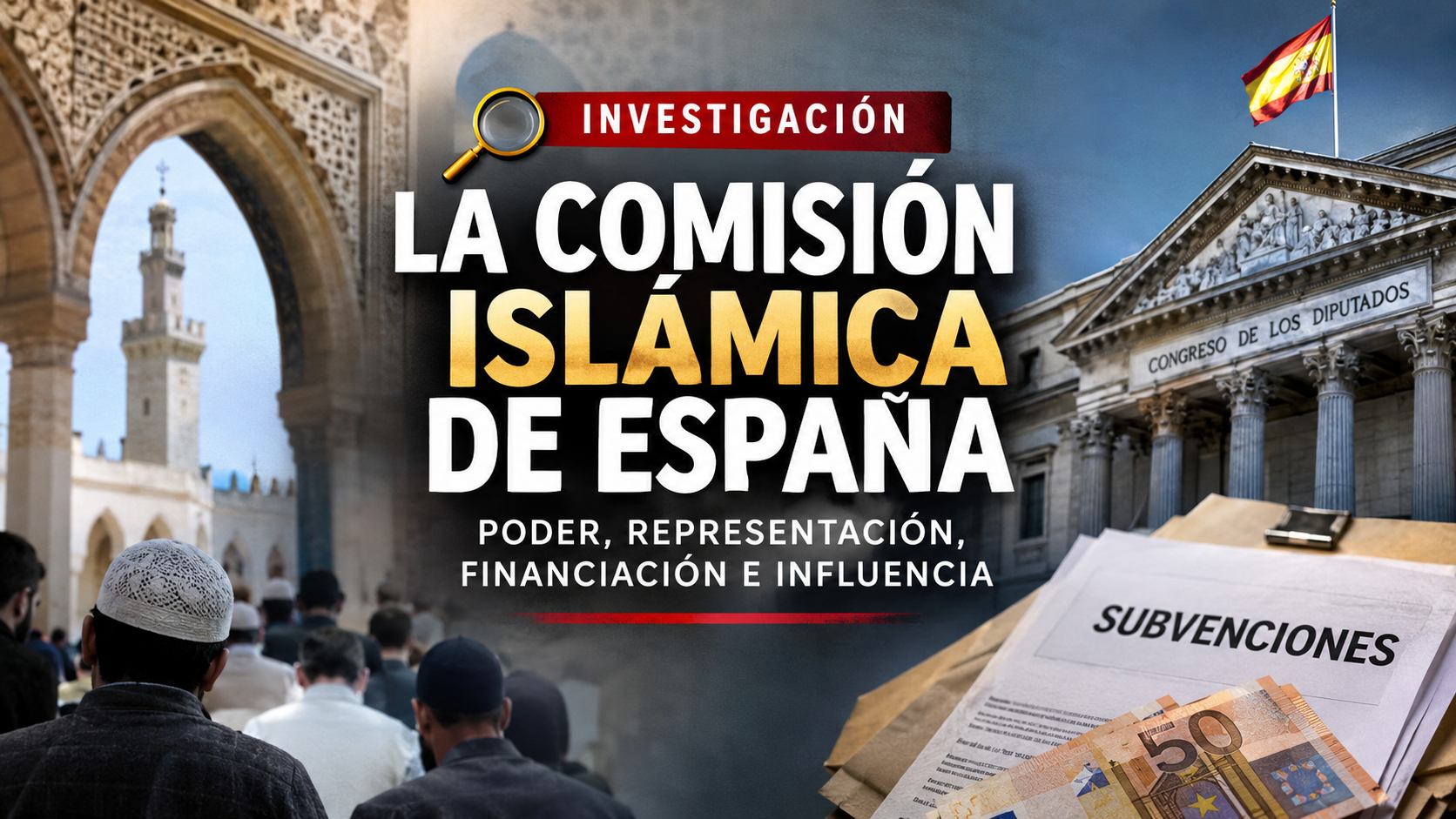
Who represents Muslim communities before the Spanish State? How is power distributed within the organisation? What public funding does it receive, and what do we know about its internal operations?
The Islamic Commission of Spain (Comisión Islámica de España, CIE) occupies a unique position within Spain’s system of cooperation with religious denominations. It is the organisation with which the Spanish State signed the Cooperation Agreement approved by Law 26/1992. This legislation recognises certain rights and establishes mechanisms for institutional dialogue in areas such as Islamic religious education, religious assistance in public institutions, places of worship and halal food.
This position gives the Commission a capacity to intervene in institutional matters that goes beyond the ordinary activities of a religious association.
However, several questions deserve closer examination: Who does the CIE actually represent? How is it organised? Which federations carry the greatest weight in its governing bodies? How much public money does it receive? How are those resources distributed? What information is available about the remuneration of its officials and its oversight mechanisms?
This investigation examines the available legal, institutional, financial, academic and journalistic documentation. Its purpose is not to judge the religious beliefs of its members, but to examine the functioning of an organisation that maintains a significant institutional relationship with the State and manages public resources.
1. A special institutional position: whom does the CIE represent?
The Islamic Commission of Spain is not just another religious association.
Its institutional position derives from the Cooperation Agreement signed on 28 April 1992 and approved by the Spanish Parliament through Law 26/1992 of 10 November.
The law’s preamble identifies the CIE as the representative body of Islam in Spain before the State for the negotiation, signing and monitoring of cooperation agreements.
However, there is a fundamental distinction that must be maintained throughout this investigation: institutional representation of the communities affiliated with the CIE does not necessarily mean representation of all Muslims living in Spain.
Article 1 of the Agreement defines its scope of application. It covers Muslim communities affiliated with the Commission and registered in the Register of Religious Entities, as well as those that join in accordance with the legally established procedure.
It therefore cannot be assumed that all Muslims residing in Spain belong to the CIE, are affiliated with its federations or have chosen its representatives.
The relevant question is a different one: to what extent does the structure that negotiates with public institutions reflect the organisational and social diversity of Spain’s Muslim population?
We have not found sufficient public data to measure the proportion of Muslims who support, participate in or feel represented by the Commission.
The absence of such data does not prove that the CIE lacks representativeness. It means that its level of support among the wider Muslim population cannot currently be quantified.
2. Origins: FEERI, UCIDE and the search for a common interlocutor
The history of the CIE is closely linked to two organisations:
- FEERI: Spanish Federation of Islamic Religious Entities.
- UCIDE: Union of Islamic Communities of Spain.
The creation of these organisations was largely driven by the need to establish an interlocutor with the State in order to negotiate a cooperation agreement.
The academic study by Sol Tarrés and Javier Rosón, published by CIDOB in 2017, reconstructs this process. FEERI was established in September 1989, while UCIDE was registered in the Register of Religious Entities in October 1991.
The Islamic Commission of Spain was established on 19 February 1992, initially formed by the two federations. Two months later, on 28 April, the Cooperation Agreement with the State was signed.
The creation of a common interlocutor made it possible to establish an institutional framework covering matters such as places of worship, imams, religious marriage, Islamic education, religious holidays and religious assistance.
However, relations between the two founding federations were not straightforward.
The internal crisis documented by the Council of State
One of the most relevant documents for understanding the institutional development of the CIE is Opinion 1092/2015 of the Spanish Council of State.
This document examined a proposed regulatory reform intended to establish the position of president and guarantee the participation of federations and communities in the Commission’s operations.
The opinion describes difficulties in reaching agreement between FEERI and UCIDE and the problems caused by a dual organisational structure in which both federations had their own representation through general secretaries.
The background to the file describes a deadlock that hindered decision-making and the effective incorporation of new entities.
Among the data cited is the statement that more than 30% of Muslim communities were excluded from effective representation within the CIE during that period. This figure appears in the preamble of the draft regulation reproduced in the background documentation of the opinion. It should not be interpreted as the result of an independent count carried out by the Council of State.
The document also refers to difficulties faced by certain federations and communities in registering their representatives and participating fully in the governing bodies.
The problem was not merely internal. It affected the operation of the Cooperation Agreement and the ability of affiliated entities to exercise the rights recognised by law.
The 2015 reform introduced changes to the Commission’s structure, including the position of president and a reorganisation of the Standing Commission.
This historical record shows that the CIE experienced an institutional representation crisis documented in official material. It does not, by itself, prove that the same problems continue today.
The unresolved question is whether the reformed structure has succeeded in ensuring balanced participation by the different federations and communities.
3. Who belongs to the CIE: federations, representatives and leadership
The Islamic Commission of Spain is not an organisation based on individual membership by all Muslims residing in Spain. Its structure is organised through federations and religious communities.
One of its main bodies is the Standing Commission, which the organisation itself describes as the representative body of Islamic communities.
According to the membership list published on its institutional transparency website, it consists of 25 members.
Distribution of the published positions
| Federation | Published representatives |
|---|---|
| UCIDE | 15 |
| FEERI | 3 |
| FEME | 1 |
| CISCOVA | 1 |
| FIRM | 1 |
| FEMCOVA | 1 |
| FIVASCO | 1 |
| FIDA | 1 |
| FICAIB | 1 |
| TOTAL | 25 |
The most notable figure is that UCIDE occupies 15 of the 25 published positions, representing 60% of the Standing Commission.
FEERI has three representatives, while each of the other seven federations has one.
This distribution shows where organisational weight is concentrated within the representative body.
It does not, in itself, demonstrate an irregularity or prove that there is illegitimate control. Assessing whether the distribution is proportional would require knowledge of the applicable statutory criteria, the number of active communities represented by each federation and the mechanisms used to verify that representation.
The published composition raises legitimate questions:
- How many active religious communities does each federation represent?
- How is the number of representatives calculated?
- Who verifies that the communities counted remain active?
- What mechanisms allow smaller federations to influence decisions?
- How frequently is the composition of the Standing Commission reviewed?
These questions are relevant to assessing the internal pluralism of an organisation that performs public institutional liaison functions.
The Board of Directors: names and positions
The CIE’s institutional transparency page identifies the following individuals as members of its Board of Directors:
| Position | Person |
|---|---|
| President | Aiman Adlbi |
| Secretary | Mohamed Ajana |
| Deputy Secretary | Laarbi Al·lal |
| Treasurer | Abdeslam Elhinda |
| Deputy Treasurer | Ihab Fahmy |
| Board Member | Adel Najjar |
| Board Member | A. Yamán Omar |
| Board Member | Ahmed Faaisse |
| Board Member | Fouad Borni |
| Board Member | Lahsen El Hímer |
| Board Member | Mahfouz S. M. Abu Mahfouz |
| Board Member | Mariam D. Cuenca |
| Board Member | M. Muhammad Kaleem |
| Board Member | Mohamed Bouzarad |
| Board Member | Mustafa Abdeselam |
According to the explanation published by the CIE itself, the Board manages the organisation when the Standing Commission is not in session and coordinates its ordinary activities.
The organisation states that its members are selected by the president from among the members of the Standing Commission, through a vote on an agreed candidate list that reflects the proportional representation of the different entities.
This description provides information about the procedure the CIE says it follows. However, it does not replace consultation of its statutes, electoral minutes and internal resolutions in order to reconstruct all its governance decisions.
Greater transparency regarding electoral procedures, terms of office and voting results would help provide a clearer picture of how the organisation operates.
4. What institutional power and influence does the CIE have?
To understand the Commission’s influence, it is necessary to examine the 1992 Cooperation Agreement.
Its provisions recognise specific functions and mechanisms for intervention in different areas of public life.
This is not general administrative power, nor does it give the Commission the authority to replace public institutions. Its powers are specific responsibilities linked to the framework of religious cooperation.
Main areas of involvement
| Area | Function recognised in the Agreement |
|---|---|
| Places of worship | CIE’s approval in the certification of mosques and places of worship belonging to affiliated communities |
| Imams | Approval in the certification of Islamic religious leaders |
| Marriage | Participation in the civil recognition system for marriages celebrated according to Islamic religious rites |
| Religious education | Involvement in teacher appointments and approval of religious content |
| Hospitals and prisons | Participation in organising religious assistance |
| Armed Forces | Cooperation framework for Islamic religious assistance |
| Halal food | Protection of the halal designation and the corresponding registered trademark |
| Islamic heritage | Cooperation with the State in preservation and dissemination |
| Legislation | Right to be informed of legislative initiatives affecting the Agreement and to express its views |
Places of worship and imams
Article 2 establishes that buildings or premises exclusively intended for the habitual practice of prayer, religious education or assistance are legally considered mosques or places of worship when certified as such by the relevant community with the approval of the CIE.
Article 3 establishes that imams and religious leaders must prove that they meet certain requirements through certification issued by their community, with the approval of the Commission.
This means that the CIE participates in procedures affecting the institutional recognition of communities and their religious leaders.
Islamic marriages
Article 7 recognises civil effects for marriages celebrated according to Islamic religious rites when the requirements concerning legal capacity and other legal conditions are met.
The marriage must be celebrated before an authorised person and in the presence of at least two adult witnesses. Civil recognition also requires registration with the Civil Registry.
The CIE participates in the accreditation of ministers of religion, but it does not replace civil requirements or the powers of the Civil Registry.
Religious education
Article 10 recognises the right of Muslim pupils to receive Islamic religious education in public and publicly funded private schools, under the conditions established by law.
The teaching is provided by teachers appointed by communities belonging to the CIE, with the approval of the relevant federation.
The religious content and textbooks are provided by the communities, with the approval of the Commission.
This role is particularly important because it connects the organisation to an activity taking place within the education system and affecting minors.
Religious assistance in hospitals and prisons
Article 9 guarantees the right to receive Islamic religious assistance in prisons, hospitals, care institutions and other public establishments.
Assistance may be provided by imams or other persons appointed by the communities, who must obtain authorisation from the competent administrative bodies.
The CIE therefore participates in the system, but administrative authorisation remains the responsibility of the competent public authorities.
5. Halal Spain: the trademark and an economic activity that deserves investigation
Article 14 of the 1992 Agreement assigns the CIE a role in protecting the correct use of the halal designation and establishes that it must apply for the corresponding trademark registrations.
The organisation itself states that it obtained registration of the Halal Spain trademark, number M3.676.011, between 2017 and 2018.
It also explains that it is developing a procedure to regulate the use of the trademark and establish the requirements that professional certification bodies must meet.
There is an important clarification: the CIE expressly states that it is not a certification body, consultancy or auditing firm. Its declared role is to regulate and supervise the application of its trademark, while professional certification activities are carried out by specialised organisations.
This opens up an economic research area of public interest:
- Which certification bodies are authorised to use the trademark?
- What requirements must they meet?
- What contractual relationship exists between the trademark owner and the certifiers?
- Are fees, subscriptions or usage rights charged?
- What income, if any, does the CIE receive from use of the trademark?
- What mechanisms exist to monitor quality and compliance?
The documentation examined supports the CIE’s claim to ownership of the trademark, as stated in its institutional information. However, it does not allow us to quantify commercial income or demonstrate that there is an irregular economic relationship with certification companies.
This issue deserves a specific investigation.
6. Public funding: how much does the CIE receive and how is it managed?
Funding is one of the central issues in understanding the Commission’s operations.
The Pluralism and Coexistence Foundation (Fundación Pluralismo y Convivencia), a public-sector entity, manages grants intended to facilitate the effective exercise of religious freedom and the development of cooperation agreements with minority religious denominations.
The CIE itself explains that the grant system has evolved over time.
From grants to federations to a global CIE programme
According to information published by the organisation:
- Between 2005 and 2015, grants were channelled mainly through federations and religious communities.
- In 2016, the CIE received its first direct grant from the Foundation.
- From 2021 onwards, the system changed and the Commission began submitting a global programme that includes its own activities as well as projects run by selected federations and communities.
This change is significant. The CIE began to play a role in coordinating and managing a programme that can include activities carried out by other religious entities.
The Commission itself distinguishes between the grants allocated to its programme and resources received by the federations and communities included in it.
It is therefore incorrect to automatically attribute all the money listed in the statistics for grants to the Muslim denomination to the CIE’s central structure.
The 2025 state grant: €444,000
Royal Decree 560/2025 of 1 July regulates the direct awarding of grants to minority religious denominations that have signed cooperation agreements with the State.
The decree establishes a total allocation of €1.2 million and sets the following maximum amounts:
| Organisation | Maximum amount in 2025 |
|---|---|
| FEREDE | €540,000 |
| Federation of Jewish Communities of Spain | €216,000 |
| Islamic Commission of Spain | €444,000 |
| TOTAL | €1,200,000 |
The maximum amount allocated to the CIE in 2025 was therefore €444,000.
This figure must be interpreted correctly.
It does not mean that the money represents a financial benefit for the organisation or that it is intended entirely for its leaders. Nor does it show, by itself, how much the Commission ultimately spent on its central structure.
What can the money be spent on?
Royal Decree 560/2025 provides for various eligible activities:
- Institutional representation and liaison.
- Ordinary operation of governing bodies.
- Training for ministers of religion and teachers.
- Religious assistance in public institutions.
- Legal and administrative advice.
- Support for and coordination of federations and communities.
- Information, communication and awareness-raising activities.
- Social inclusion and outreach initiatives.
The decree allows salaries for staff directly involved in the subsidised activities to be funded, as well as operating costs, meetings, training, travel and publications.
It also sets limits for certain ordinary operating expenses: costs allocated to this category may not exceed 15% of the total grant awarded.
This means that part of the public funding may be used to finance the operational structure required to carry out approved activities.
However, three amounts must be distinguished:
- The maximum amount provided for in the regulation.
- The amount actually awarded and paid.
- The expenditure ultimately incurred and justified.
These are not equivalent concepts.
How much has the CIE received since 2021?
This figure requires particular care.
The arithmetic sum of the maximum reference amounts published for 2021-2025 is €2,176,522.04. This sum represents the annual maximum limits, not the actual expenditure or the money necessarily retained by the Commission’s central structure.
Separately, Maldita.es published a fact-check in December 2025 based on the National Grants Database, stating that the CIE had received €1,835,352.04 in state grants since 2021.
These are different measurements. A sum of maximum limits must not be presented as the amount actually received or spent.
The CIE itself states that projects and expenses associated with its grants are justified before the granting authorities and that, since 2021, an audit of the supporting account documentation has been required under the grant-awarding rules.
To establish the final destination of the resources, it would be necessary to examine the award decisions, activity reports, supporting accounts and audit reports for each financial year.
7. Other public grants: prisons, the Basque Country and Ceuta
The CIE’s funding is not limited to the general programme managed by the Pluralism and Coexistence Foundation.
The organisation itself declares that it receives grants from other administrations:
| Administration | Declared purpose |
|---|---|
| Ministry of the Interior | Islamic religious assistance in state prisons |
| Basque Government | Religious assistance in prisons in the Basque Country |
| Autonomous City of Ceuta | Project to support the Muslim community in Ceuta |
According to the CIE’s institutional information, it has received the state prison grant since 2013, the Basque grant since 2021 and the Ceuta grant since 2018.
The information examined does not contain a complete and up-to-date breakdown of the amounts from regional and local administrations.
The 2026 state prison grant
Royal Decree 635/2026 of 29 July establishes a direct grant of €21,000 to the CIE to ensure Islamic religious assistance in prisons under the authority of the General State Administration.
This is a separate allocation from the general grant managed by the Pluralism and Coexistence Foundation.
The Ministry of the Interior also publishes implementation indicators for 2025:
- Expenditure executed: €21,000, representing 100% of the allocation.
- Ministers of religion accessing prisons each month: eight, compared with ten planned.
- Religious services recorded: 1,178, compared with a target of 700.
These figures provide information about part of the funded activity and show that administrative indicators exist to evaluate its implementation.
However, assessing the actual reach of the service would require more detailed information about the prisons served, geographical distribution, frequency of visits and the needs of the prison population.
8. Private donations and foreign funding: what do we know and what do we not know?
Article 11 of the Cooperation Agreement recognises the right of the CIE and its member communities to receive contributions from members, organise public collections and accept offerings and donations.
There is therefore a legal basis for receiving private contributions.
However, the CIE itself states on its grants page that it has no independent sources of funding and receives state, regional and local public aid to carry out its projects.
These two statements are not necessarily contradictory.
Having the legal capacity to receive donations is one thing. Actually receiving donations that constitute a significant source of income is another.
In the public documentation examined, we have not found a sufficient breakdown to establish:
- The annual volume of private donations.
- The origins of the main private resources.
- Contributions from foreign entities.
- The existence of financial agreements with institutions in other countries.
- The weight of these resources in relation to total income.
We have also not found sufficient documentary evidence to claim that the current CIE is funded or controlled by foreign governments.
International links in the origins of organised Islam in Spain
The academic study by Sol Tarrés and Javier Rosón, published by CIDOB in 2017, describes the presence of international relationships in the institutionalisation of Islam in Spain.
The historical background includes the presence of the Saudi ambassador at the beginning of negotiations between the State and FEERI representatives in October 1989. The study also examines historical relationships between Spanish Muslim organisations and actors in North Africa and other countries.
These precedents help explain the political and religious context in which the first organisational structures emerged.
However, they do not allow us to conclude that the current CIE is controlled by Saudi Arabia, Morocco or another foreign government.
Evidence supporting such a claim would require financial documents, transfers, contracts, agreements, institutional communications or proof of direct intervention in governance decisions.
International influence during the origins of a religious organisation and foreign control of its current leadership are different issues.
9. Salaries and remuneration: how much do the leaders earn?
This is a legitimate question when examining an organisation that receives public funding and performs institutional functions.
However, the documentation examined does not allow us to provide verifiable figures.
We have not located a complete public table detailing the remuneration of the president, secretary, treasurer, board members or staff employed by the CIE.
Three different situations must be distinguished:
Remuneration of board members. We have not found sufficient information to determine whether members of the Board of Directors receive salaries, allowances, compensation or serve on a voluntary basis.
Administrative staff. Grants may cover staff costs linked to approved activities. However, we do not have a complete breakdown of the number of employees, their contracts or the actual payroll.
Imams and ministers of religion. Their remuneration may be paid by religious communities or through specific religious-assistance programmes. It should not be confused with payments to the Commission’s governing bodies.
Is the CIE required to publish its leaders’ salaries?
Law 19/2013 on Transparency includes certain private entities among those subject to transparency requirements when they receive more than €100,000 a year in public grants or subsidies, or meet the alternative threshold of 40% of income from public funding and a minimum of €5,000.
However, these obligations have a more limited scope for private entities than for public administrations.
Article 8.2 requires them to publish contracts and agreements concluded with public administrations and the grants they receive from public administrations.
It does not automatically impose all the financial disclosure obligations applicable to public bodies, such as publishing full budgets, annual accounts or the remuneration of their senior officials.
Therefore, the absence of a public salary table does not, in itself, demonstrate a breach of the law.
From the perspective of public interest, however, it would be desirable for an organisation with this level of institutional engagement to publish more detailed information about its budget, staff costs, allowances and distribution of resources.
10. Controversies and documented problems
10.1. The historical representation crisis
Opinion 1092/2015 of the Council of State documented internal problems that affected the CIE’s functioning for years.
The lack of agreement between FEERI and UCIDE, the deadlock in internal governing bodies and difficulties integrating new communities had consequences for the implementation of the Cooperation Agreement.
The reference to more than 30% of excluded communities relates to the background of the draft regulation examined in that opinion. It should not automatically be applied to the current situation.
The question that remains relevant is how the participation of different federations and communities is guaranteed today.
10.2. The concentration of representation in UCIDE
The published composition of the Standing Commission assigns UCIDE 15 of its 25 seats.
This is a clear majority within the representative body.
However, it is not possible to conclude that this arrangement is illegitimate without knowing the statutory criteria and the representation base of each federation.
Further research should compare the number of active communities, their geographical distribution and the number of positions allocated to each organisation.
The CIE reported that presidential elections were held in July 2024 with two candidates, Aiman Adlbi and Francisco Jiménez, and that Adlbi was re-elected by an absolute majority.
Publishing the minutes, detailed results and representation criteria would make it possible to better understand the process.
10.3. The Aiman Adlbi case: police investigation and judicial dismissal
This episode requires particular care to avoid confusing suspicions, investigations and facts established by a court.
Aiman Adlbi was arrested in March 2021 in the context of an investigation into the alleged financing of jihadist organisations linked to Syria.
In January 2024, EL PAÍS published information based on a police report from the General Information Commission attributing a possible role to Adlbi in a fundraising network whose money allegedly reached armed groups in Syria linked to Al-Qaeda.
Those reports described investigators’ suspicions. They did not constitute a court judgment and did not, in themselves, establish the commission of a criminal offence.
On 2 December 2025, Central Investigating Court No. 6 of Spain’s National High Court ordered the provisional dismissal and closure of the case with regard to Aiman Adlbi and other individuals under investigation, including Fawaz Nahhas, Adel Najjar and Mohamad Hatem Rohaibani.
The CIE published a statement about the ruling and said that the court considered the alleged offence insufficiently substantiated and that it had not been established that the individuals under investigation knew of or participated in activities intended to finance terrorism.
Maldita.es reported that it had attempted to obtain the court order directly from the National High Court and the investigating court, but had not been able to access the document through those channels.
This investigation therefore records the existence of the dismissal and the information published about it, but does not attribute to the court order any specific content that we have been unable to verify through a complete copy obtained directly from the court.
It is important to clarify the legal scope of the decision: provisional dismissal is neither a conviction nor a final acquittal. Nor does it allow the suspicions that gave rise to the investigation to be presented as proven facts. It is a provisional closure adopted on the procedural grounds provided for in the Criminal Procedure Act.
10.4. Historical weaknesses in grant oversight
The Court of Auditors reviewed the actions of the General State Administration concerning economic cooperation with religious denominations during the 2017 financial year.
The report, approved in 2020, identified weaknesses in the monitoring and justification mechanisms for grants.
Among the problems identified were:
- Difficulties linking justified expenditure to the activities or projects carried out.
- Activity reports that were too general.
- Insufficient justification for some scores and award decisions.
- Problems with information and monitoring systems.
The report also identified that, as of 31 December 2017, 76 religious communities had outstanding grant repayment debts totalling €93,536.
This amount relates to all the affected communities and cannot be attributed entirely to the CIE.
There is also an essential time-related distinction: the audit concerns the 2017 financial year and a funding system that preceded the global direct-grant programme introduced from 2021 onwards.
Therefore, the report documents historical weaknesses in public oversight of grants to minority religious denominations, but does not demonstrate that the CIE committed irregularities in subsequent grants.
11. What institutional interests does the CIE have?
An organisation that performs liaison, coordination and representation functions has its own institutional interests. Identifying them does not mean attributing hidden intentions to it.
In the case of the CIE, these interests can be grouped into several areas:
| Institutional interest | What it involves |
|---|---|
| Maintaining its position as interlocutor | Preserving its recognition and role before public administrations |
| Coordinating federations and communities | Organising the participation of affiliated entities |
| Managing public resources | Implementing funded projects and coordinating activities |
| Involvement in religious education | Maintaining the functions recognised by the Agreement |
| Participation in religious accreditation | Taking part in the procedures established for ministers of religion |
| Managing the halal trademark | Regulating the conditions of use of its trademark |
| Defending religious rights | Facilitating the exercise of legally recognised rights |
These interests are compatible with the nature and declared functions of a religious organisation.
The relevant question is how they are balanced with transparency, internal pluralism, accountability and the effective participation of communities.
12. What we know and what we still cannot demonstrate
The documentation examined allows us to establish a number of findings, but it also leaves important questions unanswered.
| Question | Research finding |
|---|---|
| Does the CIE have an institutional position recognised by the State? | Established |
| Does it perform significant functions under the 1992 Agreement? | Established |
| Does it manage public grants? | Established |
| Does it have a federative structure? | Established |
| Have there been representation disputes? | Historically established |
| Does UCIDE occupy 15 of the 25 published positions? | Established according to the institutional composition consulted |
| Are the remuneration of all its leaders publicly known? | Not located in the documentation examined |
| Is the full detail of its internal expenditure and transfers known? | Public information insufficient |
| Is the current volume of private donations known? | Not determined |
| Is it currently funded or controlled by foreign governments? | Not established |
| Has Aiman Adlbi been convicted in connection with the investigated events? | No; the case was provisionally dismissed |
| Has it been demonstrated that the CIE diverted state grants to terrorist organisations? | Not established |
| Is the proportion of Muslims in Spain who support the CIE known? | Not quantified |
The distinction between “not established” and “false” is important. A lack of public documentation does not allow a claim to be confirmed, but it does not automatically prove the opposite either.
13. Conclusions: an influential institution that requires greater public scrutiny
The Islamic Commission of Spain occupies an important position within Spain’s model of cooperation with religious denominations. Its influence derives from the functions recognised in the 1992 Agreement and its role as an interlocutor with public administrations.
This investigation leads to six main conclusions.
First. The CIE has significant institutional influence. Its involvement extends to areas such as religious education, assistance in public institutions, accreditation of ministers of religion and administrative liaison.
Second. Its representativeness deserves closer examination. The Council of State documented historical representation problems. The currently published composition shows a significant weight for UCIDE, but more information is needed to assess whether the distribution adequately reflects the communities affiliated with the Commission.
Third. The Commission manages recurring public funding. The maximum grant amount provided for the CIE in 2025 was €444,000. This must not be confused with the actual expenditure of the central organisation, since the programme includes activities and projects run by other entities.
Fourth. There is a gap in public information about its internal finances. We have not located a complete breakdown of remuneration, staff, operating costs, private donations and the final distribution of resources. This limits the ability to assess the organisation’s financial operations in detail.
Fifth. Controversies must be treated with documentary rigour. The historical representation crisis and general weaknesses in grant oversight are recorded in official documents. In the Aiman Adlbi judicial case, it is essential to include the provisional dismissal of December 2025 and not present police suspicions as proven facts.
Sixth. International links require further research. There are historical precedents of international relationships and influence in the development of organised Islam in Spain. However, the documentation examined does not show that the current CIE leadership is controlled by foreign governments.
The central question is not whether the Islamic Commission of Spain is a good or bad organisation, nor whether its leaders hold particular religious beliefs.
The public-interest question is different:
How does an organisation function when it holds an important institutional position, manages public resources and participates in decisions affecting thousands of religious communities? What mechanisms exist to oversee its representativeness, funding and internal operations?
Answering these questions does not challenge Muslims’ right to organise or the right to religious freedom. On the contrary, it makes it possible to examine whether the institutions involved in exercising that freedom operate with sufficient transparency, pluralism and accountability.
Methodological note
This investigation is a documentary study based on legislation, public registers and institutional websites, Council of State documents, Court of Auditors reports, grant regulations, journalistic reporting and academic studies.
We have not had access to the CIE’s bank accounts or all of its internal records. Nor have we independently verified every figure concerning the implementation and distribution of public grants.
When a statement comes from the organisation itself, it is identified as institutional information. In matters involving judicial controversies, the investigation distinguishes between the suspicions under investigation and the subsequent court decision.
The conclusions are limited to what the documentation examined allows us to establish.
Main sources
- Law 26/1992: Cooperation Agreement between the State and the Islamic Commission of Spain.
- Council of State Opinion 1092/2015.
- CIE Standing Commission: published membership.
- CIE Board of Directors.
- CIE transparency and grants.
- Royal Decree 560/2025: grants to minority religious denominations.
- Royal Decree 635/2026: Ministry of the Interior grants.
- Ministry of the Interior: progress report on the 2024-2026 Strategic Subsidy Plan.
- Court of Auditors: audit of economic cooperation with religious denominations, 2017 financial year.
- Maldita.es: what is known about state funding for the CIE and the judicial proceedings.
- EL PAÍS: reporting on the police investigation into the Adlbi case.
- CIE: statement on the provisional dismissal of the case, 2 December 2025.
- CIDOB: “Muslims or immigrants? The institutionalisation of Islam in Spain (1860-1992)”.
- Law 19/2013 on transparency, access to public information and good governance.