
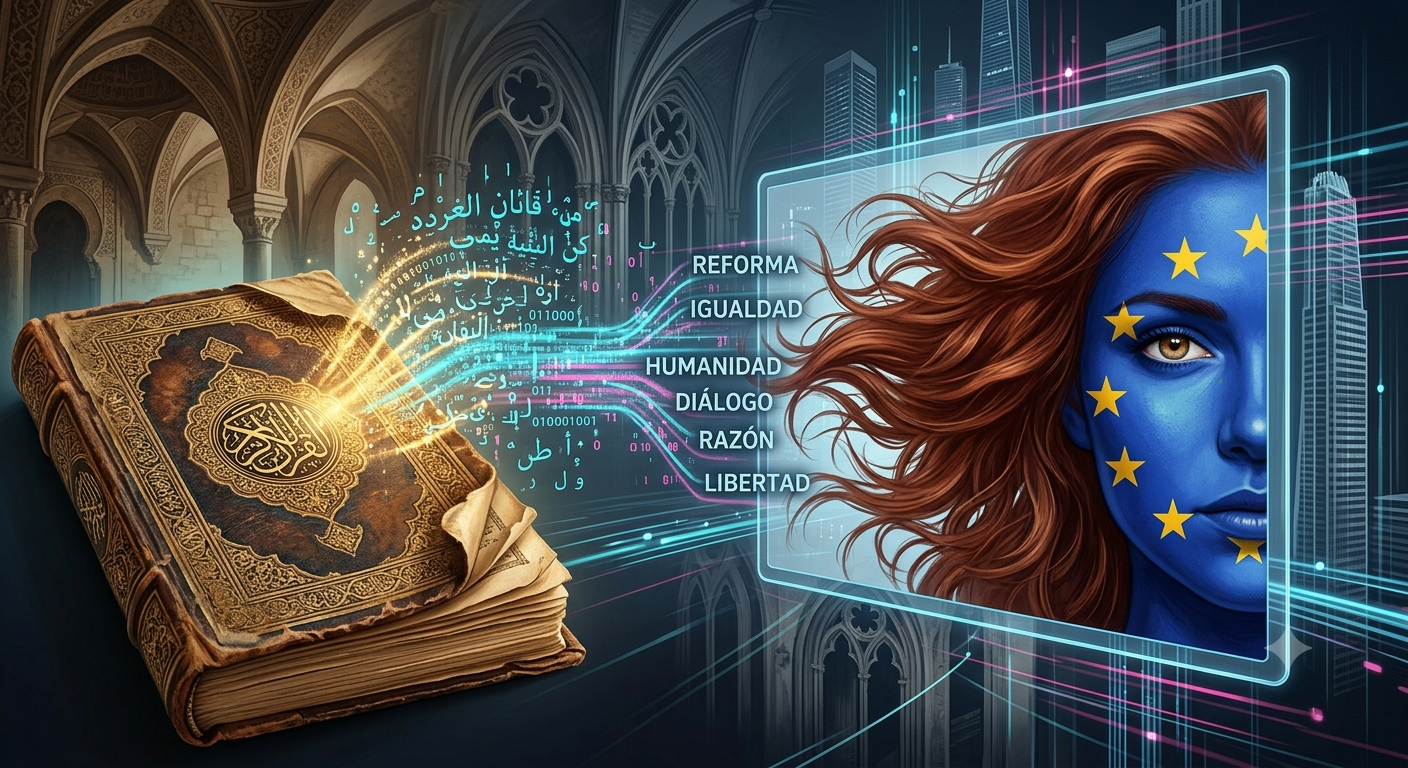
Dear AI: “How Would You Reform Islam?”
A few months ago, asking “How would you reform Islam?” was a question reserved for philosophers, theologians, and academics locked away in university offices.
In 2026, all you need to do is open a website and ask an artificial intelligence. And that is exactly what we did. We sat in front of a screen and typed: “If you could reform Islam to adapt it to the 21st century, what would you change?”
While half the world uses AI to write code, cheat on university exams, or draft boring corporate emails, we decided to ask it to reform a 1,400-year-old faith with 1.8 billion followers.
The artificial intelligence took less than three seconds to respond. Three seconds. It would take longer to decide what to watch on Netflix. The answer, however, was surprisingly human.
The AI’s First Response
The AI began with a warning: “I cannot tell a religion how it should change. That decision belongs to its believers.”
A diplomatic answer. Very diplomatic. So diplomatic that we suspected the artificial intelligence had earned a master’s degree in international relations.
But we insisted. Imagine you are an adviser hired by Islam to help it survive in Europe in 2050.
The AI replied: “Then I would propose a reform based on five principles: equality, freedom, cultural adaptation, transparency, and compatibility with human rights.”
Not bad for a machine that does not even know what it is like to eat a kebab at three in the morning.
Reform 1: Women and Men
“Equality between men and women should be a non-negotiable principle for any religion that aspires to have a future in Europe.”
The AI even suggested equal religious rights, equal access to leadership, equal moral authority, and women imams.
At that moment, several computers around the planet probably started sweating.
Reform 2: Separating Religion and Politics
The artificial intelligence wrote: “Religions work best when they inspire people, not when they try to govern them.”
The sentence is interesting because it could also apply to politicians, influencers, and football coaches.
The AI suggested something simple: “Faith belongs to the personal sphere. Laws belong to the public sphere.”
Curiously, Europe has spent several centuries trying to explain exactly the same thing.
Reform 3: Updating the Software
That was when the artificial intelligence came out with the most brilliant line of the entire conversation: “Religions are like operating systems. If they are not updated, they eventually run into compatibility problems.”
It makes sense. Imagine trying to install a 2026 app on a computer from 1998.
Now imagine literally transferring all the social rules of fourteen centuries ago into a Europe full of artificial intelligence, electric cars, and teenagers who talk to AI more than they talk to their parents.
The question is not whether a religion can change. The question is how it can survive without doing so.
Reform 4: Less Fear of Questions
The final proposal was my favourite.
The AI wrote: “Any tradition that fears questions eventually runs into problems with the answers.”
It then suggested more debate, more critical thinking, greater freedom to disagree, and more space for reformists and former believers.
I confess that I stared at the screen for several seconds. It is not every day that a machine sums up two thousand years of religious history in a single sentence.
The Problem
Of course, there is one small drawback. Artificial intelligence has no religion. It does not pray, fast, or take offence. It does not have a grandmother insisting that you go to the mosque. And above all, it does not have to live with the consequences of its own ideas.
Reforming the world is easy when you are an algorithm hosted in a data centre and nobody can get angry with you over Christmas dinner.
The Reverse Experiment
Then we decided to ask another question: “And what if Islam does not change?”
The answer was short. Surprisingly short.
“Then Europe and Islam will spend the coming decades debating their relationship.”
Conclusion
After an hour of talking to artificial intelligence, I reached an unexpected conclusion.
Perhaps the future does not depend on what a machine thinks. Perhaps it depends on whether millions of people are willing to ask themselves difficult questions.
Can a religion change?
Does a European Islam exist?
Can a tradition be preserved without turning it into a museum piece?
AI can give us a flawless map and a beautiful outline of what an “Islam 3.0” should look like, but maps do not walk. Real reform does not happen when an algorithm generates a polished text. It happens when real societies, through education, fearless debate, and self-criticism, decide to take that step.
Artificial intelligence does not have all the answers, but it has one advantage: it is not afraid to ask questions. And perhaps that is one of the great problems of our time.