
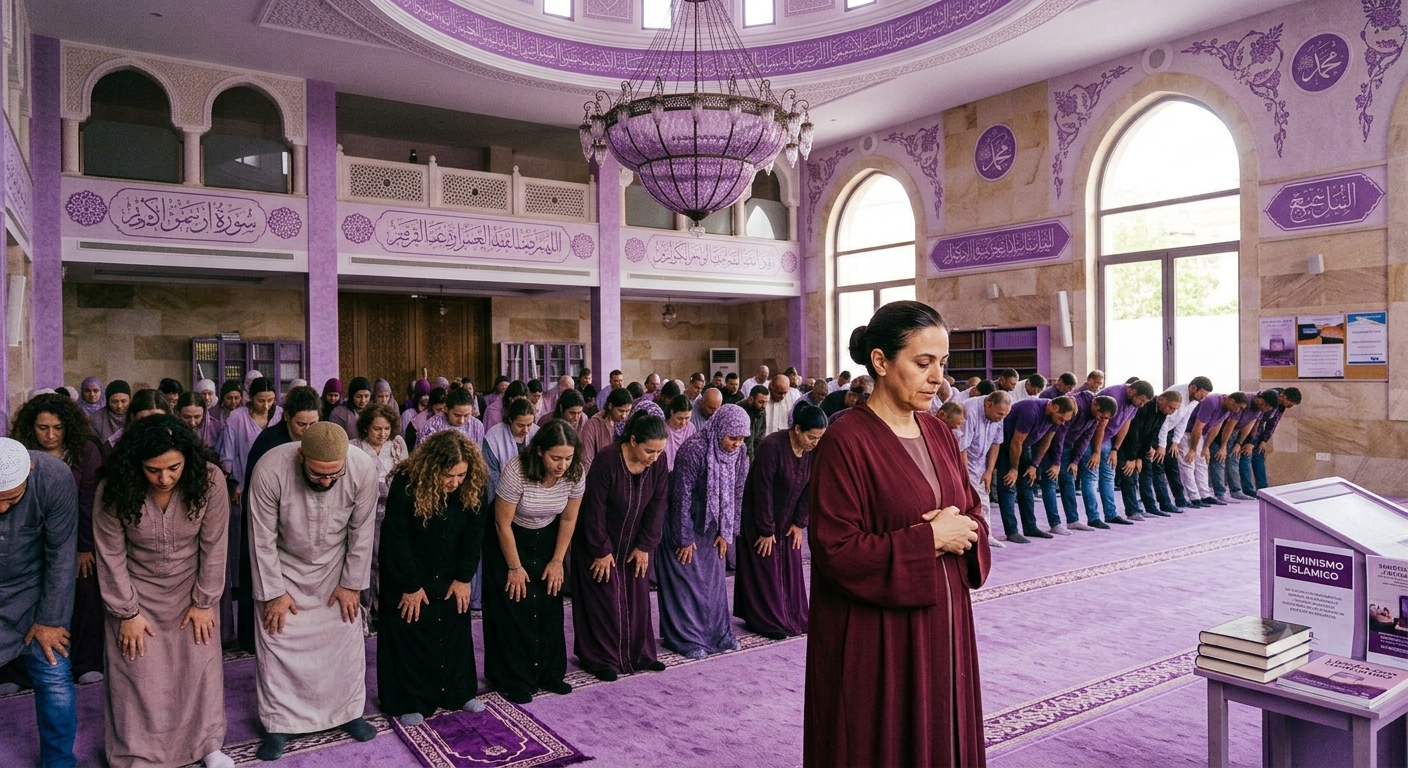
Imagining the Mosque of the Future
For centuries, most religions have been interpreted primarily by men. Not because women had no ideas, but because they rarely had access to religious power, institutions or the spaces where decisions were made.
Let us imagine for a moment what feminist Islam in action might look like: an updated version, free from bearded men deciding what women can do with their lives, their bodies and their choices.
Islam has been no exception, but in recent years an increasingly visible question has emerged: Can a feminist Islam exist?
For some, the answer is an unequivocal yes. For others, it is an impossible contradiction, and that is precisely what makes the debate so interesting.
First: What Does “Feminist Islam” Mean?
It does not necessarily mean copying Western feminism, nor does it mean abandoning religion.
The basic idea is different: to reread Islamic sources from a perspective that upholds equal rights and opportunities for men and women.
Its supporters argue that many present-day inequalities stem less from Islam itself than from historical interpretations developed in deeply patriarchal societies.
Put simply: “We do not want to change the faith; we want to reconsider the lenses through which it has been read for centuries.”
The Big, Uncomfortable Question
Imagine an extraterrestrial landing on Earth.
She visits a mosque and observes who leads, who makes decisions and who interprets the rules.
Then she asks: Are women half of the community? Yes.
So why do they not occupy half of the leadership positions? An uncomfortable silence follows.
The Mosque of 2050
Imagine a European mosque twenty-five years from now. Not just any mosque, but one inspired by the ideas of feminist Islam. What would we find?
Women in Leadership
Today, many women actively participate in Muslim communities. They organise activities, promote social projects and educate children.
However, they often have little representation in decision-making bodies. Feminist Islam would ask: Why?
If a community is made up of men and women, should that not be reflected in its leadership?
Women Imams
This is where one of the great theological earthquakes begins.
The idea that a woman’s voice or presence is a “distraction” is over. The real distraction has been ignoring the talent and leadership of half the population for more than a millennium.
Some Muslim women argue that women should be able to lead prayers and perform religious leadership roles; others disagree. The debate already exists and will probably continue to grow.
The Mystery of the Front Row
In many mosques, men occupy the main prayer area, while women usually pray behind them or in separate sections.
Those advocating change ask: Is this a permanent religious obligation, or a historical custom linked to other eras?
The answers vary according to religious tradition and country, but the question is now on the table.
The Male Club of Religious Interpreters
For centuries, most religious jurists were men, not because women were less intelligent, but simply because they had less access to formal education. This had consequences.
Many rules were examined from a single perspective. Feminist Islam proposes something quite revolutionary: bringing women’s voices into religious interpretation on a much larger scale.
Because if only half of humanity writes the rules, part of the story may be missing.
Marriage: Version 2.0
Feminist Islam also questions certain traditional aspects of marriage, divorce, inheritance and family authority.
Its supporters argue that modern societies require more egalitarian reinterpretations. Critics respond that certain restrictions are an essential part of the tradition.
And so one of the most intense debates in the contemporary Muslim world continues.
The Veil: From State Imposition to Personal Choice (For Real)
In feminist Islam, there is no room for morality police or community pressure. The guiding principle is consent and bodily autonomy:
Want to wear the hijab? Perfect. It is your choice and your spirituality.
Do not want to wear it? Equally perfect. Nobody has the right to judge your faith by your clothing.
Patriarchy on one side forces women to remove it; patriarchy on the other forces them to wear it. Feminist Islam would tell both to get lost: faith is not measured in metres of fabric, but in ethics and justice.
A Spirituality That Celebrates Pleasure and Freedom
For a long time, religion has been used to instil guilt, control female sexuality and reduce women’s role to that of a self-sacrificing mother and wife.
Feminist Islam recovers the historical tradition that understands spirituality as a space for well-being, freedom and personal fulfilment.
Women cease to be “objects of guardianship” and become full political and spiritual subjects, with the right to make decisions about their bodies, careers, sexuality and future without asking anyone for forgiveness.
The Quiet Revolution of Young Muslim Women
Perhaps the most important change is not happening in universities or mosques. It is happening on mobile phones. Millions of young Muslim women now have access to books, lectures, debates and social media.
For the first time in history, they can compare multiple interpretations without relying exclusively on local authority. The internet has turned many believers into amateur researchers, and that changes the rules of the game.
What Advantages Could It Bring?
Supporters of feminist Islam believe it could facilitate integration into democratic societies, reduce inequalities and enrich intellectual debate within Islam.
And What About the Problems?
Not everything would be an advantage. There are also important criticisms.
Traditional resistance: Many believers consider some proposals excessive reinterpretations of religious sources. They fear that continuity with tradition could be lost.
Internal polarisation: Discussions about gender often generate deep divisions, and religious communities are no exception.
European Feminist Islam
Europe offers a particular setting. Here, religious freedom, legal equality, universal education, freedom of expression and cultural diversity coexist.
This context raises new questions and forces many religious communities to reflect on them. Islam is not the only one.
Conclusion: The Mosque Where Women Ask Questions
Feminist Islam is neither a passing trend imported from abroad nor some strange invention. It is the logical consequence of applying the principle of justice that the faith itself proclaims.
Demanding equality within Islam means taking the remote control away from hard-line factions and reminding them of an uncomfortable truth: faith belongs to those who practise it freely, not to those who use it to control others.
Perhaps feminist Islam will not create a single version of Islam. It may create something more interesting:
A space where questions that men have asked for centuries can also be raised, answered and interpreted by women.
And when a community embraces new voices, new experiences and new perspectives, something unexpected tends to happen.
The debates do not disappear. There are more of them. But more ideas emerge, too. And ideas, for better or worse, are often the first step towards any historical change.
The great unknown is not whether feminist Islam will transform Islam. The real question is how much Islam will change when millions of women participate fully in the conversation.