
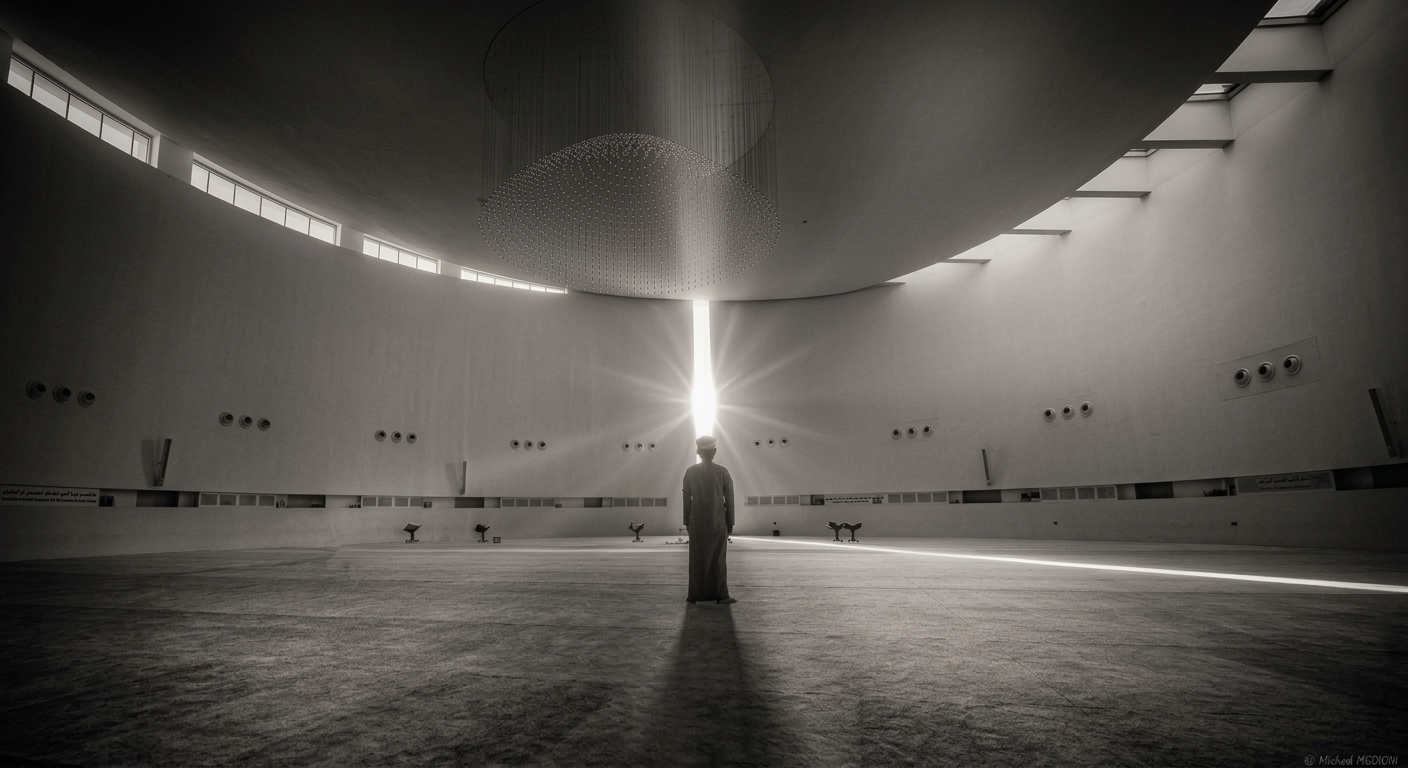
The Day Islam Disappeared: A Rather Uncomfortable Thought Experiment
We are not talking about a war. We are not talking about a ban. Nor are we talking about all Muslims converting to Christianity, Judaism, Buddhism, or atheism.
Something impossible simply happens: Islam disappears.
All religious texts associated with Islam cease to have religious significance. People who were Muslim yesterday stop believing in Islam. Mosques lose their religious function. Islamic organisations cease to exist as religious organisations.
And now comes the interesting question: What would happen to the world? Welcome to the most politically incorrect thought experiment imaginable.
08:00 — The World Wakes Up, and Nobody Quite Knows What Has Happened
In Casablanca, Jakarta, Cairo, Istanbul, London, Paris, and Barcelona, millions of people wake up to find that something has changed.
They no longer believe in Islam. They are not angry or sad. They simply… no longer believe.
Some have breakfast, others go to work, and others check their phones. Meanwhile, some face a rather awkward meeting: What do we do with the mosque? The problem is that it is now just a building. Nothing more.
First Consequence: A Religion Disappears… but the People Do Not
Here lies the first trap of this experiment. Islam disappears, but human beings do not. Approximately 2 billion people would have to rebuild part of their identity.
And that could be far more complicated than it seems, because a religion is not simply a list of beliefs.
It also provides identity, community, rituals, calendars, marriages, funerals, festivals, institutions, associations, schools, businesses, and family relationships.
Eliminating religion does not automatically eliminate all these things. It means having to decide what to do with everything we have built around it.
Second Consequence: Mosques Would Face a Monumental Real Estate Problem
Imagine the first major property market in history triggered by the disappearance of a religion. Thousands upon thousands of mosques would lose their religious function, and someone would have to decide what to do with them.
Third Consequence: The Halal Industry Takes a Deadly Blow
The disappearance of Islam would not only affect religion; it would also affect an enormous economic industry.
The State of the Global Islamic Economy 2025/26 report estimates that Muslim consumption across six sectors of the real economy — food, pharmaceuticals, cosmetics, modest fashion, travel, and media and entertainment — reached approximately $2.60 trillion in 2024.
That means our experiment has just pressed the red button on a gigantic economy.
The following would disappear or have to transform: halal certifications, halal food products, halal cosmetics, Muslim tourism, hotels targeting the Muslim market, certain Islamic financial products, fashion specifically associated with religious rules, specialist media, religious schools, and specialist publishers.
Not everything would necessarily disappear, but it would have to change its name, audience, or business model.
A halal restaurant could simply become a restaurant. A “Muslim-friendly” hotel could become an ordinary hotel. And a company that certified hamburgers as halal might have to find a new reason to exist.
Fourth Consequence: Trillions of Dollars Look for a New Home
The disappearance of Islam would not magically destroy all that money. The money would still exist; what would disappear are certain reasons for spending or investing it.
Companies would have to reinvent themselves, investors would look for new markets, banks specialising in Islamic finance would have to adapt, and financial products specifically designed to comply with Sharia principles would lose their raison d’être.
According to DinarStandard, Islamic finance assets reached approximately $5.99 trillion in 2024, and the sector continues to grow.
In our experiment, part of this enormous ecosystem would have to transform. The capital would not necessarily disappear; the religious rationale that organised it would. And that would trigger a massive economic restructuring.
Fifth Consequence: The Global Calendar Changes
Goodbye Ramadan, goodbye Eid al-Fitr, goodbye Eid al-Adha. Millions of people would stop organising their lives around these occasions.
Families would no longer arrange certain gatherings, and cities would stop preparing for particular celebrations.
And a question would emerge: What do we do with all those dates now?
New holidays would probably appear, because human beings have a strange fondness for inventing reasons to get together, eat too much, and congratulate someone.
Sixth Consequence: Some Countries Would Face an Identity Crisis
Some countries have an explicit reference to Islam in their official names. For example, historical and official designations include names such as the Islamic Republic of Iran and the Islamic Republic of Pakistan.
If Islam disappeared, we would have a minor paperwork problem. Would those countries keep their names?
Constitutions, symbols, institutions, and official designations would probably have to be reviewed.
Seventh Consequence: Legislation Would Have to Be Rewritten
This would be one of the most profound changes.
In some Muslim-majority countries, religion has a direct relationship with the state, family law, or certain institutions.
If Islam suddenly disappeared, decisions would have to be made about what happens to religious laws, religious courts, certain family codes, religious institutions, and religious education.
It would not simply be a matter of saying, “We remove Islam and carry on with our lives.”
It would be a gigantic legal undertaking, probably one of the largest simultaneous constitutional reforms in history.
Eighth Consequence: Would Wars Disappear?
It would be very easy to write: “Without Islam, wars would come to an end.”
But that would be far too simplistic. Wars do not have a single cause. Therefore, eliminating Islam would not automatically eliminate war, although one specific source of political mobilisation, identity, and religious legitimisation would disappear.
Jihadist groups, for example, would lose precisely the ideological and religious framework they use. Al-Qaeda and ISIS could not exist as we know them. That alone would represent a huge change.
But other forms of extremism would probably fill some of the vacuum, because removing an ideology does not automatically eliminate the human need to find enemies.
Ninth Consequence: Some Conflicts Would Lose Their Religious Dimension
There are conflicts in which religion plays an important role. In our experiment, that dimension would disappear, but territorial, national, and political disputes would not necessarily vanish.
Israel and Palestine would not magically turn into Switzerland. Territorial, national, historical, and political issues would remain.
The disappearance of Islam could profoundly change certain positions, actors, and narratives, but it would not instantly erase decades of history.
Tenth Consequence: Millions of People Would Face an Identity Crisis
Imagine someone who has built their identity around Islam throughout their entire life: their family, marriage, values, celebrations, diet, and worldview. Suddenly, all of that disappears.
For some, it would be a liberation. For others, an emptiness. For still others, a profound personal crisis.
Because removing a belief does not automatically provide a new philosophy of life.
Eleventh Consequence: A Huge Replacement Market Would Emerge
Millions of souls adrift — and a race among the rivals.
If a collective identity shared by 2 billion people disappeared, they would not be immune to the marketplace of the soul. Other alternatives would emerge: humanism, Christianity, Buddhism, alternative forms of spirituality, and cultural movements.
Twelfth Consequence: Europe Would Have to Rethink Many Debates
For years, Europe has been debating issues related to headscarves, mosques, religious symbols, halal food, radicalisation, and Islamophobia. In our hypothetical world, many of these debates would disappear, but others would emerge.
Because the fundamental question would remain: How do we organise a democratic society when people have different values, beliefs, and identities? That question would not disappear with Islam.
Thirteenth Consequence: The World Would Not Automatically Become Paradise
Here lies the moral of the story that probably appeals least to the extremes on either side.
If Islam disappeared tomorrow, a perfect world would not automatically emerge.
Dictatorships, wars, fanaticism, territorial conflicts, and human stupidity would not disappear. Human beings have a remarkably democratic capacity for creating problems.
So, What Would We Have Gained?
It would depend on where we looked. In some places, certain forms of religious authoritarianism might disappear.
Jihadist movements might disappear. Certain restrictions based on religious interpretations might disappear. Internal conflicts linked to particular doctrines might disappear.
But millions of communities, traditions, cultural works, charitable institutions, family ties, and forms of identity would disappear as well. For millions of people, that could represent an enormous loss.
Because religion can simultaneously be a belief, a culture, a community, an identity, and a source of hope.
The Last Day of the Experiment
At 23:59, the experiment ends. Islam returns, mosques fill with worshippers again, halal returns, Ramadan returns, and the debates return.
But one uncomfortable question remains. For a few hours, we have been able to observe which things were genuinely connected to a religion and which were connected instead to power, money, culture, or politics.
And perhaps that is the purpose of the experiment. Not to prove that the world would be better without Islam, nor to prove that it would be worse, but to force us to examine what happens when we remove one of the major building blocks of contemporary civilisation and ask: What remains?
Our thought experiment should not end with the question, “Would a world without Islam be better?”
The more interesting question is this: What part of modern society genuinely depends on religion, and what part could exist perfectly well without it?
Because perhaps Europe’s future does not lie in eliminating religions.
Perhaps it lies in something far more difficult: ensuring that no religion has to disappear for a liberal democracy to function.
The Final Diagnosis
This thought experiment reveals an uncomfortable truth: if you suddenly remove Islam from the planet, you do not get an Enlightenment utopia or the end of human tensions. What you get is a massive identity crisis, a brutal commercial upheaval, and confirmation that humanity is perfectly capable of finding new and absurd reasons to fight, with or without religion.