
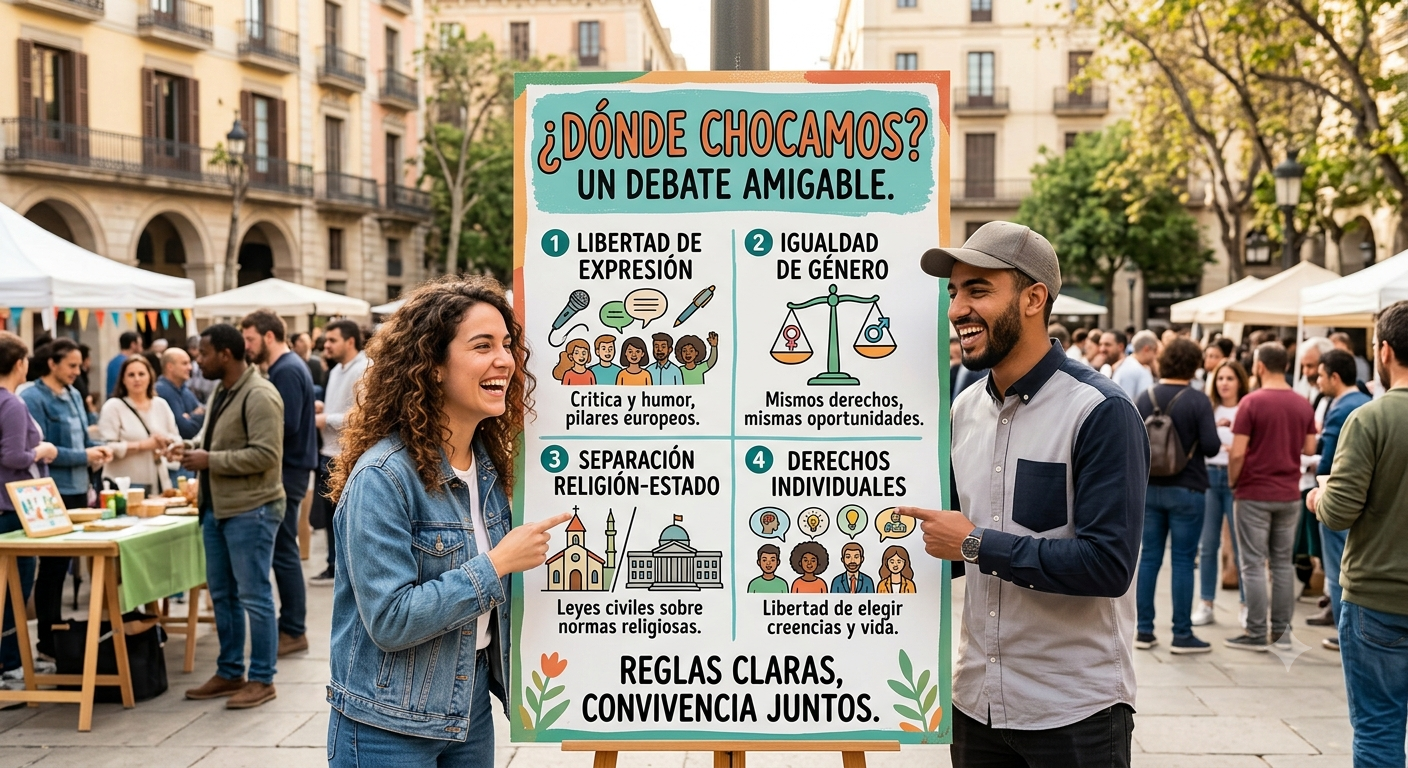
Compatible or in “Conflict Mode”? An Unfiltered Look at the Clashes Between Islam and European Values
Let’s be clear: the relationship between the values of modern Europe and certain traditional precepts of Islam is not always smooth sailing. Between European tolerance (which sometimes borders on naivety) and traditional religious dogmatism (which sometimes seems stuck in the Middle Ages), a cultural clash is almost inevitable.
The problem is not that Muslims live in Europe. That is part of present-day European reality. The real debate is something else: what happens when certain interpretations of Islam clash with values Europe considers fundamental, such as freedom of expression, equality between men and women, or the separation of religion and politics?
But where exactly are the points of friction? Without beating around the bush or getting bogged down in tedious theological jargon, let’s examine the main areas of conflict and, most importantly, what on earth can be done about them.
Let’s look at the main points of conflict.
1. Freedom of Expression: Can a Religion Be Criticised?
Europe has built much of its modern identity around a simple idea: all ideas can be discussed, criticised and even ridiculed. This includes Christianity, Judaism, communism, capitalism and Islam. This is where one of the biggest cultural clashes emerges.
In some Islamic traditions, criticising the Prophet Muhammad or joking about religious matters is considered a very serious offence. Many Europeans, by contrast, respond: “People deserve respect. Ideas have no right to be shielded from criticism.”
The Problem
When cartoons, books, films or comments provoke protests or threats, an uncomfortable question arises: should a religion enjoy special protection from criticism?
Those Who Advocate Greater Protection Say
Religious beliefs must be respected. Gratuitous provocation creates tension. Living together requires sensitivity.
Defenders of Freedom of Expression Respond
No idea should be untouchable. Criticism is part of democracy. What is forbidden from being criticised today may become censorship tomorrow.
Possible Solution
Firmly defend freedom of expression while fostering a culture of respectful debate rather than permanent provocation.
2. Equality Between Men and Women
Europe believes that men and women should have exactly the same rights. However, some traditional interpretations of Islam establish differences between the two.
For example: differences in inheritance rights, differences in legal testimony, distinct family roles and restrictions on women’s clothing.
The Problem
Many Europeans consider these differences incompatible with modern legal equality.
Defenders of Tradition Respond
These are religious rules. They are part of a cultural identity. They should not be judged by Western standards.
Critics Respond
Individual rights take precedence over traditions. Equality cannot be negotiable.
Possible Solution
Apply a simple rule: every private practice is legitimate as long as it fully respects fundamental rights and each woman’s individual freedom.
3. The Hijab, Niqab and Burqa: Clothing That Sparks More Debate Than a Football Match
Few garments have sparked as many arguments in Europe. For some, the hijab is a free expression of religious identity. For others, it symbolises inequality between men and women.
The Problem
How can we distinguish between a free choice and family or social pressure?
Supporters of the Veil Argue
It is a personal decision. It is part of religious freedom. Banning it would be discriminatory.
Critics Respond
In some cases, social pressure exists. The niqab makes identification more difficult. It may represent an unequal view of the sexes.
Possible Solution
Ensure that every decision is genuinely free, without pressure from family, society or the state.
4. Religion and Politics: Who Is Really in Charge?
Most European democracies clearly separate religion and the state. Laws are made by citizens through democratic institutions. However, some Islamist movements believe religious law should play a central role in public life.
The Problem
What happens when a religious rule contradicts a democratic law?
Supporters of Separation Say
Civil law must be the same for everyone. No religion can place itself above Parliament.
Advocates of a Greater Religious Presence Respond
Believers also have the right to influence politics.
Possible Solution
Allow all citizens to participate in politics while always upholding the supremacy of the Constitution and democratic laws.
5. Homosexuality
This is probably one of the biggest points of cultural conflict. Europe has spent decades moving towards greater acceptance of LGBTQ+ rights. However, many traditional interpretations of Islam regard homosexuality as a sin.
The Problem
How can people live together when one part of society considers something a right while another considers it a moral failing?
Possible Solution
The European response is usually clear: everyone has the right to hold religious beliefs. But nobody has the right to discriminate against or persecute others because of their sexual orientation.
6. Apostasy: The Right to Leave a Religion
In Europe, changing religion or having no religion at all is considered a personal decision. However, some traditional interpretations of Islam have historically regarded apostasy as a serious offence.
The Problem
Can someone leave Islam without facing family or social pressure?
Possible Solution
Protect religious freedom in both directions: the right to believe, the right not to believe, and the right to change religion.
7. Education and Values
European schools seek to teach common principles: equality, freedom, democracy and mutual respect.
Tensions sometimes arise when certain families believe that some educational content contradicts their religious beliefs.
The Problem
Who decides which values are taught?
Possible Solution
Public schools should teach shared constitutional principles while respecting religious diversity.
8. Foreign Funding of Mosques
This debate is not about religion itself, but about political influence. Many Europeans ask: who funds certain mosques, and for what purposes?
The Problem
When foreign governments fund religious institutions, they may also seek to export their political or religious outlooks.
Possible Solution
Greater financial transparency and more imam training in Europe.
Conclusion: The Conflict Is Not Between Muslims and Europeans
The problem is not that people believe in God or have different customs; food, art and diversity enrich any society. The real conflict arises when a belief system seeks to impose itself on the rules of a liberal democracy: individual rights, freedom of expression, gender equality and secular governance.
The real debate is not between people. It is between ideas.
The central question is straightforward: can Islam fully adapt to principles such as freedom of expression, legal equality between men and women, religious freedom and liberal democracy?
Some believe it can, pointing to examples of European Muslims who fully embrace these values. Others believe that certain traditional interpretations continue to generate significant tensions.
Perhaps Europe’s future will depend not on one side defeating the other, but on finding a balance in which any religion can be practised freely, provided it respects the same democratic rules that apply to everyone.
The solution is neither xenophobia nor the kind of well-meaning naivety that turns a blind eye. It lies in establishing clear ground rules: welcoming people while insisting on strict compliance with the values that guarantee everyone’s freedom.