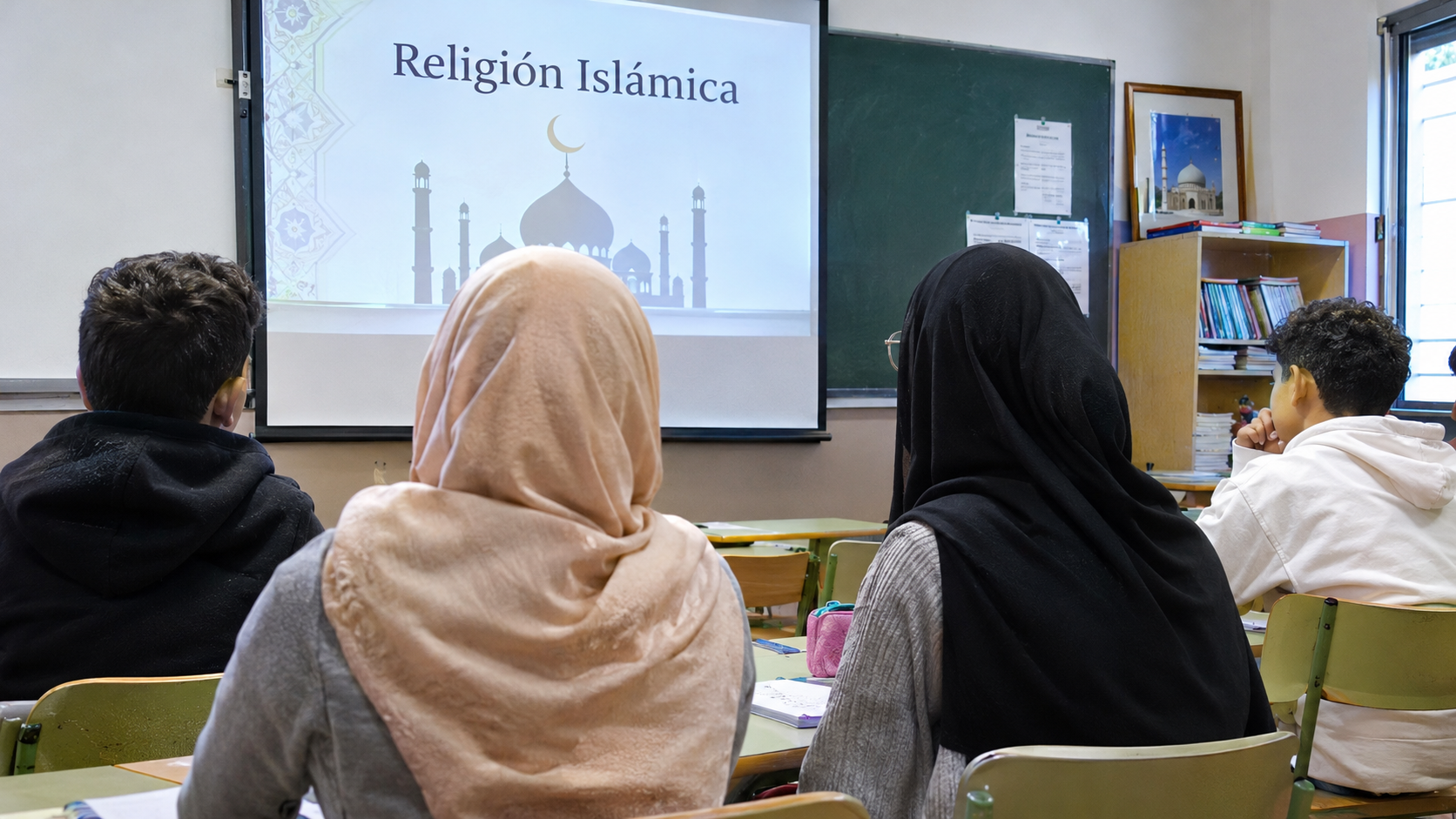
Who monitors the content of Islamic religious education in Spanish public schools?
The Islamic Commission of Spain plays a role in selecting teachers and defining religious content. Educational authorities are responsible for supervising teaching materials and classroom activities. But do we know how this oversight works in practice?
1. A question for which little public information is available
In Spain, Muslim pupils have the right to receive Islamic religious education in public schools, in accordance with the Constitution and the cooperation agreements signed between the State and religious denominations.
This right allows thousands of pupils to receive religious education during their school years.
However, an important question deserves closer examination: who decides what is taught in these classes, and who checks that the content and materials used comply with Spain’s constitutional and educational framework?
This is not a private activity taking place outside the education system. It is teaching that may take place within public schools, with teachers employed by educational authorities and under the general framework of the Spanish education system.
It is therefore necessary to understand how responsibilities are divided between religious organisations, schools and public authorities.
This investigation examines the legal framework, the role of the Islamic Commission of Spain (CIE), the mechanisms for supervising teaching materials and the powers of educational inspectors.
It also addresses a fundamental question: what information is available to establish whether the legal oversight mechanisms are actually being implemented?
The aim is not to question the right to receive religious education or the beliefs of Muslim families. It is to examine the guarantees of transparency, oversight and protection of pupils’ rights in religious education delivered within public schools.
2. The legal framework: what rights does the State recognise?
The starting point is found in two articles of the Spanish Constitution.
Article 16 recognises freedom of ideology, religion and worship, and establishes that no religion shall have the status of a state religion.
Article 27.3 recognises parents’ right to ensure that their children receive religious and moral education in accordance with their own convictions.
These principles must be interpreted together: the State guarantees religious freedom, while also preserving its neutrality and ensuring compliance with the rules governing the education system.
The specific framework for Muslim religious education is established by Law 26/1992 of 10 November, which approved the Cooperation Agreement between the Spanish State and the Islamic Commission of Spain.
Article 10 recognises Muslim pupils’ right to receive Islamic religious education in public and publicly funded private schools, at the educational levels covered by the agreement.
The same article establishes three key provisions:
- Teachers are appointed by the Muslim communities belonging to the Islamic Commission of Spain, with the approval of the federation to which they belong.
- Religious education content and textbooks are provided by the respective communities, with the approval of the Islamic Commission of Spain.
- Schools must provide suitable premises for these lessons without disrupting normal teaching activities.
The agreement therefore gives religious organisations a direct role in determining religious content and proposing teachers.
However, this does not mean that such teaching falls outside the education system or that religious organisations can operate independently of general legislation.
Religious freedom guarantees the right to receive confessional education, but it does not remove the educational and constitutional obligations that apply in public schools.
Sources:
- Spanish Constitution, Articles 16 and 27.
- Law 26/1992, Article 10.
3. The Islamic Commission of Spain: who determines religious content?
The Islamic Commission of Spain occupies a central position in the Islamic religious education system.
Article 10.3 of Law 26/1992 expressly establishes that religious education content and textbooks are provided by the respective Muslim communities, with the approval of the Islamic Commission of Spain.
This means that the definition of religious content does not fall directly to the Ministry of Education or the regional educational authorities.
Responsibility for determining the religious orientation of the teaching lies with the religious organisations recognised under the cooperation agreement.
The Islamic Commission also participates in the organisation of teachers and the coordination of this form of education.
On its institutional website, the CIE states that it has a Technical Education Committee which liaises with requesting schools, manages a pool of teachers and participates in teacher appointment proposals.
It also states that it monitors existing employment agreements with certain educational authorities.
Furthermore, the organisation reports that it monitors certain general school textbooks when they address issues relating to Islam or Muslims.
This information shows that the CIE carries out internal coordination and oversight functions.
However, two different types of responsibility must be distinguished:
Religious oversight: carried out by religious organisations within the framework established by the cooperation agreement.
Educational and legal oversight: the responsibility of public authorities, which must ensure that activities carried out in schools comply with education legislation and fundamental rights.
These are different responsibilities and must not be confused.
4. The official curriculum: what is taught in classrooms?
A key document for understanding the intended content is the Resolution of 16 September 2022, published in Spain’s Official State Gazette on 22 September 2022.
This resolution publishes the Islamic religious education curricula for Early Childhood Education, Primary Education, Compulsory Secondary Education and Baccalaureate.
The document was prepared on the basis of a proposal by the communities grouped within the Islamic Commission of Spain, with the Commission’s approval.
The resolution states that educational authorities are responsible for adopting the necessary measures to ensure that these curricula are delivered as published.
The prescribed content includes:
- The Qur’an and its historical contexts.
- Hadith and sources of religious interpretation.
- The life of the Prophet Muhammad.
- The principles and practices of Islam.
- Islamic jurisprudence.
- Different interpretations of religious texts.
- The history of Islam and its cultural contributions.
However, the curriculum also includes content relating to democratic society and Spain’s constitutional framework.
In Secondary Education, for example, it refers to:
- Rights and freedoms recognised in the Constitution.
- Freedom of religion and worship.
- Living together in a democratic and plural society.
- Identifying false information about Islam.
- The social consequences of certain individual and collective behaviours.
At Baccalaureate level, the curriculum includes references to Spain’s non-confessional State, religious freedom in Spain, the Universal Declaration of Human Rights and cooperation agreements between the State and the Islamic Commission of Spain.
It also includes content on equal opportunities, justice between women and men, non-sexist language and the rejection of hate speech.
These elements are significant because they show that the official curriculum is not limited to the transmission of religious knowledge.
It also addresses coexistence, fundamental rights and the constitutional environment.
Nevertheless, there is a fundamental distinction between the curriculum as published and what actually happens in classrooms.
The fact that content appears in the official curriculum does not prove that it is effectively taught in every school or delivered in the same way everywhere.
Verifying this would require examining teaching plans, textbooks and actual classroom practice.
Source: Resolution of 16 September 2022, Official State Gazette, BOE-A-2022-15418.
5. Textbooks: who provides them and who supervises them?
This is one of the most important aspects of the investigation.
Law 26/1992 assigns Muslim communities, with the approval of the Islamic Commission of Spain, responsibility for providing the content and textbooks used in Islamic religious education.
On its institutional website, the CIE states that it makes textbooks available to families and teachers, including the collection Discovering Islam (Descubrir el Islam).
The organisation claims that these materials are supervised by the Islamic Commission and that their content is adapted to the official curriculum.
It also announces the existence of a Technical Education Committee responsible for providing information and advice and monitoring the implementation of this form of education.
These are internal oversight mechanisms within the religious organisation.
However, another level of supervision is particularly important.
Additional Provision Four of Organic Law 2/2006 on Education establishes the general rules governing textbooks and curricular materials.
It provides that:
- Public schools’ teaching coordination bodies adopt the textbooks and materials used in different educational programmes, exercising their pedagogical autonomy.
- Materials do not require prior administrative authorisation.
- They must meet appropriate standards of scientific rigour for the pupils’ age and comply with the relevant curriculum.
- They must respect constitutional principles, values, freedoms, rights and duties.
- Supervision of textbooks and other curricular materials is the responsibility of educational authorities and forms part of the ordinary inspection process.
This regulation is particularly important.
The CIE’s responsibility for providing and approving religious content does not replace the educational powers of schools and public authorities.
There are therefore two forms of involvement: a religious one, relating to the definition of confessional content, and an educational one, relating to the adoption of materials and compliance with common rules.
It should also be noted that legislation does not require individual administrative authorisation of every textbook before it can be used.
Public supervision is integrated into the ordinary educational inspection process.
This raises an important question: how frequently are the materials used in these classes examined, and what criteria are applied to ensure that they comply with the official curriculum and constitutional framework?
The law establishes who is responsible, but information from educational authorities is needed to establish how these powers are exercised in practice.
Source: Organic Law 2/2006, Additional Provision Four.
6. Teachers: who proposes them and who employs them?
The selection of Islamic religious education teachers is governed by a specific legal framework.
Royal Decree 696/2007 regulates the employment relationship of religious education teachers working in public schools.
Article 3 establishes that teachers must:
- Hold the qualifications required for the relevant educational level.
- Be proposed by the religious denomination’s authority.
- Obtain a declaration of religious suitability or equivalent certification from the relevant religious denomination.
Religious suitability is therefore a requirement determined by the religious authority.
Meanwhile, Additional Provision Three of the Organic Law on Education establishes that religious education teachers who do not belong to the civil service teaching corps are employed under labour contracts by the competent educational authorities.
Access to teaching positions must respect objective assessment criteria and the principles of equality, merit, ability and transparency.
Responsibilities are therefore divided:
- The religious organisation participates in proposing the teacher and certifying religious suitability.
- The educational authority is responsible for employment and compliance with academic and labour requirements.
Religious suitability and professional teaching competence must be distinguished. They are separate requirements.
The former concerns religious authorisation to teach the subject. The latter concerns the academic and professional qualifications required by the education system.
Source: Royal Decree 696/2007.
7. Educational inspection: the main mechanism of public oversight
Educational inspection is one of the main public mechanisms for supervising teaching in schools.
Article 148 of the Organic Law on Education establishes that inspection is the responsibility of public authorities and must cover all elements and aspects of the education system.
Article 151 states that its functions include:
- Supervising, evaluating and monitoring the pedagogical and organisational operation of schools.
- Supervising teaching practice.
- Checking compliance with education legislation.
- Ensuring the application of the principles and values established by law.
- Advising the different members of the educational community.
Inspectors are also empowered to enter schools, examine academic and pedagogical documentation, participate in meetings and issue requirements when they identify non-compliance.
These powers are not limited to particular subjects.
Islamic religious education delivered in public schools therefore falls within the scope of educational inspection.
The 2026 update: Royal Decree 68/2026
Royal Decree 68/2026 of 4 February was published on 5 February 2026 and entered into force on 25 February.
It develops the functions and powers of educational inspectors.
Among other things, it establishes that inspectors may:
- Supervise and observe activities taking place in schools.
- Examine academic, pedagogical and administrative documentation.
- Request information and cooperation from educational officials.
- Issue reports.
- Require corrective action in cases of regulatory non-compliance.
- Carry out inspection activities within their legal powers.
The regulation also addresses inspectors’ professional training and qualifications, as well as the evaluation of their performance.
Inspection must respect fundamental rights, public freedoms, democratic values and the principle of non-discrimination.
This has an important consequence: public authorities must guarantee both respect for religious freedom and compliance with educational obligations.
Inspectors are not responsible for deciding which theological interpretation of Islam is correct.
Their role is to ensure that teaching takes place within the legal, educational and constitutional framework.
Source: Royal Decree 68/2026 of 4 February.
8. What happens if teaching materials or practices violate rights?
Religious freedom does not mean that any content or practice is exempt from the law.
Teaching in public schools must respect fundamental rights, education legislation and constitutional principles.
For example, the following may be subject to review:
- Materials containing discriminatory statements that violate the legal framework.
- Activities that infringe pupils’ rights.
- Content that does not comply with the applicable official curriculum.
- Teaching practices that contradict educational obligations.
- Conduct that may affect equality or pupils’ freedom of conscience.
When potential breaches are identified, educational inspectors may examine the facts, issue reports and require corrective measures within their powers.
Administrative or judicial liability may also arise where the circumstances justify it.
However, a distinction must be made between disagreement over a religious interpretation and an actual violation of rights or education legislation.
The State cannot impose an official religious doctrine or decide which theological interpretation is valid.
Its responsibility is to ensure that teaching delivered within the public education system complies with common rules.
This distinction is essential to preserving both religious freedom and State neutrality.
9. Child protection: obligations applying to all forms of education
In addition to education legislation, religious education teachers are subject to the general child-protection obligations applicable to staff working in educational institutions.
Organic Law 8/2021 on the comprehensive protection of children and adolescents against violence establishes obligations for schools.
These include:
- The existence of school coexistence plans.
- The implementation of protocols against bullying, abuse, mistreatment and other forms of violence.
- The appointment of a wellbeing and protection coordinator.
- Prevention, detection and response obligations when situations of violence arise.
These obligations apply regardless of the religious denomination involved.
They do not constitute a specific system for reviewing religious doctrine, but they form part of the safeguards that must protect children throughout their school activities.
Source: Organic Law 8/2021.
10. Division of responsibilities: who oversees each area?
Based on the legislation examined, responsibilities can be summarised as follows:
| Area | Responsible body |
|---|---|
| Definition of religious content | Muslim communities, with CIE approval |
| Provision of religious materials | Muslim communities, with CIE approval |
| Proposal of teachers | Relevant religious authority |
| Religious suitability certification | Relevant religious authority |
| Employment of public-school teachers | Educational authorities |
| Adoption of textbooks and materials at school level | School teaching coordination bodies |
| Supervision of curricular materials | Educational authorities |
| Inspection of teaching activities | Educational inspection services |
| Compliance with constitutional principles | Public authorities within their respective powers |
There is also a State High Inspectorate, whose responsibilities include checking compliance with basic national regulations and certain aspects of the education system in Spain’s autonomous communities.
This should not be confused with ordinary educational inspection, which supervises schools and their day-to-day activities.
The Spanish model therefore distributes responsibilities between religious authorities and public administrations.
Religious organisations do not have unlimited authority, nor does their internal supervision replace public educational oversight.
11. The main unanswered question: do we know how supervision works in practice?
This is one of the most relevant findings of the investigation.
The law identifies who has the authority to supervise content, teaching materials and classroom activities.
However, knowing the legal powers is not the same as knowing how they are exercised in practice.
In the institutional documentation reviewed for this investigation, we have not identified a consolidated national dataset that allows us to establish:
- How many inspections have specifically examined Islamic religious education materials.
- How many textbooks have been reviewed during these inspections.
- Which materials are actually used in different public schools.
- How many complaints families have submitted concerning classroom content.
- What outcomes those complaints have produced.
- Whether specific supervision protocols exist across the autonomous communities.
- What specific training inspectors receive to assess Islamic religious education materials.
The absence of consolidated public information does not prove that inspections or controls do not take place.
Nor does it allow us to claim that the materials used violate the law.
It means that, based on the documentation identified, we cannot determine with sufficient precision the frequency, intensity or results of specific inspection activities.
Spain has a decentralised education system. Regional educational authorities carry out inspection activities within their respective powers and may organise their own procedures.
Consequently, establishing how the system works in practice requires examining information from each regional administration.
The difference between having legal powers and being able to demonstrate how they are exercised is one of the main outstanding issues identified by this investigation.
12. Transparency: what information should public authorities provide?
From the perspective of transparency and accountability, educational authorities should publish regular information about the supervision of religious education delivered in public schools.
The following data would help assess how the system operates:
- Number of public schools offering Islamic religious education.
- Number of teachers employed and the academic qualifications required.
- List of textbooks and materials used at each educational level.
- Procedures followed by schools when adopting those materials.
- Number of inspection activities relating to this form of education.
- Number of complaints submitted by families and their outcomes.
- Criteria used to assess whether materials comply with the curriculum and constitutional framework.
- Existence of specific supervision and monitoring protocols.
- Reports or evaluations concerning the actual implementation of the official curriculum.
Publishing this information would not undermine religious freedom.
On the contrary, it would make it possible to better understand how a legally recognised right is implemented and how the obligations common to all teaching in public schools are guaranteed.
Transparency must, of course, be compatible with the protection of personal data and children’s rights.
13. Conclusions: oversight exists in law, but its implementation remains unclear
The documentary investigation supports six main conclusions.
First. Spain has a legal framework recognising Muslim pupils’ right to receive Islamic religious education in public schools, in accordance with Law 26/1992 and education legislation.
Second. The Islamic Commission of Spain and its member communities play a decisive role in defining religious content, providing materials and proposing teachers.
Third. The official Islamic religious education curriculum has been published in the Official State Gazette since 2022 and includes religious content as well as references to coexistence, democracy, constitutional rights and religious freedom.
Fourth. Educational authorities have legal powers to supervise textbooks, curricular materials and teaching activities. This supervision forms part of the ordinary educational inspection process.
Fifth. Teachers must meet the relevant academic requirements, be proposed and approved by the religious authority, and be employed by the competent educational authority.
Sixth. Although legal oversight mechanisms exist, the documentation reviewed does not allow us to determine with sufficient precision the frequency or outcomes of inspection activities specifically relating to Islamic religious education content.
The outstanding question is therefore not simply who is legally responsible for overseeing this form of education.
It is also how that oversight is exercised, which materials are used and what guarantees exist to ensure that pupils’ rights are effectively protected.
Religious freedom and public oversight are not incompatible principles. Both are part of the same constitutional framework.
14. The next investigation: from legislation to classrooms
This documentary investigation opens a second line of research.
The question we should now ask is specific:
Are educational authorities checking that the textbooks and materials used in Islamic religious education classes comply with the official curriculum and respect constitutional principles?
Reading legislation alone is not enough to answer this question.
It is necessary to request documentation from educational authorities, identify the materials used in schools and examine inspection procedures.
Conagora believes it is in the public interest to establish:
- Which textbooks are actually used in schools.
- Who has produced them and who has participated in their review.
- What procedures schools follow when adopting them.
- What checks educational inspectors carry out.
- What mechanisms families have to submit complaints.
- What information public authorities publish about inspection outcomes.
The aim is not to restrict the right to receive religious education or question the beliefs of Muslim families.
It is to establish how public authorities ensure that teaching delivered within public schools complies with the same educational and constitutional obligations that apply throughout the education system.
Transparency about what is taught in public schools is a matter of public interest. The exercise of a right must be accompanied by safeguards that can be verified.
DOCUMENTARY AND LEGAL SOURCES
Spanish legislation
- Spanish Constitution, Articles 16 and 27.
https://www.boe.es/buscar/act.php?id=BOE-A-1978-31229 - Law 26/1992 of 10 November, approving the Cooperation Agreement between the State and the Islamic Commission of Spain.
https://www.boe.es/buscar/act.php?id=BOE-A-1992-24855 - Organic Law 2/2006 of 3 May on Education. In particular, Additional Provisions Two, Three and Four, and Articles 148–153.
https://www.boe.es/buscar/act.php?id=BOE-A-2006-7899 - Royal Decree 696/2007 of 1 June, regulating the employment relationship of religious education teachers.
https://www.boe.es/eli/es/rd/2007/06/01/696 - Resolution of 16 September 2022, publishing the Islamic religious education curricula for Early Childhood Education, Primary Education, Compulsory Secondary Education and Baccalaureate. BOE-A-2022-15418.
https://www.boe.es/diario_boe/txt.php?id=BOE-A-2022-15418 - Royal Decree 68/2026 of 4 February, regulating educational inspection.
https://www.boe.es/buscar/act.php?id=BOE-A-2026-2622 - Organic Law 8/2021 on the comprehensive protection of children and adolescents against violence.
https://www.boe.es/buscar/act.php?id=BOE-A-2021-9347
Institutional sources
- Islamic Commission of Spain. Islamic Education.
https://comisionislamica.org/ciudadanos/eri/ - Islamic Commission of Spain. Education Committee.
https://comisionislamica.org/comisiones/comision-de-educacion/
Methodology and scope: Documentary research based on legislation published in Spain’s Official State Gazette and available institutional documentation. Conclusions concerning legal powers are distinguished from questions concerning their practical implementation. No direct inspection of schools or audit of classroom materials has been carried out. Outstanding questions are explicitly identified as areas for further research.
Conagora Think Tank | Independent Research