
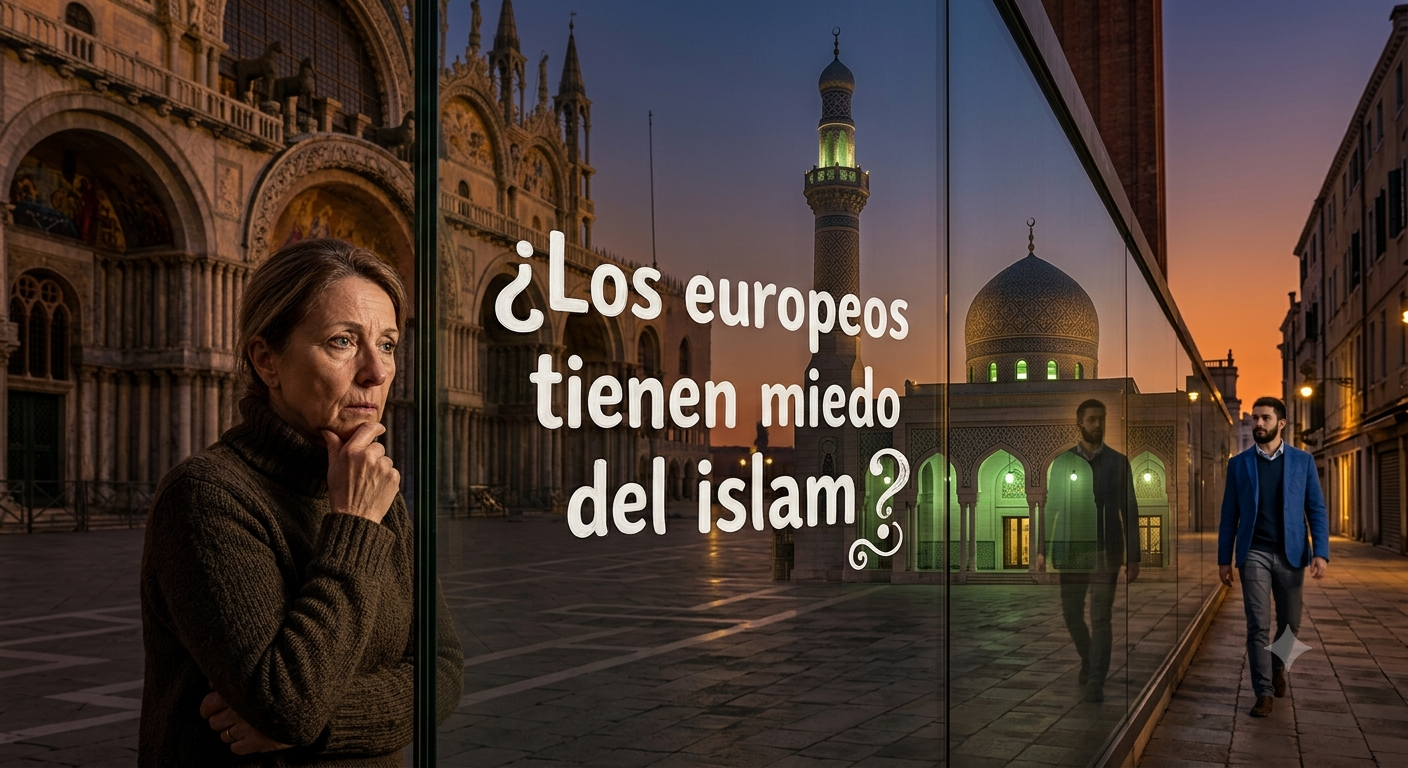
Europe’s Great Taboo: Are Europeans Afraid of Islam?
The Hot Potato Game
Try a little experiment.
The next time you are having dinner with friends, wait until the conversation falls silent and ask this question: “What do you think about Islam in Europe?” Or bring up a news story about the hijab, a neighborhood mosque, or Ramadan.
Now watch what happens. One person will immediately look at their phone; another will reply, “Oh, let’s talk about something else.”
Someone will say, “It’s a very complicated subject.” And there will always be an anonymous hero who whispers, “I don’t want to get cancelled.”
You can talk about politics, sex, money, the royal family, or even ask someone how much they earn a year. But mention Islam and suddenly the room takes on the tension of a suspense movie.
Why does this happen?
In Europe, we have developed a kind of “allergy to debate” about Islam. It is not that we have no opinions; it is that we are terrified of expressing them. Where does this fear come from, and which parts of it make sense and which are pure paranoia?
Fears That DO Have a Logical Basis (Justified Fear)
To be intellectually honest, we must acknowledge that some fears are reasonable and rooted in Europe’s recent historical and social experience.
A. The Fear of Losing Freedoms That Took Centuries to Win
The explanation: Europe fought bloody, long battles to curb the power of the Catholic Church and secure gender equality, LGBTQ+ rights, and freedom of expression, including the right to make fun of sacred things.
The logic behind the fear: When Islam is debated, many Europeans fear—with good reason—that the arrival of conservative religious dogmas in the public sphere could mean taking steps backward on these hard-won rights. It is not hatred of foreigners; it is an instinct to protect civil liberties.
B. Physical Fear (The Shadow of Self-Censorship)
The explanation: This is the rawest form of fear. From the attacks on the satirical magazine Charlie Hebdo in France to threats against teachers, writers, and filmmakers, there is a real fear that openly criticizing or making fun of certain aspects of Islam could end in physical violence.
The logic behind the fear: When criticizing an idea can cost you your life or force you to live under police protection, fear stops being a sociological theory and becomes a matter of survival. It is a tragically justified fear.
Fears That Make NO Sense (Unjustified Fear)
This is where self-criticism and humor come in to dismantle the ghosts people create for themselves.
A. Panic About a Demographic “Invasion” (The Armchair Conspiracy)
The famous “replacement” theory, or the idea that Europe will become a caliphate within ten years.
This completely ignores how sociology works. The children and grandchildren of Muslim immigrants born in Europe often go through the same processes of secularization as young Christians. They go to festivals, become obsessed with TikTok, stop going to the mosque just as locals stop going to church, and prefer consumerism to theocracy. Thinking that 1.8 billion people act like a unified hive mind with a master plan to conquer your town is simply something out of a cheap science-fiction movie.
B. Panic About “Offending People” (Walking on Eggshells)
The fear among the left or progressive groups of being labelled racist or Islamophobic if they criticize issues such as sexism or homophobia within Muslim communities.
It is a hilarious contradiction. People fiercely criticize whichever bishop happens to be homophobic—which is great—but look the other way when an imam says exactly the same thing across the street, supposedly out of “cultural respect.” Treating Muslims like fragile children who cannot be criticized is, at heart, a form of paternalistic racism. True respect means applying the same democratic standards to everyone.
Conclusion: The Danger of Staying Silent
When ordinary, intellectually honest citizens are afraid to discuss an issue, they leave the microphone open to extremists.
If moderate people stay silent because they are afraid of getting it wrong, the only ones left talking about Islam are xenophobes who want to expel everyone and fundamentalists who refuse to accept any criticism.
Overcoming the fear of debate—with courtesy, humor, and no hatred, but with absolute firmness in our democratic values—is not about turning against anyone. It is the only way to achieve genuine integration. Because a healthy society is not one that never argues, but one that knows how to argue without falling apart.
And if Europe wants to remain Europe, it will have to reclaim precisely that: the ability to ask questions and the ability to listen.
Above all, it must recover the ability to say: “I disagree with you, but we can still share a table, a coffee, and a conversation.”
Because, in the end, societies do not fall apart when difficult questions arise. They fall apart when people stop asking them.