
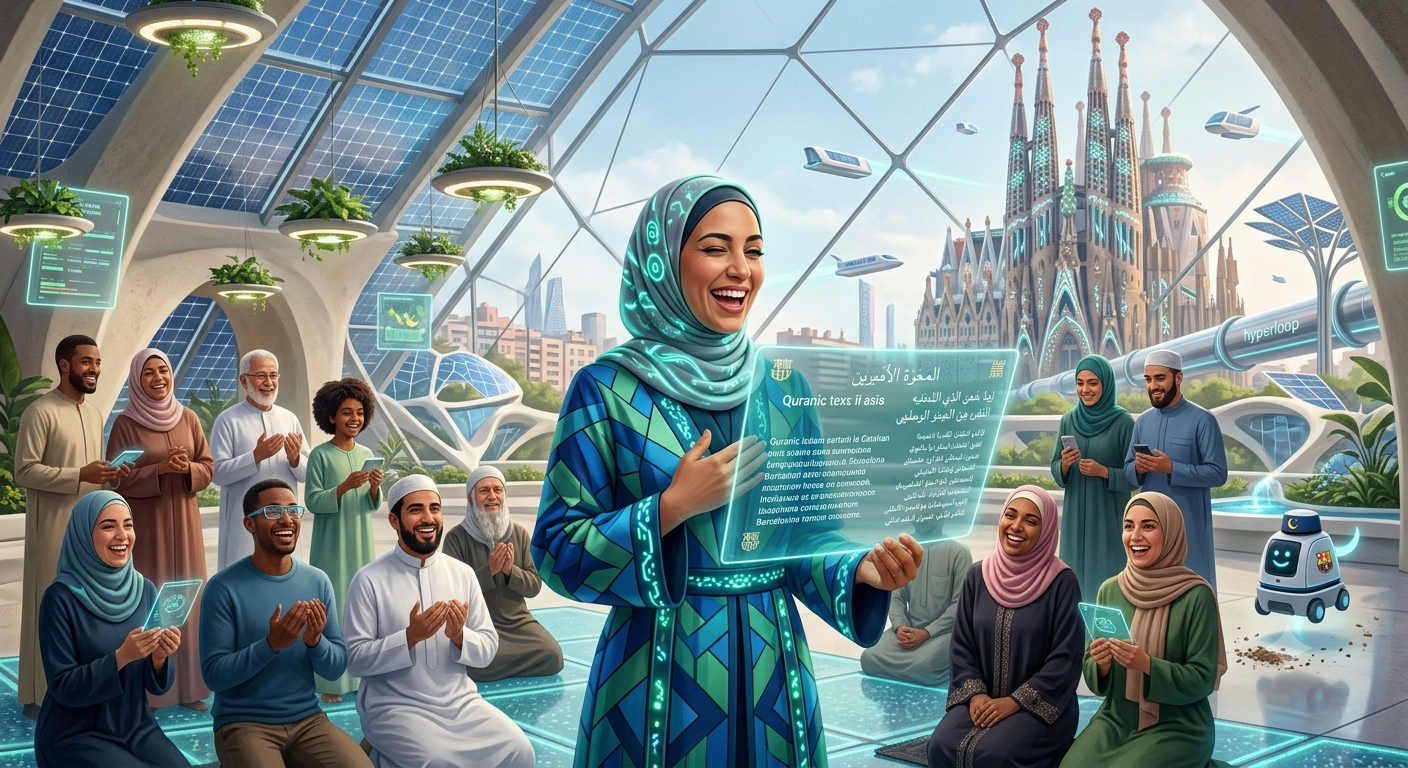
The Female Imam of Barcelona: The Feminist Revolution in Islam
The year is 2038. It is seven o’clock in the evening at a mosque in Barcelona.
Men and women enter through the same door. There are no curtains separating them. The sermon is delivered in Catalan and Spanish. On the wall, a sign reads: “Please turn off your mobile phones and remember that God understands every language.”
The person leading the prayer is called Amina García. She is 42 years old, was born in L’Hospitalet, studied Law and Theology, and is the first prominent female imam in Catalonia.
For some, this is a historic revolution. For others, it is a fantasy with Wi-Fi. And so begins one of the most fascinating debates of the twenty-first century.
A Question That Makes Half the Planet Uncomfortable
Let us ask a simple question: Why can’t a woman lead a mosque? The answer depends on whom you ask.
The more traditional sectors of Islam maintain that the role of imam has historically been held by men and that religious tradition is relatively clear on this matter.
Reformists respond: Very well, but there was also a time when women could not vote, study at university, or become judges. And so the debate turns into a genuine theological tennis match.
The Experiment Has Already Begun
Although many people are unaware of it, female imams already exist. Initiatives challenging centuries of tradition have emerged in various countries.
Inclusive Mosque Initiative in the United Kingdom promotes more inclusive spaces for prayer. Sherin Khankan founded a mosque in Denmark where women play a leading role. And Amina Wadud made history when she led a mixed-gender prayer, generating headlines, criticism, and probably more than a few arguments in thousands of family living rooms.
We are not talking about science fiction. We are talking about small laboratories of the future.
Those Who Say “Yes”
Supporters of female imams have some fairly straightforward arguments.
First Argument: Equality
If women can be:
-
Prime ministers
-
Defence ministers
-
Supreme Court judges
-
Astronauts
-
Company directors
Why shouldn’t they be able to lead a prayer?
It is a difficult question to answer in a Europe where equality between men and women is one of the fundamental pillars of society.
Second Argument: A European Islam
Many reformists believe that Islam in Europe will eventually evolve, not because anyone imposes change, but because religions change as societies change.
The question is: What will European Islam look like in 2126?
Perhaps it will include female imams, perhaps not, but the debate is already on the table.
Those Who Say “No”
Of course, there is considerable opposition.
Critics argue that Islam is not a democracy in which changes are decided by voting, that tradition carries considerable weight, that religion should not adapt to social fashions, and that Europe cannot rewrite fourteen centuries of religious history.
And they have an argument that deserves to be heard: “If a religion changes so much that it no longer resembles itself, is it still the same religion?”
The Silent Revolution
Imagine for a moment that Europe embraces this model.
The year is 2050. We find mosques with:
-
Sermons in Spanish, French, and German.
-
Men and women praying together.
-
Gender-balanced religious councils.
-
Male and female imams chosen by the community.
-
Debates about artificial intelligence and ethics.
-
Apps for booking a place during Ramadan.
The Domino Effect
If hundreds of female imams emerged across Europe, the impact would be enormous.
Social Impact
It would change how millions of Muslims in Europe and around the world perceive Islam. Many people who currently see religion as incompatible with equality would begin asking new questions.
Religious Impact
It would open up an enormous debate within the Muslim world. Some countries would view these mosques as an example to follow, while others would consider them a deviation. The internet, as always, would explode for several weeks.
Political Impact
European governments would face a delicate question: Should they support religious initiatives that are more compatible with European values?
Or, put another way: Can public policy be designed to promote a “European Islam”?
The Problem Nobody Mentions
There is one small complication. Most Muslims around the world would probably continue to defend more traditional models.
Europe represents a relatively small part of the global Muslim community. So we could find ourselves in a curious situation—the franchises of Islam:
-
European Islam.
-
Asian Islam.
-
African Islam.
-
Gulf Islam.
And a hundred years from now, some historian might write: “It all began when a woman from Barcelona decided to stand in front of the first row.”
A Utopia or an Inevitability?
Nobody knows. A hundred years ago, many people thought women would never become judges, mayors, or scientists.
Fifty years ago, the idea of same-sex marriage seemed impossible to much of the world.
History has a very annoying habit: it surprises us. Perhaps in a few decades, female imams will be commonplace, or perhaps they will remain an exception.
The Final Scene
Let us return to our Barcelona mosque in 2038.
The prayer has ended. A 75-year-old man approaches the female imam and says: “I never thought I would live to see this.”
She smiles. “Neither did I. I never thought I would have to explain to my mother that my job is to lead a mosque.”
Because, in the end, all revolutions begin in the same way. First, they seem impossible. Then, they cause outrage. Later, they become normal.
And one day, someone asks in surprise: “Was there really a time when this was forbidden?”
Perhaps that will be the great debate about Islam in Europe over the next century. And perhaps, a hundred years from now, our grandchildren will laugh about all this while checking their smart glasses to see what time the next sermon by the female imam is due to begin.
Because the future has a strange habit: arriving when we least expect it.
The Future Is Written in the Present
The debate about female imams is not just about who stands at the front of the prayer carpet; it is about who has the authority to interpret religious texts and define the future of a community.
Will Europe become the birthplace of a spiritual reform led by women, or will this experiment remain a footnote in the history of urban avant-garde movements?
The answer is being written today, through sermons, theological debates, and a younger generation that is no longer willing to ask permission to claim its place.