
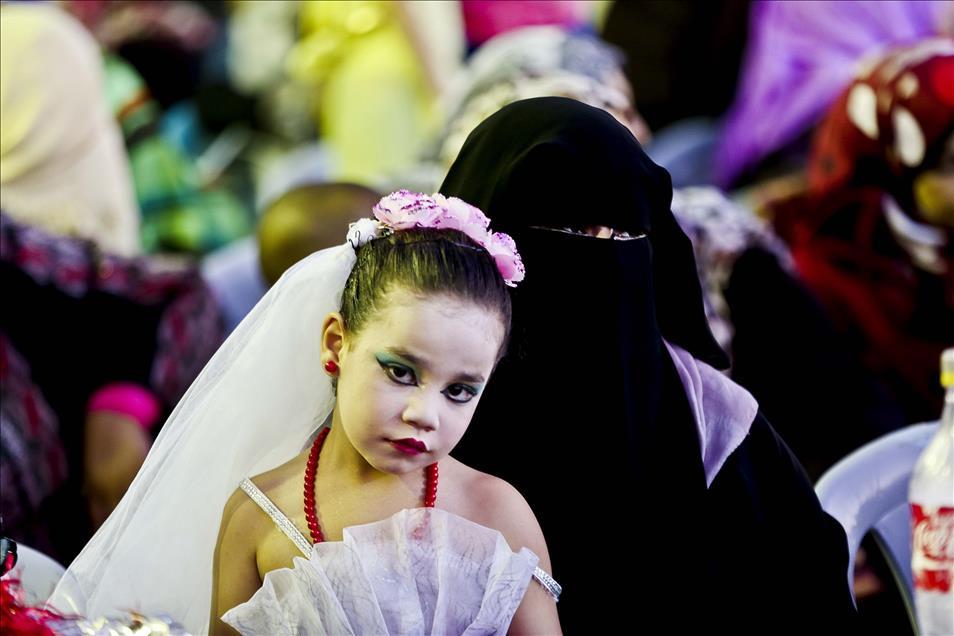
A Tradition That Survives Between Religion, Law and Inequality
There are questions Europe prefers to avoid.
One of them is this: What happens when a girl who should still be studying becomes a wife?
In some parts of the world, thousands of girls continue to enter into marriages before reaching the age of 18.
In many Muslim-majority countries, child marriage remains a significant reality.
And here an uncomfortable question arises: To what extent are religion, family traditions and certain interpretations of Islamic law involved?
To answer this question, we must avoid two mistakes.
The first is to say that child marriage is simply “an Islamic custom.”
The second is to pretend that Islam has never had any connection with the historical rules that allowed these marriages. The reality is considerably more complicated.
WHAT EXACTLY IS CHILD MARRIAGE?
The international definition is fairly straightforward.
Child marriage is any formal or informal marriage or union in which at least one of the people involved is under the age of 18. It does not matter whether there is a religious ceremony, a civil contract or simply a union recognised by the community.
According to the United Nations, child marriage is a violation of human rights and primarily affects girls.
Currently, around 650 million women and girls alive today were married before turning 18. Approximately one in five young women worldwide was married during childhood. (UNICEF DATA)
But these figures are global, not exclusively related to Muslim communities, and this distinction matters.
WHERE DOES THIS PRACTICE COME FROM?
Child marriage did not originate with Islam. It existed long before Muhammad. For centuries, many societies considered it normal for girls to marry at a very young age. In ancient societies, marriage had little to do with the modern idea of romantic love.
It was a family institution. It served to create alliances, protect property, organise inheritance, establish relationships between families and control women’s sexuality.
Puberty could be interpreted as a sign that a girl was ready for marriage. The problem is that this conception of childhood was very different from today’s. Modern childhood, based on compulsory education, legal protection and personal autonomy, is a relatively recent development.
WHAT DOES ISLAM HAVE TO DO WITH IT?
This is where the most delicate part begins.
Islam emerged in the seventh century in a society where early marriages already existed. Classical Islamic texts established rules governing marriage, but they did not set a universal minimum age equivalent to today’s 18-year threshold.
Over the centuries, different schools of Islamic jurisprudence developed their own interpretations of the capacity to enter into marriage.
One of the best-known debates concerns Aisha, Muhammad’s wife.
For centuries, the most widespread Islamic tradition has interpreted certain hadiths as indicating that Aisha was very young when the marriage took place. According to this interpretation, Aisha was six years old when the marriage contract was concluded and nine when the marriage was consummated.
However, some contemporary Muslim researchers and thinkers challenge this interpretation and argue that she was older.
Why is this debate important? Because certain traditional interpretations have historically been used to argue that marriage can take place before the age of 18.
But that does not mean Islam requires girls to marry. At the same time, however, it does not prohibit the practice outright, and that is a major problem.
The question is: Can a religious interpretation justify a practice today that violates a minor’s rights?
THE PROBLEM IS NOT JUST RELIGIOUS
In many countries where child marriage exists, we find a combination of factors: poverty, lack of education, gender inequality, family pressure, fear of sexual relationships outside marriage, control over female sexuality, local traditions and, in some cases, religious interpretations that can be used to legitimise certain practices.
It would therefore be too simplistic to say, “Islam is the problem.” But it would also be too simplistic to say, “Religion has nothing to do with it.”
In some places, there is indeed a connection between religion, legislation and child marriage, and that connection deserves to be examined.
THE MAP IS MUCH BIGGER THAN THE MIDDLE EAST
When we talk about child marriage in Muslim-majority countries, many people immediately think of the Middle East. But the phenomenon is much broader, occurring in parts of South Asia and Africa as well.
In the Arab region, for example, around 37 million women and girls have experienced being married during childhood, according to UNFPA.
The proportion across the Arab region has fallen over the past 25 years, from approximately one in three young women to one in five. However, progress has stalled in some places because of conflict, economic crises and other vulnerable circumstances.
The differences between countries are enormous. There is no single “Islamic world.” Some countries have raised the legal minimum age for marriage to 18, while others retain exceptions.
In some places, the law may allow a judge to authorise marriages below that age.
For example, UNICEF has documented how Morocco raised the legal minimum age to 18 but retained a judicial exception allowing minors to marry.
Jordan also has a legal minimum age of 18, with possibilities for judicial exceptions.
In Egypt, the legal minimum age is 18, although problems remain involving unregistered marriages.
This brings us to a fundamental point: It is not enough to look at the age written into the law. We must also examine what actually happens in practice.
THE LAW MAY SAY ONE THING, WHILE REALITY SAYS ANOTHER
This is one of the major problems. A state may establish that nobody can marry before the age of 18, but if a family arranges an unregistered religious union, the situation may fall outside the state’s control.
The girl may live as a wife and become pregnant, yet the marriage may not legally exist as a registered union. This creates a kind of double reality: the official law says one thing, while the community may operate according to different rules.
UNICEF has specifically highlighted the problem of unregistered marriages in some countries across the Middle East and North Africa.
And this is where one of the major shadows appears: when religious, family or community authority manages to escape the oversight of civil law.
WHAT HAPPENS TO A GIRL WHO GETS MARRIED?
Child marriage does not simply mean “getting married a little earlier.” The physical and psychological consequences of this practice can be devastating. It completely changes a girl’s life.
Physical consequences: A girl’s body may not be biologically ready for pregnancy. Complications during childbirth are among the leading causes of death among girls aged 15 to 19 worldwide, and childbirth can also result in serious injuries such as obstetric fistulas.
Educational and employment apartheid: A married girl may leave school immediately, leaving her trapped in a perpetual cycle of economic dependence, illiteracy and social exclusion.
Invisible violence: Girls who marry as children face higher rates of domestic violence, sexual abuse and mental health problems such as chronic depression and post-traumatic stress disorder.
And there is an even deeper issue: consent.
Can a 12-, 13- or 14-year-old girl make a completely free decision about who her husband will be and what the rest of her life will look like?
International law holds that consent to marriage must be free and full. A person who has not yet reached the maturity needed to understand the consequences of such an important decision can hardly exercise that consent on the same terms as an adult.
WHAT HAPPENS WHEN THIS REALITY REACHES EUROPE?
This is where a debate begins that Europe has not yet fully resolved. Immigration can also bring certain family customs from one country to another, and cases of forced marriage and child marriage do occur in Europe.
For years, the Council of Europe has warned that all European countries can be affected by forced marriages. These may take place within Europe, be arranged outside Europe for European citizens or residents, or be imposed before a person arrives on the continent. (Council of Europe Parliamentary Assembly)
And here we encounter a particularly complicated situation.
A girl may live in Europe, attend a European school and hold European citizenship, yet face intense family pressure to marry someone chosen by her family.
She may even be sent temporarily to her parents’ country of origin and return already married.
SPAIN IS NOT COMPLETELY UNAFFECTED EITHER
Spain does not have a child marriage problem comparable to that of the regions of the world where the practice is most widespread.
But it would be a mistake to assume that the phenomenon is impossible here. In 2024, Spain’s Ministry of the Interior recorded eight cases of human trafficking for the purpose of forced marriage, involving eight victims, six of whom were minors.
The victims had various nationalities: Bulgarian, Romanian, Spanish, Moroccan, Gambian and Afghan.
This matters because it demonstrates something important: forced marriage is neither exclusively a Muslim phenomenon nor exclusively a foreign one.
EUROPE’S MISTAKE: CONFUSING RESPECT WITH TOLERANCE
Here we reach one of the most important debates.
Europe must respect religious freedom, but religious freedom cannot become an exception that allows a minor’s rights to be violated.
A girl has rights of her own, and those rights do not disappear because her parents follow a particular religion.
This should be a red line. Neither religion, nor tradition, nor family honour can take precedence over a minor’s fundamental rights.
CONCLUSION: A RED LINE FOR EUROPE
Child marriage is not an exclusively Islamic problem. It is a human problem.
If Europe wants to build genuine integration, it must be able to discuss these issues without fear, neither demonising Islam nor concealing problems in the name of multiculturalism.
The position should be much simpler: a religion may have its own rules, and a family may have its own traditions.
But a girl has the right to grow up, study, decide her own future and freely choose her partner when she has reached the necessary age and maturity.
Because if Europe truly wants to defend human rights, there is one boundary no tradition should be allowed to cross: no tradition can turn a girl into an adult before her time.