
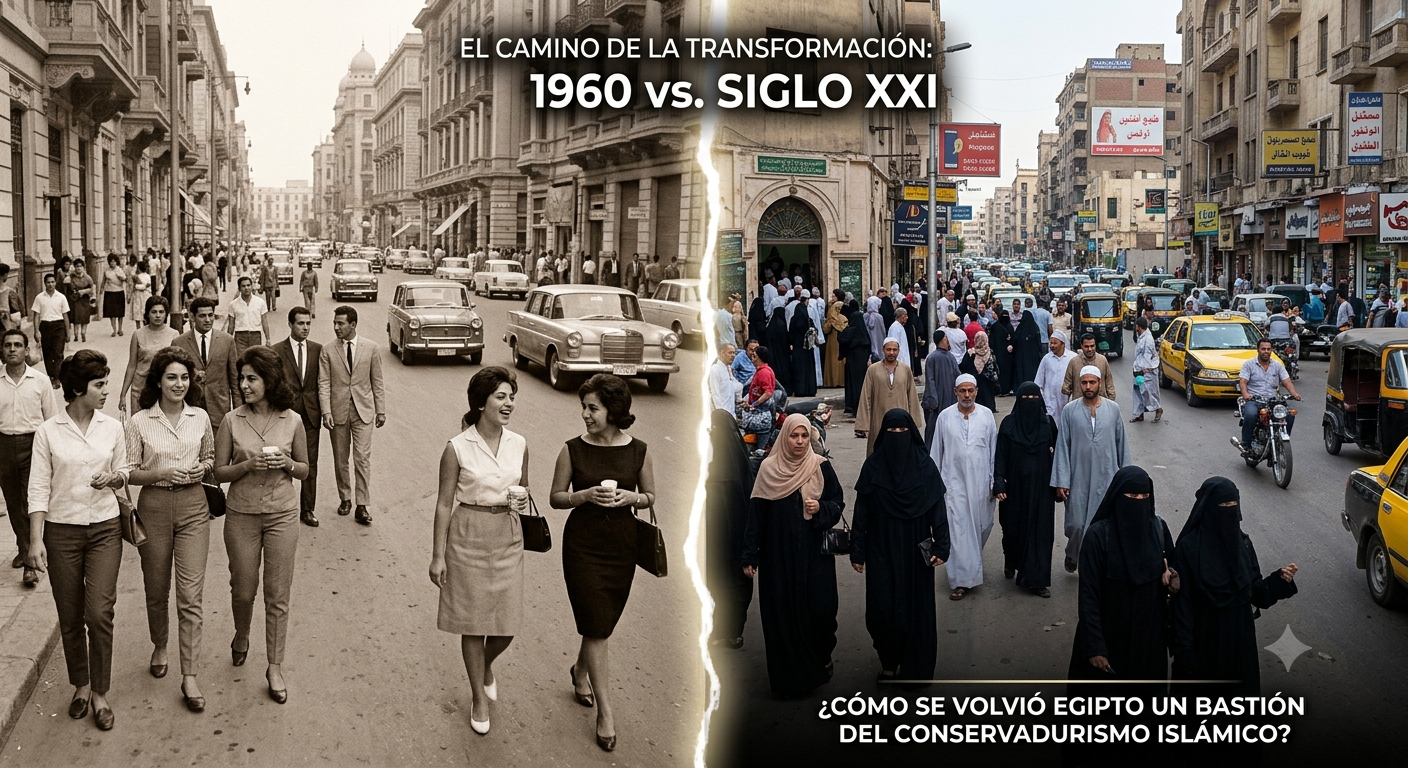
How Did Egypt Become Such a Conservative Country in Just 70 Years?
The gradual Islamisation of Egyptian society since the 1970s was not a change imposed overnight. It was a slow process that unfolded over several decades.
If someone could travel to Cairo in 1950 and then return to Egypt today, they would probably think they had visited two completely different countries.
We are not talking about buildings, roads, or technology. We are talking about how people dress, think, interact with one another, how men and women relate to each other, and the role religion plays in everyday life.
If you travel to Cairo today, you will find a chaotic, fascinating metropolis, but above all, a deeply conservative one. The veil (hijab) is almost ubiquitous, dress codes are strict, and religion shapes every minute of the day and every social interaction.
What happened along the way? How did a country that once served as a beacon of Arab modernity become a stronghold of Islamic conservatism?
Let’s explain it simply, step by step and without beating around the bush…
1. The 1950s and 1960s: Cosmopolitan, Secular Egypt in Miniskirts
Following the 1952 revolution, led by the charismatic president Gamal Abdel Nasser, Egypt became a republic that looked to the future through a secular and socialist lens.
The veil anecdote: There is a famous video circulating online of Nasser delivering a speech in the 1950s. In it, he jokingly recounts how the leader of the Muslim Brotherhood, the Islamist group of the time, had asked him to make wearing the veil mandatory for women in public. The audience bursts into laughter. Nasser replies: “I told him: ‘You have a daughter studying at medical school who doesn’t wear a veil. Why don’t you start by applying that rule to your own family?’” That collective laughter illustrates how conservatism was perceived at the time: as something outdated and marginal.
Fashion and culture without inhibitions: At universities in Cairo and Alexandria, female students wore miniskirts, cocktail dresses, and hairstyles inspired by Parisian fashion. Egyptian cinema during its golden age—the Hollywood of the Arab world—featured glamorous actresses, on-screen kisses, romance, and modern debates. Religion was a private matter; nobody judged you in the street for how you dressed or what you did in your free time.
The beaches were full of swimsuits similar to those seen in Europe. It was not a perfect society: inequality, poverty, and political authoritarianism existed. However, in terms of social customs, urban life was much more open.
2. The 1970s: Anwar Sadat’s Deal with the Devil
The major turning point came after Nasser’s death, when Anwar Sadat took power. To consolidate his government and counter the strength of the left, particularly Nasser’s supporters, Sadat made a historic mistake: he opened the door to Islamists.
Political prisoners released: Sadat freed thousands of Muslim Brotherhood members who had been imprisoned in previous decades and allowed them to become politically active in universities and trade unions.
Religion enters the law: In 1980, Sadat amended the Constitution to declare the principles of Sharia (Islamic law) the principal source of Egyptian legislation. The seeds of state-backed conservatism had been planted. Ironically, Sadat himself was assassinated in 1981 by Islamic extremists whom his own political system had helped empower.
3. The Persian Gulf Factor: How Oil Money Changed Attitudes
Alongside Sadat’s political manoeuvres, a powerful sociological phenomenon took place: mass labour migration.
The influence of Wahhabism: Millions of working-class Egyptians emigrated to Saudi Arabia and other Gulf countries to work during the oil boom. When they returned to Egypt years later with money in their pockets, they brought back more than wealth. They also brought a stricter, more austere, and more puritanical version of Islam: Wahhabism.
The hijab as a status symbol: From a minority practice to the majority norm
What had previously been considered rural or old-fashioned clothing increasingly came to be seen as the standard for a “decent woman” from a respectable family. Gradually, social pressure in neighbourhoods began to suffocate women who preferred not to cover their hair. Not wearing a veil became associated with immorality.
Everyday Life Changed Too
Religion began to occupy a much more visible place in society. The number of mosques increased, religious programmes gained prominence on television, and preachers’ sermons reached millions of people.
Religious expressions became part of everyday conversations, and religious practice acquired greater visibility in public life.
Relations Between Men and Women Changed
In many settings, social rules governing contact between the sexes became stricter. Some families began placing greater restrictions on their daughters’ freedom.
Premarital relationships faced greater disapproval in certain environments, while greater importance was attached to behaviour considered “modest”, particularly for women.
Not all families experienced these changes in the same way, but the overall trend was towards greater conservatism.
Coptic Christians Felt the Impact Too
Egypt has a significant Coptic Christian community whose presence dates back long before the birth of Islam.
Various studies and testimonies have indicated that, in recent decades, many Copts have perceived an increase in social pressure and religious tensions, although the situation varies depending on the region and the political climate.
4. The 1980s and 1990s: The Slow Drip of Conservatism Under Mubarak
During Hosni Mubarak’s long dictatorship, the government pursued a contradictory strategy. On the one hand, it used military force to combat jihadist terrorism; on the other, it tried to “appear more Islamic than the Islamists themselves” to maintain its popularity.
The takeover of television and public spaces: The state gave television channels and mosques over to highly conservative preachers. A discourse that blamed women for any harassment they suffered if they did not dress “modestly” became normalised. Books were censored, the LGBTQ+ community was fiercely persecuted, and critical thinking increasingly came to be viewed as a betrayal of cultural identity.
The rise of street harassment: As society became increasingly obsessed with controlling women’s bodies, Cairo’s streets paradoxically became some of the most unsafe in the world for women.
Verbal and physical harassment became a daily epidemic, often justified on the basis of the victim’s clothing.
5. Egypt Today: The Failed Revolution and Military Conservatism
The Arab Spring of 2011 brought an enormous wave of hope. Young people took to Tahrir Square demanding “bread, freedom, and social justice”. However, after Mubarak’s fall, the Muslim Brotherhood won the elections and governed for a brief period, accelerating its Islamist agenda.
Although the military staged a coup in 2013 to remove the Brotherhood from power, and General Abdel Fattah el-Sisi now governs the country, social conservatism has not receded. The current regime is dictatorial and theoretically secular, but in practice:
It maintains social control through morality: It continues to prosecute social media content creators, including young women on TikTok, on accusations of “violating Egyptian family values”.
A society on the defensive: Seventy years of conservative indoctrination have left a deep mark. The vast majority of Egyptians today have grown up with the idea that being a “good patriot” means being a traditionalist and devout Muslim, leaving very little room for dissent, secularism, or diversity.
The Great Lesson
One of the most frequently repeated ideas is that present-day Egypt represents the unchanging essence of its culture.
Yet a look at photographs, films, and everyday life from seventy years ago is enough to demonstrate that societies change.
Social norms that seem natural today may have been very different in another era.
Understanding this historical evolution does not mean idealising the past or rejecting the religious beliefs of millions of people. It means recognising that customs are not static and that the relationship between religion, culture, and society is constantly evolving.
Perhaps that is the main lesson of the Egyptian case: if a society can change profoundly in one direction over a few decades, it can continue to change in the future. Egypt’s history shows that no culture is completely frozen in time and that debates about freedom, tradition, identity, and modernity are part of an ongoing process that continues today.
Conclusion: The Price of Losing Individual Freedom
Egypt’s journey from the 1950s to the present day demonstrates that progress and freedom do not follow a one-way path. Societies can also move backwards.
Egypt exchanged its vibrant cultural diversity and open Mediterranean outlook for a bleak, moralistic conservatism that, far from solving the country’s economic and social problems, has constrained the lives of its citizens, particularly women.
Those black-and-white images of Nasser’s audience laughing at the idea of compulsory veiling now seem to belong to a golden age of freedom that feels tragically distant.