
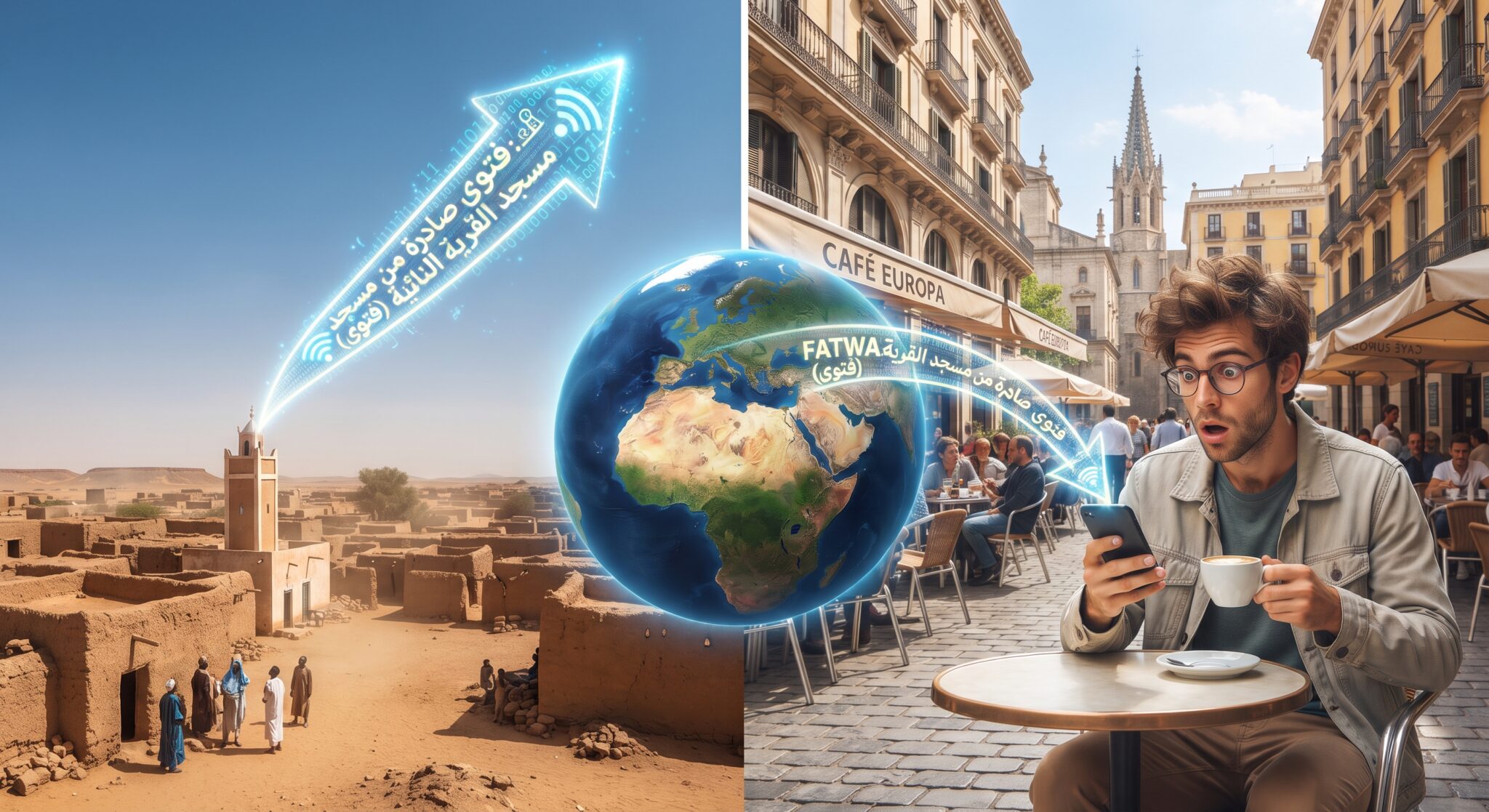
Can an Imam from a Remote Mosque in Africa Influence the Life of a European?
Imagine a scene. In a small mosque in a city that many Europeans would struggle to locate on a map, an imam answers a religious question.
What should we do when people insult our religion?
The imam responds… Someone records the answer. Another person uploads it to YouTube. Someone else translates it into French. Another cuts it into a 35-second video. A fourth user posts it on TikTok. The algorithm does the rest.
And a few hours later, that conversation, which began behind four walls thousands of kilometres from Europe, appears on the phone of a young person living in Brussels, Paris, Barcelona or Berlin. Welcome to the wonderful world of religion globalised by the internet.
In the past, you had to visit a preacher’s mosque to hear them speak. Today, all you need is Wi-Fi. And this raises an issue Europe should take much more seriously: who controls the religious authority entering the minds of millions of people living within our democracies?
The question is not whether a particular fatwa is good or bad. The question is much more interesting: what happens when a religious opinion expressed anywhere on the planet can become a real influence on people living in Europe, thanks to the internet?
First: What on earth is a fatwa?
To European citizens, the word fatwa might sound like a kind of Islamic judicial ruling. Not exactly.
A fatwa is, generally speaking, a religious-legal opinion or interpretation issued by a religious authority on a specific question. And here is the first important distinction: a fatwa is not a law.
In fact, a response from the European Parliament concerning so-called online fatwas makes precisely this point: a mufti’s opinion is not legally binding. In other words, a mufti can say, “According to my religious interpretation, this is how it should be done.”
But that does not mean, “Starting tomorrow, this is compulsory for everyone.” The problem begins when someone fails to distinguish between a religious opinion and an absolute obligation.
And when that opinion becomes a tool for justifying discrimination, hatred or violence, the matter stops being a theological discussion and enters another realm. That is the real problem. The fatwa begins in a mosque and ends up on your phone. The fatwa’s journey is no longer geographical; it is digital.
The power of an authority without borders
For centuries, religious authority faced one very simple limitation: distance.
A preacher might have been highly influential in their own town, but getting their message to millions of people on the other side of the planet was quite difficult. The internet has destroyed that barrier.
Today, a preacher can be in Cairo, Lagos, Karachi, London or a remote village and speak directly to a European audience. They do not need a publisher, a television network or even to know where Europe is. They just need a mobile phone. And that completely changes the nature of the problem.
The problem is not the imam, but the ecosystem
We must avoid oversimplification. We are not suggesting that every African, Egyptian, Asian or European imam is automatically a threat. A fatwa can address entirely harmless matters, such as food, prayer or marriage. So far, nothing out of a horror film.
The problem arises when a religious interpretation is used to address issues affecting fundamental rights, coexistence, discrimination or violence. At that point, we are no longer talking about theology alone. We are talking about how society should be organised.
And here comes Europe’s great short circuit
Europe has an extraordinary characteristic: it allows practically everyone to say almost anything. That is wonderful. And it is also a problem.
Freedom of expression protects even opinions we consider absurd, offensive or profoundly misguided. But there is a boundary: defending an idea is one thing; inciting violence or participating in terrorist activities is another.
The European Union already considers terrorist content online a security problem and has mechanisms for ordering its removal. Furthermore, its new 2026 ProtectEU agenda identifies radicalisation, the digital ecosystem and extremist propaganda as security priorities.
Therefore, Europe’s solution cannot be to create a kind of police force for religious opinions. That would be incompatible with a free society. The real question is different: how can we identify when a religious opinion stops being merely an opinion and becomes a tool for radicalisation, intimidation or violence?
A fatwa can become a “religious meme”
Here comes the amusing part, although there is nothing funny about the issue.
A medieval fatwa required a specialist, a text, a community and time. A 21st-century fatwa can work like this: a preacher → a mobile phone → TikTok → an algorithm → two million views. And that is it.
The algorithm does not ask, “Does this person have theological authority?” It asks, “Do people keep watching the video?” If the content provokes outrage, fear, anger or enthusiasm, so much the better, because that generates engagement, and engagement generates distribution.
Technology can therefore turn an extremely specialised religious discussion into a viral product for mass consumption.
The European Union explicitly recognises that the online ecosystem is used by terrorist and extremist organisations for propaganda, recruitment, incitement and radicalisation. The problem is no longer simply, “What did the imam say?” It is also, “What happens next?”
Geographical distance no longer protects Europe
Twenty years ago, a preacher located 5,000 kilometres away might have seemed like a purely local concern. Not today. The internet has made distance almost irrelevant.
A message produced in Africa can reach Europe in seconds. We now have a genuine global marketplace of religious ideas. Europe participates in that marketplace with one particular characteristic: its citizens live under constitutional democracies based on individual rights.
That is why the debate should focus on a fundamental question: how can Europe protect religious freedom without allowing any foreign religious authority to become, in practice, a parallel authority over its citizens?
The real danger: Parallel authority
This is probably the heart of the problem. A democracy has a legitimate political authority: the Constitution, the laws and the courts.
Islam can have its own spiritual authorities: imams, muftis, religious councils, theologians and others. As long as both spheres remain separate, there is not necessarily any conflict. The problem arises when someone claims, “The law of my religion takes precedence over the law of this country.” That is when a clash occurs.
So should fatwas be banned?
No. Banning a religious opinion simply because it is religious would create another enormous problem. It would also be practically impossible.
Religious freedom requires clear legal boundaries, not widespread religious censorship. The line should be drawn around conduct and content that genuinely crosses the legal threshold: threats, incitement to violence, terrorism, recruitment, financing of terrorist organisations and so on.
So what can Europe do?
1. Create a map of transnational religious authorities
Europe should know who the main religious actors influencing its citizens are.
Not to persecute them, but to understand the ecosystem. Who produces the content? Who finances these platforms? Who has millions of followers? Who translates their messages? Who distributes their videos? Who maintains connections with European organisations?
In security, understanding the terrain is better than discovering it after an attack.
2. Distinguish religious radicalism from terrorism
This is extremely important. Someone can advocate a conservative religious interpretation without being a terrorist. They may hold ideas that many Europeans consider backward, but that alone should not be a criminal offence.
However, when incitement to violence, threats, recruitment or operational support for terrorism emerge, the situation changes completely.
3. Monitor terrorist content, not religion
Monitoring should focus on dangerous conduct and content. The European Commission states that terrorist content online must be removed promptly and that platforms have specific obligations in this area.
4. Build a genuine European Muslim intellectual authority
And here we find one of the most interesting solutions. Europe needs to encourage the development of European Islamic thought. Not an Islam imported from Cairo, Riyadh, Karachi, Lagos or anywhere else.
An Islam that engages with liberal democracy, the rule of law, freedom of expression, individual rights, equality between men and women and European citizenship.
This is not about manufacturing a religion in an office in Brussels. It is about allowing European Muslims themselves to develop religious responses to European realities.
Because if a young European Muslim has a question about life in Europe and the only answer they can find comes from a preacher 4,000 kilometres away, we have a problem. Europe is leaving the intellectual space empty, and when a space is empty, someone eventually fills it.
The great challenge for the future
Europe cannot control every mosque on the planet. Nor can it prevent a Muslim citizen from consulting a foreign theologian. What it can do is ensure that no foreign religious authority has the power to replace European law, impose violence or turn radicalisation into a digital industry.
The internet has made traditional Islam far more global. But perhaps that is precisely why Europe needs to develop a more intellectually autonomous European Islam, capable of responding from within Europe to the questions of Muslims living in Europe.
Conclusion
The future of European Islam will not be decided solely in the mosques of Paris, Barcelona or Berlin. It will also be decided on mobile phones and social media.
And if European Muslims are to build a religious tradition compatible with the democratic societies in which they live, the question should not be, “How do we prevent the Muslim world from communicating with Europe?”
The question should be: “How do we ensure that Europe has its own voice in that conversation?”
This could become one of the great debates surrounding European Islam in the coming decades, and it will probably be far more important than we imagine today.