
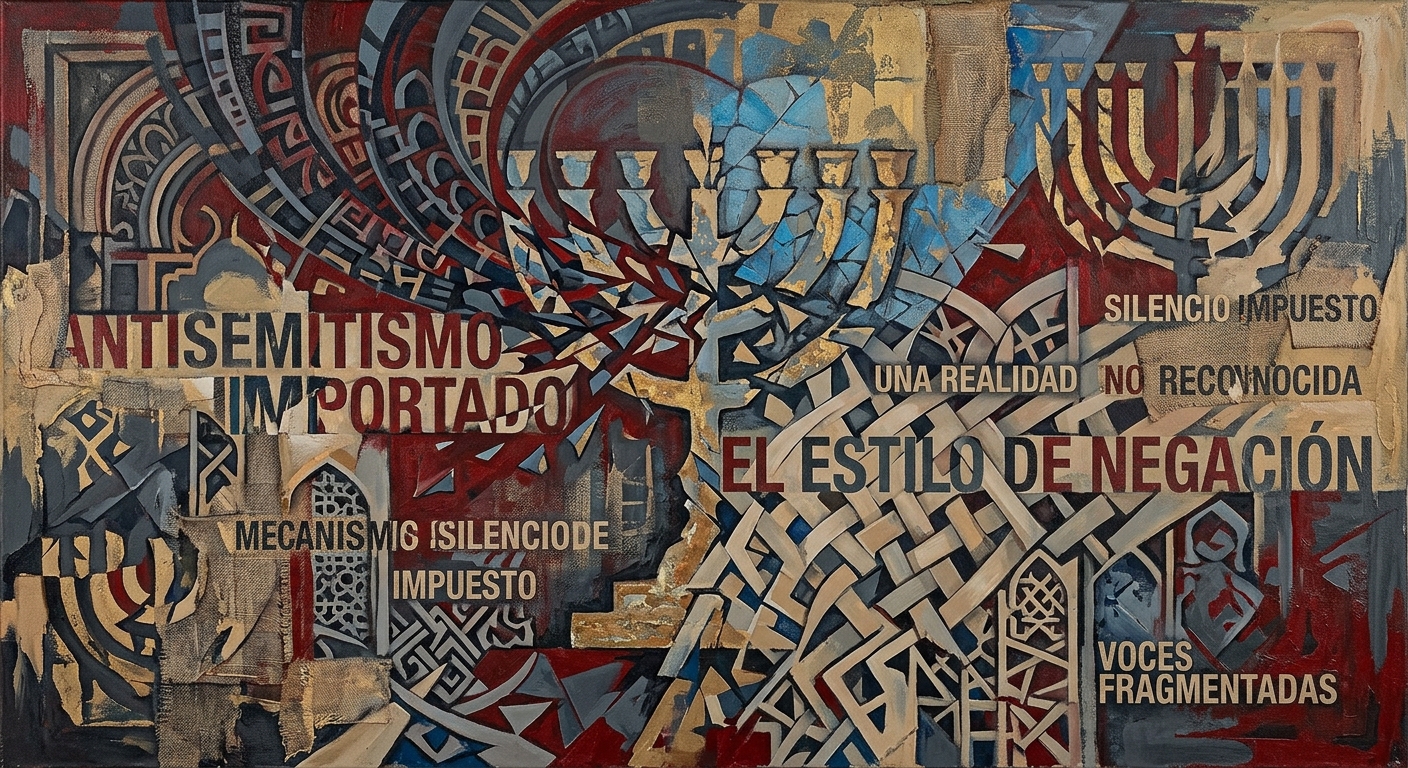
Imported Antisemitism in Europe and the Art of Willful Blindness
Europe has spent decades debating immigration, integration, identity, multiculturalism and coexistence. Yet there is one subject that many politicians, journalists and activists prefer to navigate around as if it were an endless roundabout: antisemitism present in certain sectors of Muslim origin.
We are not talking about all Muslims. Europe is home to millions of Muslim citizens who are fully integrated and respect Jewish people just as they respect anyone else. But there is also an uncomfortable reality: various surveys, academic studies and reports from Jewish organisations indicate that a significant proportion of contemporary antisemitism in some European cities comes from groups influenced by conflicts, prejudices or rhetoric imported from the Middle East.
It is such an uncomfortable subject that, at times, it resembles a European competition in collective silence.
Why Does This Problem Exist?
The explanation is not simple. Religious, historical, political and cultural factors are mixed together in a kind of explosive cocktail.
1. The Israeli-Palestinian Conflict
This is probably the most important factor.
Millions of people across the Muslim world have grown up viewing the Israeli-Palestinian conflict as a struggle between Muslims and Jews, even though it is, in reality, a far more complex political, territorial and national conflict.
The problem arises when legitimate criticism of the Israeli government turns into hostility towards all Jewish people. Saying “I disagree with Israeli policy” is one thing. Saying “The Jews are the problem” is something entirely different.
The first is a political opinion. The second is antisemitism.
2. Literal Interpretations of Religious Traditions
As with Christianity and Judaism, some Islamic texts contain historical references to conflicts between religious communities. Most modern believers interpret these texts within their historical context. However, more conservative or Islamist groups tend to interpret them literally and apply them to the present day, generating hostility towards Jewish people.
The problem is not exclusive to Islam. For centuries, Christian Europe also fostered anti-Jewish prejudice through extreme religious interpretations. The difference is that Europe underwent a profound cultural reassessment, while in some Muslim-majority countries that process remains unfinished.
3. The Politicisation of Faith
The emergence of movements such as the Muslim Brotherhood and the rise of Salafism transformed old theological prejudices into an aggressive anti-Jewish political dogma.
4. Education in Certain Countries
In some countries across the Middle East and North Africa, educational materials, sermons and media outlets have circulated for decades that portray Jewish people through negative stereotypes.
When some people migrate to Europe, those prejudices can travel with them. People can change countries in a matter of hours. Ideas usually take much longer.
The Clash with European Reality
Modern Europe was built on three fundamental pillars: religious freedom, equality before the law and the protection of minorities.
Any form of antisemitism therefore directly conflicts with European democratic principles. And here an interesting contradiction emerges.
Many Europeans defend multiculturalism because they believe in tolerance. But tolerance cannot mean tolerating intolerance.
If someone arrives in Europe with prejudices against Jewish people, women, homosexuals or any other minority, the solution is not to ignore those prejudices out of cultural respect. The solution is to challenge them just as firmly as we would challenge any other form of racism.
The Problem of Denial
Perhaps the most worrying phenomenon is not antisemitism itself. Perhaps it is how difficult it has become to talk about it.
For years, some political groups have avoided addressing the problem for fear of being accused of racism or Islamophobia. The result is paradoxical.
In trying to prevent prejudice against Muslims, people end up avoiding a discussion about prejudice against Jews. It is like trying to put out a fire by closing your eyes. It does not work.
Consequences for Jewish Communities
The consequences are real. In several European cities, many Jewish people say they feel less safe than they did twenty years ago. Some conceal religious symbols, others avoid certain areas, and some parents have doubts about sending their children to Jewish schools.
When a minority is afraid to show publicly who they are, democracy has a problem. And that problem affects everyone, not just Jewish people.
The Big Question: Is Islam Incompatible with Jewish People?
History shows that Muslims and Jews coexisted for long periods in different places.
There were conflicts, discrimination and violence, but also intellectual cooperation, trade and peaceful coexistence.
Therefore, claiming that Islam is inherently anti-Jewish would be just as absurd as claiming that Christianity is inherently antisemitic.
What can be said, however, is that certain modern Islamist interpretations contain elements of hostility towards Jewish people that clash directly with European values. And this must be open to free discussion.
Solutions for a Freer Europe
Shared Civic Education
All citizens, regardless of their background, should understand the Holocaust, democratic values and fundamental rights.
Democracy must also be learned.
Zero Tolerance for Hate
Authorities must tackle antisemitism as firmly as any other form of racism, without exceptions, excuses or cultural discounts.
Religious Reform
European Muslim leaders can play a fundamental role. Mosques that promote interfaith dialogue and clearly reject antisemitism should receive greater visibility and social support.
Open Debate
Criticism of certain ideas found within Muslim communities must be possible without demonising all Muslims. Europe needs less censorship and more rational discussion.
Conclusion: Coexistence Cannot Function on the Basis of Taboos
After centuries of religious wars, Europe has achieved something extraordinary: building societies where people of different beliefs can live together peacefully.
But this coexistence requires clear rules, including one very simple principle: nobody has the right to hate another citizen for being Jewish. Or Muslim. Or Christian. Or for believing in nothing at all.
Imported antisemitism exists, and denying it does not help combat it. Exaggerating it to attack all Muslims does not help either.
Europe’s task is something more difficult and more intelligent: defending freedom, fighting hatred and demanding that everyone play by the same democratic rules.
Because a mature democracy is not afraid to face problems head-on, much less to talk about them.