
“The Strangest Thing About the 21st Century Was That We Argued About Things That Today Belong in a Museum” — The Year 2100
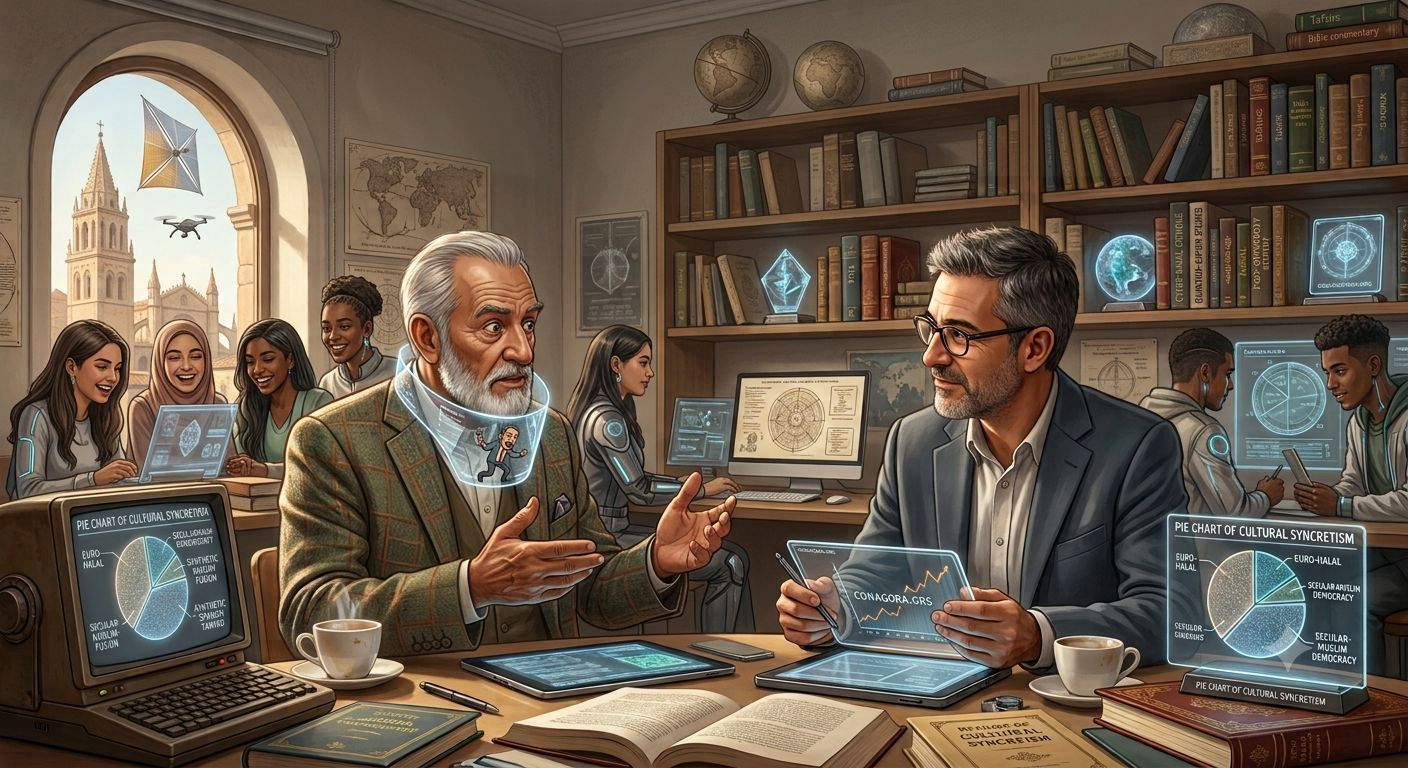
A journalist from the European Historical Archive travels into the future to interview Karim Haddad, a professor of the History of Religions and an expert on the transformation of European Islam during the 21st century.
The mission is simple: to understand how a religion that for decades was at the centre of intense debates about equality, freedom and individual rights ended up coexisting with a European liberal democracy.
Journalist
Karim, when you study European Islam in the 21st century, what surprises students the most?
Karim
That people argued so much about clothing and so little about coexistence. My students are fascinated to discover that there were three-hour panel discussions about a headscarf and only ten minutes about science education or youth employment.
They say it looked like a medieval fashion contest sponsored by a television station from the year 1400.
Journalist
And what was the most difficult issue?
Karim
Equality between men and women. The fact that different rules applied depending on sex, even in everyday matters such as dressing, travelling, inheriting or socialising.
Today, when I explain that in some contexts men were expected to behave one way and women another, students simply do not understand it.
Journalist
And what happened to the idea that men should have greater authority within the family?
Karim
It became a historical curiosity.
Young people ask:
—And how did they decide who was right?
—Because he had a beard?
Journalist
Did the beard lose its importance?
Karim
Enormously.
In 2100, nobody can imagine that the size of a beard could be used as a measure of virtue. Historians are still searching for the scientific connection between beard length and wisdom. So far, we have not found one.
Journalist
Historians talk a lot about the veil.
Karim
Yes, it was almost a collective obsession. Eventually, something revolutionary was discovered: a person’s head belongs to that person.
Neither the state, nor the neighbour, nor the uncle from the village, nor the committee of experts on “what someone else should wear” should decide for them.
Once the choice became genuinely free, the issue lost half its drama.
Journalist
And what about mosques? Did anything change?
Karim
A great deal. Today there are traditional, reformist, cultural and academic mosques. Some are led by men, others by women, and others by mixed teams.
The great revolution was discovering that a microphone does not lose its signal when a woman uses it.
Journalist
Was there resistance to women becoming religious leaders?
Karim
Of course. But the resistance diminished when someone asked a very uncomfortable question: “Does wisdom have a gender?”
After several seconds of silence, the debate began to change.
Journalist
Let us move on to another sensitive subject: homosexuality. How is it viewed in 2100?
Karim
With considerable historical astonishment. My students ask: “Were people really concerned about whom their adult neighbour had dinner with?”
They struggle to understand how the private lives of other citizens could become a permanent political or religious issue.
Journalist
Are there still gay Muslims in 2100?
Karim
Of course. And nobody considers the two things incompatible.
Today, it seems obvious that sexual orientation belongs to the private sphere and that all citizens should enjoy the same rights.
Journalist
What happened to the debates about apostates and ex-Muslims?
Karim
That was another major change. Islam eventually consolidated a very simple idea: religious freedom also includes the freedom to leave a religion.
It may seem obvious now, but for decades it was an enormously controversial issue.
Journalist
And what happens today if someone leaves Islam?
Karim
Exactly the same as when someone changes football teams. Nothing. It is a personal decision.
Journalist
And what happened to caricatures and freedom of expression?
Karim
People came to understand something fundamental. Having the right to criticise a religion does not mean hating its believers. And having the right to practise a religion does not mean being protected from all criticism.
Once both ideas were accepted, conflict diminished considerably.
Journalist
What happened to the idea that religious laws should take precedence over democratic laws?
Karim
It was probably the most important change. Most people came to understand that, in a democracy, laws belong to all citizens.
Religions can inspire people, but they cannot govern those who do not share their beliefs.
Journalist
Does Islam still exist in 2100?
Karim
Of course. Just as other religions still exist.
What disappeared was the idea that a single interpretation should govern everyone’s lives.
Today, very traditional believers, reformist believers and people with no religion live side by side. They all have exactly the same rights under the law.
Journalist
What was the hardest thing to change?
Karim
People’s mindsets. Changing a book is easy. Changing a custom can take generations.
Journalist
What makes you laugh the most when you study the year 2025?
Karim
The sheer number of people convinced that any change would destroy religion, only for many things to change anyway. And religion continued to exist.
Journalist
If you could send a message to Europeans in 2025, what would you tell them?
Karim
That religions, just like societies, are always evolving; that debate is healthy; and that criticism is not hatred.
And that no tradition should be afraid of difficult questions, because strong ideas survive questioning. Weak ones are the ones that need to hide from it.
Before saying goodbye, Karim points to an exhibition entitled “The Great European Religious Controversies of the 21st Century”.
Inside are display cases dedicated to the veil, freedom of expression, equality between men and women, gay rights, apostasy and other historical debates.
A group of students walks past. One of them reads the signs and asks: “Did people really argue about all this?”
The professor replies: “Of course.”
Every generation believes it lives in the most modern era in history. Then the next generation arrives and discovers things that once seemed normal but no longer make sense.
The students look at one another and smile.
Probably, a hundred years from now, someone will say exactly the same thing about us.