
Islam, Police Officers and Soldiers: Model Integration or a Conflict Waiting to Happen?
When Allah Puts on a Uniform
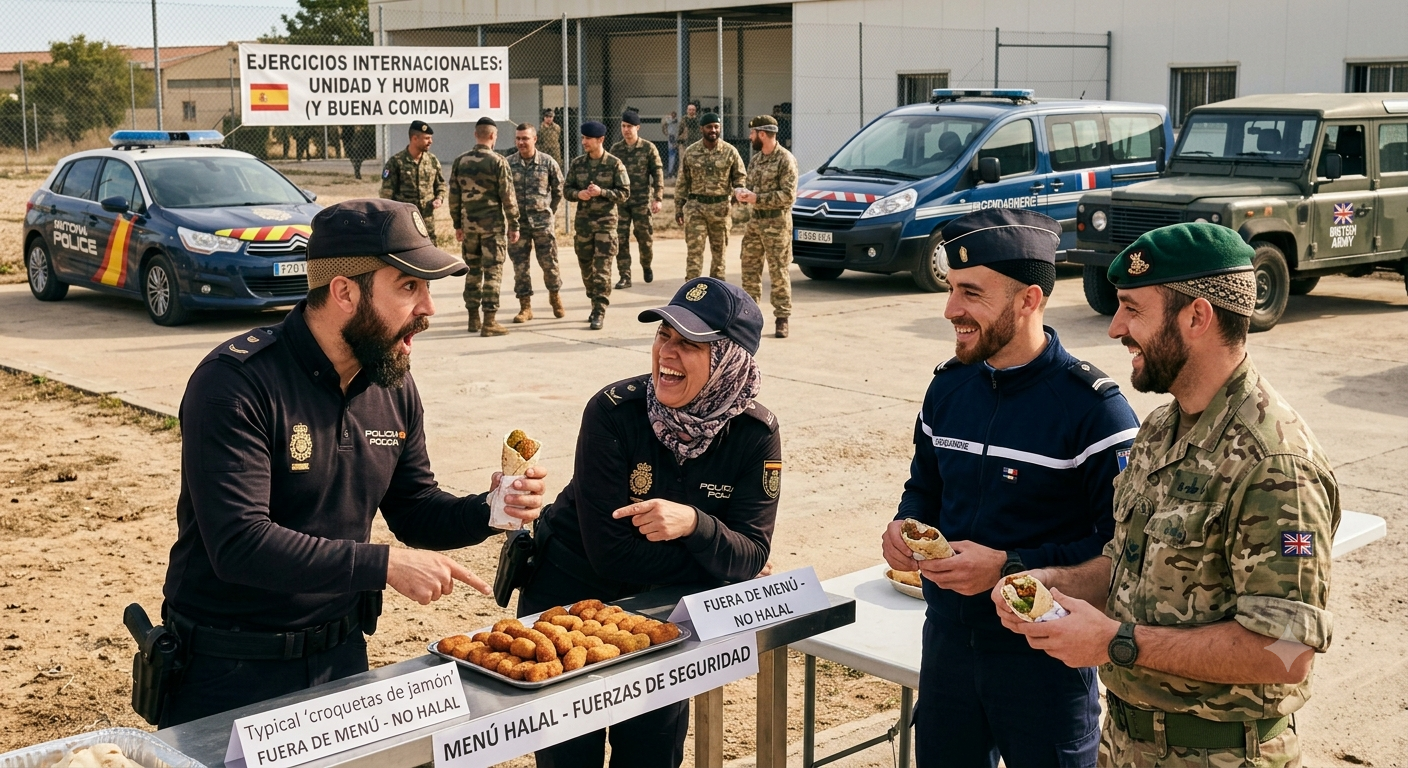
Imagine a scene. A Muslim police officer patrols the streets of Madrid during Ramadan. He has gone twelve hours without eating or drinking. A few kilometres away, a Muslim female soldier takes part in military exercises with the Spanish Army. Meanwhile, in France, an officer requests permission to pray during his working hours. In Germany, a political debate erupts because a candidate wants to wear a hijab while serving in the police.
The question arises naturally: How does Islam fit into Europe’s armed forces and police services?
And the answer, as with almost everything related to religion and integration in Europe, is far more complex than it might seem.
A Relatively New Phenomenon
For much of the twentieth century, European armed forces and police services were culturally homogeneous institutions.
Most of their members shared a language, a national history and, even if they were not particularly observant, a Christian cultural tradition. But Europe changed.
Migration from North Africa, Turkey, the Middle East, Pakistan and the Balkans has created much more diverse societies.
Today, there are thousands of Muslim police officers, military personnel and security officers in Spain, France, Germany, Belgium, the Netherlands, Sweden and the United Kingdom, and their numbers are likely to grow.
The question is no longer whether Muslims will be part of these institutions. The question is how to manage this reality.
The Argument in Favour: Integration at Its Best
Supporters of Muslim participation usually offer a straightforward argument. If a Muslim citizen can be a doctor, teacher, engineer or judge, why shouldn’t they be a police officer or soldier?
In fact, many believe this is precisely where integration proves that it works. An immigrant can arrive in Europe, and their child can end up defending the Spanish or French Constitution.
From this perspective, a Muslim police officer does not represent a problem; they represent a success. It means that national identity is compatible with different religious beliefs.
The Critical Argument: What Happens When Religion Conflicts with the Uniform?
Here comes the big question that nobody wants to ask too loudly.
The armed forces and police services demand absolute loyalty to the law and the Constitution. But Islam, like other religions, also contains rules, principles and commandments. What happens if the two come into conflict?
For example: protecting events considered blasphemous, security at demonstrations critical of Islam, same-sex marriage, LGBTQ+ rights, freedom of expression about Muhammad, or Quran burnings.
The vast majority of European Muslims accept democratic laws. However, critics point out that the problem does not arise when everything is going smoothly.
It arises when religious convictions conflict with professional duties. And this question does not affect Muslims alone; it also applies to Christians, Jews, and anyone with deeply held religious beliefs.
The Hijab: A Simple Piece of Fabric Capable of Triggering Political Battles
Few issues generate as much debate as wearing an Islamic headscarf while serving in the police or armed forces.
Supporters argue that it is an expression of religious belief, does not affect job performance, and promotes inclusion.
Critics respond that uniforms should be neutral. The police represent the state, not a religion. If the headscarf is allowed, why not other religious symbols?
The discussion may seem minor, but it is actually about something much bigger.
The Challenge of Ramadan
Here we encounter a practical issue, neither ideological nor philosophical, but simply physical.
During Ramadan, many Muslims fast from dawn until sunset.
This means not eating, not drinking water, and working through long days.
In office jobs, this may be manageable. During a summer police patrol or military exercises in temperatures of 40°C, the situation changes.
Commanders must balance two principles: respecting religious freedom and ensuring safety and operational effectiveness. This is not always easy.
The Fear of Extremism
This is probably the most sensitive subject, and also the most delicate.
The jihadist attacks carried out in Europe over recent decades have generated understandable concern. Police and military services conduct extremely rigorous security checks.
The reason is simple: an extremist with access to sensitive information can cause enormous damage.
However, another risk emerges here: confusing radical Islamism with Islam. They are not the same thing.
The vast majority of European Muslims have never had any connection with extremism. Nevertheless, security services continue to monitor potential radicalisation because the risk, although limited to a minority, exists.
Should the State Remain Completely Neutral or Reflect Society’s Diversity?
France: The Hard Line
France probably represents the strictest model.
The French tradition of laïcité holds that public institutions should remain separate from any visible expression of religion. As a result, the debate over religious symbols in public service is particularly intense.
For many French people, state neutrality is sacred. For others, that neutrality has become a way of excluding certain minorities.
The United Kingdom: The Flexible Model
The United Kingdom generally adopts a much more pragmatic approach.
For years, it has permitted Sikh police officers to wear turbans, made religious accommodations, and allowed certain symbols of faith compatible with public service.
The British approach is simple: as long as you obey the law and do your job well, your religion belongs to the private sphere.
This model aims to attract talent from diverse communities. However, it also faces criticism for potentially creating parallel identities within public institutions.
Spain: A Still Limited but Growing Reality
In Spain, the debate tends to be less intense than in France or Belgium.
Nevertheless, more and more issues are emerging concerning religious freedom, halal food, prayer schedules, the use of religious symbols, and cultural diversity in training academies.
The presence of Muslim Spanish citizens is an established reality, particularly in cities such as Ceuta and Melilla, and everything suggests it will increase over the coming decades.
The Question Europe Will Have to Answer
Perhaps this debate is not really about Islam. Perhaps it is about European identity.
Europe is trying to answer a huge question: How can strong religious traditions be integrated into institutions that consider themselves neutral?
There is no perfect answer. If absolute neutrality is required, some citizens may feel excluded.
If too many religious exceptions are allowed, others may feel that neutrality is disappearing. It is a difficult balance, an extremely difficult one.
Conclusion: The Uniform Comes First
Perhaps the most reasonable solution is also the simplest. A liberal democracy should not exclude anyone because of their religion, but neither should it allow any religion to stand above the law. Not Christianity. Not Judaism. Not Islam. Not any other religion.
The fundamental principle should be clear: when someone puts on a police or military uniform, they can remain a believer if they wish. But while on duty, they represent, above all, the Constitution, the law, and the citizens.
A democratic state can have Muslim, Christian, atheist, or Buddhist police officers. What it cannot afford is to have officers who put their religion before their duty to the state.
And that distinction, however small it may seem, is precisely what sustains the entire architecture of European liberal democracy.