
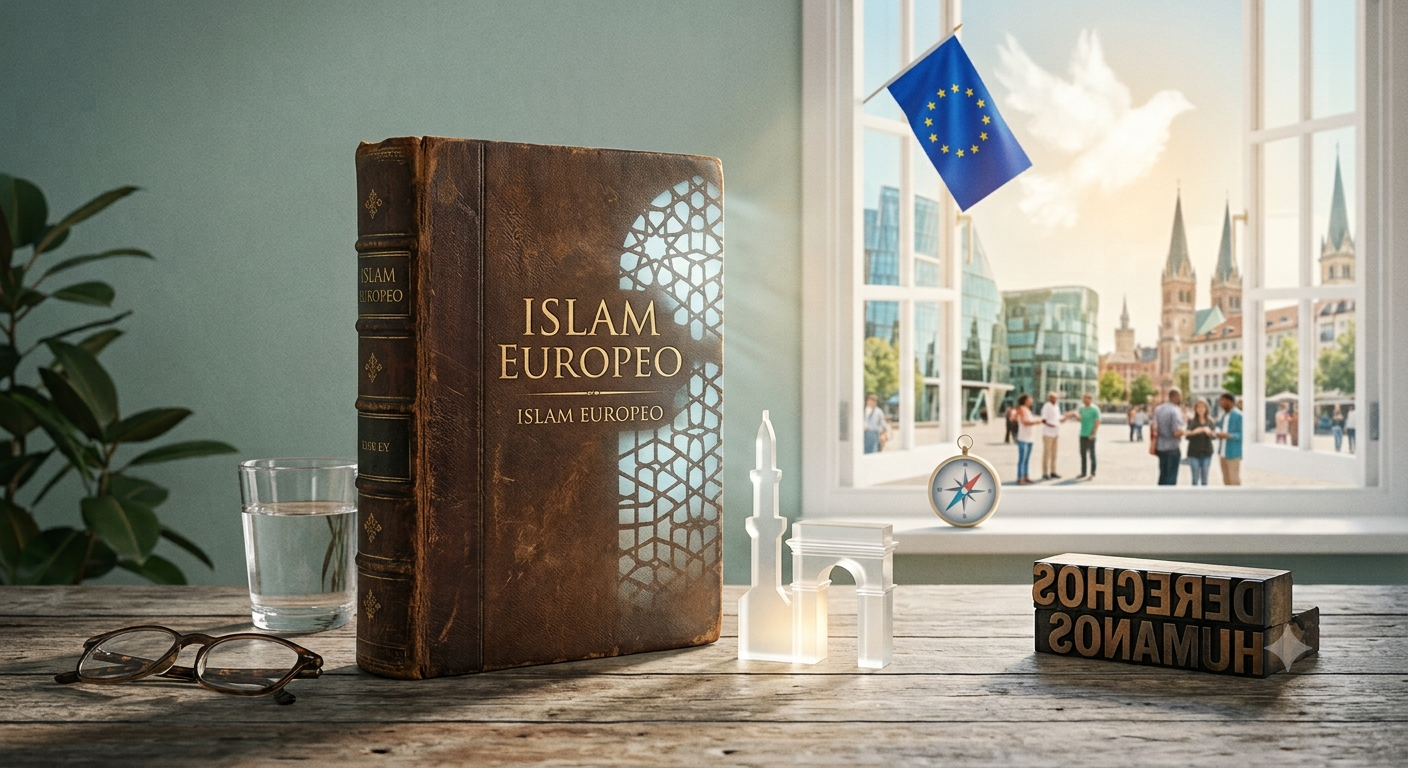
Islam Light? A Proposal for Europe’s Future
Imagine a food product from which sugar and saturated fats have been removed. It still tastes the same and retains its essence, but it is no longer harmful to the body. The same product, with the elements that damage our health eliminated.
Could this same formula be applied to religion? Is an “Islam Light” possible? Why not open a similar debate about Islam in Europe?
Before going any further, one important clarification: this article is not about Muslim people. It is about ideas, religious interpretations, and how they fit—or fail to fit—within a liberal democracy.
Today, raising this question is not a theoretical exercise; it is an urgent necessity. Demographic projections estimate that the number of Muslims in Europe could approach 100 million by 2050.
As someone born into the Arab world, I studied Islam from an early age, just like millions of students in Muslim-majority countries. We know firsthand about its other side: a structure that has historically been imposed by force, rejects otherness, and clashes head-on with universal human rights.
This experience has led me to one conclusion: there is an enormous difference between practising a religion and turning its traditional rules into a model for organising society.
I do not intend to analyse the Quran verse by verse here. But it is enough to recall a few examples found in Islamic tradition.
You do not need to be a theology scholar to see the problem. You only need to look at the civil laws of most Islamic countries today. Well into the twenty-first century, legal frameworks still allow men to inherit twice as much as women, women’s testimony to carry half the weight of men’s in court, polygyny, and even a husband’s right to physically punish his wife. Not to mention explicit hostility towards secularism, atheism, sexual diversity, and freedom of expression. It is no coincidence that many of these rules remain part of the legislation in numerous Muslim-majority countries.
Here arises the uncomfortable question that Europe tends to avoid: Are these values compatible with Western societies? The short answer is no. In fact, anyone attempting to enforce many of these precepts on European soil would end up in prison for committing a criminal offence.
The Packaging Versus the Content
To solve this puzzle, the key lies in learning to dissect religion into two parts: ritual and value system.
Islam as a religious practice—praying, observing Ramadan, making the pilgrimage to Mecca, or celebrating religious festivals—is the packaging. It is an intimate, harmless practice that is essential to the believer’s identity and spiritual well-being. The real conflict does not lie there; it lies in Islam as a political and behavioural code: Islam understood as a comprehensive system of rules governing political, social, and family life, a body of content that directly collides with Western laws and freedoms.
The solution, therefore, is to embrace the rituals and abandon the political dogma. Islam Light. The average religious practitioner would barely notice the difference in their daily life because their sacred customs would remain intact, yet the social impact would be revolutionary.
The Revolution Must Be European
How can a transformation of this magnitude be achieved? The answer lies in classrooms and pulpits. We need a new generation of imams with a European mindset: free-thinking citizens with a critical outlook who understand that human rights and democratic laws take precedence over any sacred book.
With an Islam that preserves religious rituals but renounces interpretations incompatible with equality, freedom, and human rights, most believers could continue practising their religion much as they do today. They would still pray, fast, celebrate their festivals, and identify as Muslims.
What would change are the ideas that clash with a free society.
This theological revolution will not emerge from traditional centres of power such as Al-Azhar in Egypt, nor from movements funded by Saudi Arabia and Morocco. It must emerge from where it is needed most: Europe.
It is time to embrace new horizons without fear: hybrid theories, women imams, gay imams, and mixed-gender mosques. This is not simply about putting a new face on a couple of concepts; it is about structural reform.
If there is one place where a new way of understanding this religion can emerge, that place is Europe.
Why not debate new ideas?
Why not talk about a European Islam?
Why not develop an interpretation that is fully compatible with human rights?
Enjoying the freedom we have in the West and defending it tooth and nail is a moral obligation. I could not publish these lines in many Muslim-majority countries without ending up in prison or worse. Precisely because I know the price of living without that freedom, I know that the only way to preserve it is to dare to demand radical change.