
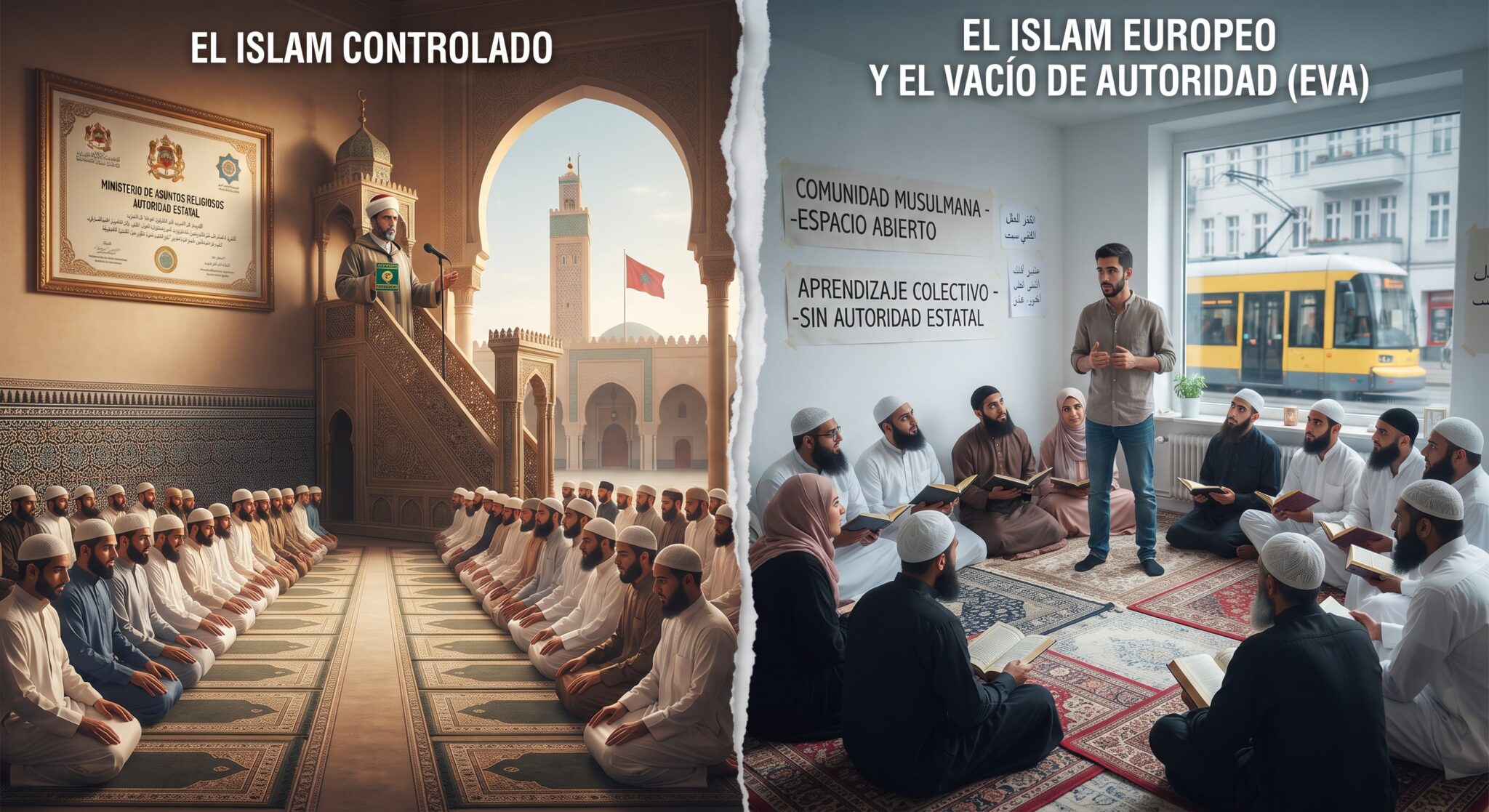
FROM STATE-CONTROLLED ISLAM TO EUROPEAN ISLAM
When Islam Leaves the State-Controlled Ecosystem: The Experiment of the Authority Vacuum Ecosystem (AVE)
What happens when a religious system that has spent decades operating within state-controlled structures enters a space where the state no longer directly controls its doctrine, religious authorities, or internal evolution?
To understand what may happen to Islam in Europe, perhaps we need to start somewhere else. Not in Europe, but in the countries where millions of Muslims have lived for generations.
Across much of the Arab and Muslim world, religion does not operate separately from the state. The state can intervene in mosques, religious education, imam training, religious institutions, awqaf or religious endowments, funding, and certain aspects of religious discourse.
A pattern emerges: the state has built institutions to organize, regulate, supervise, or even direct a significant part of religious life. Research on Egypt, Morocco, Algeria, Tunisia, Saudi Arabia, and other countries shows different forms of this relationship between the state and Islamic institutions.
But here a much more interesting question arises. What happens when that control disappears? What happens when the same Islam enters Europe?
THE FIRST ECOSYSTEM: ISLAM WITHIN THE STATE
During the formation of modern Arab states, religion was gradually incorporated into administrative structures.
A mosque could be linked to the state, an imam could depend on an official institution, religious education could become part of the education system, and religious endowments could be administered by public bodies. Governments could determine who was allowed to preach, where they could do so, and under what conditions.
The result is an ecosystem whose relationships can be represented as follows:
STATE → RELIGIOUS INSTITUTIONS → MOSQUES → IMAMS → RELIGIOUS EDUCATION → SOCIETY
This does not mean that the state completely controls each individual’s beliefs. But one fundamental feature exists: there is a central institutional centre of gravity. The state has the capacity to intervene, and that fundamentally changes how the religious ecosystem operates.
WHY DO STATES CONTROL ISLAM?
This question is fundamental, and there are several reasons.
Political power
Religion can become a source of political legitimacy. A government may try to present itself as the protector of religion, national identity, or a particular interpretation of Islam.
Security
Following the rise of Islamist movements and violent groups, many states have regarded control over religious institutions as a security measure.
National identity
The state may attempt to construct a “national Islam”: an Algerian Islam, a Moroccan Islam, or an Egyptian Islam.
In other words, religion also becomes a matter of state policy.
Social control
Mosques, religious schools, associations, and charitable networks can have enormous social-organizing capacity. Any government may therefore consider it important to determine who controls these networks.
That is why control over Islam is not merely religious. It is also political, social, institutional, economic, and cultural.
AND THEN EUROPE ENTERS THE PICTURE
This is where the real experiment begins.
A Muslim person born in or arriving in Europe enters a completely different ecosystem. The European democratic state, despite significant differences between countries, cannot simply declare:
“This is the correct interpretation of Islam.”
It cannot establish an official theology for Muslims. In principle, religious freedom protects precisely this autonomy.
And here we encounter a fundamental difference that completely transforms the ecosystem: the European state cannot become the theological authority of Islam.
FROM A SINGLE CENTRE TO MULTIPLE CENTRES
Instead of a relatively centralized system, something like the following emerges:
EUROPEAN STATE → RELIGIOUS FREEDOM → MOSQUES → IMAMS → FEDERATIONS → MUSLIM ORGANIZATIONS → INTERNATIONAL NETWORKS → DIGITAL PREACHERS
There is no longer a single centre. There are many.
THE AUTHORITY VACUUM ECOSYSTEM — AVE
The AVE does not mean that religious authorities do not exist in Europe. Many do. The problem is different: there is no single, widely recognized, specifically European authority capable of defining what European Islam is and who has the legitimacy to speak on its behalf.
That is the vacuum.
And when a central authority disappears, power does not necessarily disappear with it. Power begins to compete.
An imam may hold authority within their community. An association may influence its members. A federation may represent certain mosques. An online preacher may have millions of followers. A foreign country may finance institutions. An intellectual may influence public debate.
Therefore, an authority vacuum does not mean an absence of power. It means competition for power.
THE GREAT EUROPEAN EXPERIMENT
Europe may be conducting an enormous historical experiment without necessarily having designed it as such.
What happens when an Islam accustomed to different forms of state regulation enters a pluralistic ecosystem in which the state does not control its theological evolution?
The experiment poses a question: What kind of Islam emerges when the conditions surrounding it change radically?
The same religious phenomenon can behave differently depending on the ecosystem in which it exists.
THE FIRST EFFECT OF THE AVE: FRAGMENTATION
When a central authority disappears, multiple interpretations may emerge.
Some will defend a traditional interpretation. Others will seek to reform it. Some will develop political Islam. Others will attempt to build an Islam compatible with European secularism. Still others will look for answers online.
The result may be considerable fragmentation.
But fragmentation is not necessarily negative. It can create competition, and competition can lead to innovation.
THE SECOND EFFECT: RELIGIOUS INNOVATION
Here, a completely different possibility emerges. The absence of a single authority may allow new ideas to develop.
European Muslims may begin asking themselves:
Can an Islam fully compatible with liberal democracy exist?
Can complete equality between men and women exist?
Can a person leave Islam without facing social pressure?
Can a European interpretation of religious texts emerge?
Can a specifically European Islamic tradition be developed?
These questions could generate profound transformation.
THE THIRD EFFECT: THE RETURN OF EXTERNAL AUTHORITIES
But there is a problem. If Europe leaves a space of authority unoccupied, someone may try to fill it.
That actor could be an international organization, a foreign religious institution, a foreign government, an ideological organization, or a digital preacher.
This creates a paradox: Europe may eliminate direct state control over religion while simultaneously allowing other actors to increase their influence within the ecosystem.
Several fundamental questions arise:
Who provides the funding?
Who trains the imams?
Who administers the mosques?
Who produces the religious content?
These questions should form part of any serious analysis of European Islam.
THE FOURTH EFFECT: THE EMERGENCE OF “DIGITAL ISLAM”
The internet changes the rules even further.
For centuries, listening to a preacher meant physically attending a mosque. Today, that is no longer necessary.
A person can listen on their phone to a preacher thousands of kilometres away, follow dozens of religious figures, and create their own community.
This produces an entirely new situation: religious authority no longer depends exclusively on physical institutions. The algorithm also begins to play a role in constructing authority.
THE BIG QUESTION: WHO REPRESENTS EUROPEAN ISLAM?
Here we encounter one of the great contradictions.
European governments need interlocutors. They want to know: “Who do we talk to?”
But European Islam has no single representative. One organization may represent one section of the community, another organization may represent a different section, a mosque may hold a different position, and communities in different countries may operate under entirely different models.
Therefore, Europe’s problem is not simply the absence of authority. It is also the absence of common representation.
FROM A VACUUM TO COMPETITION
The AVE can be represented as a chain:
END OF DIRECT STATE CONTROL → RELIGIOUS FREEDOM → AUTONOMY → MULTIPLICATION OF ACTORS → COMPETITION FOR AUTHORITY → FRAGMENTATION → INNOVATION, RADICALIZATION, OR INTEGRATION
There is no single predetermined outcome, and this is a fundamental part of the theory.
The AVE does not necessarily predict a good or bad future.
It predicts something different: a process of competition for authority.
The outcome will depend on who succeeds in establishing legitimacy.
FOUR POSSIBLE FUTURES FOR EUROPEAN ISLAM
SCENARIO 1 — INTEGRATED EUROPEAN ISLAM
New generations build their own institutions. Imams receive training in Europe. Mosques have transparent funding. Organizations develop democratic structures. European Muslim intellectuals emerge.
Outcome: An autonomous European Islam is born.
It would not simply be the Islam of Morocco, Algeria, Egypt, Turkey, or Pakistan transplanted to Europe. It would be an evolution shaped within Europe itself.
SCENARIO 2 — PARALLEL ISLAM
Communities develop their own networks.
Their own schools. Their own associations. Their own media. Their own leaders.
Outcome: A socially fragmented society.
SCENARIO 3 — TRANSNATIONAL ISLAM
The European vacuum is gradually occupied by external actors.
Funding comes from abroad. Religious authorities come from abroad. Religious content comes from abroad. International networks gain influence.
Outcome: Europe has religious freedom, but part of its religious authority continues to be imported.
SCENARIO 4 — THE GREAT TRANSFORMATION
The vacuum is filled neither by a foreign government nor by a traditional religious authority.
Instead, it is filled by a new European generation: Muslims born in Europe, intellectuals, imams trained at European universities, and new organizations.
These actors begin building something that does not yet fully exist: a European Islamic intellectual tradition.
WHAT SHOULD EUROPE DO?
The solution should not be: “Europe must control Islam.”
An alternative approach might be:
Do not control the religion. Establish and enforce the rules governing the ecosystem.
This is a fundamental distinction. The state should not decide which Muslims are right.
But it can require:
Financial transparency. Who funds a religious organization?
Institutional transparency. Who runs a mosque?
Training. What qualifications does a religious leader working with a community have?
Compliance with the law. Religious freedom does not mean being above the law.
Equality. Religious institutions must respect the European legal framework.
Individual freedom. Every person must be free to believe, not believe, change religion, or leave a religion without coercion.
Independence. European religious institutions should be able to operate without becoming instruments of foreign governments.
A NEW AUTHORITY WITHOUT A NEW FORM OF STATE CONTROL
Europe does not need to create a “Ministry of Islam.” It needs to foster the conditions in which a European ecosystem of religious and intellectual authority can emerge.
Not a single authority, but a network: universities, research centres, religious institutions, intellectuals, philosophers, sociologists, and others competing, debating, and building legitimacy.
Authority would not come from the state. It would come from knowledge, trust, education, and social legitimacy.
EUROPEAN ISLAM IN 2050
If this theory is correct, the major change will not simply be demographic. It will be institutional.
European Islam will have to answer a question it may be unable to avoid:
Who has the authority to interpret Islam in Europe?
That is why 2050 may be an interesting milestone, not because we know what Islam will look like then, but because we can observe which ecosystem of authority is beginning to take shape today.
Who will build European Islam?
Perhaps the answer will not be a state. Perhaps it will not be a religious institution either.
Perhaps it will be the ecosystem itself.
CONCLUSION
The entire theory can be summarized in a single idea:
When a religious system moves from an ecosystem of strong state intervention to a democratic and pluralistic ecosystem, religious power does not disappear. It is redistributed.
Europe may be facing a phenomenon we do not yet fully understand.
For decades, we have spoken about Islam as though it were a fixed reality.
But Islam does not exist in a vacuum.
It exists within ecosystems.
Islam within an authoritarian state does not operate in exactly the same way as Islam within a liberal democracy.
Islam financed from abroad does not operate in exactly the same way as Islam financed locally.
Islam directed by state institutions does not operate in exactly the same way as Islam organized by independent communities.
That is why the most important question may not be, “How will Europe change Islam?” but rather:
“What will happen to Islam when the ecosystem in which it exists changes completely?”
That is the European experiment.
And the Authority Vacuum Ecosystem, or AVE, seeks to study precisely this moment: the point at which a central authority disappears and competition begins to establish a new one.